

Chemtec Publishing offers a large collection of books on polymers, plastics, and rubber.
- Grid List
Filter
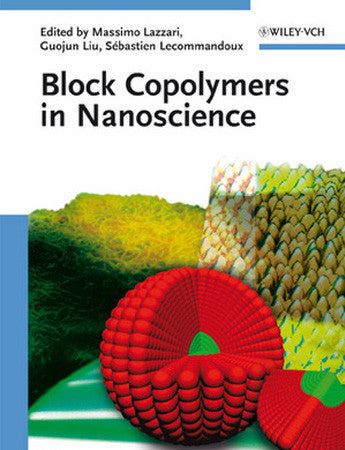
Block Copolymers in Na...
$261.00
{"id":11242200964,"title":"Block Copolymers in Nanoscience","handle":"978-3-527-31309-9","description":"\u003ch5\u003eDescription\u003c\/h5\u003e\nAuthor: Eds., M. Lazzari, Guojun Liu, S. Lecommandoux \u003cbr\u003eISBN \u003cspan\u003e978-3-527-61056-3\u003c\/span\u003e \u003cbr\u003e\u003cbr\u003epages 447, Hardcover\n\u003ch5\u003eSummary\u003c\/h5\u003e\nThe book investigates all types of application for block copolymers: as tools for fabricating other nanomaterials, as structural components in hybrid materials and nanocomposites, and as functional materials. The multidisciplinary approach covers all stages from chemical synthesis and characterization, presenting applications from physics and chemistry to biology and medicine, such as micro- and nanolithography, membranes, optical labeling, drug delivery, as well as sensory and analytical uses.\n\u003ch5\u003eTable of Contents\u003c\/h5\u003e\nAn Introduction to Block Copolymer Applications: State-of-the-art and Future Developments. \u003cbr\u003e\u003cbr\u003e2. Guidelines for Synthesizing Block Copolymers. \u003cbr\u003e\u003cbr\u003e3. Block Copolymer Vesicles. \u003cbr\u003e\u003cbr\u003e4. Block Copolymer Micelles for Drug Delivery in Nanoscience. \u003cbr\u003e\u003cbr\u003e5. Stimuli-responsive Block Copolymer Assemblies. \u003cbr\u003e\u003cbr\u003e6. Self-assembly of Linear Polypeptide-based Block Copolymers. \u003cbr\u003e\u003cbr\u003e7. Synthesis, Self-assembly and Applications of Polyferrocenylsilane (PFS) Block Copolymers. \u003cbr\u003e\u003cbr\u003e8. Supramolecular Block Polymers Containing Metal-Ligand Binding Sites: From Synthesis to Properties. \u003cbr\u003e\u003cbr\u003e9. Methods for the Alignment and the Large-scale Ordering of Block Copolymer Morphologies. \u003cbr\u003e\u003cbr\u003e10. Block Copolymer Nanofibers and Nanotubes. \u003cbr\u003e\u003cbr\u003e11. Nanostructured Carbons from Block Coplymers. \u003cbr\u003e\u003cbr\u003e12. Block Copolymers at Interfaces. \u003cbr\u003e\u003cbr\u003e13. Block Copolymers as Templates for the Generation of Mesostructured Inorganic Materials. \u003cbr\u003e\u003cbr\u003e14. Mesostructured Polymers-Inorganic Hybrid Materials from Blocked Macromolecular Architectures and Nanoparticles. \u003cbr\u003e\u003cbr\u003e15. Block Ionomers for Fuel Cell Application. \u003cbr\u003e\u003cbr\u003e16. Structure, Properties and Applications of Crystallizable ABA and ABC Triblock Copolymers with Hydrogenated Polybutadiene Blocks. \u003cbr\u003e\u003cbr\u003e17. Basic Understanding of Phase Behavior and Structure of Silicone Block Copolymers and Surfactant-Block Copolymer Mixtures. \u003cbr\u003e\u003cbr\u003eSubject Index.\u003cbr\u003e\u003cbr\u003e\n\u003ch5\u003eAbout Author\u003c\/h5\u003e\n\u003cb\u003eMassimo Lazzari\u003c\/b\u003e received his PhD in Macromolecular Chemistry at the University of Torino (Italy) under the supervision of Prof. O. Chiantore. After a two years postdoctoral work with Prof. K. Hatada at the Osaka University (Japan), where he learned the secrets of anionic polymerisation, in 1998 he became the assistant professor at the University of Torino, working on the characterisation and degradation of complex polymer systems. After several stays at the University of Santiago de Compostela (Spain), he is actually in the Institute of Technological Investigations. His current research interests are focused on the synthesis of self-assembling block copolymers, with a special attention on their use as templates and for the hierarchical self-assembly of metal nanoparticles. Guojun Liu received his PhD. degree from the University of Toronto in 1989. After 8 months as a post-doctoral fellow in the University of Toronto, he joined McGill University for another post-doctoral year. He was appointed assistant professor at the University of Calgary in 1990, promoted to associate professor in 1995 and full professor in 1999. Since 2004 he has been serving the Department of Chemistry at Queen's University as Tier I (senior) Canada Research Chair in Materials Science. He has published more than 100 papers mostly on block copolymer nanomaterials. Physico-chemist of formation, Sebasstien Lecommandoux has integrated the Centre de Recherche Paul Pascal (group of Professor Franz Hardouin, Bordeaux, France) in 1992 to prepare his Master and his Diploma Thesis in Chemistry and Physics (1996) on Liquid Crystal Polymers. Then, he went to the Material Research Laboratory and the Beckman Institute (University of Illinois at Urbana-Champaign, USA), as a Post-Doc in the group of Professor Samuel I. Stupp, and learned the Art of Supramolecular Chemistry from January to December 1998. He joined the Laboratoire de Chimie des Polymeres Organiques (CNRS, University of Bordeaux, France) as Associate Professor in 1998 and became Professor in 2005. He received the Bronze Medal Award from the CNRS in 2004 for the work he did on the self-assembly of polypeptide-based block copolymers. His current research interests mainly focus on macromolecular engineering via block copolymer self-assembly in solution and in bulk, with a special attention on the relationship between nanostructures and biological functions.","published_at":"2017-06-22T21:12:40-04:00","created_at":"2017-06-22T21:12:40-04:00","vendor":"Chemtec Publishing","type":"Book","tags":["2007","ABA","ABC","block copolymer","book","membranes","mesostructured","nano","nanofibers","nanolithography","nanotubes. nanostructured carbons interfaces","polybutadiene","polymers","silicone","templates","triblock"],"price":26100,"price_min":26100,"price_max":26100,"available":true,"price_varies":false,"compare_at_price":null,"compare_at_price_min":0,"compare_at_price_max":0,"compare_at_price_varies":false,"variants":[{"id":43378308036,"title":"Default Title","option1":"Default Title","option2":null,"option3":null,"sku":"","requires_shipping":true,"taxable":true,"featured_image":null,"available":true,"name":"Block Copolymers in Nanoscience","public_title":null,"options":["Default Title"],"price":26100,"weight":1000,"compare_at_price":null,"inventory_quantity":1,"inventory_management":null,"inventory_policy":"continue","barcode":"978-3-527-61056-3","requires_selling_plan":false,"selling_plan_allocations":[],"quantity_rule":{"min":1,"max":null,"increment":1}}],"images":["\/\/chemtec.org\/cdn\/shop\/products\/978-3-527-31309-9.jpg?v=1499189503"],"featured_image":"\/\/chemtec.org\/cdn\/shop\/products\/978-3-527-31309-9.jpg?v=1499189503","options":["Title"],"media":[{"alt":null,"id":353915371613,"position":1,"preview_image":{"aspect_ratio":0.767,"height":450,"width":345,"src":"\/\/chemtec.org\/cdn\/shop\/products\/978-3-527-31309-9.jpg?v=1499189503"},"aspect_ratio":0.767,"height":450,"media_type":"image","src":"\/\/chemtec.org\/cdn\/shop\/products\/978-3-527-31309-9.jpg?v=1499189503","width":345}],"requires_selling_plan":false,"selling_plan_groups":[],"content":"\u003ch5\u003eDescription\u003c\/h5\u003e\nAuthor: Eds., M. Lazzari, Guojun Liu, S. Lecommandoux \u003cbr\u003eISBN \u003cspan\u003e978-3-527-61056-3\u003c\/span\u003e \u003cbr\u003e\u003cbr\u003epages 447, Hardcover\n\u003ch5\u003eSummary\u003c\/h5\u003e\nThe book investigates all types of application for block copolymers: as tools for fabricating other nanomaterials, as structural components in hybrid materials and nanocomposites, and as functional materials. The multidisciplinary approach covers all stages from chemical synthesis and characterization, presenting applications from physics and chemistry to biology and medicine, such as micro- and nanolithography, membranes, optical labeling, drug delivery, as well as sensory and analytical uses.\n\u003ch5\u003eTable of Contents\u003c\/h5\u003e\nAn Introduction to Block Copolymer Applications: State-of-the-art and Future Developments. \u003cbr\u003e\u003cbr\u003e2. Guidelines for Synthesizing Block Copolymers. \u003cbr\u003e\u003cbr\u003e3. Block Copolymer Vesicles. \u003cbr\u003e\u003cbr\u003e4. Block Copolymer Micelles for Drug Delivery in Nanoscience. \u003cbr\u003e\u003cbr\u003e5. Stimuli-responsive Block Copolymer Assemblies. \u003cbr\u003e\u003cbr\u003e6. Self-assembly of Linear Polypeptide-based Block Copolymers. \u003cbr\u003e\u003cbr\u003e7. Synthesis, Self-assembly and Applications of Polyferrocenylsilane (PFS) Block Copolymers. \u003cbr\u003e\u003cbr\u003e8. Supramolecular Block Polymers Containing Metal-Ligand Binding Sites: From Synthesis to Properties. \u003cbr\u003e\u003cbr\u003e9. Methods for the Alignment and the Large-scale Ordering of Block Copolymer Morphologies. \u003cbr\u003e\u003cbr\u003e10. Block Copolymer Nanofibers and Nanotubes. \u003cbr\u003e\u003cbr\u003e11. Nanostructured Carbons from Block Coplymers. \u003cbr\u003e\u003cbr\u003e12. Block Copolymers at Interfaces. \u003cbr\u003e\u003cbr\u003e13. Block Copolymers as Templates for the Generation of Mesostructured Inorganic Materials. \u003cbr\u003e\u003cbr\u003e14. Mesostructured Polymers-Inorganic Hybrid Materials from Blocked Macromolecular Architectures and Nanoparticles. \u003cbr\u003e\u003cbr\u003e15. Block Ionomers for Fuel Cell Application. \u003cbr\u003e\u003cbr\u003e16. Structure, Properties and Applications of Crystallizable ABA and ABC Triblock Copolymers with Hydrogenated Polybutadiene Blocks. \u003cbr\u003e\u003cbr\u003e17. Basic Understanding of Phase Behavior and Structure of Silicone Block Copolymers and Surfactant-Block Copolymer Mixtures. \u003cbr\u003e\u003cbr\u003eSubject Index.\u003cbr\u003e\u003cbr\u003e\n\u003ch5\u003eAbout Author\u003c\/h5\u003e\n\u003cb\u003eMassimo Lazzari\u003c\/b\u003e received his PhD in Macromolecular Chemistry at the University of Torino (Italy) under the supervision of Prof. O. Chiantore. After a two years postdoctoral work with Prof. K. Hatada at the Osaka University (Japan), where he learned the secrets of anionic polymerisation, in 1998 he became the assistant professor at the University of Torino, working on the characterisation and degradation of complex polymer systems. After several stays at the University of Santiago de Compostela (Spain), he is actually in the Institute of Technological Investigations. His current research interests are focused on the synthesis of self-assembling block copolymers, with a special attention on their use as templates and for the hierarchical self-assembly of metal nanoparticles. Guojun Liu received his PhD. degree from the University of Toronto in 1989. After 8 months as a post-doctoral fellow in the University of Toronto, he joined McGill University for another post-doctoral year. He was appointed assistant professor at the University of Calgary in 1990, promoted to associate professor in 1995 and full professor in 1999. Since 2004 he has been serving the Department of Chemistry at Queen's University as Tier I (senior) Canada Research Chair in Materials Science. He has published more than 100 papers mostly on block copolymer nanomaterials. Physico-chemist of formation, Sebasstien Lecommandoux has integrated the Centre de Recherche Paul Pascal (group of Professor Franz Hardouin, Bordeaux, France) in 1992 to prepare his Master and his Diploma Thesis in Chemistry and Physics (1996) on Liquid Crystal Polymers. Then, he went to the Material Research Laboratory and the Beckman Institute (University of Illinois at Urbana-Champaign, USA), as a Post-Doc in the group of Professor Samuel I. Stupp, and learned the Art of Supramolecular Chemistry from January to December 1998. He joined the Laboratoire de Chimie des Polymeres Organiques (CNRS, University of Bordeaux, France) as Associate Professor in 1998 and became Professor in 2005. He received the Bronze Medal Award from the CNRS in 2004 for the work he did on the self-assembly of polypeptide-based block copolymers. His current research interests mainly focus on macromolecular engineering via block copolymer self-assembly in solution and in bulk, with a special attention on the relationship between nanostructures and biological functions."}
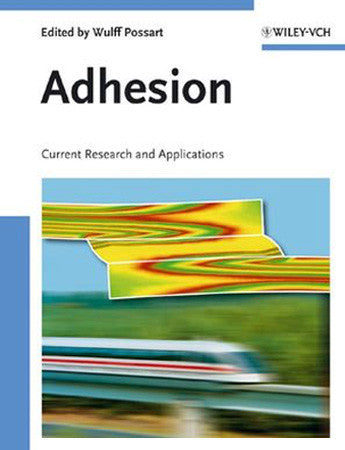
Adhesion: Current Rese...
$325.00
{"id":11242201156,"title":"Adhesion: Current Research and Applications","handle":"978-3-527-60710-5","description":"\u003ch5\u003eDescription\u003c\/h5\u003e\nAuthor: Ed., Wulff Possart \u003cbr\u003eISBN 978-3-527-60710-5 \u003cbr\u003e\u003cbr\u003epages 608, Hardcover\n\u003ch5\u003eSummary\u003c\/h5\u003e\nEmphasizing the most recent developments this book addresses both the basic and applied aspects of adhesion. The authors present the latest results on fundamental aspects, adhesion in biology, chemistry for the adhesive formulation, surface chemistry and the pretreatment of adherends, mechanical issues, non-destructive testing and the durability of adhesive joints, as well as advanced technical applications of adhesive joints. Prominent scientists review the current level of knowledge concerning the role of chemical bonds in adhesion, new resins and nanocomposites for adhesives, and about the role played by macromolecular architecture in the properties of hot melt and pressure sensitive adhesives.\n\u003ch5\u003eTable of Contents\u003c\/h5\u003e\nPreface. \u003cbr\u003e\u003cbr\u003eList of Contributors. \u003cbr\u003e\u003cbr\u003e1. The Interfacial Chemistry of Adhesion: Novel Routes to the Holy Grail (J. Watts). \u003cbr\u003e\u003cbr\u003e2. Modeling Fundamental Aspects of the Surface Chemistry of Oxides and their Interactions with Coupling Agents (P. Schiffels, et al.). \u003cbr\u003e\u003cbr\u003e3. Adhesion at the Nanoscale: An Approach by AFM (M. Brogly, et al.). \u003cbr\u003e\u003cbr\u003e4. Organization of PCL-b-PMMA Diblock Thin Films: Relationship to the Adsorption Substrate Chemistry (T. Elzein, et al.). \u003cbr\u003e\u003cbr\u003e5. Adhesion and Friction Properties of Elastomers at Macroscopic and Nanoscopic Scales (S. Bistac \u0026amp; A. Galliano). \u003cbr\u003e\u003cbr\u003e6. Chemical Structure Formation and Morphology in Ultrathin Polyurethane Films on Metals (C. Wehlack \u0026amp; W. Possart). \u003cbr\u003e\u003cbr\u003e7. Properties of the Interphase Epoxy–Amine\/Metal: Influences from the Nature of the Amine and the Metal (M. Aufray \u0026amp; A. Roche). \u003cbr\u003e\u003cbr\u003e8. Mapping Epoxy Interphases (M. Munz, et al.). \u003cbr\u003e\u003cbr\u003e9. Mechanical Interphases in Epoxies as seen by Nondestructive High-Performance Brillouin Microscopy (J. Krüger, et al.). \u003cbr\u003e\u003cbr\u003e10. Structure Formation in Barnacle Adhesive (M. Wiegemann). \u003cbr\u003e\u003cbr\u003e11. Adhesion Molecule-Modified Cardiovascular Prostheses: Characterization of Cellular Adhesion in a Cell Culture Model and by Cellular Force Spectroscopy (U. Bakowsky, et al.). \u003cbr\u003e\u003cbr\u003e12. Surface Engineering by Coating of Hydrophilic Layers: Bioadhesion and Biocontamination (G. Legeay \u0026amp; F. Poncin-Epaillard). \u003cbr\u003e\u003cbr\u003e13. New Resins and Nanosystems for High-Performance Adhesives (R. Mülhaupt). \u003cbr\u003e\u003cbr\u003e14. Influence of Proton Donors on the Cationic Polymerization of Epoxides (A. Hartwig, et al.). \u003cbr\u003e\u003cbr\u003e15. Novel Adhesion Promoters Based on Hyperbranched Polymers ( A. Buchman, et al.). \u003cbr\u003e\u003cbr\u003e16. Rheology of Hot-Melt PSAs: Influence of Polymer Structure (C. Derail \u0026amp; G. Marin). \u003cbr\u003e\u003cbr\u003e17. Preparation and Characterization of UV-Crosslinkable Pressure-Sensitive Adhesives (H. Do, et al.). \u003cbr\u003e\u003cbr\u003e18. The contribution of Chemical Interactions to the Adhesion Between Evaporated Metals and Functional Groups of Different Types at Polymer Surfaces (J. Friedrich, et al.). \u003cbr\u003e\u003cbr\u003e19. Alkene Pulsed Plasma Functionalized Surfaces: An Interfacial Diels-Alder Reaction Study (F. Siffer, et al.). \u003cbr\u003e\u003cbr\u003e20. Laser Surface Treatment of Composite Materials to Enhance Adhesion Properties (Q. Bénard, et al.). \u003cbr\u003e\u003cbr\u003e21. Effects of the Interphase on the Mechanical Behavior of Thin Adhesive Films—A Modeling Approach (S. Diebels, et al.). \u003cbr\u003e\u003cbr\u003e22. Effect of the Diblock Content on the Adhesive and Deformation Properties of PSAs Based on Styrenic Block Copolymers (C. Creton, et al.). \u003cbr\u003e\u003cbr\u003e23. Contact Mechanics and Interfacial Fatigue Studies between Thin Semicrystalline and Glassy Polymer Films (R. McSwain, et al.). \u003cbr\u003e\u003cbr\u003e24. Local and Global Aspects of Adhesion Phenomena in Soft Polymers (M. Vallat). \u003cbr\u003e\u003cbr\u003e25. Calibration and Evaluation of Nonlinear Ultrasonic Transmission Measurements of Thin-Bonded Interfaces (S. Hirsekorn, et al.). \u003cbr\u003e\u003cbr\u003e26. Debonding of Pressure-Sensitive Adhesives: A Combined Tack and Ultra-Small Angle X-Ray Scattering Study (E. Maurer, et al.). \u003cbr\u003e\u003cbr\u003e27. Nondestructive Testing of Adhesive Curing in Glass-Metal Compounds by Unilateral NMR (K. Kremer, et al.). \u003cbr\u003e\u003cbr\u003e28. Chemical Processes During Aging in Ultra-thin Epoxy Films on Metals (A. Meiser, et al.). \u003cbr\u003e\u003cbr\u003e29. Depth-Resolved Analysis of the Aging Behavior of Epoxy Thin Films by Positron Spectroscopy (J. Kanzow, et al.). \u003cbr\u003e\u003cbr\u003e30. Epoxies on Stainless Steel—Curing and Aging (D. Fata, et al.). \u003cbr\u003e\u003cbr\u003e31. Scanning Kelvin Probe Studies of Ion Transport and De-adhesion Processes at Polymer\/Metal Interfaces (K. Wapner \u0026amp; G. Grundmeier). \u003cbr\u003e\u003cbr\u003e32. Advanced Mass Transport Applications with Elastic Bonding of Sandwich Components (S. Koch, et al.). \u003cbr\u003e\u003cbr\u003e33. Adhesive Joints for Modular Components in Railway Applications (C. Nagel, et al.). \u003cbr\u003e\u003cbr\u003e34. The behavior of Dismantlable Adhesives Including Thermally Expansive Microcapsules (Y. Nishiyama \u0026amp; C. Sato). \u003cbr\u003e\u003cbr\u003eSubject Index.\u003cbr\u003e\u003cbr\u003e\n\u003ch5\u003eAbout Author\u003c\/h5\u003e\n\u003cb\u003eProf. Wulff Possart\u003c\/b\u003e holds the chair for Adhesion and Interphases in Polymers at the University of the Saarland in Saarbrücken Germany. He gained his doctorate in interfacial science and adhesion from the Academy of Sciences of the GDR in 1984 and received his lecturing qualification in solid state physics from Potsdam University, Germany, in 1993. He is the author of more than 88 scientific papers, book chapters, and books, and serves on the editorial boards of several scientific journals. Professor Possart's work focuses on mechanisms of fundamental adhesion, structure formation and properties of thin organic and polymer films, interphase chemistry in reactive systems, polymer dynamics at the phase boundary, and on the aging and durability of thin films and interphases.","published_at":"2017-06-22T21:12:40-04:00","created_at":"2017-06-22T21:12:40-04:00","vendor":"Chemtec Publishing","type":"Book","tags":["2006","acrylic polymers","adherends","adhesion","aging","biology","book","chemistry","durability","epoxies","fatigue","films","glassy","interfacial","joints","non-destructive testing","p-chemical","plastic","polymer","resins","semicrystalline","stainless steel Curing","surface","thin","ultra-thin","X-Ray"],"price":32500,"price_min":32500,"price_max":32500,"available":true,"price_varies":false,"compare_at_price":null,"compare_at_price_min":0,"compare_at_price_max":0,"compare_at_price_varies":false,"variants":[{"id":43378308484,"title":"Default Title","option1":"Default Title","option2":null,"option3":null,"sku":"","requires_shipping":true,"taxable":true,"featured_image":null,"available":true,"name":"Adhesion: Current Research and Applications","public_title":null,"options":["Default Title"],"price":32500,"weight":1000,"compare_at_price":null,"inventory_quantity":1,"inventory_management":null,"inventory_policy":"continue","barcode":"978-3-527-60710-5","requires_selling_plan":false,"selling_plan_allocations":[],"quantity_rule":{"min":1,"max":null,"increment":1}}],"images":["\/\/chemtec.org\/cdn\/shop\/products\/978-3-527-60710-5.jpg?v=1498185245"],"featured_image":"\/\/chemtec.org\/cdn\/shop\/products\/978-3-527-60710-5.jpg?v=1498185245","options":["Title"],"media":[{"alt":null,"id":350140334173,"position":1,"preview_image":{"aspect_ratio":0.767,"height":450,"width":345,"src":"\/\/chemtec.org\/cdn\/shop\/products\/978-3-527-60710-5.jpg?v=1498185245"},"aspect_ratio":0.767,"height":450,"media_type":"image","src":"\/\/chemtec.org\/cdn\/shop\/products\/978-3-527-60710-5.jpg?v=1498185245","width":345}],"requires_selling_plan":false,"selling_plan_groups":[],"content":"\u003ch5\u003eDescription\u003c\/h5\u003e\nAuthor: Ed., Wulff Possart \u003cbr\u003eISBN 978-3-527-60710-5 \u003cbr\u003e\u003cbr\u003epages 608, Hardcover\n\u003ch5\u003eSummary\u003c\/h5\u003e\nEmphasizing the most recent developments this book addresses both the basic and applied aspects of adhesion. The authors present the latest results on fundamental aspects, adhesion in biology, chemistry for the adhesive formulation, surface chemistry and the pretreatment of adherends, mechanical issues, non-destructive testing and the durability of adhesive joints, as well as advanced technical applications of adhesive joints. Prominent scientists review the current level of knowledge concerning the role of chemical bonds in adhesion, new resins and nanocomposites for adhesives, and about the role played by macromolecular architecture in the properties of hot melt and pressure sensitive adhesives.\n\u003ch5\u003eTable of Contents\u003c\/h5\u003e\nPreface. \u003cbr\u003e\u003cbr\u003eList of Contributors. \u003cbr\u003e\u003cbr\u003e1. The Interfacial Chemistry of Adhesion: Novel Routes to the Holy Grail (J. Watts). \u003cbr\u003e\u003cbr\u003e2. Modeling Fundamental Aspects of the Surface Chemistry of Oxides and their Interactions with Coupling Agents (P. Schiffels, et al.). \u003cbr\u003e\u003cbr\u003e3. Adhesion at the Nanoscale: An Approach by AFM (M. Brogly, et al.). \u003cbr\u003e\u003cbr\u003e4. Organization of PCL-b-PMMA Diblock Thin Films: Relationship to the Adsorption Substrate Chemistry (T. Elzein, et al.). \u003cbr\u003e\u003cbr\u003e5. Adhesion and Friction Properties of Elastomers at Macroscopic and Nanoscopic Scales (S. Bistac \u0026amp; A. Galliano). \u003cbr\u003e\u003cbr\u003e6. Chemical Structure Formation and Morphology in Ultrathin Polyurethane Films on Metals (C. Wehlack \u0026amp; W. Possart). \u003cbr\u003e\u003cbr\u003e7. Properties of the Interphase Epoxy–Amine\/Metal: Influences from the Nature of the Amine and the Metal (M. Aufray \u0026amp; A. Roche). \u003cbr\u003e\u003cbr\u003e8. Mapping Epoxy Interphases (M. Munz, et al.). \u003cbr\u003e\u003cbr\u003e9. Mechanical Interphases in Epoxies as seen by Nondestructive High-Performance Brillouin Microscopy (J. Krüger, et al.). \u003cbr\u003e\u003cbr\u003e10. Structure Formation in Barnacle Adhesive (M. Wiegemann). \u003cbr\u003e\u003cbr\u003e11. Adhesion Molecule-Modified Cardiovascular Prostheses: Characterization of Cellular Adhesion in a Cell Culture Model and by Cellular Force Spectroscopy (U. Bakowsky, et al.). \u003cbr\u003e\u003cbr\u003e12. Surface Engineering by Coating of Hydrophilic Layers: Bioadhesion and Biocontamination (G. Legeay \u0026amp; F. Poncin-Epaillard). \u003cbr\u003e\u003cbr\u003e13. New Resins and Nanosystems for High-Performance Adhesives (R. Mülhaupt). \u003cbr\u003e\u003cbr\u003e14. Influence of Proton Donors on the Cationic Polymerization of Epoxides (A. Hartwig, et al.). \u003cbr\u003e\u003cbr\u003e15. Novel Adhesion Promoters Based on Hyperbranched Polymers ( A. Buchman, et al.). \u003cbr\u003e\u003cbr\u003e16. Rheology of Hot-Melt PSAs: Influence of Polymer Structure (C. Derail \u0026amp; G. Marin). \u003cbr\u003e\u003cbr\u003e17. Preparation and Characterization of UV-Crosslinkable Pressure-Sensitive Adhesives (H. Do, et al.). \u003cbr\u003e\u003cbr\u003e18. The contribution of Chemical Interactions to the Adhesion Between Evaporated Metals and Functional Groups of Different Types at Polymer Surfaces (J. Friedrich, et al.). \u003cbr\u003e\u003cbr\u003e19. Alkene Pulsed Plasma Functionalized Surfaces: An Interfacial Diels-Alder Reaction Study (F. Siffer, et al.). \u003cbr\u003e\u003cbr\u003e20. Laser Surface Treatment of Composite Materials to Enhance Adhesion Properties (Q. Bénard, et al.). \u003cbr\u003e\u003cbr\u003e21. Effects of the Interphase on the Mechanical Behavior of Thin Adhesive Films—A Modeling Approach (S. Diebels, et al.). \u003cbr\u003e\u003cbr\u003e22. Effect of the Diblock Content on the Adhesive and Deformation Properties of PSAs Based on Styrenic Block Copolymers (C. Creton, et al.). \u003cbr\u003e\u003cbr\u003e23. Contact Mechanics and Interfacial Fatigue Studies between Thin Semicrystalline and Glassy Polymer Films (R. McSwain, et al.). \u003cbr\u003e\u003cbr\u003e24. Local and Global Aspects of Adhesion Phenomena in Soft Polymers (M. Vallat). \u003cbr\u003e\u003cbr\u003e25. Calibration and Evaluation of Nonlinear Ultrasonic Transmission Measurements of Thin-Bonded Interfaces (S. Hirsekorn, et al.). \u003cbr\u003e\u003cbr\u003e26. Debonding of Pressure-Sensitive Adhesives: A Combined Tack and Ultra-Small Angle X-Ray Scattering Study (E. Maurer, et al.). \u003cbr\u003e\u003cbr\u003e27. Nondestructive Testing of Adhesive Curing in Glass-Metal Compounds by Unilateral NMR (K. Kremer, et al.). \u003cbr\u003e\u003cbr\u003e28. Chemical Processes During Aging in Ultra-thin Epoxy Films on Metals (A. Meiser, et al.). \u003cbr\u003e\u003cbr\u003e29. Depth-Resolved Analysis of the Aging Behavior of Epoxy Thin Films by Positron Spectroscopy (J. Kanzow, et al.). \u003cbr\u003e\u003cbr\u003e30. Epoxies on Stainless Steel—Curing and Aging (D. Fata, et al.). \u003cbr\u003e\u003cbr\u003e31. Scanning Kelvin Probe Studies of Ion Transport and De-adhesion Processes at Polymer\/Metal Interfaces (K. Wapner \u0026amp; G. Grundmeier). \u003cbr\u003e\u003cbr\u003e32. Advanced Mass Transport Applications with Elastic Bonding of Sandwich Components (S. Koch, et al.). \u003cbr\u003e\u003cbr\u003e33. Adhesive Joints for Modular Components in Railway Applications (C. Nagel, et al.). \u003cbr\u003e\u003cbr\u003e34. The behavior of Dismantlable Adhesives Including Thermally Expansive Microcapsules (Y. Nishiyama \u0026amp; C. Sato). \u003cbr\u003e\u003cbr\u003eSubject Index.\u003cbr\u003e\u003cbr\u003e\n\u003ch5\u003eAbout Author\u003c\/h5\u003e\n\u003cb\u003eProf. Wulff Possart\u003c\/b\u003e holds the chair for Adhesion and Interphases in Polymers at the University of the Saarland in Saarbrücken Germany. He gained his doctorate in interfacial science and adhesion from the Academy of Sciences of the GDR in 1984 and received his lecturing qualification in solid state physics from Potsdam University, Germany, in 1993. He is the author of more than 88 scientific papers, book chapters, and books, and serves on the editorial boards of several scientific journals. Professor Possart's work focuses on mechanisms of fundamental adhesion, structure formation and properties of thin organic and polymer films, interphase chemistry in reactive systems, polymer dynamics at the phase boundary, and on the aging and durability of thin films and interphases."}
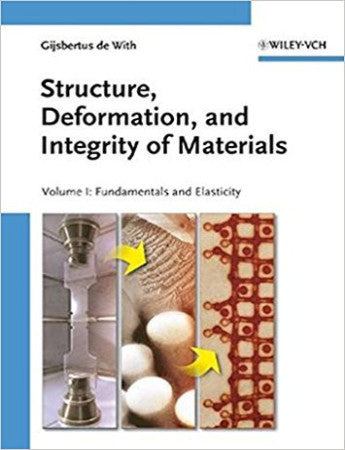
Structure, Deformation...
$239.00
{"id":11242200644,"title":"Structure, Deformation, and Integrity of Materials: Volume I: Fundamentals and Elasticity \/ Volume II: Plasticity, Visco-elasticity, and Fracture, 2 Volumes","handle":"978-3-527-31426-3","description":"\u003ch5\u003eDescription\u003c\/h5\u003e\nAuthor: Gijsbertus de With \u003cbr\u003eISBN 978-3-527-31426-3 \u003cbr\u003e\u003cbr\u003e\u003cmeta charset=\"utf-8\"\u003e\u003cspan\u003ePublished: 2006 \u003cbr\u003e\u003c\/span\u003eHardcover\u003cbr\u003e894 pages\u003cbr\u003e\u003cbr\u003e\n\u003ch5\u003eSummary\u003c\/h5\u003e\nThis first integrated approach to thermomechanics deals equally with the atomic scale, the mesoscale of microstructures and morphology, as well as the macroscopic level of actual components and workpieces for applications. With some 85 examples and 150 problems, it covers the three important material classes of ceramics, polymers, and metals in a didactic manner. The renowned author surveys mechanical material behavior at both the introductory and advanced level, providing a reading incentive to both students as well as specialists in such disciplines as materials science, chemistry, physics, and mechanical engineering. Backed by five appendices on symbols, abbreviations, data sheets, materials properties, statistics, and a summary of contact mechanics.\n\u003ch5\u003eTable of Contents\u003c\/h5\u003e\nVolume I: Fundamentals and Elasticity. \u003cbr\u003e\u003cbr\u003eA. Overview. \u003cbr\u003e\u003cbr\u003eIntroduction. \u003cbr\u003e\u003cbr\u003eConstitutive Behaviour. \u003cbr\u003e\u003cbr\u003eB. Basics. \u003cbr\u003e\u003cbr\u003eMathematical Preliminaries. \u003cbr\u003e\u003cbr\u003eKinematics. \u003cbr\u003e\u003cbr\u003eKinetics. \u003cbr\u003e\u003cbr\u003eThermodynamics. \u003cbr\u003e\u003cbr\u003eC, Q and S Mechanics. \u003cbr\u003e\u003cbr\u003eStructure and Bonding. \u003cbr\u003e\u003cbr\u003eC. Elasticity. \u003cbr\u003e\u003cbr\u003eContinuum Elasticity. \u003cbr\u003e\u003cbr\u003eElasticity of Structures. \u003cbr\u003e\u003cbr\u003eMolecular Basis of Elasticity. \u003cbr\u003e\u003cbr\u003eMicrostructural Aspects of Elasticity. \u003cbr\u003e\u003cbr\u003eAppendix A: Units, Physical Constants, and Conversion Factors. \u003cbr\u003e\u003cbr\u003eAppendix B: Properties of Structural Materials. \u003cbr\u003e\u003cbr\u003eAppendix C: Properties of Plane Areas. \u003cbr\u003e\u003cbr\u003eVolume II: Plasticity and Fracture. \u003cbr\u003e\u003cbr\u003eD. Plasticity. \u003cbr\u003e\u003cbr\u003eContinuum Plasticity. \u003cbr\u003e\u003cbr\u003eApplications of Plasticity Theory. \u003cbr\u003e\u003cbr\u003eDislocations. \u003cbr\u003e\u003cbr\u003eDislocations and Plasticity. \u003cbr\u003e\u003cbr\u003eMechanisms in Polymers \u003cbr\u003e\u003cbr\u003eContinuum Visco-elasticity \u003cbr\u003e\u003cbr\u003eApplications of Visco-elasticity Theory \u003cbr\u003e\u003cbr\u003eStructural Aspects of Visco-elasticity \u003cbr\u003e\u003cbr\u003eE. Fracture. \u003cbr\u003e\u003cbr\u003eContinuum Fracture. \u003cbr\u003e\u003cbr\u003eApplications of Fracture Theory. \u003cbr\u003e\u003cbr\u003eStructural Aspects of Fracture. \u003cbr\u003e\u003cbr\u003eFatigue. \u003cbr\u003e\u003cbr\u003ePerspective and Outlook. \u003cbr\u003e\u003cbr\u003eAppendix D: Statistics. \u003cbr\u003e\u003cbr\u003eAppendix E: Contact Mechanics.\u003cbr\u003e\u003cbr\u003e\n\u003ch5\u003eAbout Author\u003c\/h5\u003e\n\u003cb\u003eGijsbertus de With\u003c\/b\u003e is full professor in materials science. He graduated from Utrecht State University and received his Ph.D. in 1977 from the University of Twente on the 'Structure and charge distribution of molecular crystals'. In the same year, he joined Philips Research Laboratories, Eindhoven. In 1985 he was appointed part-time professor and in 1996 he became full professor at the Eindhoven University of Technology. His research interests include the chemical and mechanical processing as well as the chemo-mechanical behaviour of multi-phase materials and he holds about 10 patents.","published_at":"2017-06-22T21:12:39-04:00","created_at":"2017-06-22T21:12:39-04:00","vendor":"Chemtec Publishing","type":"Book","tags":["2006","bonding","book","elasticity","fracture","general","kinematics","macroscopic","microstructures","morphology","plasticity","statisctics","structure","thermodynamics","units","visco-elasticity","wiley"," kinetics"],"price":23900,"price_min":23900,"price_max":23900,"available":true,"price_varies":false,"compare_at_price":null,"compare_at_price_min":0,"compare_at_price_max":0,"compare_at_price_varies":false,"variants":[{"id":43378305796,"title":"Default Title","option1":"Default Title","option2":null,"option3":null,"sku":"","requires_shipping":true,"taxable":true,"featured_image":null,"available":true,"name":"Structure, Deformation, and Integrity of Materials: Volume I: Fundamentals and Elasticity \/ Volume II: Plasticity, Visco-elasticity, and Fracture, 2 Volumes","public_title":null,"options":["Default Title"],"price":23900,"weight":1000,"compare_at_price":null,"inventory_quantity":1,"inventory_management":null,"inventory_policy":"continue","barcode":"978-3-527-31426-3","requires_selling_plan":false,"selling_plan_allocations":[],"quantity_rule":{"min":1,"max":null,"increment":1}}],"images":["\/\/chemtec.org\/cdn\/shop\/products\/978-3-527-31426-3_690d2417-25c2-40bf-b586-2b6c9747d6b6.jpg?v=1499955997"],"featured_image":"\/\/chemtec.org\/cdn\/shop\/products\/978-3-527-31426-3_690d2417-25c2-40bf-b586-2b6c9747d6b6.jpg?v=1499955997","options":["Title"],"media":[{"alt":null,"id":358768935005,"position":1,"preview_image":{"aspect_ratio":0.767,"height":450,"width":345,"src":"\/\/chemtec.org\/cdn\/shop\/products\/978-3-527-31426-3_690d2417-25c2-40bf-b586-2b6c9747d6b6.jpg?v=1499955997"},"aspect_ratio":0.767,"height":450,"media_type":"image","src":"\/\/chemtec.org\/cdn\/shop\/products\/978-3-527-31426-3_690d2417-25c2-40bf-b586-2b6c9747d6b6.jpg?v=1499955997","width":345}],"requires_selling_plan":false,"selling_plan_groups":[],"content":"\u003ch5\u003eDescription\u003c\/h5\u003e\nAuthor: Gijsbertus de With \u003cbr\u003eISBN 978-3-527-31426-3 \u003cbr\u003e\u003cbr\u003e\u003cmeta charset=\"utf-8\"\u003e\u003cspan\u003ePublished: 2006 \u003cbr\u003e\u003c\/span\u003eHardcover\u003cbr\u003e894 pages\u003cbr\u003e\u003cbr\u003e\n\u003ch5\u003eSummary\u003c\/h5\u003e\nThis first integrated approach to thermomechanics deals equally with the atomic scale, the mesoscale of microstructures and morphology, as well as the macroscopic level of actual components and workpieces for applications. With some 85 examples and 150 problems, it covers the three important material classes of ceramics, polymers, and metals in a didactic manner. The renowned author surveys mechanical material behavior at both the introductory and advanced level, providing a reading incentive to both students as well as specialists in such disciplines as materials science, chemistry, physics, and mechanical engineering. Backed by five appendices on symbols, abbreviations, data sheets, materials properties, statistics, and a summary of contact mechanics.\n\u003ch5\u003eTable of Contents\u003c\/h5\u003e\nVolume I: Fundamentals and Elasticity. \u003cbr\u003e\u003cbr\u003eA. Overview. \u003cbr\u003e\u003cbr\u003eIntroduction. \u003cbr\u003e\u003cbr\u003eConstitutive Behaviour. \u003cbr\u003e\u003cbr\u003eB. Basics. \u003cbr\u003e\u003cbr\u003eMathematical Preliminaries. \u003cbr\u003e\u003cbr\u003eKinematics. \u003cbr\u003e\u003cbr\u003eKinetics. \u003cbr\u003e\u003cbr\u003eThermodynamics. \u003cbr\u003e\u003cbr\u003eC, Q and S Mechanics. \u003cbr\u003e\u003cbr\u003eStructure and Bonding. \u003cbr\u003e\u003cbr\u003eC. Elasticity. \u003cbr\u003e\u003cbr\u003eContinuum Elasticity. \u003cbr\u003e\u003cbr\u003eElasticity of Structures. \u003cbr\u003e\u003cbr\u003eMolecular Basis of Elasticity. \u003cbr\u003e\u003cbr\u003eMicrostructural Aspects of Elasticity. \u003cbr\u003e\u003cbr\u003eAppendix A: Units, Physical Constants, and Conversion Factors. \u003cbr\u003e\u003cbr\u003eAppendix B: Properties of Structural Materials. \u003cbr\u003e\u003cbr\u003eAppendix C: Properties of Plane Areas. \u003cbr\u003e\u003cbr\u003eVolume II: Plasticity and Fracture. \u003cbr\u003e\u003cbr\u003eD. Plasticity. \u003cbr\u003e\u003cbr\u003eContinuum Plasticity. \u003cbr\u003e\u003cbr\u003eApplications of Plasticity Theory. \u003cbr\u003e\u003cbr\u003eDislocations. \u003cbr\u003e\u003cbr\u003eDislocations and Plasticity. \u003cbr\u003e\u003cbr\u003eMechanisms in Polymers \u003cbr\u003e\u003cbr\u003eContinuum Visco-elasticity \u003cbr\u003e\u003cbr\u003eApplications of Visco-elasticity Theory \u003cbr\u003e\u003cbr\u003eStructural Aspects of Visco-elasticity \u003cbr\u003e\u003cbr\u003eE. Fracture. \u003cbr\u003e\u003cbr\u003eContinuum Fracture. \u003cbr\u003e\u003cbr\u003eApplications of Fracture Theory. \u003cbr\u003e\u003cbr\u003eStructural Aspects of Fracture. \u003cbr\u003e\u003cbr\u003eFatigue. \u003cbr\u003e\u003cbr\u003ePerspective and Outlook. \u003cbr\u003e\u003cbr\u003eAppendix D: Statistics. \u003cbr\u003e\u003cbr\u003eAppendix E: Contact Mechanics.\u003cbr\u003e\u003cbr\u003e\n\u003ch5\u003eAbout Author\u003c\/h5\u003e\n\u003cb\u003eGijsbertus de With\u003c\/b\u003e is full professor in materials science. He graduated from Utrecht State University and received his Ph.D. in 1977 from the University of Twente on the 'Structure and charge distribution of molecular crystals'. In the same year, he joined Philips Research Laboratories, Eindhoven. In 1985 he was appointed part-time professor and in 1996 he became full professor at the Eindhoven University of Technology. His research interests include the chemical and mechanical processing as well as the chemo-mechanical behaviour of multi-phase materials and he holds about 10 patents."}
Biopolymers
$153.00
{"id":11242200836,"title":"Biopolymers","handle":"978-1-85957-379-2","description":"\u003ch5\u003eDescription\u003c\/h5\u003e\nAuthor: R.M. Johnson, L.Y. Mwaikambo and N. Tucker \u003cbr\u003eISBN 978-1-85957-379-2 \u003cbr\u003e\u003cbr\u003epages 158\n\u003ch5\u003eSummary\u003c\/h5\u003e\nThe earth has finite resources in terms of fossil origin fuel and a finite capacity for disposal of waste. Biopolymers may offer a solution to both these issues in the long-term. The ideal biopolymer is both of renewable biological origin and biodegradable at the end of its life. In some cases material may be of a biological origin and not readily biodegradable, such as thermosets made from cashew nut shell liquid. On the other hand, polyvinyl alcohol is an example of a polymer of a synthetic origin and biodegradable. \u003cbr\u003e\u003cbr\u003eEnvironmental degradation can involve enzymatic pathways and microorganisms such as bacteria and fungi, or chemical pathways such as hydrolysis. It is important that biopolymers have an adequate life span for applications - their biodegradability makes them ideal for use in resorbable medical products such as sutures, in short-term packaging applications for fast foods and fresh groceries, and for sanitary uses. \u003cbr\u003e\u003cbr\u003eThis review sets out to examine the current trends in biopolymer science. The different types of biological polymers are discussed. The chemistry and synthesis of some key biopolymers is described, including cellulose, hemicellulose, starch, polyhydroxyalkanoates (of bacterial origin), tannins (polyphenolic plant products), cashew nut shell liquid, rosins (from tree sap), lignin (from wood), and man made polylactides. Many other biopolymers are also being investigated, for example, alginates from seaweed and algae, and proteins such as casein and soybean. The abstracts at the end of this report cover an extensive range of materials and are fully indexed. \u003cbr\u003e\u003cbr\u003eCommercially, bioplastics have proven to be relatively expensive and available only in small quantities. This has lead to limitations on applications to date. However, there are signs that this is changing, with increasing environmental awareness and more stringent legislation regarding recyclability and restrictions on waste disposal. Cargill Dow has a polylactic acid polymer in production (Natureworks). Metabolix has been working on polyhydroxyalkanoates (Biopol). Several companies have been developing starch products such as Avebe, Biop, Earthshell and Midwest Grain Products Inc. Polyols for polyurethane have been obtained from vegetable oils, etc. \u003cbr\u003e\u003cbr\u003eCertification of compostability is now available from DIN CERTCO. The requirements for this standard are discussed in the report. Additives can compromise the environmentally-friendly status of a polymer and must be chosen with care. Thus natural fibre reinforcements are also discussed briefly here. Biocomposites have been developed comprising natural origin polymer matrices and natural fibres, such as sugar cane bagasse and jute. \u003cbr\u003e\u003cbr\u003eThis review is accompanied by over 400 abstracts from papers and books in the Rapra Polymer Library database, to facilitate further reading on this subject. A subject index and a company index are included.\u003cbr\u003e\u003cbr\u003e\n\u003ch5\u003eTable of Contents\u003c\/h5\u003e\n1. Introduction\u003cbr\u003e1.1 Biopolymers\u003cbr\u003e1.2 Biodisintegratables or Biodeteriorating Polymers\u003cbr\u003e1.3 Biodegradability\u003cbr\u003e1.4 Environmental Impact\u003cbr\u003e1.5 Market Size \u003cbr\u003e2. Synthesis of Biopolymers\u003cbr\u003e2.1 Cellulose\u003cbr\u003e2.2 Starch\u003cbr\u003e2.3 Hemicellulose\u003cbr\u003e2.4 Polyhydroxyalkanoates (PHA)\u003cbr\u003e2.5 Tannins\u003cbr\u003e2.6 Cashew Nut Shell Liquid (CNSL)\u003cbr\u003e2.6.1 The Structure of CNSL\u003cbr\u003e2.6.2 Polymer Synthesis of CNSL\u003cbr\u003e2.7 Rosins\u003cbr\u003e2.8 Lignin\u003cbr\u003e2.9 Polylactic Acids and Polylactides\u003cbr\u003e2.10 Other \u003cbr\u003e3. Commercially Available Biopolymers \u003cbr\u003e4. Uses of Biopolymers\u003cbr\u003e4.1 General Uses\u003cbr\u003e4.2 Uses of Specific Polymer Types \u003cbr\u003e5. Manufacturing Technologies for Biopolymers\u003cbr\u003e5.1 Introduction\u003cbr\u003e5.2 Manufacturing Methods\u003cbr\u003e5.3 Additives\u003cbr\u003e5.3.1 Plasticizers\u003cbr\u003e5.3.2 Lubricants\u003cbr\u003e5.3.3 Colorants\u003cbr\u003e5.3.4 Flame Retardants\u003cbr\u003e5.3.5 Blowing (Foaming) Agents\u003cbr\u003e5.3.6 Crosslinkers\u003cbr\u003e5.3.7 Fillers \u003cbr\u003e6. Fillers and Reinforcement for Biopolymers \u003cbr\u003e7.The Markets and Economics for Biopolymers \u003cbr\u003e8.Compostability Certification \u003cbr\u003e9.The Chemistry and Biology of Polymer Degradation \u003cbr\u003e10.Conclusions\u003cbr\u003eAdditional References\u003cbr\u003eAbbreviations and Acronyms\u003cbr\u003e\u003cbr\u003e\n\u003ch5\u003eAbout Author\u003c\/h5\u003e\n\u003cb\u003eMark Johnson\u003c\/b\u003e is currently reading for a doctorate in Engineering Business Management (EngD) at the University of Warwick. Prior to this he worked as a production engineer in composite fabrication. The areas of study of his doctorate are biodegradable composites, their fabrication, performance, biodegradability and the factors affecting their uptake and usage by industry. \u003cbr\u003e\u003cb\u003e\u003cbr\u003eDr. Leonard Mwaikambo\u003c\/b\u003e\u003cbr\u003eholds the post of Lecturer at the Sokoine University of Agriculture, Tanzania, and is currently a Research Fellow in the Department of Chemistry, University of Warwick. His research concerns the development of sustainably produced, recyclable natural fibre composites. He has keen interest in developing matrices based on polymerised natural oils and fats for composite manufacture. \u003cbr\u003e\u003cbr\u003e\u003cb\u003eNick Tucker\u003c\/b\u003e's interest in biopolymers was started by a request from the Rover Group to examine the potential effect of biodegradable polymers on end-of-life vehicle disposal. His current research portfolio now covers the economic manufacture and application of low environmental impact biodegradable composites from sustainable resources. In parallel with these activities, he runs the Sustainable Composites Network with the Biocomposites Centre at the University of Wales, Bangor.\u003cbr\u003e\u003cbr\u003e\u003cb\u003e\u003cbr\u003e\u003c\/b\u003e","published_at":"2017-06-22T21:12:39-04:00","created_at":"2017-06-22T21:12:39-04:00","vendor":"Chemtec Publishing","type":"Book","tags":["2003","applications","bacterial origin","biodegradability","biodeteriorating polymers","biodisintegratables","biological origin polymers","biopolymers","book","cashew nut shell liquid","cellulose","environmental impact","hemicellulose","lignin","polyhydroxyalkanoates","polylactides","polyphenolic plant products","product properties environmental\/safety issues each technology area. These papers are not contained main conference book. RAPRA Business Machines Appliances","rosins","starch","synthesis","tannins","tree sap"],"price":15300,"price_min":15300,"price_max":15300,"available":true,"price_varies":false,"compare_at_price":null,"compare_at_price_min":0,"compare_at_price_max":0,"compare_at_price_varies":false,"variants":[{"id":43378307268,"title":"Default Title","option1":"Default Title","option2":null,"option3":null,"sku":"","requires_shipping":true,"taxable":true,"featured_image":null,"available":true,"name":"Biopolymers","public_title":null,"options":["Default Title"],"price":15300,"weight":1000,"compare_at_price":null,"inventory_quantity":1,"inventory_management":null,"inventory_policy":"continue","barcode":"978-1-85957-379-2","requires_selling_plan":false,"selling_plan_allocations":[],"quantity_rule":{"min":1,"max":null,"increment":1}}],"images":["\/\/chemtec.org\/cdn\/shop\/products\/978-1-85957-379-2.jpg?v=1499185953"],"featured_image":"\/\/chemtec.org\/cdn\/shop\/products\/978-1-85957-379-2.jpg?v=1499185953","options":["Title"],"media":[{"alt":null,"id":353911668829,"position":1,"preview_image":{"aspect_ratio":0.767,"height":450,"width":345,"src":"\/\/chemtec.org\/cdn\/shop\/products\/978-1-85957-379-2.jpg?v=1499185953"},"aspect_ratio":0.767,"height":450,"media_type":"image","src":"\/\/chemtec.org\/cdn\/shop\/products\/978-1-85957-379-2.jpg?v=1499185953","width":345}],"requires_selling_plan":false,"selling_plan_groups":[],"content":"\u003ch5\u003eDescription\u003c\/h5\u003e\nAuthor: R.M. Johnson, L.Y. Mwaikambo and N. Tucker \u003cbr\u003eISBN 978-1-85957-379-2 \u003cbr\u003e\u003cbr\u003epages 158\n\u003ch5\u003eSummary\u003c\/h5\u003e\nThe earth has finite resources in terms of fossil origin fuel and a finite capacity for disposal of waste. Biopolymers may offer a solution to both these issues in the long-term. The ideal biopolymer is both of renewable biological origin and biodegradable at the end of its life. In some cases material may be of a biological origin and not readily biodegradable, such as thermosets made from cashew nut shell liquid. On the other hand, polyvinyl alcohol is an example of a polymer of a synthetic origin and biodegradable. \u003cbr\u003e\u003cbr\u003eEnvironmental degradation can involve enzymatic pathways and microorganisms such as bacteria and fungi, or chemical pathways such as hydrolysis. It is important that biopolymers have an adequate life span for applications - their biodegradability makes them ideal for use in resorbable medical products such as sutures, in short-term packaging applications for fast foods and fresh groceries, and for sanitary uses. \u003cbr\u003e\u003cbr\u003eThis review sets out to examine the current trends in biopolymer science. The different types of biological polymers are discussed. The chemistry and synthesis of some key biopolymers is described, including cellulose, hemicellulose, starch, polyhydroxyalkanoates (of bacterial origin), tannins (polyphenolic plant products), cashew nut shell liquid, rosins (from tree sap), lignin (from wood), and man made polylactides. Many other biopolymers are also being investigated, for example, alginates from seaweed and algae, and proteins such as casein and soybean. The abstracts at the end of this report cover an extensive range of materials and are fully indexed. \u003cbr\u003e\u003cbr\u003eCommercially, bioplastics have proven to be relatively expensive and available only in small quantities. This has lead to limitations on applications to date. However, there are signs that this is changing, with increasing environmental awareness and more stringent legislation regarding recyclability and restrictions on waste disposal. Cargill Dow has a polylactic acid polymer in production (Natureworks). Metabolix has been working on polyhydroxyalkanoates (Biopol). Several companies have been developing starch products such as Avebe, Biop, Earthshell and Midwest Grain Products Inc. Polyols for polyurethane have been obtained from vegetable oils, etc. \u003cbr\u003e\u003cbr\u003eCertification of compostability is now available from DIN CERTCO. The requirements for this standard are discussed in the report. Additives can compromise the environmentally-friendly status of a polymer and must be chosen with care. Thus natural fibre reinforcements are also discussed briefly here. Biocomposites have been developed comprising natural origin polymer matrices and natural fibres, such as sugar cane bagasse and jute. \u003cbr\u003e\u003cbr\u003eThis review is accompanied by over 400 abstracts from papers and books in the Rapra Polymer Library database, to facilitate further reading on this subject. A subject index and a company index are included.\u003cbr\u003e\u003cbr\u003e\n\u003ch5\u003eTable of Contents\u003c\/h5\u003e\n1. Introduction\u003cbr\u003e1.1 Biopolymers\u003cbr\u003e1.2 Biodisintegratables or Biodeteriorating Polymers\u003cbr\u003e1.3 Biodegradability\u003cbr\u003e1.4 Environmental Impact\u003cbr\u003e1.5 Market Size \u003cbr\u003e2. Synthesis of Biopolymers\u003cbr\u003e2.1 Cellulose\u003cbr\u003e2.2 Starch\u003cbr\u003e2.3 Hemicellulose\u003cbr\u003e2.4 Polyhydroxyalkanoates (PHA)\u003cbr\u003e2.5 Tannins\u003cbr\u003e2.6 Cashew Nut Shell Liquid (CNSL)\u003cbr\u003e2.6.1 The Structure of CNSL\u003cbr\u003e2.6.2 Polymer Synthesis of CNSL\u003cbr\u003e2.7 Rosins\u003cbr\u003e2.8 Lignin\u003cbr\u003e2.9 Polylactic Acids and Polylactides\u003cbr\u003e2.10 Other \u003cbr\u003e3. Commercially Available Biopolymers \u003cbr\u003e4. Uses of Biopolymers\u003cbr\u003e4.1 General Uses\u003cbr\u003e4.2 Uses of Specific Polymer Types \u003cbr\u003e5. Manufacturing Technologies for Biopolymers\u003cbr\u003e5.1 Introduction\u003cbr\u003e5.2 Manufacturing Methods\u003cbr\u003e5.3 Additives\u003cbr\u003e5.3.1 Plasticizers\u003cbr\u003e5.3.2 Lubricants\u003cbr\u003e5.3.3 Colorants\u003cbr\u003e5.3.4 Flame Retardants\u003cbr\u003e5.3.5 Blowing (Foaming) Agents\u003cbr\u003e5.3.6 Crosslinkers\u003cbr\u003e5.3.7 Fillers \u003cbr\u003e6. Fillers and Reinforcement for Biopolymers \u003cbr\u003e7.The Markets and Economics for Biopolymers \u003cbr\u003e8.Compostability Certification \u003cbr\u003e9.The Chemistry and Biology of Polymer Degradation \u003cbr\u003e10.Conclusions\u003cbr\u003eAdditional References\u003cbr\u003eAbbreviations and Acronyms\u003cbr\u003e\u003cbr\u003e\n\u003ch5\u003eAbout Author\u003c\/h5\u003e\n\u003cb\u003eMark Johnson\u003c\/b\u003e is currently reading for a doctorate in Engineering Business Management (EngD) at the University of Warwick. Prior to this he worked as a production engineer in composite fabrication. The areas of study of his doctorate are biodegradable composites, their fabrication, performance, biodegradability and the factors affecting their uptake and usage by industry. \u003cbr\u003e\u003cb\u003e\u003cbr\u003eDr. Leonard Mwaikambo\u003c\/b\u003e\u003cbr\u003eholds the post of Lecturer at the Sokoine University of Agriculture, Tanzania, and is currently a Research Fellow in the Department of Chemistry, University of Warwick. His research concerns the development of sustainably produced, recyclable natural fibre composites. He has keen interest in developing matrices based on polymerised natural oils and fats for composite manufacture. \u003cbr\u003e\u003cbr\u003e\u003cb\u003eNick Tucker\u003c\/b\u003e's interest in biopolymers was started by a request from the Rover Group to examine the potential effect of biodegradable polymers on end-of-life vehicle disposal. His current research portfolio now covers the economic manufacture and application of low environmental impact biodegradable composites from sustainable resources. In parallel with these activities, he runs the Sustainable Composites Network with the Biocomposites Centre at the University of Wales, Bangor.\u003cbr\u003e\u003cbr\u003e\u003cb\u003e\u003cbr\u003e\u003c\/b\u003e"}
Additives in Polymers:...
$550.00
{"id":11242200772,"title":"Additives in Polymers: Industrial Analysis and Applications","handle":"978-0-470-85062-6","description":"\u003ch5\u003eDescription\u003c\/h5\u003e\nAuthor: Jan C. J. Bart \u003cbr\u003eISBN 978-0-470-85062-6 \u003cbr\u003e\u003cbr\u003epages 836 Hardcover\n\u003ch5\u003eSummary\u003c\/h5\u003e\nThis industrially relevant resource covers all established and emerging analytical methods for the deformulation of polymeric materials, with emphasis on the non-polymeric components. \u003cbr\u003e\n\u003cul\u003e\n\u003cli\u003eEach technique is evaluated on its technical and industrial merits.\u003c\/li\u003e\n\u003cli\u003eEmphasis is on understanding (principles and characteristics) and industrial applicability.\u003c\/li\u003e\n\u003cli\u003eExtensively illustrated throughout with over 200 figures, 400 tables, and 3,000 references.\u003c\/li\u003e\n\u003c\/ul\u003e\n\u003cbr\u003e\n\u003ch5\u003eTable of Contents\u003c\/h5\u003e\n\u003cbr\u003eForeword. \u003cbr\u003ePreface. \u003cbr\u003eAbout the Author. \u003cbr\u003eAcknowledgements. \u003cbr\u003eChapter 1: Introduction. \u003cbr\u003e1.1 Additives. \u003cbr\u003e1.2 Plastics formulations . \u003cbr\u003e1.3 Economic impact of polymer additives. \u003cbr\u003e1.4 Analysis of plastics. \u003cbr\u003e1.5 Bibliography. \u003cbr\u003e1.6 References. \u003cbr\u003eChapter 2: Deformulation Principles. \u003cbr\u003e2.1 Polymer identification. \u003cbr\u003e2.2 Additive analysis of rubbers: ‘Best Practice’. \u003cbr\u003e2.3 Polymer extract analysis. \u003cbr\u003e2.4 In situ polymer\/additive analysis. \u003cbr\u003e2.5 Class-specific polymer\/additive analysis. \u003cbr\u003e2.6 Bibliography. \u003cbr\u003e2.7 References. \u003cbr\u003eChapter 3: Sample Preparation Perspectives. \u003cbr\u003e3.1 Solvents. \u003cbr\u003e3.2 Extraction strategy. \u003cbr\u003e3.3 Conventional extraction technologies. \u003cbr\u003e3.4 High-pressure solvent extraction methods. \u003cbr\u003e3.5 Sorbent extraction. \u003cbr\u003e3.6 Methodological comparison of extraction methods. \u003cbr\u003e3.7 Polymer\/additive dissolution methods. \u003cbr\u003e3.8 Hydrolysis. \u003cbr\u003e3.9 Bibliography. \u003cbr\u003e3.10 References. \u003cbr\u003eChapter 4: Separation Techniques. \u003cbr\u003e4.1 Analytical detectors. \u003cbr\u003e4.2 Gas chromatography. \u003cbr\u003e4.3 Supercritical fluid chromatography. \u003cbr\u003e4.4 Liquid chromatography techniques. \u003cbr\u003e4.5 Capillary electrophoretic techniques. \u003cbr\u003e4.6 Bibliography. \u003cbr\u003e4.7 References. \u003cbr\u003eChapter 5: Polymer\/Additive Analysis: The Spectroscopic Alternative. \u003cbr\u003e5.1 Ultraviolet\/visible spectrophotometry. \u003cbr\u003e5.2 Infrared spectroscopy. \u003cbr\u003e5.3 Luminescence spectroscopy. \u003cbr\u003e5.4 High-resolution nuclear magnetic resonance spectroscopy. \u003cbr\u003e5.5 Bibliography. \u003cbr\u003e5.6 References. \u003cbr\u003eChapter 6: Organic Mass-Spectrometric Methods. \u003cbr\u003e6.1 Basic instrumentation. \u003cbr\u003e6.2 Ion sources. \u003cbr\u003e6.3 Mass analysers. \u003cbr\u003e6.4 Direct mass-spectrometric polymer compound analysis. \u003cbr\u003e6.5 Ion mobility spectrometry. \u003cbr\u003e6.6 Bibliography. \u003cbr\u003e6.7 References. \u003cbr\u003eChapter 7: Multihyphenation and Multidimensionality in Polymer\/Additive Analysis. \u003cbr\u003e7.1 Precolumn hyphenation. \u003cbr\u003e7.2 Coupled sample preparation – spectroscopy\/spectrometry. \u003cbr\u003e7.3 Postcolumn hyphenation. \u003cbr\u003e7.4 Multidimensional chromatography. \u003cbr\u003e7.5 Multidimensional spectroscopy. \u003cbr\u003e7.6 Bibliography. \u003cbr\u003e7.7 References. \u003cbr\u003eChapter 8: Inorganic and Element Analytical Methods. \u003cbr\u003e8.1 Element analytical protocols. \u003cbr\u003e8.2 Sample destruction for classical elemental analysis. \u003cbr\u003e8.3 Analytical atomic spectrometry. \u003cbr\u003e8.4 X-ray spectrometry. \u003cbr\u003e8.5 Inorganic mass spectrometry. \u003cbr\u003e8.6 Radioanalytical and nuclear analytical methods. \u003cbr\u003e8.7 Electroanalytical techniques. \u003cbr\u003e8.8 Solid-state speciation analysis. \u003cbr\u003e8.9 Bibliography. \u003cbr\u003e8.10 References. \u003cbr\u003eChapter 9: Direct Methods of Deformulation of Polymer\/Additive Dissolutions. \u003cbr\u003e9.1 Chromatographic methods. \u003cbr\u003e9.2 Spectroscopic techniques. \u003cbr\u003e9.3 Mass-spectrometric methods. \u003cbr\u003e9.4 References. \u003cbr\u003eChapter 10: A Vision for the Future. \u003cbr\u003e10.1 Trends in polymer technology. \u003cbr\u003e10.2 Trends in additive technology. \u003cbr\u003e10.3 Environmental, legislative and regulatory constraints. \u003cbr\u003e10.4 Analytical consequences. \u003cbr\u003e10.5 Epilogue. \u003cbr\u003e10.6 Bibliography. \u003cbr\u003e10.7 References. \u003cbr\u003eAppendix I: List of Symbols. \u003cbr\u003eAppendix II: Functionality of Common Additives Used in Commercial Thermoplastics, Rubbers, and Thermosetting Resins. \u003cbr\u003eAppendix III: Specimen Polymer Additives Product Sheets. \u003cbr\u003eIndex. \u003cbr\u003e\u003cbr\u003e\n\u003ch5\u003eAbout Author\u003c\/h5\u003e\n\u003cb\u003eJan C.J. Bart\u003c\/b\u003e (Ph.D. Structural Chemistry, University of Amsterdam) is a senior scientist with a broad interest in materials characterisation, heterogeneous catalysis and product development who spent an industrial career in R\u0026amp;D with Monsanto, Montedison and DSM Research in various countries. The author has held several teaching assignments and researched extensively in both academic and industrial areas; he authored over 250 scientific papers, including chapters in books. Dr. Bart has acted as a Ramsay Memorial Fellow at the Universities of Leeds (Colour Chemistry) and Oxford (Material Science), a visiting scientist at Institut de Recherches sur la Catalyse (CNRS, Villeurbanne), and a Meyerhoff Visiting Professor at WIS (Rehovoth), and held an Invited Professorship at USTC (Hefei). He is currently a Full Professor of Industrial Chemistry at the University of Messina. He is also a member of the Royal Society of Chemistry, Royal Dutch Chemical Society, Society of Plastic Engineers and The Institute of Materials.","published_at":"2017-06-22T21:12:39-04:00","created_at":"2017-06-22T21:12:39-04:00","vendor":"Chemtec Publishing","type":"Book","tags":["2005","additives","book","extraction","fillers","Gas chromatography. supercritical fluid chromatography","hydrolisis","liquid chromatography","p-chemical","plastic","plastics","polymer","rubber","solvents","spectroscopy. radioanalytical"],"price":55000,"price_min":55000,"price_max":55000,"available":true,"price_varies":false,"compare_at_price":null,"compare_at_price_min":0,"compare_at_price_max":0,"compare_at_price_varies":false,"variants":[{"id":43378306308,"title":"Default Title","option1":"Default Title","option2":null,"option3":null,"sku":"","requires_shipping":true,"taxable":true,"featured_image":null,"available":true,"name":"Additives in Polymers: Industrial Analysis and Applications","public_title":null,"options":["Default Title"],"price":55000,"weight":1000,"compare_at_price":null,"inventory_quantity":1,"inventory_management":null,"inventory_policy":"continue","barcode":"978-0-470-85062-6","requires_selling_plan":false,"selling_plan_allocations":[],"quantity_rule":{"min":1,"max":null,"increment":1}}],"images":["\/\/chemtec.org\/cdn\/shop\/products\/978-0-470-85062-6.jpg?v=1499914044"],"featured_image":"\/\/chemtec.org\/cdn\/shop\/products\/978-0-470-85062-6.jpg?v=1499914044","options":["Title"],"media":[{"alt":null,"id":350139580509,"position":1,"preview_image":{"aspect_ratio":0.767,"height":450,"width":345,"src":"\/\/chemtec.org\/cdn\/shop\/products\/978-0-470-85062-6.jpg?v=1499914044"},"aspect_ratio":0.767,"height":450,"media_type":"image","src":"\/\/chemtec.org\/cdn\/shop\/products\/978-0-470-85062-6.jpg?v=1499914044","width":345}],"requires_selling_plan":false,"selling_plan_groups":[],"content":"\u003ch5\u003eDescription\u003c\/h5\u003e\nAuthor: Jan C. J. Bart \u003cbr\u003eISBN 978-0-470-85062-6 \u003cbr\u003e\u003cbr\u003epages 836 Hardcover\n\u003ch5\u003eSummary\u003c\/h5\u003e\nThis industrially relevant resource covers all established and emerging analytical methods for the deformulation of polymeric materials, with emphasis on the non-polymeric components. \u003cbr\u003e\n\u003cul\u003e\n\u003cli\u003eEach technique is evaluated on its technical and industrial merits.\u003c\/li\u003e\n\u003cli\u003eEmphasis is on understanding (principles and characteristics) and industrial applicability.\u003c\/li\u003e\n\u003cli\u003eExtensively illustrated throughout with over 200 figures, 400 tables, and 3,000 references.\u003c\/li\u003e\n\u003c\/ul\u003e\n\u003cbr\u003e\n\u003ch5\u003eTable of Contents\u003c\/h5\u003e\n\u003cbr\u003eForeword. \u003cbr\u003ePreface. \u003cbr\u003eAbout the Author. \u003cbr\u003eAcknowledgements. \u003cbr\u003eChapter 1: Introduction. \u003cbr\u003e1.1 Additives. \u003cbr\u003e1.2 Plastics formulations . \u003cbr\u003e1.3 Economic impact of polymer additives. \u003cbr\u003e1.4 Analysis of plastics. \u003cbr\u003e1.5 Bibliography. \u003cbr\u003e1.6 References. \u003cbr\u003eChapter 2: Deformulation Principles. \u003cbr\u003e2.1 Polymer identification. \u003cbr\u003e2.2 Additive analysis of rubbers: ‘Best Practice’. \u003cbr\u003e2.3 Polymer extract analysis. \u003cbr\u003e2.4 In situ polymer\/additive analysis. \u003cbr\u003e2.5 Class-specific polymer\/additive analysis. \u003cbr\u003e2.6 Bibliography. \u003cbr\u003e2.7 References. \u003cbr\u003eChapter 3: Sample Preparation Perspectives. \u003cbr\u003e3.1 Solvents. \u003cbr\u003e3.2 Extraction strategy. \u003cbr\u003e3.3 Conventional extraction technologies. \u003cbr\u003e3.4 High-pressure solvent extraction methods. \u003cbr\u003e3.5 Sorbent extraction. \u003cbr\u003e3.6 Methodological comparison of extraction methods. \u003cbr\u003e3.7 Polymer\/additive dissolution methods. \u003cbr\u003e3.8 Hydrolysis. \u003cbr\u003e3.9 Bibliography. \u003cbr\u003e3.10 References. \u003cbr\u003eChapter 4: Separation Techniques. \u003cbr\u003e4.1 Analytical detectors. \u003cbr\u003e4.2 Gas chromatography. \u003cbr\u003e4.3 Supercritical fluid chromatography. \u003cbr\u003e4.4 Liquid chromatography techniques. \u003cbr\u003e4.5 Capillary electrophoretic techniques. \u003cbr\u003e4.6 Bibliography. \u003cbr\u003e4.7 References. \u003cbr\u003eChapter 5: Polymer\/Additive Analysis: The Spectroscopic Alternative. \u003cbr\u003e5.1 Ultraviolet\/visible spectrophotometry. \u003cbr\u003e5.2 Infrared spectroscopy. \u003cbr\u003e5.3 Luminescence spectroscopy. \u003cbr\u003e5.4 High-resolution nuclear magnetic resonance spectroscopy. \u003cbr\u003e5.5 Bibliography. \u003cbr\u003e5.6 References. \u003cbr\u003eChapter 6: Organic Mass-Spectrometric Methods. \u003cbr\u003e6.1 Basic instrumentation. \u003cbr\u003e6.2 Ion sources. \u003cbr\u003e6.3 Mass analysers. \u003cbr\u003e6.4 Direct mass-spectrometric polymer compound analysis. \u003cbr\u003e6.5 Ion mobility spectrometry. \u003cbr\u003e6.6 Bibliography. \u003cbr\u003e6.7 References. \u003cbr\u003eChapter 7: Multihyphenation and Multidimensionality in Polymer\/Additive Analysis. \u003cbr\u003e7.1 Precolumn hyphenation. \u003cbr\u003e7.2 Coupled sample preparation – spectroscopy\/spectrometry. \u003cbr\u003e7.3 Postcolumn hyphenation. \u003cbr\u003e7.4 Multidimensional chromatography. \u003cbr\u003e7.5 Multidimensional spectroscopy. \u003cbr\u003e7.6 Bibliography. \u003cbr\u003e7.7 References. \u003cbr\u003eChapter 8: Inorganic and Element Analytical Methods. \u003cbr\u003e8.1 Element analytical protocols. \u003cbr\u003e8.2 Sample destruction for classical elemental analysis. \u003cbr\u003e8.3 Analytical atomic spectrometry. \u003cbr\u003e8.4 X-ray spectrometry. \u003cbr\u003e8.5 Inorganic mass spectrometry. \u003cbr\u003e8.6 Radioanalytical and nuclear analytical methods. \u003cbr\u003e8.7 Electroanalytical techniques. \u003cbr\u003e8.8 Solid-state speciation analysis. \u003cbr\u003e8.9 Bibliography. \u003cbr\u003e8.10 References. \u003cbr\u003eChapter 9: Direct Methods of Deformulation of Polymer\/Additive Dissolutions. \u003cbr\u003e9.1 Chromatographic methods. \u003cbr\u003e9.2 Spectroscopic techniques. \u003cbr\u003e9.3 Mass-spectrometric methods. \u003cbr\u003e9.4 References. \u003cbr\u003eChapter 10: A Vision for the Future. \u003cbr\u003e10.1 Trends in polymer technology. \u003cbr\u003e10.2 Trends in additive technology. \u003cbr\u003e10.3 Environmental, legislative and regulatory constraints. \u003cbr\u003e10.4 Analytical consequences. \u003cbr\u003e10.5 Epilogue. \u003cbr\u003e10.6 Bibliography. \u003cbr\u003e10.7 References. \u003cbr\u003eAppendix I: List of Symbols. \u003cbr\u003eAppendix II: Functionality of Common Additives Used in Commercial Thermoplastics, Rubbers, and Thermosetting Resins. \u003cbr\u003eAppendix III: Specimen Polymer Additives Product Sheets. \u003cbr\u003eIndex. \u003cbr\u003e\u003cbr\u003e\n\u003ch5\u003eAbout Author\u003c\/h5\u003e\n\u003cb\u003eJan C.J. Bart\u003c\/b\u003e (Ph.D. Structural Chemistry, University of Amsterdam) is a senior scientist with a broad interest in materials characterisation, heterogeneous catalysis and product development who spent an industrial career in R\u0026amp;D with Monsanto, Montedison and DSM Research in various countries. The author has held several teaching assignments and researched extensively in both academic and industrial areas; he authored over 250 scientific papers, including chapters in books. Dr. Bart has acted as a Ramsay Memorial Fellow at the Universities of Leeds (Colour Chemistry) and Oxford (Material Science), a visiting scientist at Institut de Recherches sur la Catalyse (CNRS, Villeurbanne), and a Meyerhoff Visiting Professor at WIS (Rehovoth), and held an Invited Professorship at USTC (Hefei). He is currently a Full Professor of Industrial Chemistry at the University of Messina. He is also a member of the Royal Society of Chemistry, Royal Dutch Chemical Society, Society of Plastic Engineers and The Institute of Materials."}
Handbook of Plasticize...
$285.00
{"id":11242200196,"title":"Handbook of Plasticizers, 2nd Edition","handle":"978-1-895198-50-8","description":"\u003ch5\u003eDescription\u003c\/h5\u003e\nAuthor: George Wypych Editor \u003cbr\u003eISBN 978-1-895198-50-8 \u003cbr\u003e\u003cbr\u003ePages 748, Tables 114, Figures 416, References 3876\n\u003ch5\u003eSummary\u003c\/h5\u003e\nThis book contains the comprehensive review of information available in open literature, such as published scientific papers, information from plasticizer manufacturers, and patent literature. The book contains information from the most recent sources and updated information from the previous edition. \u003cbr\u003e\u003cbr\u003eThe information available today permits to use plasticizers more effectively and to avoid certain plasticizers in applications where they may cause health or material durability problems. Plasticizer incorporation demands a broad background of information because plasticizers are now added to complex mixtures containing the variety of materials which may have different reactions to the presence of plasticizers. Plasticizer's choice is also not simple because there is a large selection of commercial plasticizers and various environmental issues dictating preferred solutions.\u003cbr\u003e\u003cbr\u003eBoth aspects considered indicate the need for a comprehensive source which, using currently available means of the computerized database should provide data and a broad background of theoretical information in the condensed form easy to search. \u003cbr\u003e\u003cbr\u003eAll numerical data are in the form of database (see information on Plasticizer Database which is a separate publication), whereas the theoretical component of information is given in the traditional form of a printed book.\u003cbr\u003e\u003cbr\u003eTwenty one chapters are included in Handbook of Plasticizers. Full Table of Contents is also available for review. Only some chapters are discussed here to add more information which may not be obvious from the table of contents.\u003cbr\u003e\u003cbr\u003eData are available for a large number of commercial plasticizers. This data is used in Chapter 2 to specify typical properties of plasticizers which belong to one of the groups and also to give ranges of expected properties for a given group.\u003cbr\u003e\u003cbr\u003eChapters 5, 6 and 7 contain new and historical approaches, which explain mechanisms of plasticizers action and their behavior in plasticized systems. This theoretical background helps to understand practical observations and provides guidance to the methods of material improvement. Chapter 9 shows plasticization steps and results of various analytical studies which help in understanding these steps and parameters which may control them.\u003cbr\u003e\u003cbr\u003eTwenty five Sections of Chapter 10 discuss plasticizers effect on physical and mechanical properties of plasticized materials. These sections are essential for understanding the behavior of materials and principles of their formulation. \u003cbr\u003e\u003cbr\u003eChapter 11 contains data on the use of plasticizers in 61 groups of polymers. The information is grouped under the following sections – Frequently used plasticizers, Practical concentrations, Main functions performed by plasticizers, Mechanism of plasticizer action, Effect of plasticizers on polymer and other additives, and Typical formulations. Use of such consistent method of data presentation helps to find information quickly and to compare data from various sources and applications. \u003cbr\u003e\u003cbr\u003eSimilar, Chapter 13 discusses the use of plasticizers in 34 groups of products according to a similar breakdown including Plasticizer types, Plasticizer concentration, Reasons for plasticizer use, Advantages and disadvantages of plasticizers use, Effect of plasticizers on product properties, and Examples of formulations. Both chapters make use of a large number of patents and information in open literature discussing the most current findings and trends.\u003cbr\u003e\u003cbr\u003eIn Chapter 14 attempts are being made to discuss the following topics: Effect of plasticizers on process conditions, Processing defects formation and elimination with use of plasticizers, Influence of rheological changes on the process, Equipment maintenance, and Energy consumption. This chapter discusses 15 methods of polymer and rubber processing.\u003cbr\u003e\u003cbr\u003eSeveral chapters which follow discuss various aspects of plasticizer effect on health, safety, and environment. Chapter 17 contains opinions of renowned experts on various aspects of plasticizers effect on health and safety. Chapter 18 contains information on plasticizers persistence in soil and water. Plasticizers releases and their presence in the environment are discussed for many important commercial plasticizers.\u003cbr\u003e\u003cbr\u003eThis short review and the Table of Contents show that this book is the most comprehensive source of current information on plasticizers. Plasticizers are used in so many products that every library should have this reference source of information on plasticizers readily available for its readers. Especially considering that so many aspects of application plasticizers have recently changed that older books cannot provide right answers. This book should be used in conjunction with Plasticizer Database which gives information on the present status and properties of industrial and research plasticizers.\u003cbr\u003e\u003cbr\u003e\n\u003ch5\u003eTable of Contents\u003c\/h5\u003e\n1 INTRODUCTION \u003cbr\u003e1.1 Historical developments \u003cbr\u003e1.2 Expectations from plasticizers\u003cbr\u003e1.3 Definitions \u003cbr\u003e1.4 Classification \u003cbr\u003e\u003cbr\u003e\u003cbr\u003e2 PLASTICIZER TYPES \u003cbr\u003e2.1 Introduction \u003cbr\u003e2.2 Characteristic properties of industrial plasticizers \u003cbr\u003e2.2.1 Abietates \u003cbr\u003e2.2.2 Adipates \u003cbr\u003e2.2.3 Alkyl sulfonates \u003cbr\u003e2.2.4 Amides and amines \u003cbr\u003e2.2.5 Azelates\u003cbr\u003e2.2.6 Benzoates\u003cbr\u003e2.2.7 Bioplasticizers \u003cbr\u003e2.2.8 Biodegradable plasticizers \u003cbr\u003e2.2.9 Chlorinated paraffins \u003cbr\u003e2.2.10 Citrates \u003cbr\u003e2.2.11 Cycloxehane dicarboxylate \u003cbr\u003e2.2.12 Cyclohexane dicarboxylic acid, diisononyl ester \u003cbr\u003eMax Kron \u003cbr\u003e2.2.13 Energetic plasticizers\u003cbr\u003e2.2.14 Epoxides\u003cbr\u003e2.2.15 Esters of C10-30 dicarboxylic acids \u003cbr\u003e2.2.16 Ether-ester plasticizers \u003cbr\u003e2.2.17 Glutarates\u003cbr\u003e2.2.18 Hydrocarbon oils \u003cbr\u003e2.2.19 Isobutyrates\u003cbr\u003e2.2.20 Maleates \u003cbr\u003e2.2.21 Oleates \u003cbr\u003e2.2.22 Pentaerythritol derivatives \u003cbr\u003e2.2.23 Phosphates \u003cbr\u003e2.2.24 Phthalate-free plasticizers \u003cbr\u003e2.2.25 Phthalates \u003cbr\u003e2.2.26 Polymeric plasticizers \u003cbr\u003e2.2.27 Ricinoleates \u003cbr\u003e2.2.28 Sebacates \u003cbr\u003e2.2.29 Sulfonamides \u003cbr\u003e2.2.30 Superplasticizers and plasticizers for concrete\u003cbr\u003e2.2.31 Tri- and pyromellitates \u003cbr\u003e2.2.32 Other plasticizers \u003cbr\u003e2.3 Methods of synthesis and their effect on properties of plasticizers\u003cbr\u003e2.4 Reactive plasticizers and internal \u003cbr\u003e\u003cbr\u003e\u003cbr\u003e3 TYPICAL METHODS OF QUALITY CONTROL OF PLASTICIZERS\u003cbr\u003e3.1 Abbreviations, terminology, and vocabulary\u003cbr\u003e3.2 Acid number \u003cbr\u003e3.3 Aging studies \u003cbr\u003e3.4 Ash \u003cbr\u003e3.5 Brittleness temperature \u003cbr\u003e3.6 Brookfield viscosity \u003cbr\u003e3.7 Chemical resistance \u003cbr\u003e3.8 Color \u003cbr\u003e3.9 Compatibility \u003cbr\u003e3.10 Compression set \u003cbr\u003e3.11 Concrete additives \u003cbr\u003e3.12 Electrical properties \u003cbr\u003e3.13 Extractable matter \u003cbr\u003e3.14 Flash and fire point \u003cbr\u003e3.15 Fogging\u003cbr\u003e3.16 Fusion\u003cbr\u003e3.17 Gas chromatography\u003cbr\u003e3.18 Hardness \u003cbr\u003e3.19 Infrared analysis of plasticizers \u003cbr\u003e3.20 Kinematic viscosity \u003cbr\u003e3.21 Marking (classification) \u003cbr\u003e3.22 Melt rheology\u003cbr\u003e3.23 Migration \u003cbr\u003e3.24 Poly(vinyl chloride) – standard specification \u003cbr\u003e3.25 Powder-mix time\u003cbr\u003e3.26 Purity\u003cbr\u003e3.27 Refractive index\u003cbr\u003e3.28 Residual contamination \u003cbr\u003e3.29 Sampling \u003cbr\u003e3.30 Saponification value\u003cbr\u003e3.31 Saybolt viscosity\u003cbr\u003e3.32 Sorption of plasticizer\u003cbr\u003e3.33 Specific gravity \u003cbr\u003e3.34 Specification\u003cbr\u003e3.35 Staining \u003cbr\u003e3.36 Stiffness\u003cbr\u003e3.37 Tensile properties\u003cbr\u003e3.38 Thermal expansion coefficient \u003cbr\u003e3.39 Unsaponifiable contents \u003cbr\u003e3.40 Viscosity of plastisols and organosols \u003cbr\u003e3.41 Water concentration\u003cbr\u003e3.42 Weight \u003cbr\u003e\u003cbr\u003e\u003cbr\u003e4 TRANSPORTATION AND STORAGE\u003cbr\u003e4.1 Transportation\u003cbr\u003e4.2 Storage \u003cbr\u003e\u003cbr\u003e\u003cbr\u003e\u003cbr\u003e\u003cbr\u003e5 MECHANISMS OF PLASTICIZERS ACTION\u003cbr\u003eA. Marcilla and M. Beltrán \u003cbr\u003e5.1 Classical theories \u003cbr\u003e5.1.1 The lubricity theory\u003cbr\u003e5.1.2 The gel theory \u003cbr\u003e5.1.3 Moorshead's empirical approach \u003cbr\u003e5.2 The free volume theory \u003cbr\u003e5.2.1 Mathematical models \u003cbr\u003e\u003cbr\u003e\u003cbr\u003e6 THEORIES OF COMPATIBILITY\u003cbr\u003eValery Yu. Senichev and Vasiliy V. Tereshatov \u003cbr\u003e6.1 Compatibility concepts \u003cbr\u003e6.1.1 Thermodynamic treatment \u003cbr\u003e6.1.2 Interaction parameter\u003cbr\u003e6.1.3 Effect of chemical structure of plasticizers and matrix \u003cbr\u003e6.2 Solubility parameter and the cohesive energy density \u003cbr\u003e6.2.1 Solubility parameter concept \u003cbr\u003e6.2.2 Experimental evaluation of solubility parameters of plasticizers \u003cbr\u003e6.2.3 Methods of experimental evaluation and calculation of solubility parameters of polymers \u003cbr\u003e6.2.4 The methods of calculation of solubility parameters \u003cbr\u003e6.2.5 Multi-dimensional approaches \u003cbr\u003e6.3 Methods of plasticizer selection based on principles of compatibility\u003cbr\u003e6.3.1 How much plasticizer is necessary for a polymer composition? \u003cbr\u003e6.3.2 Initial experimental estimation of compatibility \u003cbr\u003e6.3.3 Thermodynamic compatibility \u003cbr\u003e6.4 Practical approaches in using theory of compatibility for plasticizers selection \u003cbr\u003e6.5 Experimental data illustrating effect of compatibility on plasticized systems \u003cbr\u003e6.5.1 Influence of compatibility on the physical stability of the plasticized polymer\u003cbr\u003e6.5.2 Influence of compatibility on viscosity of the plasticized composition\u003cbr\u003e6.5.3 Influence of compatibility on mechanical properties and physical properties of plasticized polymer\u003cbr\u003e\u003cbr\u003e7 PLASTICIZER MOTION AND DIFFUSION\u003cbr\u003e7.1 Plasticizer diffusion rate and the methods of study\u003cbr\u003e7.2 Plasticizer motion and distribution in matrix \u003cbr\u003e7.3 Plasticizer migration\u003cbr\u003e7.4 Plasticizer distribution of materials in contact \u003cbr\u003eVasiliy V Tereshatov and Valery Yu Senichev\u003cbr\u003e7.5 Antiplasticization \u003cbr\u003e7.6 Effect of diffusion and mobility of plasticizers on their \u003cbr\u003e\u003cbr\u003e\u003cbr\u003e8 EFFECT OF PLASTICIZERS ON OTHER COMPONENTS OF FORMULATION\u003cbr\u003e8.1 Plasticizer consumption by fillers \u003cbr\u003e8.2 Solubility of additives in plasticizers \u003cbr\u003e8.3 Additive molecular mobility and transport in the presence of plasticizers \u003cbr\u003e8.4 Effect of plasticizers on polymerization and curing reactions \u003cbr\u003e\u003cbr\u003e\u003cbr\u003e9 PLASTICIZATION STEPS \u003cbr\u003eA. Marcilla, J. C. García, and M. Beltrán \u003cbr\u003e9.1 Plasticization steps\u003cbr\u003e9.2 Studies of plastisol's behavior during gelation and fusion \u003cbr\u003e9.2.1 Rheological characterization \u003cbr\u003e9.2.2 Studies by scanning electron microscopy \u003cbr\u003e9.2.3 Study of polymer-plasticizer interactions by DSC \u003cbr\u003e9.2.4 Study of polymer-plasticizer interactions by SALS\u003cbr\u003e9.2.5 Study of polymer-plasticizer interactions by FTIR \u003cbr\u003e9.2.6 Study of polymer-plasticizer interactions by \u003cbr\u003e\u003cbr\u003e\u003cbr\u003e10 EFFECT OF PLASTICIZERS ON PROPERTIES OF PLASTICIZED MATERIALS\u003cbr\u003e10.1 Mechanical properties\u003cbr\u003e10.1.1 Tensile strength \u003cbr\u003e10.1.2 Elongation\u003cbr\u003e10.1.3 Hardness\u003cbr\u003e10.1.4 Toughness, stiffness, ductility, modulus \u003cbr\u003e10.1.5 Other mechanical properties \u003cbr\u003e10.2 Optical properties \u003cbr\u003e10.3 Spectral properties \u003cbr\u003e10.4 Gloss \u003cbr\u003e10.5 Sound \u003cbr\u003e10.6 Rheological properties \u003cbr\u003eJuan Carlos Garcia, and Antonio Francisco Marcilla \u003cbr\u003e10.6.1 Torque measurement in mixers \u003cbr\u003e10.6.2 Capillary viscometers \u003cbr\u003e10.6.3 Dynamic experiments \u003cbr\u003e10.6.4 Rheology of PVC plastisols \u003cbr\u003e10.7 Magnetorheological properties \u003cbr\u003e10.8 Electrical properties \u003cbr\u003e10.9 Influence of plasticizers on the glass transition temperature of polymers \u003cbr\u003eValery Yu Senichev and Vasiliy V Tereshatov \u003cbr\u003e10.10 Flammability and smoke formation in the presence of plasticizers \u003cbr\u003e10.11 Thermal degradation \u003cbr\u003e10.11.1 Thermal degradation of plasticizer \u003cbr\u003e10.11.2 Effect of polymer degradation products on plasticizers \u003cbr\u003e10.11.3 Effect of plasticizer degradation products on polymer degradation\u003cbr\u003e10.11.4 Loss of plasticizer from material due to the chemical decomposition reactions and evaporation \u003cbr\u003e10.11.5 Effect of plasticizers on the thermal degradation of material \u003cbr\u003e10.12 Effect of UV and ionized radiation on plasticized materials\u003cbr\u003e10.13 Hydrolysis \u003cbr\u003e10.14 Biodegradation in the presence of plasticizers \u003cbr\u003e10.15 Crystallization, structure, and orientation of macromolecules \u003cbr\u003e10.16 Morphology\u003cbr\u003e10.17 Plasticizer effect on contact with other materials \u003cbr\u003e10.18 Influence of plasticizers on swelling of crosslinked elastomers \u003cbr\u003eVasiliy V. Tereshatov, Valery Yu. Senichev \u003cbr\u003e10.18.1 Change of elastic properties of elastomers on swelling in liquids of different polarity \u003cbr\u003e10.18.2 Influence of swelling on viscoelastic properties of crosslinked amorphous elastomers\u003cbr\u003e10.18.3 Influence of swelling on tensile strength and critical strain of elastic materials \u003cbr\u003e10.19 The swelling of nano-heterogenous coatings in plasticizers \u003cbr\u003eVasiliy V.Tereshatov, Valery Yu. Senichev, Marina A. Makarova \u003cbr\u003e10.20 Peculiarities of plasticization of polyurethanes by binary plasticizers \u003cbr\u003eVasiliy V. Tereshatov, Valery Yu. Senichev, Vladimir N. Strel'nikov, \u003cbr\u003eElsa N. Tereshatova, Marina A. Makarova \u003cbr\u003e10.21 Self-healing \u003cbr\u003e10.22 Shrinkage\u003cbr\u003e10.23 Soiling \u003cbr\u003e10.24 Free volume \u003cbr\u003e10.25 Effect of plasticizers on other properties \u003cbr\u003e\u003cbr\u003e\u003cbr\u003e11 PLASTICIZERS USE AND SELECTION FOR SPECIFIC POLYMERS\u003cbr\u003e11.1 ABS \u003cbr\u003e11.2 Acrylics \u003cbr\u003e11.3 Bromobutyl rubber \u003cbr\u003e11.4 Butyl terpolymer\u003cbr\u003e11.5 Cellulose acetate \u003cbr\u003e11.6 Cellulose butyrates and propionates \u003cbr\u003e11.7 Cellulose nitrate \u003cbr\u003e11.8 Chitosan\u003cbr\u003e11.9 Chlorinated polyvinyl chloride \u003cbr\u003e11.10 Chlorosulfonated polyethylene \u003cbr\u003e11.11 Copolymers \u003cbr\u003e11.12 Cyanoacrylates \u003cbr\u003e11.13 Ethylcellulose\u003cbr\u003e11.14 Ethylene-propylene-diene copolymer, EPDM \u003cbr\u003e11.15 Epoxy resin \u003cbr\u003e11.16 Ethylene-vinyl acetate copolymer, EVA \u003cbr\u003e11.17 Ionomers \u003cbr\u003e11.18 Nitrile rubber\u003cbr\u003e11.19 Perfluoropolymers \u003cbr\u003e11.20 Polyacrylonitrile\u003cbr\u003e11.21 Polyamide\u003cbr\u003e11.22 Polyamine \u003cbr\u003e11.23 Polyaniline \u003cbr\u003e11.24 Polybutadiene\u003cbr\u003e11.25 Polybutylene \u003cbr\u003e11.26 Poly(butyl methacrylate)\u003cbr\u003e11.27 Polycarbonate \u003cbr\u003e11.28 Polyester \u003cbr\u003e11.29 Polyetherimide \u003cbr\u003e11.30 Polyethylacrylate \u003cbr\u003e11.31 Polyethylene \u003cbr\u003e11.32 Poly(ethylene oxide) \u003cbr\u003e11.33 Poly(3-hydroxybutyrate) \u003cbr\u003e11.34 Polyisobutylene\u003cbr\u003e11.35 Polyisoprene \u003cbr\u003e11.36 Polyimide \u003cbr\u003e11.37 Polylactide\u003cbr\u003e11.38 Polymethylmethacrylate \u003cbr\u003e11.39 Polypropylene \u003cbr\u003e11.40 Poly(propylene carbonate) \u003cbr\u003e11.41 Poly(N-vinylcarbazole) \u003cbr\u003e11.42 Poly(N-vinylpyrrolidone) \u003cbr\u003e11.43 Poly(phenylene ether) \u003cbr\u003e11.44 Poly(phenylene sulfide) \u003cbr\u003e11.45 Polystyrene \u003cbr\u003e11.46 Polysulfide \u003cbr\u003e11.47 Polysulfone \u003cbr\u003e11.48 Polyurethanes\u003cbr\u003eVasiliy Tereshatov V., Valery Senichev Yu., Elsa Tereshatova N., Marina Makarova A. \u003cbr\u003e11.49 Polyvinylacetate\u003cbr\u003e11.50 Polyvinylalcohol \u003cbr\u003e11.51 Polyvinylbutyral \u003cbr\u003e11.52 Polyvinylchloride \u003cbr\u003e11.53 Polyvinyl fluoride \u003cbr\u003e11.54 Polyvinylidenefluoride \u003cbr\u003e11.55 Polyvinylidenechloride \u003cbr\u003e11.56 Proteins \u003cbr\u003e11.57 Rubber, natural\u003cbr\u003e11.58 Silicone\u003cbr\u003e11.59 Styrene-butadiene rubber \u003cbr\u003e11.60 Styrene-butadiene-styrene rubber \u003cbr\u003e11.61 Starch \u003cbr\u003e\u003cbr\u003e\u003cbr\u003e12 PLASTICIZERS IN POLYMER BLENDS \u003cbr\u003e12.1 Plasticizer partition between component polymers \u003cbr\u003e12.2 Interaction of plasticizers with blend components \u003cbr\u003e12.3 Effect of plasticizers on blend properties \u003cbr\u003e12.4 Blending to reduce or to replace plasticizers \u003cbr\u003e\u003cbr\u003e\u003cbr\u003e13 PLASTICIZERS IN VARIOUS INDUSTRIAL PRODUCTS\u003cbr\u003e13.1 Adhesives and sealants \u003cbr\u003e13.2 Aerospace \u003cbr\u003e13.3 Agriculture \u003cbr\u003e13.4 Automotive applications \u003cbr\u003e13.5 Cementitious materials \u003cbr\u003e13.6 Coated fabrics \u003cbr\u003e13.7 Composites \u003cbr\u003e13.8 Cosmetics\u003cbr\u003e13.9 Cultural heritage\u003cbr\u003e13.10 Dental materials \u003cbr\u003e13.11 Electrical and electronics \u003cbr\u003e13.12 Fibers\u003cbr\u003e13.13 Film \u003cbr\u003e13.14 Food \u003cbr\u003e13.15 Flooring \u003cbr\u003e13.16 Foams\u003cbr\u003e13.17 Footwear \u003cbr\u003e13.18 Fuel cells \u003cbr\u003e13.19 Gaskets\u003cbr\u003e13.20 Household products \u003cbr\u003e13.21 Inks, varnishes, and lacquers \u003cbr\u003e13.22 Medical applications \u003cbr\u003e13.23 Membranes \u003cbr\u003e13.24 Microspheres \u003cbr\u003e13.25 Paints and coatings \u003cbr\u003e13.26 Pharmaceutical products \u003cbr\u003e13.27 Photographic materials\u003cbr\u003e13.28 es \u003cbr\u003e13.29 Roofing materials \u003cbr\u003e13.30 Tires\u003cbr\u003e13.31 Toys \u003cbr\u003eA. Marcilla\n\u003ch5\u003eAbout Author\u003c\/h5\u003e\nJ.C. García","published_at":"2017-06-22T21:12:37-04:00","created_at":"2017-06-22T21:12:37-04:00","vendor":"Chemtec Publishing","type":"Book","tags":["2012","abiotic","adipates","adsorption","alkyl sulfonates","azelates","benzoates","biodegradation","book","chlorinated paraffins","citrates","coated fabrics","cosmetics","database","degradation","dental materials","electrical","electronics","energetic plasticizers","environment","epoxides","eye protection","fibers","film","flooring","foams","food","footwear","gaskets","gloves","inks","medical applications","membranes","p-additives","paints","pharmaceutical products","plasticisers","plasticizers additives","polymer","releases","solubility","varnishes","volatilization","water"],"price":28500,"price_min":28500,"price_max":28500,"available":true,"price_varies":false,"compare_at_price":null,"compare_at_price_min":0,"compare_at_price_max":0,"compare_at_price_varies":false,"variants":[{"id":43378305028,"title":"Default Title","option1":"Default Title","option2":null,"option3":null,"sku":"","requires_shipping":true,"taxable":true,"featured_image":null,"available":true,"name":"Handbook of Plasticizers, 2nd Edition","public_title":null,"options":["Default Title"],"price":28500,"weight":1000,"compare_at_price":null,"inventory_quantity":1,"inventory_management":null,"inventory_policy":"continue","barcode":"978-1-895198-50-8","requires_selling_plan":false,"selling_plan_allocations":[],"quantity_rule":{"min":1,"max":null,"increment":1}}],"images":["\/\/chemtec.org\/cdn\/shop\/products\/978-1-895198-50-8.jpg?v=1499470955"],"featured_image":"\/\/chemtec.org\/cdn\/shop\/products\/978-1-895198-50-8.jpg?v=1499470955","options":["Title"],"media":[{"alt":null,"id":356335190109,"position":1,"preview_image":{"aspect_ratio":0.776,"height":499,"width":387,"src":"\/\/chemtec.org\/cdn\/shop\/products\/978-1-895198-50-8.jpg?v=1499470955"},"aspect_ratio":0.776,"height":499,"media_type":"image","src":"\/\/chemtec.org\/cdn\/shop\/products\/978-1-895198-50-8.jpg?v=1499470955","width":387}],"requires_selling_plan":false,"selling_plan_groups":[],"content":"\u003ch5\u003eDescription\u003c\/h5\u003e\nAuthor: George Wypych Editor \u003cbr\u003eISBN 978-1-895198-50-8 \u003cbr\u003e\u003cbr\u003ePages 748, Tables 114, Figures 416, References 3876\n\u003ch5\u003eSummary\u003c\/h5\u003e\nThis book contains the comprehensive review of information available in open literature, such as published scientific papers, information from plasticizer manufacturers, and patent literature. The book contains information from the most recent sources and updated information from the previous edition. \u003cbr\u003e\u003cbr\u003eThe information available today permits to use plasticizers more effectively and to avoid certain plasticizers in applications where they may cause health or material durability problems. Plasticizer incorporation demands a broad background of information because plasticizers are now added to complex mixtures containing the variety of materials which may have different reactions to the presence of plasticizers. Plasticizer's choice is also not simple because there is a large selection of commercial plasticizers and various environmental issues dictating preferred solutions.\u003cbr\u003e\u003cbr\u003eBoth aspects considered indicate the need for a comprehensive source which, using currently available means of the computerized database should provide data and a broad background of theoretical information in the condensed form easy to search. \u003cbr\u003e\u003cbr\u003eAll numerical data are in the form of database (see information on Plasticizer Database which is a separate publication), whereas the theoretical component of information is given in the traditional form of a printed book.\u003cbr\u003e\u003cbr\u003eTwenty one chapters are included in Handbook of Plasticizers. Full Table of Contents is also available for review. Only some chapters are discussed here to add more information which may not be obvious from the table of contents.\u003cbr\u003e\u003cbr\u003eData are available for a large number of commercial plasticizers. This data is used in Chapter 2 to specify typical properties of plasticizers which belong to one of the groups and also to give ranges of expected properties for a given group.\u003cbr\u003e\u003cbr\u003eChapters 5, 6 and 7 contain new and historical approaches, which explain mechanisms of plasticizers action and their behavior in plasticized systems. This theoretical background helps to understand practical observations and provides guidance to the methods of material improvement. Chapter 9 shows plasticization steps and results of various analytical studies which help in understanding these steps and parameters which may control them.\u003cbr\u003e\u003cbr\u003eTwenty five Sections of Chapter 10 discuss plasticizers effect on physical and mechanical properties of plasticized materials. These sections are essential for understanding the behavior of materials and principles of their formulation. \u003cbr\u003e\u003cbr\u003eChapter 11 contains data on the use of plasticizers in 61 groups of polymers. The information is grouped under the following sections – Frequently used plasticizers, Practical concentrations, Main functions performed by plasticizers, Mechanism of plasticizer action, Effect of plasticizers on polymer and other additives, and Typical formulations. Use of such consistent method of data presentation helps to find information quickly and to compare data from various sources and applications. \u003cbr\u003e\u003cbr\u003eSimilar, Chapter 13 discusses the use of plasticizers in 34 groups of products according to a similar breakdown including Plasticizer types, Plasticizer concentration, Reasons for plasticizer use, Advantages and disadvantages of plasticizers use, Effect of plasticizers on product properties, and Examples of formulations. Both chapters make use of a large number of patents and information in open literature discussing the most current findings and trends.\u003cbr\u003e\u003cbr\u003eIn Chapter 14 attempts are being made to discuss the following topics: Effect of plasticizers on process conditions, Processing defects formation and elimination with use of plasticizers, Influence of rheological changes on the process, Equipment maintenance, and Energy consumption. This chapter discusses 15 methods of polymer and rubber processing.\u003cbr\u003e\u003cbr\u003eSeveral chapters which follow discuss various aspects of plasticizer effect on health, safety, and environment. Chapter 17 contains opinions of renowned experts on various aspects of plasticizers effect on health and safety. Chapter 18 contains information on plasticizers persistence in soil and water. Plasticizers releases and their presence in the environment are discussed for many important commercial plasticizers.\u003cbr\u003e\u003cbr\u003eThis short review and the Table of Contents show that this book is the most comprehensive source of current information on plasticizers. Plasticizers are used in so many products that every library should have this reference source of information on plasticizers readily available for its readers. Especially considering that so many aspects of application plasticizers have recently changed that older books cannot provide right answers. This book should be used in conjunction with Plasticizer Database which gives information on the present status and properties of industrial and research plasticizers.\u003cbr\u003e\u003cbr\u003e\n\u003ch5\u003eTable of Contents\u003c\/h5\u003e\n1 INTRODUCTION \u003cbr\u003e1.1 Historical developments \u003cbr\u003e1.2 Expectations from plasticizers\u003cbr\u003e1.3 Definitions \u003cbr\u003e1.4 Classification \u003cbr\u003e\u003cbr\u003e\u003cbr\u003e2 PLASTICIZER TYPES \u003cbr\u003e2.1 Introduction \u003cbr\u003e2.2 Characteristic properties of industrial plasticizers \u003cbr\u003e2.2.1 Abietates \u003cbr\u003e2.2.2 Adipates \u003cbr\u003e2.2.3 Alkyl sulfonates \u003cbr\u003e2.2.4 Amides and amines \u003cbr\u003e2.2.5 Azelates\u003cbr\u003e2.2.6 Benzoates\u003cbr\u003e2.2.7 Bioplasticizers \u003cbr\u003e2.2.8 Biodegradable plasticizers \u003cbr\u003e2.2.9 Chlorinated paraffins \u003cbr\u003e2.2.10 Citrates \u003cbr\u003e2.2.11 Cycloxehane dicarboxylate \u003cbr\u003e2.2.12 Cyclohexane dicarboxylic acid, diisononyl ester \u003cbr\u003eMax Kron \u003cbr\u003e2.2.13 Energetic plasticizers\u003cbr\u003e2.2.14 Epoxides\u003cbr\u003e2.2.15 Esters of C10-30 dicarboxylic acids \u003cbr\u003e2.2.16 Ether-ester plasticizers \u003cbr\u003e2.2.17 Glutarates\u003cbr\u003e2.2.18 Hydrocarbon oils \u003cbr\u003e2.2.19 Isobutyrates\u003cbr\u003e2.2.20 Maleates \u003cbr\u003e2.2.21 Oleates \u003cbr\u003e2.2.22 Pentaerythritol derivatives \u003cbr\u003e2.2.23 Phosphates \u003cbr\u003e2.2.24 Phthalate-free plasticizers \u003cbr\u003e2.2.25 Phthalates \u003cbr\u003e2.2.26 Polymeric plasticizers \u003cbr\u003e2.2.27 Ricinoleates \u003cbr\u003e2.2.28 Sebacates \u003cbr\u003e2.2.29 Sulfonamides \u003cbr\u003e2.2.30 Superplasticizers and plasticizers for concrete\u003cbr\u003e2.2.31 Tri- and pyromellitates \u003cbr\u003e2.2.32 Other plasticizers \u003cbr\u003e2.3 Methods of synthesis and their effect on properties of plasticizers\u003cbr\u003e2.4 Reactive plasticizers and internal \u003cbr\u003e\u003cbr\u003e\u003cbr\u003e3 TYPICAL METHODS OF QUALITY CONTROL OF PLASTICIZERS\u003cbr\u003e3.1 Abbreviations, terminology, and vocabulary\u003cbr\u003e3.2 Acid number \u003cbr\u003e3.3 Aging studies \u003cbr\u003e3.4 Ash \u003cbr\u003e3.5 Brittleness temperature \u003cbr\u003e3.6 Brookfield viscosity \u003cbr\u003e3.7 Chemical resistance \u003cbr\u003e3.8 Color \u003cbr\u003e3.9 Compatibility \u003cbr\u003e3.10 Compression set \u003cbr\u003e3.11 Concrete additives \u003cbr\u003e3.12 Electrical properties \u003cbr\u003e3.13 Extractable matter \u003cbr\u003e3.14 Flash and fire point \u003cbr\u003e3.15 Fogging\u003cbr\u003e3.16 Fusion\u003cbr\u003e3.17 Gas chromatography\u003cbr\u003e3.18 Hardness \u003cbr\u003e3.19 Infrared analysis of plasticizers \u003cbr\u003e3.20 Kinematic viscosity \u003cbr\u003e3.21 Marking (classification) \u003cbr\u003e3.22 Melt rheology\u003cbr\u003e3.23 Migration \u003cbr\u003e3.24 Poly(vinyl chloride) – standard specification \u003cbr\u003e3.25 Powder-mix time\u003cbr\u003e3.26 Purity\u003cbr\u003e3.27 Refractive index\u003cbr\u003e3.28 Residual contamination \u003cbr\u003e3.29 Sampling \u003cbr\u003e3.30 Saponification value\u003cbr\u003e3.31 Saybolt viscosity\u003cbr\u003e3.32 Sorption of plasticizer\u003cbr\u003e3.33 Specific gravity \u003cbr\u003e3.34 Specification\u003cbr\u003e3.35 Staining \u003cbr\u003e3.36 Stiffness\u003cbr\u003e3.37 Tensile properties\u003cbr\u003e3.38 Thermal expansion coefficient \u003cbr\u003e3.39 Unsaponifiable contents \u003cbr\u003e3.40 Viscosity of plastisols and organosols \u003cbr\u003e3.41 Water concentration\u003cbr\u003e3.42 Weight \u003cbr\u003e\u003cbr\u003e\u003cbr\u003e4 TRANSPORTATION AND STORAGE\u003cbr\u003e4.1 Transportation\u003cbr\u003e4.2 Storage \u003cbr\u003e\u003cbr\u003e\u003cbr\u003e\u003cbr\u003e\u003cbr\u003e5 MECHANISMS OF PLASTICIZERS ACTION\u003cbr\u003eA. Marcilla and M. Beltrán \u003cbr\u003e5.1 Classical theories \u003cbr\u003e5.1.1 The lubricity theory\u003cbr\u003e5.1.2 The gel theory \u003cbr\u003e5.1.3 Moorshead's empirical approach \u003cbr\u003e5.2 The free volume theory \u003cbr\u003e5.2.1 Mathematical models \u003cbr\u003e\u003cbr\u003e\u003cbr\u003e6 THEORIES OF COMPATIBILITY\u003cbr\u003eValery Yu. Senichev and Vasiliy V. Tereshatov \u003cbr\u003e6.1 Compatibility concepts \u003cbr\u003e6.1.1 Thermodynamic treatment \u003cbr\u003e6.1.2 Interaction parameter\u003cbr\u003e6.1.3 Effect of chemical structure of plasticizers and matrix \u003cbr\u003e6.2 Solubility parameter and the cohesive energy density \u003cbr\u003e6.2.1 Solubility parameter concept \u003cbr\u003e6.2.2 Experimental evaluation of solubility parameters of plasticizers \u003cbr\u003e6.2.3 Methods of experimental evaluation and calculation of solubility parameters of polymers \u003cbr\u003e6.2.4 The methods of calculation of solubility parameters \u003cbr\u003e6.2.5 Multi-dimensional approaches \u003cbr\u003e6.3 Methods of plasticizer selection based on principles of compatibility\u003cbr\u003e6.3.1 How much plasticizer is necessary for a polymer composition? \u003cbr\u003e6.3.2 Initial experimental estimation of compatibility \u003cbr\u003e6.3.3 Thermodynamic compatibility \u003cbr\u003e6.4 Practical approaches in using theory of compatibility for plasticizers selection \u003cbr\u003e6.5 Experimental data illustrating effect of compatibility on plasticized systems \u003cbr\u003e6.5.1 Influence of compatibility on the physical stability of the plasticized polymer\u003cbr\u003e6.5.2 Influence of compatibility on viscosity of the plasticized composition\u003cbr\u003e6.5.3 Influence of compatibility on mechanical properties and physical properties of plasticized polymer\u003cbr\u003e\u003cbr\u003e7 PLASTICIZER MOTION AND DIFFUSION\u003cbr\u003e7.1 Plasticizer diffusion rate and the methods of study\u003cbr\u003e7.2 Plasticizer motion and distribution in matrix \u003cbr\u003e7.3 Plasticizer migration\u003cbr\u003e7.4 Plasticizer distribution of materials in contact \u003cbr\u003eVasiliy V Tereshatov and Valery Yu Senichev\u003cbr\u003e7.5 Antiplasticization \u003cbr\u003e7.6 Effect of diffusion and mobility of plasticizers on their \u003cbr\u003e\u003cbr\u003e\u003cbr\u003e8 EFFECT OF PLASTICIZERS ON OTHER COMPONENTS OF FORMULATION\u003cbr\u003e8.1 Plasticizer consumption by fillers \u003cbr\u003e8.2 Solubility of additives in plasticizers \u003cbr\u003e8.3 Additive molecular mobility and transport in the presence of plasticizers \u003cbr\u003e8.4 Effect of plasticizers on polymerization and curing reactions \u003cbr\u003e\u003cbr\u003e\u003cbr\u003e9 PLASTICIZATION STEPS \u003cbr\u003eA. Marcilla, J. C. García, and M. Beltrán \u003cbr\u003e9.1 Plasticization steps\u003cbr\u003e9.2 Studies of plastisol's behavior during gelation and fusion \u003cbr\u003e9.2.1 Rheological characterization \u003cbr\u003e9.2.2 Studies by scanning electron microscopy \u003cbr\u003e9.2.3 Study of polymer-plasticizer interactions by DSC \u003cbr\u003e9.2.4 Study of polymer-plasticizer interactions by SALS\u003cbr\u003e9.2.5 Study of polymer-plasticizer interactions by FTIR \u003cbr\u003e9.2.6 Study of polymer-plasticizer interactions by \u003cbr\u003e\u003cbr\u003e\u003cbr\u003e10 EFFECT OF PLASTICIZERS ON PROPERTIES OF PLASTICIZED MATERIALS\u003cbr\u003e10.1 Mechanical properties\u003cbr\u003e10.1.1 Tensile strength \u003cbr\u003e10.1.2 Elongation\u003cbr\u003e10.1.3 Hardness\u003cbr\u003e10.1.4 Toughness, stiffness, ductility, modulus \u003cbr\u003e10.1.5 Other mechanical properties \u003cbr\u003e10.2 Optical properties \u003cbr\u003e10.3 Spectral properties \u003cbr\u003e10.4 Gloss \u003cbr\u003e10.5 Sound \u003cbr\u003e10.6 Rheological properties \u003cbr\u003eJuan Carlos Garcia, and Antonio Francisco Marcilla \u003cbr\u003e10.6.1 Torque measurement in mixers \u003cbr\u003e10.6.2 Capillary viscometers \u003cbr\u003e10.6.3 Dynamic experiments \u003cbr\u003e10.6.4 Rheology of PVC plastisols \u003cbr\u003e10.7 Magnetorheological properties \u003cbr\u003e10.8 Electrical properties \u003cbr\u003e10.9 Influence of plasticizers on the glass transition temperature of polymers \u003cbr\u003eValery Yu Senichev and Vasiliy V Tereshatov \u003cbr\u003e10.10 Flammability and smoke formation in the presence of plasticizers \u003cbr\u003e10.11 Thermal degradation \u003cbr\u003e10.11.1 Thermal degradation of plasticizer \u003cbr\u003e10.11.2 Effect of polymer degradation products on plasticizers \u003cbr\u003e10.11.3 Effect of plasticizer degradation products on polymer degradation\u003cbr\u003e10.11.4 Loss of plasticizer from material due to the chemical decomposition reactions and evaporation \u003cbr\u003e10.11.5 Effect of plasticizers on the thermal degradation of material \u003cbr\u003e10.12 Effect of UV and ionized radiation on plasticized materials\u003cbr\u003e10.13 Hydrolysis \u003cbr\u003e10.14 Biodegradation in the presence of plasticizers \u003cbr\u003e10.15 Crystallization, structure, and orientation of macromolecules \u003cbr\u003e10.16 Morphology\u003cbr\u003e10.17 Plasticizer effect on contact with other materials \u003cbr\u003e10.18 Influence of plasticizers on swelling of crosslinked elastomers \u003cbr\u003eVasiliy V. Tereshatov, Valery Yu. Senichev \u003cbr\u003e10.18.1 Change of elastic properties of elastomers on swelling in liquids of different polarity \u003cbr\u003e10.18.2 Influence of swelling on viscoelastic properties of crosslinked amorphous elastomers\u003cbr\u003e10.18.3 Influence of swelling on tensile strength and critical strain of elastic materials \u003cbr\u003e10.19 The swelling of nano-heterogenous coatings in plasticizers \u003cbr\u003eVasiliy V.Tereshatov, Valery Yu. Senichev, Marina A. Makarova \u003cbr\u003e10.20 Peculiarities of plasticization of polyurethanes by binary plasticizers \u003cbr\u003eVasiliy V. Tereshatov, Valery Yu. Senichev, Vladimir N. Strel'nikov, \u003cbr\u003eElsa N. Tereshatova, Marina A. Makarova \u003cbr\u003e10.21 Self-healing \u003cbr\u003e10.22 Shrinkage\u003cbr\u003e10.23 Soiling \u003cbr\u003e10.24 Free volume \u003cbr\u003e10.25 Effect of plasticizers on other properties \u003cbr\u003e\u003cbr\u003e\u003cbr\u003e11 PLASTICIZERS USE AND SELECTION FOR SPECIFIC POLYMERS\u003cbr\u003e11.1 ABS \u003cbr\u003e11.2 Acrylics \u003cbr\u003e11.3 Bromobutyl rubber \u003cbr\u003e11.4 Butyl terpolymer\u003cbr\u003e11.5 Cellulose acetate \u003cbr\u003e11.6 Cellulose butyrates and propionates \u003cbr\u003e11.7 Cellulose nitrate \u003cbr\u003e11.8 Chitosan\u003cbr\u003e11.9 Chlorinated polyvinyl chloride \u003cbr\u003e11.10 Chlorosulfonated polyethylene \u003cbr\u003e11.11 Copolymers \u003cbr\u003e11.12 Cyanoacrylates \u003cbr\u003e11.13 Ethylcellulose\u003cbr\u003e11.14 Ethylene-propylene-diene copolymer, EPDM \u003cbr\u003e11.15 Epoxy resin \u003cbr\u003e11.16 Ethylene-vinyl acetate copolymer, EVA \u003cbr\u003e11.17 Ionomers \u003cbr\u003e11.18 Nitrile rubber\u003cbr\u003e11.19 Perfluoropolymers \u003cbr\u003e11.20 Polyacrylonitrile\u003cbr\u003e11.21 Polyamide\u003cbr\u003e11.22 Polyamine \u003cbr\u003e11.23 Polyaniline \u003cbr\u003e11.24 Polybutadiene\u003cbr\u003e11.25 Polybutylene \u003cbr\u003e11.26 Poly(butyl methacrylate)\u003cbr\u003e11.27 Polycarbonate \u003cbr\u003e11.28 Polyester \u003cbr\u003e11.29 Polyetherimide \u003cbr\u003e11.30 Polyethylacrylate \u003cbr\u003e11.31 Polyethylene \u003cbr\u003e11.32 Poly(ethylene oxide) \u003cbr\u003e11.33 Poly(3-hydroxybutyrate) \u003cbr\u003e11.34 Polyisobutylene\u003cbr\u003e11.35 Polyisoprene \u003cbr\u003e11.36 Polyimide \u003cbr\u003e11.37 Polylactide\u003cbr\u003e11.38 Polymethylmethacrylate \u003cbr\u003e11.39 Polypropylene \u003cbr\u003e11.40 Poly(propylene carbonate) \u003cbr\u003e11.41 Poly(N-vinylcarbazole) \u003cbr\u003e11.42 Poly(N-vinylpyrrolidone) \u003cbr\u003e11.43 Poly(phenylene ether) \u003cbr\u003e11.44 Poly(phenylene sulfide) \u003cbr\u003e11.45 Polystyrene \u003cbr\u003e11.46 Polysulfide \u003cbr\u003e11.47 Polysulfone \u003cbr\u003e11.48 Polyurethanes\u003cbr\u003eVasiliy Tereshatov V., Valery Senichev Yu., Elsa Tereshatova N., Marina Makarova A. \u003cbr\u003e11.49 Polyvinylacetate\u003cbr\u003e11.50 Polyvinylalcohol \u003cbr\u003e11.51 Polyvinylbutyral \u003cbr\u003e11.52 Polyvinylchloride \u003cbr\u003e11.53 Polyvinyl fluoride \u003cbr\u003e11.54 Polyvinylidenefluoride \u003cbr\u003e11.55 Polyvinylidenechloride \u003cbr\u003e11.56 Proteins \u003cbr\u003e11.57 Rubber, natural\u003cbr\u003e11.58 Silicone\u003cbr\u003e11.59 Styrene-butadiene rubber \u003cbr\u003e11.60 Styrene-butadiene-styrene rubber \u003cbr\u003e11.61 Starch \u003cbr\u003e\u003cbr\u003e\u003cbr\u003e12 PLASTICIZERS IN POLYMER BLENDS \u003cbr\u003e12.1 Plasticizer partition between component polymers \u003cbr\u003e12.2 Interaction of plasticizers with blend components \u003cbr\u003e12.3 Effect of plasticizers on blend properties \u003cbr\u003e12.4 Blending to reduce or to replace plasticizers \u003cbr\u003e\u003cbr\u003e\u003cbr\u003e13 PLASTICIZERS IN VARIOUS INDUSTRIAL PRODUCTS\u003cbr\u003e13.1 Adhesives and sealants \u003cbr\u003e13.2 Aerospace \u003cbr\u003e13.3 Agriculture \u003cbr\u003e13.4 Automotive applications \u003cbr\u003e13.5 Cementitious materials \u003cbr\u003e13.6 Coated fabrics \u003cbr\u003e13.7 Composites \u003cbr\u003e13.8 Cosmetics\u003cbr\u003e13.9 Cultural heritage\u003cbr\u003e13.10 Dental materials \u003cbr\u003e13.11 Electrical and electronics \u003cbr\u003e13.12 Fibers\u003cbr\u003e13.13 Film \u003cbr\u003e13.14 Food \u003cbr\u003e13.15 Flooring \u003cbr\u003e13.16 Foams\u003cbr\u003e13.17 Footwear \u003cbr\u003e13.18 Fuel cells \u003cbr\u003e13.19 Gaskets\u003cbr\u003e13.20 Household products \u003cbr\u003e13.21 Inks, varnishes, and lacquers \u003cbr\u003e13.22 Medical applications \u003cbr\u003e13.23 Membranes \u003cbr\u003e13.24 Microspheres \u003cbr\u003e13.25 Paints and coatings \u003cbr\u003e13.26 Pharmaceutical products \u003cbr\u003e13.27 Photographic materials\u003cbr\u003e13.28 es \u003cbr\u003e13.29 Roofing materials \u003cbr\u003e13.30 Tires\u003cbr\u003e13.31 Toys \u003cbr\u003eA. Marcilla\n\u003ch5\u003eAbout Author\u003c\/h5\u003e\nJ.C. García"}