

Chemtec Publishing offers a large collection of books on polymers, plastics, and rubber.
- Grid List
Filter
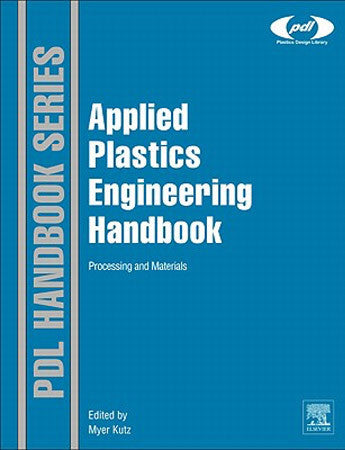
Applied Plastics Engin...
$265.00
{"id":11242218436,"title":"Applied Plastics Engineering Handbook - Processing and Materials","handle":"978-1-4377-3514-7","description":"\u003ch5\u003eDescription\u003c\/h5\u003e\nAuthor: Myer Kutz \u003cbr\u003eISBN 978-1-4377-3514-7 \u003cbr\u003e\u003cbr\u003e\n\u003cdiv\u003e574 pages, 1st. Edition\u003c\/div\u003e\n\u003cdiv\u003e\u003c\/div\u003e\n\u003ch5\u003eSummary\u003c\/h5\u003e\nThe expert contributors to this new handbook demystify new technologies and materials and present the fundamentals of plastics engineering for optimal engineering and business decisions.\u003cbr\u003e\u003cbr\u003e\u003cb\u003eKey Features\u003c\/b\u003e\u003cbr\u003e\n\u003cli\u003e• Practical introductions to both core topics and new developments make this work equally valuable for newly qualified plastics engineers seeking the practical rules-of-thumb they don’t teach you in school, and experienced practitioners evaluating new technologies or getting up to speed on a new field.\u003c\/li\u003e\n\u003cli\u003eThe depth and detail of the coverage of new developments enable engineers and managers to gain knowledge of, and evaluate, new technologies and materials in key growth areas such as biomaterials and nanotechnology.\u003c\/li\u003e\n\u003cli\u003eThis highly practical handbook is set apart from other references in the field, is written by engineers for an audience of engineers and providing a wealth of real-world examples, best practice guidance, and rules-of-thumb.\u003c\/li\u003e\n\u003cli\u003e\u003cb\u003eQuotes\u003c\/b\u003e\u003c\/li\u003e\n\u003cli\u003eAn authoritative source of practical advice for engineers, providing authoritative guidance from experts that will lead to cost savings and process improvements. Throughout the book, the focus is on the engineering aspects of producing and using plastics. The properties of plastics are explained along with techniques for testing, measuring, enhancing and analyzing them. Materials and additives are described as well as their characteristics and effects. The technologies and machinery used in processing operations are covered with reference to product design. And recent developments in a cross-section of applications demonstrate in a pragmatic way, the opportunities as well as the limitations of plastics.\"--Biospace.com\n\u003ch5\u003eTable of Contents\u003c\/h5\u003e\nPart I Plastics Engineering: Basic Fundamentals (7 chapters)\u003cbr\u003e\u003cbr\u003eIntroduction to Plastics Engineering (sections 1-4 and 6-8 of old Chapter 22, The Plastics Industry)\u003cbr\u003e\u003cbr\u003eElectrical Properties\u003cbr\u003e\u003cbr\u003eMechanical Properties\u003cbr\u003e\u003cbr\u003eTesting of Plastics\u003cbr\u003e\u003cbr\u003eTesting and Instrumental Analysis for the plastics processing industry: key technologies\u003cbr\u003e\u003cbr\u003ePlastics Processing (sections 5 of old Chapter 22, The Plastics Industry)\u003cbr\u003e\u003cbr\u003eAdditives for Plastics\u003cbr\u003e\u003cbr\u003ePart II Plastics Engineering: New Developments\u003cbr\u003e\u003cbr\u003ePlastics Materials (9 chapters)\u003cbr\u003e\u003cbr\u003eEngineering Thermoplastics\u003cbr\u003e\u003cbr\u003eThermoplastic Elastomers and Their Applications\u003cbr\u003e\u003cbr\u003eThermoset Elastomers\u003cbr\u003e\u003cbr\u003eFluoropolymers\u003cbr\u003e\u003cbr\u003eNanocomposites: preparation, structure, properties\u003cbr\u003e\u003cbr\u003ePolyolefins\u003cbr\u003e\u003cbr\u003ePolyvinyl Chloride (PVC)\u003cbr\u003e\u003cbr\u003eBiodegradable Plastics\u003cbr\u003e\u003cbr\u003ePolymeric Biomaterials\u003cbr\u003e\u003cbr\u003eAdditives (7 chapters)\u003cbr\u003e\u003cbr\u003eAdhesion Promotion\u003cbr\u003e\u003cbr\u003eCoatings and Colorant Processing Fundamentals (two chapters combined)\u003cbr\u003e\u003cbr\u003eDispersants and Coupling Agents\u003cbr\u003e\u003cbr\u003eFunctional Fillers for Plastics\u003cbr\u003e\u003cbr\u003eFlame Retardants\u003cbr\u003e\u003cbr\u003ePlasticizers\u003cbr\u003e\u003cbr\u003ePolymer Stabilization\u003cbr\u003e\u003cbr\u003eProcesses (11 chapters)\u003cbr\u003e\u003cbr\u003eBlow Molding\u003cbr\u003e\u003cbr\u003eChaotic advection and its application for forming structured plastic materials\u003cbr\u003e\u003cbr\u003eChemical Mechanical Polishing: Role of Polymeric Additives and Composite Materials\u003cbr\u003e\u003cbr\u003eCompression Molding\u003cbr\u003e\u003cbr\u003eExtrusion\u003cbr\u003e\u003cbr\u003eInjection Molding\u003cbr\u003e\u003cbr\u003eMicrocellular Processing\u003cbr\u003e\u003cbr\u003eRotational Molding\u003cbr\u003e\u003cbr\u003eThermoforming\u003cbr\u003e\u003cbr\u003eProcess Monitoring \u0026amp; Control\u003cbr\u003e\u003cbr\u003eRecycling of Plastics\u003cbr\u003e\u003cbr\u003eApplications (6 chapters)\u003cbr\u003e\u003cbr\u003eDesign of Plastic Parts\u003cbr\u003e\u003cbr\u003ePlastics in Building and Construction\u003cbr\u003e\u003cbr\u003eFiber Reinforced Polymer Composites Applications\u003cbr\u003e\u003cbr\u003ePlastic Piping Materials\u003cbr\u003e\u003cbr\u003ePolyethylene Terephthalate (PET) Bottles\u003cbr\u003e\u003cbr\u003eTissue Engineering Scaffolds Fabrication\n\u003ch5\u003eAbout Author\u003c\/h5\u003e\nEdited by Myer Kutz, Myer Kutz Associates. Inc., Delmar, NY, USA\u003c\/li\u003e","published_at":"2017-06-22T21:13:36-04:00","created_at":"2017-06-22T21:13:36-04:00","vendor":"Chemtec Publishing","type":"Book","tags":["2011","additives","applications","biomaterials","book","material","plastics","recycling","testing"],"price":26500,"price_min":26500,"price_max":26500,"available":true,"price_varies":false,"compare_at_price":null,"compare_at_price_min":0,"compare_at_price_max":0,"compare_at_price_varies":false,"variants":[{"id":43378362180,"title":"Default Title","option1":"Default Title","option2":null,"option3":null,"sku":"","requires_shipping":true,"taxable":true,"featured_image":null,"available":true,"name":"Applied Plastics Engineering Handbook - Processing and Materials","public_title":null,"options":["Default Title"],"price":26500,"weight":1000,"compare_at_price":null,"inventory_quantity":1,"inventory_management":null,"inventory_policy":"continue","barcode":"978-1-4377-3514-7","requires_selling_plan":false,"selling_plan_allocations":[],"quantity_rule":{"min":1,"max":null,"increment":1}}],"images":["\/\/chemtec.org\/cdn\/shop\/products\/978-1-4377-3514-7.jpg?v=1498190758"],"featured_image":"\/\/chemtec.org\/cdn\/shop\/products\/978-1-4377-3514-7.jpg?v=1498190758","options":["Title"],"media":[{"alt":null,"id":350156128349,"position":1,"preview_image":{"aspect_ratio":0.767,"height":450,"width":345,"src":"\/\/chemtec.org\/cdn\/shop\/products\/978-1-4377-3514-7.jpg?v=1498190758"},"aspect_ratio":0.767,"height":450,"media_type":"image","src":"\/\/chemtec.org\/cdn\/shop\/products\/978-1-4377-3514-7.jpg?v=1498190758","width":345}],"requires_selling_plan":false,"selling_plan_groups":[],"content":"\u003ch5\u003eDescription\u003c\/h5\u003e\nAuthor: Myer Kutz \u003cbr\u003eISBN 978-1-4377-3514-7 \u003cbr\u003e\u003cbr\u003e\n\u003cdiv\u003e574 pages, 1st. Edition\u003c\/div\u003e\n\u003cdiv\u003e\u003c\/div\u003e\n\u003ch5\u003eSummary\u003c\/h5\u003e\nThe expert contributors to this new handbook demystify new technologies and materials and present the fundamentals of plastics engineering for optimal engineering and business decisions.\u003cbr\u003e\u003cbr\u003e\u003cb\u003eKey Features\u003c\/b\u003e\u003cbr\u003e\n\u003cli\u003e• Practical introductions to both core topics and new developments make this work equally valuable for newly qualified plastics engineers seeking the practical rules-of-thumb they don’t teach you in school, and experienced practitioners evaluating new technologies or getting up to speed on a new field.\u003c\/li\u003e\n\u003cli\u003eThe depth and detail of the coverage of new developments enable engineers and managers to gain knowledge of, and evaluate, new technologies and materials in key growth areas such as biomaterials and nanotechnology.\u003c\/li\u003e\n\u003cli\u003eThis highly practical handbook is set apart from other references in the field, is written by engineers for an audience of engineers and providing a wealth of real-world examples, best practice guidance, and rules-of-thumb.\u003c\/li\u003e\n\u003cli\u003e\u003cb\u003eQuotes\u003c\/b\u003e\u003c\/li\u003e\n\u003cli\u003eAn authoritative source of practical advice for engineers, providing authoritative guidance from experts that will lead to cost savings and process improvements. Throughout the book, the focus is on the engineering aspects of producing and using plastics. The properties of plastics are explained along with techniques for testing, measuring, enhancing and analyzing them. Materials and additives are described as well as their characteristics and effects. The technologies and machinery used in processing operations are covered with reference to product design. And recent developments in a cross-section of applications demonstrate in a pragmatic way, the opportunities as well as the limitations of plastics.\"--Biospace.com\n\u003ch5\u003eTable of Contents\u003c\/h5\u003e\nPart I Plastics Engineering: Basic Fundamentals (7 chapters)\u003cbr\u003e\u003cbr\u003eIntroduction to Plastics Engineering (sections 1-4 and 6-8 of old Chapter 22, The Plastics Industry)\u003cbr\u003e\u003cbr\u003eElectrical Properties\u003cbr\u003e\u003cbr\u003eMechanical Properties\u003cbr\u003e\u003cbr\u003eTesting of Plastics\u003cbr\u003e\u003cbr\u003eTesting and Instrumental Analysis for the plastics processing industry: key technologies\u003cbr\u003e\u003cbr\u003ePlastics Processing (sections 5 of old Chapter 22, The Plastics Industry)\u003cbr\u003e\u003cbr\u003eAdditives for Plastics\u003cbr\u003e\u003cbr\u003ePart II Plastics Engineering: New Developments\u003cbr\u003e\u003cbr\u003ePlastics Materials (9 chapters)\u003cbr\u003e\u003cbr\u003eEngineering Thermoplastics\u003cbr\u003e\u003cbr\u003eThermoplastic Elastomers and Their Applications\u003cbr\u003e\u003cbr\u003eThermoset Elastomers\u003cbr\u003e\u003cbr\u003eFluoropolymers\u003cbr\u003e\u003cbr\u003eNanocomposites: preparation, structure, properties\u003cbr\u003e\u003cbr\u003ePolyolefins\u003cbr\u003e\u003cbr\u003ePolyvinyl Chloride (PVC)\u003cbr\u003e\u003cbr\u003eBiodegradable Plastics\u003cbr\u003e\u003cbr\u003ePolymeric Biomaterials\u003cbr\u003e\u003cbr\u003eAdditives (7 chapters)\u003cbr\u003e\u003cbr\u003eAdhesion Promotion\u003cbr\u003e\u003cbr\u003eCoatings and Colorant Processing Fundamentals (two chapters combined)\u003cbr\u003e\u003cbr\u003eDispersants and Coupling Agents\u003cbr\u003e\u003cbr\u003eFunctional Fillers for Plastics\u003cbr\u003e\u003cbr\u003eFlame Retardants\u003cbr\u003e\u003cbr\u003ePlasticizers\u003cbr\u003e\u003cbr\u003ePolymer Stabilization\u003cbr\u003e\u003cbr\u003eProcesses (11 chapters)\u003cbr\u003e\u003cbr\u003eBlow Molding\u003cbr\u003e\u003cbr\u003eChaotic advection and its application for forming structured plastic materials\u003cbr\u003e\u003cbr\u003eChemical Mechanical Polishing: Role of Polymeric Additives and Composite Materials\u003cbr\u003e\u003cbr\u003eCompression Molding\u003cbr\u003e\u003cbr\u003eExtrusion\u003cbr\u003e\u003cbr\u003eInjection Molding\u003cbr\u003e\u003cbr\u003eMicrocellular Processing\u003cbr\u003e\u003cbr\u003eRotational Molding\u003cbr\u003e\u003cbr\u003eThermoforming\u003cbr\u003e\u003cbr\u003eProcess Monitoring \u0026amp; Control\u003cbr\u003e\u003cbr\u003eRecycling of Plastics\u003cbr\u003e\u003cbr\u003eApplications (6 chapters)\u003cbr\u003e\u003cbr\u003eDesign of Plastic Parts\u003cbr\u003e\u003cbr\u003ePlastics in Building and Construction\u003cbr\u003e\u003cbr\u003eFiber Reinforced Polymer Composites Applications\u003cbr\u003e\u003cbr\u003ePlastic Piping Materials\u003cbr\u003e\u003cbr\u003ePolyethylene Terephthalate (PET) Bottles\u003cbr\u003e\u003cbr\u003eTissue Engineering Scaffolds Fabrication\n\u003ch5\u003eAbout Author\u003c\/h5\u003e\nEdited by Myer Kutz, Myer Kutz Associates. Inc., Delmar, NY, USA\u003c\/li\u003e"}
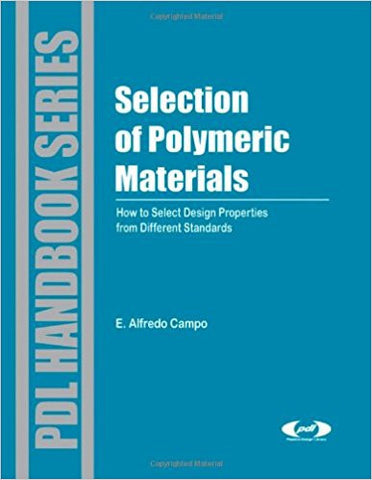
Selection of Polymeric...
$250.00
{"id":11242218244,"title":"Selection of Polymeric Materials","handle":"978-0-8155-1551-7","description":"\u003ch5\u003eDescription\u003c\/h5\u003e\nAuthor: Alfredo Campo \u003cbr\u003eISBN 978-0-8155-1551-7 \u003cbr\u003e\u003cbr\u003eHow to Select Design Properties from Different Standards\u003cbr\u003e\u003cbr\u003e\u003cmeta charset=\"utf-8\"\u003e\u003cspan\u003ePublished: 2008\u003cbr\u003e\u003c\/span\u003ePages 253 pp, Hardback, 159 Illustrations\u003cbr\u003e\n\u003ch5\u003eSummary\u003c\/h5\u003e\nToday engineers, designers, buyers and all those who have to work with plastics face a dilemma. There has been a proliferation of test methods by which plastic properties are measured. The property data measured by these test methods are not identical and sometimes have large differences. How are engineers, designers, buyers going to decide the type and resin grade and their property data? Which are the valid test methods? The right plastic property data are the difference between success and failure of a design, thus making the property selection process critical. For the first time, this book provides a simple and efficient approach to a highly complex and time-consuming task. There are over 26,000 different grades of polymers and millions of parts and applications, further adding to the difficulty of the selection process. \u003cbr\u003e\u003cbr\u003eSelection of Polymeric Materials steers engineers and designers onto the right path to selecting the appropriate values for each plastic property. A large amount of property information has been provided to teach and assist the plastic part designer and others in selecting the right resin and properties for an application. Various standards including ASTM, ISO, UL, and British Specifications have been discussed to help the readers in making sound decisions. \u003cbr\u003e\u003cbr\u003e• A simple and efficient approach to a highly complex and time-consuming task. \u003cbr\u003e• Allows engineers to select from various standards including ASTM, ISO, UL, and British Specification. \u003cbr\u003e• Presents information on properties such as tensile strength, melt temperature, continuous service temperature, moisture exposure, specific gravity and flammability ratings. \u003cbr\u003e• Tried and true values narrow myriad choices down quickly for readers.\u003cbr\u003e\u003cbr\u003e\n\u003ch5\u003eTable of Contents\u003c\/h5\u003e\n\u003cstrong\u003e1. Polymeric Materials and Properties\u003c\/strong\u003e\u003cbr\u003e1.1 Tensile Stress-Strain Comparison Graphs \u003cbr\u003e1.2 Property Data Information for Polymeric Materials \u003cbr\u003e1.3 Material Selection Guidelines \u003cbr\u003e1.4 Polymeric Materials Specifications \u003cbr\u003e1.5 Testing Polymeric Materials \u003cbr\u003e1.6 The Need for Uniform Global Testing Standards \u003cbr\u003e1.7 Polymeric Materials \u003cbr\u003e1.8 Polymeric Materials Background \u003cbr\u003e1.9 Polymeric Materials Families \u003cbr\u003e1.10 Classification of Polymeric Materials by Performance \u003cbr\u003e1.11 Types of Thermoplastic Molecular Structures \u003cbr\u003e1.12 Manufacturing of Polymers \u003cbr\u003e1.13 Polymeric Materials Compounding Process \u003cbr\u003e1.14 Basic Characteristics of Polymeric Materials \u003cbr\u003e1.15 Families of Thermoplastic Polymers \u003cbr\u003e1.16 Families of Thermoplastic Elastomers (TPE) \u003cbr\u003e1.17 Families of Thermoset Polymers \u003cbr\u003e\u003cbr\u003e\u003cstrong\u003e2. Mechanical Properties of Polymeric Materials\u003c\/strong\u003e\u003cbr\u003e2.1 Introduction \u003cbr\u003e2.2 Comparison Tables of Mechanical Properties \u003cbr\u003e2.3 Comparison Between ASTM and ISO Mechanical Test Standards \u003cbr\u003e2.4 Tensile Testing \u003cbr\u003e2.5 Tensile Strength Effects Caused by Cross-Head Speeds \u003cbr\u003e2.6 Molecular Orientation Effects \u003cbr\u003e2.7 Compounding Processes \u0026amp; Properties of Glass Reinforced Polymers \u003cbr\u003e2.8 Fiber Glass Effects on Polymeric Material Properties \u003cbr\u003e2.9 Tensile Stress Effects Caused by Fiber Glass Orientation \u003cbr\u003e2.10 Weld Line Effects on Injection Molded Products \u003cbr\u003e2.11 Temperature Effects on the Behavior of Polymeric Materials \u003cbr\u003e2.12 Effects to Nylon Properties Caused by Moisture \u003cbr\u003e2.13 Flexural Testing \u003cbr\u003e2.14 Compressive Strength Testing \u003cbr\u003e2.15 Shear Strength Testing \u003cbr\u003e2.16 Stress-Strain Curves, Load Type Comparison \u003cbr\u003e2.17 Creep, Rupture, Relaxation, and Fatigue \u003cbr\u003e2.18 Tensile Creep Testing \u003cbr\u003e2.19 Flexural Creep Testing \u003cbr\u003e2.20 Isochronous Stress-Strain Curves \u003cbr\u003e2.21 Procedure for Applying Creep Modulus \u003cbr\u003e2.22 Creep Rupture \u003cbr\u003e2.23 Stress Relaxation \u003cbr\u003e2.24 Fatigue Characteristics \u003cbr\u003e2.25 Impact Strength Testing \u003cbr\u003e2.26 Impact Fracture Mechanism \u003cbr\u003e2.27 Pendulum Impact Tests \u003cbr\u003e2.28 Gardner Drop Weight Impact Testing \u003cbr\u003e2.29 Falling Weight Tower Impact Testing \u003cbr\u003e2.30 Instrumented Impact Testing \u003cbr\u003e2.31 Instrumented High-Speed Horizontal Plunger Impact Tester \u003cbr\u003e2.32 Instrumented Impact Testing (Dynatup®) \u003cbr\u003e2.33 Product Design Analysis Using Dynatup® Test Data \u003cbr\u003e2.34 Miscellaneous Impact Testing \u003cbr\u003e\u003cbr\u003e\u003cstrong\u003e3. Thermal Properties of Polymeric Materials\u003c\/strong\u003e\u003cbr\u003e3.1 Introduction \u003cbr\u003e3.2 Thermal Properties for Elevated Temperatures \u003cbr\u003e3.3 Introduction to ISO Testing Standards \u003cbr\u003e3.4 Melting Temperature Testing \u003cbr\u003e3.5 Vicat Softening Temperature Testing \u003cbr\u003e3.6 Glass Transition Temperature Testing \u003cbr\u003e3.7 Brittleness Temperature Testing \u003cbr\u003e3.8 Continuous Service Temperature Testing \u003cbr\u003e3.9 UL Temperature Index \u003cbr\u003e3.10 Heat Deflection Temperature Testing \u003cbr\u003e3.11 Soldering Heat Resistance Performance \u003cbr\u003e3.12 Coefficient of Linear Thermal Expansion Testing \u003cbr\u003e3.13 Thermal Conductivity Testing \u003cbr\u003e3.14 Melt Flow Rate \u003cbr\u003e3.15 Melt Mass-flow Rate Testing \u003cbr\u003e3.16 Capillary Rheometer Relative Melt Viscosity Testing \u003cbr\u003e3.17 Relative Melt Viscosity vs. Shear Rate Graph \u003cbr\u003e3.18 Flammability Characteristics of Polymeric Materials \u003cbr\u003e3.19 UL 94 Flammability Testing \u003cbr\u003e3.20 UL Horizontal Burn Testing \u003cbr\u003e3.21 UL Vertical Burn Testing, UL 94-V0, UL 94-V1, UL 94-V2 \u003cbr\u003e3.22 UL Vertical Burn Testing, UL 94-5V, UL 94-5VA, UL 94-5VB \u003cbr\u003e3.23 Limited Oxygen Index Testing \u003cbr\u003e3.24 Smoke Generation Testing \u003cbr\u003e3.25 Self and Flash Ignition Temperature Testing \u003cbr\u003e\u003cstrong\u003e\u003cbr\u003e4. Electrical Properties of Polymeric Materials\u003c\/strong\u003e\u003cbr\u003e4.1 Introduction \u003cbr\u003e4.2 Thermoplastic Polymers Characteristics for Electrical Applications \u003cbr\u003e4.3 Thermoset Polymers Characteristics for Electrical Applications \u003cbr\u003e4.4 ASTM\/UL Electrical Properties of Polymeric Materials \u003cbr\u003e4.5 Introduction to ISO\/IEC Electrical Test Methods \u003cbr\u003e4.6 Electrical Terminology \u003cbr\u003e4.7 Electrical Insulation Properties \u003cbr\u003e4.8 Electrical Resistance Properties \u003cbr\u003e4.9 Dielectric Constant Testing \u003cbr\u003e4.10 Dissipation Factor Testing \u003cbr\u003e4.11 Volume Resistivity Testing \u003cbr\u003e4.13 Dielectric Strength Testing \u003cbr\u003e4.14 Hot-Wire Ignition Testing \u003cbr\u003e4.15 High-Amperage Arc Ignition Testing \u003cbr\u003e4.16 High-Voltage Arc Tracking Rate \u003cbr\u003e4.17 Arc Resistance Testing \u003cbr\u003e4.18 Comparative Track Index Testing \u003cbr\u003e4.19 Glow Wire Testing \u003cbr\u003e4.20 Hot Mandrel Testing \u003cbr\u003e4.21 Underwriter’s Laboratories Yellow Cards \u003cbr\u003e4.22 How to Read and Interpret the \"UL Yellow Card\" \u003cbr\u003e4.23 \"UL Electrical Insulation Systems\" \u003cbr\u003e\u003cbr\u003e\u003cstrong\u003e5. Physical Properties of Polymeric Materials\u003c\/strong\u003e\u003cbr\u003e5.1 Introduction \u003cbr\u003e5.2 ASTM Physical Properties of Polymeric Materials \u003cbr\u003e5.3 ASTM and ISO Comparison of Physical Testing Standards \u003cbr\u003e5.4 Specific Gravity Testing \u003cbr\u003e5.5 Density Gradient Testing \u003cbr\u003e5.6 Optical Testing Properties \u003cbr\u003e5.7 Water Absorption Testing \u003cbr\u003e5.8 Surface Hardness Testing \u003cbr\u003e5.9 Abrasion Resistance Testing \u003cbr\u003e5.10 Tear Resistance \u003cbr\u003e5.11 Coefficient of Friction Testing \u003cbr\u003e5.12 Mold Shrinkage Testing \u003cbr\u003e\u003cbr\u003e\u003cstrong\u003e6. Microbial, Weather, Chemical Resistance of Polymeric Materials\u003c\/strong\u003e\u003cbr\u003e6.1 Introduction \u003cbr\u003e6.2 Fungal Resistance Testing \u003cbr\u003e6.3 Bacteria Resistance Testing \u003cbr\u003e6.4 Fungi and Bacteria Outdoor Exposure Resistance Limitations \u003cbr\u003e6.5 Weathering Tests for Polymeric Materials \u003cbr\u003e6.6 Accelerated Weathering Testing \u003cbr\u003e6.7 Exposure to Fluorescent UV Lamp, Condensation \u003cbr\u003e6.8 Accelerated Weather Testing, Weather Ometer® \u003cbr\u003e6.9 Exposure to Carbon Arc Light % Water Testing \u003cbr\u003e6.10 Exposure to Xenon Arc Light and Water Testing \u003cbr\u003e6.11 Outdoor Weathering Testing \u003cbr\u003e6.12 Chemical Resistance Testing of Polymeric Materials \u003cbr\u003e6.13 Chemical Resistance Tables of Delrin Homopolymer Acetal \u003cbr\u003eAppendices \u003cbr\u003eAcronyms for Polymeric Materials \u003cbr\u003eCommon Acronyms \u003cbr\u003eProcess Acronyms \u003cbr\u003eReinforcements and Fillers Acronyms \u003cbr\u003eNomenclature \u003cbr\u003eEnglish and Metric Units Conversion Guide\u003cbr\u003e\n\u003ch5\u003eAbout Author\u003c\/h5\u003e\nDuPont (retired), Delaware, U.S.A.\u003cbr\u003eE. Alfredo Campo is a retired DuPont senior engineer with extensive experience and in-depth technical knowledge of polymer technology. He is a widely published author of books, articles, and papers. His latest book is The Complete Part Design Handbook for Injection Molding of Thermoplastics.\u003cbr\u003e\u003cbr\u003e","published_at":"2017-06-22T21:13:35-04:00","created_at":"2017-06-22T21:13:35-04:00","vendor":"Chemtec Publishing","type":"Book","tags":["2008","application","ASTM","bacteria resistance","book","chemical resistance","creep","elastomer","fatigue","fracture","impact","ISO","material","mechanical test","polymeric materials","property","shear","specification","standards","tensile test","testing","thermal","thermoplastic","weathering"],"price":25000,"price_min":25000,"price_max":25000,"available":true,"price_varies":false,"compare_at_price":null,"compare_at_price_min":0,"compare_at_price_max":0,"compare_at_price_varies":false,"variants":[{"id":43378361924,"title":"Default Title","option1":"Default Title","option2":null,"option3":null,"sku":"","requires_shipping":true,"taxable":true,"featured_image":null,"available":true,"name":"Selection of Polymeric Materials","public_title":null,"options":["Default Title"],"price":25000,"weight":1000,"compare_at_price":null,"inventory_quantity":1,"inventory_management":null,"inventory_policy":"continue","barcode":"978-0-8155-1551-7","requires_selling_plan":false,"selling_plan_allocations":[],"quantity_rule":{"min":1,"max":null,"increment":1}}],"images":["\/\/chemtec.org\/cdn\/shop\/products\/978-0-8155-1551-7.jpg?v=1499646387"],"featured_image":"\/\/chemtec.org\/cdn\/shop\/products\/978-0-8155-1551-7.jpg?v=1499646387","options":["Title"],"media":[{"alt":null,"id":358743474269,"position":1,"preview_image":{"aspect_ratio":0.776,"height":499,"width":387,"src":"\/\/chemtec.org\/cdn\/shop\/products\/978-0-8155-1551-7.jpg?v=1499646387"},"aspect_ratio":0.776,"height":499,"media_type":"image","src":"\/\/chemtec.org\/cdn\/shop\/products\/978-0-8155-1551-7.jpg?v=1499646387","width":387}],"requires_selling_plan":false,"selling_plan_groups":[],"content":"\u003ch5\u003eDescription\u003c\/h5\u003e\nAuthor: Alfredo Campo \u003cbr\u003eISBN 978-0-8155-1551-7 \u003cbr\u003e\u003cbr\u003eHow to Select Design Properties from Different Standards\u003cbr\u003e\u003cbr\u003e\u003cmeta charset=\"utf-8\"\u003e\u003cspan\u003ePublished: 2008\u003cbr\u003e\u003c\/span\u003ePages 253 pp, Hardback, 159 Illustrations\u003cbr\u003e\n\u003ch5\u003eSummary\u003c\/h5\u003e\nToday engineers, designers, buyers and all those who have to work with plastics face a dilemma. There has been a proliferation of test methods by which plastic properties are measured. The property data measured by these test methods are not identical and sometimes have large differences. How are engineers, designers, buyers going to decide the type and resin grade and their property data? Which are the valid test methods? The right plastic property data are the difference between success and failure of a design, thus making the property selection process critical. For the first time, this book provides a simple and efficient approach to a highly complex and time-consuming task. There are over 26,000 different grades of polymers and millions of parts and applications, further adding to the difficulty of the selection process. \u003cbr\u003e\u003cbr\u003eSelection of Polymeric Materials steers engineers and designers onto the right path to selecting the appropriate values for each plastic property. A large amount of property information has been provided to teach and assist the plastic part designer and others in selecting the right resin and properties for an application. Various standards including ASTM, ISO, UL, and British Specifications have been discussed to help the readers in making sound decisions. \u003cbr\u003e\u003cbr\u003e• A simple and efficient approach to a highly complex and time-consuming task. \u003cbr\u003e• Allows engineers to select from various standards including ASTM, ISO, UL, and British Specification. \u003cbr\u003e• Presents information on properties such as tensile strength, melt temperature, continuous service temperature, moisture exposure, specific gravity and flammability ratings. \u003cbr\u003e• Tried and true values narrow myriad choices down quickly for readers.\u003cbr\u003e\u003cbr\u003e\n\u003ch5\u003eTable of Contents\u003c\/h5\u003e\n\u003cstrong\u003e1. Polymeric Materials and Properties\u003c\/strong\u003e\u003cbr\u003e1.1 Tensile Stress-Strain Comparison Graphs \u003cbr\u003e1.2 Property Data Information for Polymeric Materials \u003cbr\u003e1.3 Material Selection Guidelines \u003cbr\u003e1.4 Polymeric Materials Specifications \u003cbr\u003e1.5 Testing Polymeric Materials \u003cbr\u003e1.6 The Need for Uniform Global Testing Standards \u003cbr\u003e1.7 Polymeric Materials \u003cbr\u003e1.8 Polymeric Materials Background \u003cbr\u003e1.9 Polymeric Materials Families \u003cbr\u003e1.10 Classification of Polymeric Materials by Performance \u003cbr\u003e1.11 Types of Thermoplastic Molecular Structures \u003cbr\u003e1.12 Manufacturing of Polymers \u003cbr\u003e1.13 Polymeric Materials Compounding Process \u003cbr\u003e1.14 Basic Characteristics of Polymeric Materials \u003cbr\u003e1.15 Families of Thermoplastic Polymers \u003cbr\u003e1.16 Families of Thermoplastic Elastomers (TPE) \u003cbr\u003e1.17 Families of Thermoset Polymers \u003cbr\u003e\u003cbr\u003e\u003cstrong\u003e2. Mechanical Properties of Polymeric Materials\u003c\/strong\u003e\u003cbr\u003e2.1 Introduction \u003cbr\u003e2.2 Comparison Tables of Mechanical Properties \u003cbr\u003e2.3 Comparison Between ASTM and ISO Mechanical Test Standards \u003cbr\u003e2.4 Tensile Testing \u003cbr\u003e2.5 Tensile Strength Effects Caused by Cross-Head Speeds \u003cbr\u003e2.6 Molecular Orientation Effects \u003cbr\u003e2.7 Compounding Processes \u0026amp; Properties of Glass Reinforced Polymers \u003cbr\u003e2.8 Fiber Glass Effects on Polymeric Material Properties \u003cbr\u003e2.9 Tensile Stress Effects Caused by Fiber Glass Orientation \u003cbr\u003e2.10 Weld Line Effects on Injection Molded Products \u003cbr\u003e2.11 Temperature Effects on the Behavior of Polymeric Materials \u003cbr\u003e2.12 Effects to Nylon Properties Caused by Moisture \u003cbr\u003e2.13 Flexural Testing \u003cbr\u003e2.14 Compressive Strength Testing \u003cbr\u003e2.15 Shear Strength Testing \u003cbr\u003e2.16 Stress-Strain Curves, Load Type Comparison \u003cbr\u003e2.17 Creep, Rupture, Relaxation, and Fatigue \u003cbr\u003e2.18 Tensile Creep Testing \u003cbr\u003e2.19 Flexural Creep Testing \u003cbr\u003e2.20 Isochronous Stress-Strain Curves \u003cbr\u003e2.21 Procedure for Applying Creep Modulus \u003cbr\u003e2.22 Creep Rupture \u003cbr\u003e2.23 Stress Relaxation \u003cbr\u003e2.24 Fatigue Characteristics \u003cbr\u003e2.25 Impact Strength Testing \u003cbr\u003e2.26 Impact Fracture Mechanism \u003cbr\u003e2.27 Pendulum Impact Tests \u003cbr\u003e2.28 Gardner Drop Weight Impact Testing \u003cbr\u003e2.29 Falling Weight Tower Impact Testing \u003cbr\u003e2.30 Instrumented Impact Testing \u003cbr\u003e2.31 Instrumented High-Speed Horizontal Plunger Impact Tester \u003cbr\u003e2.32 Instrumented Impact Testing (Dynatup®) \u003cbr\u003e2.33 Product Design Analysis Using Dynatup® Test Data \u003cbr\u003e2.34 Miscellaneous Impact Testing \u003cbr\u003e\u003cbr\u003e\u003cstrong\u003e3. Thermal Properties of Polymeric Materials\u003c\/strong\u003e\u003cbr\u003e3.1 Introduction \u003cbr\u003e3.2 Thermal Properties for Elevated Temperatures \u003cbr\u003e3.3 Introduction to ISO Testing Standards \u003cbr\u003e3.4 Melting Temperature Testing \u003cbr\u003e3.5 Vicat Softening Temperature Testing \u003cbr\u003e3.6 Glass Transition Temperature Testing \u003cbr\u003e3.7 Brittleness Temperature Testing \u003cbr\u003e3.8 Continuous Service Temperature Testing \u003cbr\u003e3.9 UL Temperature Index \u003cbr\u003e3.10 Heat Deflection Temperature Testing \u003cbr\u003e3.11 Soldering Heat Resistance Performance \u003cbr\u003e3.12 Coefficient of Linear Thermal Expansion Testing \u003cbr\u003e3.13 Thermal Conductivity Testing \u003cbr\u003e3.14 Melt Flow Rate \u003cbr\u003e3.15 Melt Mass-flow Rate Testing \u003cbr\u003e3.16 Capillary Rheometer Relative Melt Viscosity Testing \u003cbr\u003e3.17 Relative Melt Viscosity vs. Shear Rate Graph \u003cbr\u003e3.18 Flammability Characteristics of Polymeric Materials \u003cbr\u003e3.19 UL 94 Flammability Testing \u003cbr\u003e3.20 UL Horizontal Burn Testing \u003cbr\u003e3.21 UL Vertical Burn Testing, UL 94-V0, UL 94-V1, UL 94-V2 \u003cbr\u003e3.22 UL Vertical Burn Testing, UL 94-5V, UL 94-5VA, UL 94-5VB \u003cbr\u003e3.23 Limited Oxygen Index Testing \u003cbr\u003e3.24 Smoke Generation Testing \u003cbr\u003e3.25 Self and Flash Ignition Temperature Testing \u003cbr\u003e\u003cstrong\u003e\u003cbr\u003e4. Electrical Properties of Polymeric Materials\u003c\/strong\u003e\u003cbr\u003e4.1 Introduction \u003cbr\u003e4.2 Thermoplastic Polymers Characteristics for Electrical Applications \u003cbr\u003e4.3 Thermoset Polymers Characteristics for Electrical Applications \u003cbr\u003e4.4 ASTM\/UL Electrical Properties of Polymeric Materials \u003cbr\u003e4.5 Introduction to ISO\/IEC Electrical Test Methods \u003cbr\u003e4.6 Electrical Terminology \u003cbr\u003e4.7 Electrical Insulation Properties \u003cbr\u003e4.8 Electrical Resistance Properties \u003cbr\u003e4.9 Dielectric Constant Testing \u003cbr\u003e4.10 Dissipation Factor Testing \u003cbr\u003e4.11 Volume Resistivity Testing \u003cbr\u003e4.13 Dielectric Strength Testing \u003cbr\u003e4.14 Hot-Wire Ignition Testing \u003cbr\u003e4.15 High-Amperage Arc Ignition Testing \u003cbr\u003e4.16 High-Voltage Arc Tracking Rate \u003cbr\u003e4.17 Arc Resistance Testing \u003cbr\u003e4.18 Comparative Track Index Testing \u003cbr\u003e4.19 Glow Wire Testing \u003cbr\u003e4.20 Hot Mandrel Testing \u003cbr\u003e4.21 Underwriter’s Laboratories Yellow Cards \u003cbr\u003e4.22 How to Read and Interpret the \"UL Yellow Card\" \u003cbr\u003e4.23 \"UL Electrical Insulation Systems\" \u003cbr\u003e\u003cbr\u003e\u003cstrong\u003e5. Physical Properties of Polymeric Materials\u003c\/strong\u003e\u003cbr\u003e5.1 Introduction \u003cbr\u003e5.2 ASTM Physical Properties of Polymeric Materials \u003cbr\u003e5.3 ASTM and ISO Comparison of Physical Testing Standards \u003cbr\u003e5.4 Specific Gravity Testing \u003cbr\u003e5.5 Density Gradient Testing \u003cbr\u003e5.6 Optical Testing Properties \u003cbr\u003e5.7 Water Absorption Testing \u003cbr\u003e5.8 Surface Hardness Testing \u003cbr\u003e5.9 Abrasion Resistance Testing \u003cbr\u003e5.10 Tear Resistance \u003cbr\u003e5.11 Coefficient of Friction Testing \u003cbr\u003e5.12 Mold Shrinkage Testing \u003cbr\u003e\u003cbr\u003e\u003cstrong\u003e6. Microbial, Weather, Chemical Resistance of Polymeric Materials\u003c\/strong\u003e\u003cbr\u003e6.1 Introduction \u003cbr\u003e6.2 Fungal Resistance Testing \u003cbr\u003e6.3 Bacteria Resistance Testing \u003cbr\u003e6.4 Fungi and Bacteria Outdoor Exposure Resistance Limitations \u003cbr\u003e6.5 Weathering Tests for Polymeric Materials \u003cbr\u003e6.6 Accelerated Weathering Testing \u003cbr\u003e6.7 Exposure to Fluorescent UV Lamp, Condensation \u003cbr\u003e6.8 Accelerated Weather Testing, Weather Ometer® \u003cbr\u003e6.9 Exposure to Carbon Arc Light % Water Testing \u003cbr\u003e6.10 Exposure to Xenon Arc Light and Water Testing \u003cbr\u003e6.11 Outdoor Weathering Testing \u003cbr\u003e6.12 Chemical Resistance Testing of Polymeric Materials \u003cbr\u003e6.13 Chemical Resistance Tables of Delrin Homopolymer Acetal \u003cbr\u003eAppendices \u003cbr\u003eAcronyms for Polymeric Materials \u003cbr\u003eCommon Acronyms \u003cbr\u003eProcess Acronyms \u003cbr\u003eReinforcements and Fillers Acronyms \u003cbr\u003eNomenclature \u003cbr\u003eEnglish and Metric Units Conversion Guide\u003cbr\u003e\n\u003ch5\u003eAbout Author\u003c\/h5\u003e\nDuPont (retired), Delaware, U.S.A.\u003cbr\u003eE. Alfredo Campo is a retired DuPont senior engineer with extensive experience and in-depth technical knowledge of polymer technology. He is a widely published author of books, articles, and papers. His latest book is The Complete Part Design Handbook for Injection Molding of Thermoplastics.\u003cbr\u003e\u003cbr\u003e"}
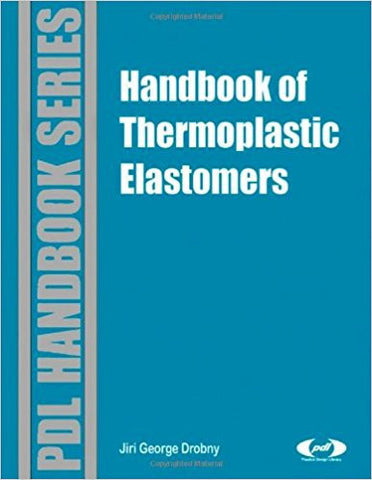
Handbook of Thermoplas...
$240.00
{"id":11242218116,"title":"Handbook of Thermoplastic Elastomers","handle":"978-08155-1549-4","description":"\u003ch5\u003eDescription\u003c\/h5\u003e\nAuthor: Jiri George Drobny \u003cbr\u003eISBN 978-08155-1549-4 \u003cbr\u003e\u003cbr\u003ePages: 736 pp, Hardback, 315 Illustrations\n\u003ch5\u003eSummary\u003c\/h5\u003e\nThermoplastic elastomers are one of the most in-demand groups of materials today. Their most attractive feature is that they can be processed like plastics, yet they exhibit properties that are close to vulcanized rubber. Consequently, they can be produced in a highly cost-effective way, using short production cycles, with a considerably reduced energy consumption, and minimum production scrap. Moreover, because they are thermoplastics, production scrap as well as post-consumer scrap can be easily recycled.\u003cbr\u003e\u003cbr\u003eThis unique practical reference work compiles in one place the current working knowledge of chemistry, processing, physical and mechanical properties, as well as applications of thermoplastic elastomers. Because of the great number of thermoplastic elastomers and the variety of chemistries involved, the work is divided into chapters describing individual commercial groups. A significant part of this book is dedicated to processing methods, applications, and material data sheets. Chapters on processing methods and applications are enhanced with ample illustrations. Each chapter includes a comprehensive list of references for a more in-depth study. Other features are a list of current suppliers, ISO nomenclature, an extensive bibliography, a list of recent patents and a glossary of terms. The work is concluded by a chapter on newest developments and trends.\u003cbr\u003e\u003cbr\u003e\n\u003ch5\u003eTable of Contents\u003c\/h5\u003e\n\u003cbr\u003e\u003cstrong\u003e1 Introduction\u003c\/strong\u003e\u003cbr\u003e1.1 Elasticity and Elastomers \u003cbr\u003e1.2 Thermoplastic Elastomers \u003cbr\u003e\u003cstrong\u003e2 Brief History of Thermoplastic Elastomers\u003c\/strong\u003e\u003cbr\u003e\u003cbr\u003e\u003cstrong\u003e3 Additives\u003c\/strong\u003e\u003cbr\u003e3.1 Antioxidants \u003cbr\u003e3.2 Light Stabilizers \u003cbr\u003e3.3 Nucleating Agents \u003cbr\u003e3.4 Flame Retardants \u003cbr\u003e3.5 Colorants \u003cbr\u003e3.6 Antistatic Agents \u003cbr\u003e3.7 Slip Agents \u003cbr\u003e3.8 Antiblocking Agents \u003cbr\u003e3.9 Processing Aids \u003cbr\u003e3.10 Fillers and Reinforcements \u003cbr\u003e3.11 Plasticizers \u003cbr\u003e3.12 Other Additives \u003cbr\u003e3.13 Selection of Additives \u003cbr\u003e3.14 Health, Hygiene, and Safety \u003cbr\u003e\u003cstrong\u003e\u003cbr\u003e4 Processing Methods Applicable to Thermoplastic Elastomers\u003c\/strong\u003e\u003cbr\u003e4.1 Introduction \u003cbr\u003e4.2 Mixing and Blending \u003cbr\u003e4.3 Extrusion \u003cbr\u003e4.4 Injection Molding \u003cbr\u003e4.5 Compression Molding \u003cbr\u003e4.6 Transfer Molding \u003cbr\u003e4.7 Blow Molding \u003cbr\u003e4.8 Rotational Molding \u003cbr\u003e4.9 Foaming of Thermoplastics \u003cbr\u003e4.10 Thermoforming \u003cbr\u003e4.11 Calendering \u003cbr\u003e4.12 Secondary Manufacturing Processes \u003cbr\u003e4.13 General Processing Technology of TPEs \u003cbr\u003e4.14 Process Simulation \u003cbr\u003e4.15 Product Development and Testing \u003cbr\u003e\u003cbr\u003e\u003cstrong\u003e5 Styrenic Block Copolymers\u003c\/strong\u003e\u003cbr\u003e5.1 Introduction \u003cbr\u003e5.2 Polystyrene– Polydiene Block Copolymers \u003cbr\u003e5.3 SBCs Synthesized by Carbocationic Polymerization \u003cbr\u003e\u003cbr\u003e\u003cstrong\u003e6 Thermoplastic Elastomers Prepared by Dynamic Vulcanization\u003c\/strong\u003e\u003cbr\u003e6.1 Introduction \u003cbr\u003e6.2 The Dynamic Vulcanization Process \u003cbr\u003e6.3 Properties of Blends Prepared by Dynamic Vulcanization \u003cbr\u003e6.4 Processing and Fabrication of TPVs \u003cbr\u003e\u003cstrong\u003e\u003cbr\u003e7 Polyolefin-Based Thermoplastic Elastomers\u003c\/strong\u003e\u003cbr\u003e7.1 Introduction \u003cbr\u003e7.2 Thermoplastic Polyolefin Blends \u003cbr\u003e7.3 Morphology \u003cbr\u003e7.4 Properties of TPOs \u003cbr\u003e7.5 Processing of TPOs \u003cbr\u003e7.6 Painting of TPOs\u003cbr\u003e\u003cbr\u003e\u003cstrong\u003e8 Thermoplastic Elastomers Based on Halogen-Containing Polyolefins\u003c\/strong\u003e\u003cbr\u003e8.1 Introduction \u003cbr\u003e8.2 Blends of PVC with Nitrile Rubber (NBR) \u003cbr\u003e8.3 Blends of PVC with Other Elastomers \u003cbr\u003e8.4 Melt-Processable Rubber \u003cbr\u003e8.5 Thermoplastic Fluorocarbon Elastomer \u003cbr\u003e\u003cbr\u003e\u003cstrong\u003e9 Thermoplastic Polyurethane Elastomers\u003c\/strong\u003e\u003cbr\u003e9.1 Introduction \u003cbr\u003e9.2 Synthesis of TPUs \u003cbr\u003e9.3 Morphology \u003cbr\u003e9.4 Thermal Transitions \u003cbr\u003e9.5 Properties \u003cbr\u003e9.6 Processing of TPUs \u003cbr\u003e9.7 Blends of TPU with Other Polymers \u003cbr\u003e9.8 Bonding and Welding \u003cbr\u003e\u003cbr\u003e\u003cstrong\u003e10 Thermoplastic Elastomers Based on Polyamides\u003c\/strong\u003e\u003cbr\u003e10.1 Introduction \u003cbr\u003e10.2 Synthesis \u003cbr\u003e10.3 Morphology \u003cbr\u003e10.4 Structure– Property Relationships \u003cbr\u003e10.5 Physical and Mechanical Properties \u003cbr\u003e10.6 Chemical and Solvent Resistance \u003cbr\u003e10.7 Electrical Properties \u003cbr\u003e10.8 Other Properties \u003cbr\u003e10.9 Compounding \u003cbr\u003e10.10 Processing \u003cbr\u003e10.11 Bonding and Welding \u003cbr\u003e\u003cbr\u003e\u003cstrong\u003e11 Thermoplastic Polyether Ester Elastomers\u003c\/strong\u003e\u003cbr\u003e11.1 Introduction \u003cbr\u003e11.2 Synthesis \u003cbr\u003e11.3 Morphology \u003cbr\u003e11.4 Properties of Commercial COPEs \u003cbr\u003e11.5 COPE Blends \u003cbr\u003e11.6 Processing \u003cbr\u003e\u003cbr\u003e\u003cstrong\u003e12 Ionomeric Thermoplastic Elastomers\u003c\/strong\u003e\u003cbr\u003e12.1 Introduction \u003cbr\u003e12.2 Synthesis \u003cbr\u003e12.3 Morphology \u003cbr\u003e12.4 Properties and Processing \u003cbr\u003e\u003cbr\u003e\u003cstrong\u003e13 Other Thermoplastic Elastomers\u003c\/strong\u003e\u003cbr\u003e13.1 Elastomeric Star Block Copolymers \u003cbr\u003e13.2 TPEs Based on Interpenetrating Networks \u003cbr\u003e13.3 TPE Based on Polyacrylates \u003cbr\u003e\u003cbr\u003e\u003cstrong\u003e14 Thermoplastic Elastomers Based on Recycled Rubber and Plastics\u003c\/strong\u003e\u003cbr\u003e14.1 Introduction \u003cbr\u003e14.2 EPDM Scrap \u003cbr\u003e14.3 Butadiene-acrylonitrile Rubber (NBR) Scrap \u003cbr\u003e14.4 Recycled Rubber \u003cbr\u003e14.5 Waste Latex \u003cbr\u003e14.6 Waste Plastics \u003cbr\u003e\u003cbr\u003e\u003cstrong\u003e15 Applications of Thermoplastic Elastomers\u003c\/strong\u003e\u003cbr\u003e15.1 Introduction \u003cbr\u003e15.2 Applications for Styrenic TPEs \u003cbr\u003e15.3 Applications of Thermoplastic Vulcanizates (TPVs) and ETPVs \u003cbr\u003e15.4 Applications of Thermoplastic Polyolefin Elastomers (TPOs) \u003cbr\u003e15.5 Applications of Melt-Processable Rubber (MPR) \u003cbr\u003e15.6 Applications of PVC Blends \u003cbr\u003e15.7 Application of TPUs \u003cbr\u003e15.8 Application of Thermoplastic Polyether Ester Elastomers \u003cbr\u003e15.9 Applications of Polyamide TPEs \u003cbr\u003e15.10 Applications of Ionomeric TPEs \u003cbr\u003e15.11 Applications of Other TPEs \u003cbr\u003e\u003cbr\u003e\u003cstrong\u003e16 Recycling of Thermoplastic Elastomers\u003c\/strong\u003e\u003cbr\u003e16.1 Introduction \u003cbr\u003e16.2 Recycling Methods for Thermoplastic Elastomers (TPEs) \u003cbr\u003e\u003cbr\u003e\u003cstrong\u003e17 Recent Developments and Trends\u003c\/strong\u003e\u003cbr\u003e17.1 Current State \u003cbr\u003e17.2 Drivers for the Growth of TPEs \u003cbr\u003e17.3 Trends in Technical Development \u003cbr\u003e17.4 Other New Developments \u003cbr\u003eAppendix 1: Books, Conferences, Major Review Articles \u003cbr\u003eAppendix 2: Major Suppliers of Thermoplastic Elastomers and Compounds \u003cbr\u003eAppendix 3: ISO Nomenclature for Thermoplastic Elastomers \u003cbr\u003eAppendix 4: Processing Data Sheets for Commercial Thermoplastic Elastomers and Compounds \u003cbr\u003eAppendix 5: Technical Data Sheets for Commercial Thermoplastic Elastomers and Compounds \u003cbr\u003eAppendix 6: Recent TPE Patents \u003cbr\u003eGlossary \u003cbr\u003eIndex\n\u003ch5\u003eAbout Author\u003c\/h5\u003e\nDrobny Polymer Associates, Inc.\u003cbr\u003eJiri George Drobny is a world renowned authority in the field of thermoplastic elastomers. His career spans over 40 years in the rubber and plastic processing industries in worldwide. He has been sought after for his multifaceted contributions to the field as an educator, lecturer, prolific author, and esteemed consultant.\u003cbr\u003e\u003cbr\u003e","published_at":"2017-06-22T21:13:35-04:00","created_at":"2017-06-22T21:13:35-04:00","vendor":"Chemtec Publishing","type":"Book","tags":["2007","additives","antiblocking","antioxidante","antistatics","book","calendering","compression","elasticity","elastomers","fillers","mixing extrusion","molding","moulding","NBR","p-chemistry","plasticizers","polymer","polyolefines blends","PVC blends","recycling","stabilizers","thermoplastics","TPE","TPU"],"price":24000,"price_min":24000,"price_max":24000,"available":true,"price_varies":false,"compare_at_price":null,"compare_at_price_min":0,"compare_at_price_max":0,"compare_at_price_varies":false,"variants":[{"id":43378361668,"title":"Default Title","option1":"Default Title","option2":null,"option3":null,"sku":"","requires_shipping":true,"taxable":true,"featured_image":null,"available":true,"name":"Handbook of Thermoplastic Elastomers","public_title":null,"options":["Default Title"],"price":24000,"weight":1000,"compare_at_price":null,"inventory_quantity":1,"inventory_management":null,"inventory_policy":"continue","barcode":"978-08155-1549-4","requires_selling_plan":false,"selling_plan_allocations":[],"quantity_rule":{"min":1,"max":null,"increment":1}}],"images":["\/\/chemtec.org\/cdn\/shop\/products\/978-08155-1549-4.jpg?v=1499472490"],"featured_image":"\/\/chemtec.org\/cdn\/shop\/products\/978-08155-1549-4.jpg?v=1499472490","options":["Title"],"media":[{"alt":null,"id":356343119965,"position":1,"preview_image":{"aspect_ratio":0.776,"height":499,"width":387,"src":"\/\/chemtec.org\/cdn\/shop\/products\/978-08155-1549-4.jpg?v=1499472490"},"aspect_ratio":0.776,"height":499,"media_type":"image","src":"\/\/chemtec.org\/cdn\/shop\/products\/978-08155-1549-4.jpg?v=1499472490","width":387}],"requires_selling_plan":false,"selling_plan_groups":[],"content":"\u003ch5\u003eDescription\u003c\/h5\u003e\nAuthor: Jiri George Drobny \u003cbr\u003eISBN 978-08155-1549-4 \u003cbr\u003e\u003cbr\u003ePages: 736 pp, Hardback, 315 Illustrations\n\u003ch5\u003eSummary\u003c\/h5\u003e\nThermoplastic elastomers are one of the most in-demand groups of materials today. Their most attractive feature is that they can be processed like plastics, yet they exhibit properties that are close to vulcanized rubber. Consequently, they can be produced in a highly cost-effective way, using short production cycles, with a considerably reduced energy consumption, and minimum production scrap. Moreover, because they are thermoplastics, production scrap as well as post-consumer scrap can be easily recycled.\u003cbr\u003e\u003cbr\u003eThis unique practical reference work compiles in one place the current working knowledge of chemistry, processing, physical and mechanical properties, as well as applications of thermoplastic elastomers. Because of the great number of thermoplastic elastomers and the variety of chemistries involved, the work is divided into chapters describing individual commercial groups. A significant part of this book is dedicated to processing methods, applications, and material data sheets. Chapters on processing methods and applications are enhanced with ample illustrations. Each chapter includes a comprehensive list of references for a more in-depth study. Other features are a list of current suppliers, ISO nomenclature, an extensive bibliography, a list of recent patents and a glossary of terms. The work is concluded by a chapter on newest developments and trends.\u003cbr\u003e\u003cbr\u003e\n\u003ch5\u003eTable of Contents\u003c\/h5\u003e\n\u003cbr\u003e\u003cstrong\u003e1 Introduction\u003c\/strong\u003e\u003cbr\u003e1.1 Elasticity and Elastomers \u003cbr\u003e1.2 Thermoplastic Elastomers \u003cbr\u003e\u003cstrong\u003e2 Brief History of Thermoplastic Elastomers\u003c\/strong\u003e\u003cbr\u003e\u003cbr\u003e\u003cstrong\u003e3 Additives\u003c\/strong\u003e\u003cbr\u003e3.1 Antioxidants \u003cbr\u003e3.2 Light Stabilizers \u003cbr\u003e3.3 Nucleating Agents \u003cbr\u003e3.4 Flame Retardants \u003cbr\u003e3.5 Colorants \u003cbr\u003e3.6 Antistatic Agents \u003cbr\u003e3.7 Slip Agents \u003cbr\u003e3.8 Antiblocking Agents \u003cbr\u003e3.9 Processing Aids \u003cbr\u003e3.10 Fillers and Reinforcements \u003cbr\u003e3.11 Plasticizers \u003cbr\u003e3.12 Other Additives \u003cbr\u003e3.13 Selection of Additives \u003cbr\u003e3.14 Health, Hygiene, and Safety \u003cbr\u003e\u003cstrong\u003e\u003cbr\u003e4 Processing Methods Applicable to Thermoplastic Elastomers\u003c\/strong\u003e\u003cbr\u003e4.1 Introduction \u003cbr\u003e4.2 Mixing and Blending \u003cbr\u003e4.3 Extrusion \u003cbr\u003e4.4 Injection Molding \u003cbr\u003e4.5 Compression Molding \u003cbr\u003e4.6 Transfer Molding \u003cbr\u003e4.7 Blow Molding \u003cbr\u003e4.8 Rotational Molding \u003cbr\u003e4.9 Foaming of Thermoplastics \u003cbr\u003e4.10 Thermoforming \u003cbr\u003e4.11 Calendering \u003cbr\u003e4.12 Secondary Manufacturing Processes \u003cbr\u003e4.13 General Processing Technology of TPEs \u003cbr\u003e4.14 Process Simulation \u003cbr\u003e4.15 Product Development and Testing \u003cbr\u003e\u003cbr\u003e\u003cstrong\u003e5 Styrenic Block Copolymers\u003c\/strong\u003e\u003cbr\u003e5.1 Introduction \u003cbr\u003e5.2 Polystyrene– Polydiene Block Copolymers \u003cbr\u003e5.3 SBCs Synthesized by Carbocationic Polymerization \u003cbr\u003e\u003cbr\u003e\u003cstrong\u003e6 Thermoplastic Elastomers Prepared by Dynamic Vulcanization\u003c\/strong\u003e\u003cbr\u003e6.1 Introduction \u003cbr\u003e6.2 The Dynamic Vulcanization Process \u003cbr\u003e6.3 Properties of Blends Prepared by Dynamic Vulcanization \u003cbr\u003e6.4 Processing and Fabrication of TPVs \u003cbr\u003e\u003cstrong\u003e\u003cbr\u003e7 Polyolefin-Based Thermoplastic Elastomers\u003c\/strong\u003e\u003cbr\u003e7.1 Introduction \u003cbr\u003e7.2 Thermoplastic Polyolefin Blends \u003cbr\u003e7.3 Morphology \u003cbr\u003e7.4 Properties of TPOs \u003cbr\u003e7.5 Processing of TPOs \u003cbr\u003e7.6 Painting of TPOs\u003cbr\u003e\u003cbr\u003e\u003cstrong\u003e8 Thermoplastic Elastomers Based on Halogen-Containing Polyolefins\u003c\/strong\u003e\u003cbr\u003e8.1 Introduction \u003cbr\u003e8.2 Blends of PVC with Nitrile Rubber (NBR) \u003cbr\u003e8.3 Blends of PVC with Other Elastomers \u003cbr\u003e8.4 Melt-Processable Rubber \u003cbr\u003e8.5 Thermoplastic Fluorocarbon Elastomer \u003cbr\u003e\u003cbr\u003e\u003cstrong\u003e9 Thermoplastic Polyurethane Elastomers\u003c\/strong\u003e\u003cbr\u003e9.1 Introduction \u003cbr\u003e9.2 Synthesis of TPUs \u003cbr\u003e9.3 Morphology \u003cbr\u003e9.4 Thermal Transitions \u003cbr\u003e9.5 Properties \u003cbr\u003e9.6 Processing of TPUs \u003cbr\u003e9.7 Blends of TPU with Other Polymers \u003cbr\u003e9.8 Bonding and Welding \u003cbr\u003e\u003cbr\u003e\u003cstrong\u003e10 Thermoplastic Elastomers Based on Polyamides\u003c\/strong\u003e\u003cbr\u003e10.1 Introduction \u003cbr\u003e10.2 Synthesis \u003cbr\u003e10.3 Morphology \u003cbr\u003e10.4 Structure– Property Relationships \u003cbr\u003e10.5 Physical and Mechanical Properties \u003cbr\u003e10.6 Chemical and Solvent Resistance \u003cbr\u003e10.7 Electrical Properties \u003cbr\u003e10.8 Other Properties \u003cbr\u003e10.9 Compounding \u003cbr\u003e10.10 Processing \u003cbr\u003e10.11 Bonding and Welding \u003cbr\u003e\u003cbr\u003e\u003cstrong\u003e11 Thermoplastic Polyether Ester Elastomers\u003c\/strong\u003e\u003cbr\u003e11.1 Introduction \u003cbr\u003e11.2 Synthesis \u003cbr\u003e11.3 Morphology \u003cbr\u003e11.4 Properties of Commercial COPEs \u003cbr\u003e11.5 COPE Blends \u003cbr\u003e11.6 Processing \u003cbr\u003e\u003cbr\u003e\u003cstrong\u003e12 Ionomeric Thermoplastic Elastomers\u003c\/strong\u003e\u003cbr\u003e12.1 Introduction \u003cbr\u003e12.2 Synthesis \u003cbr\u003e12.3 Morphology \u003cbr\u003e12.4 Properties and Processing \u003cbr\u003e\u003cbr\u003e\u003cstrong\u003e13 Other Thermoplastic Elastomers\u003c\/strong\u003e\u003cbr\u003e13.1 Elastomeric Star Block Copolymers \u003cbr\u003e13.2 TPEs Based on Interpenetrating Networks \u003cbr\u003e13.3 TPE Based on Polyacrylates \u003cbr\u003e\u003cbr\u003e\u003cstrong\u003e14 Thermoplastic Elastomers Based on Recycled Rubber and Plastics\u003c\/strong\u003e\u003cbr\u003e14.1 Introduction \u003cbr\u003e14.2 EPDM Scrap \u003cbr\u003e14.3 Butadiene-acrylonitrile Rubber (NBR) Scrap \u003cbr\u003e14.4 Recycled Rubber \u003cbr\u003e14.5 Waste Latex \u003cbr\u003e14.6 Waste Plastics \u003cbr\u003e\u003cbr\u003e\u003cstrong\u003e15 Applications of Thermoplastic Elastomers\u003c\/strong\u003e\u003cbr\u003e15.1 Introduction \u003cbr\u003e15.2 Applications for Styrenic TPEs \u003cbr\u003e15.3 Applications of Thermoplastic Vulcanizates (TPVs) and ETPVs \u003cbr\u003e15.4 Applications of Thermoplastic Polyolefin Elastomers (TPOs) \u003cbr\u003e15.5 Applications of Melt-Processable Rubber (MPR) \u003cbr\u003e15.6 Applications of PVC Blends \u003cbr\u003e15.7 Application of TPUs \u003cbr\u003e15.8 Application of Thermoplastic Polyether Ester Elastomers \u003cbr\u003e15.9 Applications of Polyamide TPEs \u003cbr\u003e15.10 Applications of Ionomeric TPEs \u003cbr\u003e15.11 Applications of Other TPEs \u003cbr\u003e\u003cbr\u003e\u003cstrong\u003e16 Recycling of Thermoplastic Elastomers\u003c\/strong\u003e\u003cbr\u003e16.1 Introduction \u003cbr\u003e16.2 Recycling Methods for Thermoplastic Elastomers (TPEs) \u003cbr\u003e\u003cbr\u003e\u003cstrong\u003e17 Recent Developments and Trends\u003c\/strong\u003e\u003cbr\u003e17.1 Current State \u003cbr\u003e17.2 Drivers for the Growth of TPEs \u003cbr\u003e17.3 Trends in Technical Development \u003cbr\u003e17.4 Other New Developments \u003cbr\u003eAppendix 1: Books, Conferences, Major Review Articles \u003cbr\u003eAppendix 2: Major Suppliers of Thermoplastic Elastomers and Compounds \u003cbr\u003eAppendix 3: ISO Nomenclature for Thermoplastic Elastomers \u003cbr\u003eAppendix 4: Processing Data Sheets for Commercial Thermoplastic Elastomers and Compounds \u003cbr\u003eAppendix 5: Technical Data Sheets for Commercial Thermoplastic Elastomers and Compounds \u003cbr\u003eAppendix 6: Recent TPE Patents \u003cbr\u003eGlossary \u003cbr\u003eIndex\n\u003ch5\u003eAbout Author\u003c\/h5\u003e\nDrobny Polymer Associates, Inc.\u003cbr\u003eJiri George Drobny is a world renowned authority in the field of thermoplastic elastomers. His career spans over 40 years in the rubber and plastic processing industries in worldwide. He has been sought after for his multifaceted contributions to the field as an educator, lecturer, prolific author, and esteemed consultant.\u003cbr\u003e\u003cbr\u003e"}
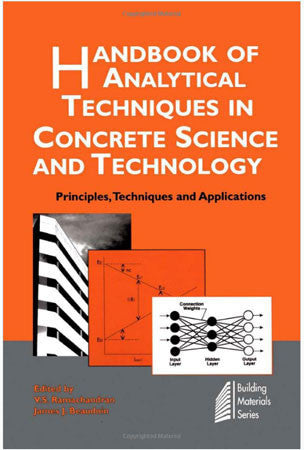
Handbook of Analytical...
$300.00
{"id":11242218052,"title":"Handbook of Analytical Techniques in Concrete","handle":"0-8155-1437-9","description":"\u003ch5\u003eDescription\u003c\/h5\u003e\nAuthor: V.S. Ramachandran, J.J. Beaudoin \u003cbr\u003eISBN 0-8155-1437-9 \u003cbr\u003e\u003cbr\u003eNational Research Council of Canada, Ottawa, Canada\u003cbr\u003e\u003cbr\u003ePages: 985, Figures: 420, Tables: 70\u003cbr\u003e\u003cbr\u003e\n\u003ch5\u003eSummary\u003c\/h5\u003e\nScientific analysis techniques for a wide variety of concretes and their additives as well as concrete technologies, perfect for practitioners, students, and professional standards writers. \u003cbr\u003eMeasuring the long-term durability of new types of concrete and concrete technologies is crucial to their acceptance in the marketplace. This long-needed handbook of analytical techniques provides a complete reference to the cutting-edge procedures used to test today's innovative materials. \u003cbr\u003eRanging from chemical and thermal analysis, to IR and Nuclear Magnetic Resonance spectroscopy, to Scanning Electron Microscopy, x-ray diffraction, computer modeling and more, the book provides first-hand explanations of modern methods - contributed by 24 leading scientists, many of whom actually developed or refined the techniques. The book includes many analytic techniques, applied to a wide range of organic, inorganic and composite materials and additives. \u003cbr\u003ePerfect for practitioners, students, and professional standards writers, the handbook is highly useful for scrutinizing materials in a variety of environments. It takes into account the many factors that affect the qualities of concrete - temperature, pore and pore size distribution, surface area, and exposure - gathering diverse evaluation methods into one convenient resource.\u003cbr\u003e\u003cbr\u003e\u003cstrong\u003ePreface\u003c\/strong\u003e\u003cbr\u003eConcrete is a composite material formed by mixing and curing ingredients such as cement, fine and coarse aggregates, and water. Most concretes, however, contain additional ingredients such as chemical admixtures including air-entraining admixtures, fly ash, fibers, slag, and other products.\u003cbr\u003eThe physical, chemical and durability characteristics of concrete depend on many factors such as the type and amount of the components, temperature, pore and pore size distribution, surface area, interfacial features, exposure conditions, etc. Consequently, a good understanding of various processes occurring in cementitious systems necessitates the application of diverse techniques.\u003cbr\u003eSeveral physical, chemical, and mechanical techniques are applied in concrete research and practice. They provide important information, including characterization of raw materials and cured concrete, quality control, quantitative estimation of products, prediction of performance, development of accelerated test methods, study of interrelationships amongst physical, chemical, mechanical, and durability characteristics, development of new materials, etc. In most instances, no single technique provides all the needed information and hence application of several techniques becomes necessary. Information on the application of various techniques in concrete is dispersed in literature, and few books are available that serve as a source or reference. Hence a handbook incorporating the latest knowledge on the application of various investigative techniques in concrete science and technology has been prepared. Standard test methods are not covered in this book as they are well described in publications of national and international standards organizations.\u003cbr\u003eThe book is divided into twenty chapters. Each chapter describes the technique and its application and limitations for the study of concrete,. Each chapter also contains a list of important references that should serve as a useful guide for further information.\u003cbr\u003e\u003cbr\u003e\n\u003ch5\u003eTable of Contents\u003c\/h5\u003e\nThe first chapter on concrete science describes the essential concepts so that information presented in subsequent chapters can be easily followed. The chapter deals with the formation of cement, its hydration behavior, physicochemical processes related to the cement paste, and several important properties of concrete and durability aspects.\u003cbr\u003e\u003cbr\u003e\u003cbr\u003eChapter 2 deals with the description of a number of specialized techniques used in conjunction with petrography for the evaluation and analysis of aggregates of concrete.\u003cbr\u003eChemical analysis methods have been applied extensively to analyze the components of concrete, chemical and mineral admixtures, raw materials for making cement and also to estimate cement contents. Modern analytical tools enable much faster analysis than the wet chemical methods. \u003cbr\u003e\u003cbr\u003eIn Chapter 3, chemical analysis techniques reviewed include atomic absorption, x-ray emission and plasma spectroscopy. The chapter also contains information on chemical (wet) methods of analysis.\u003cbr\u003eThermal analysis techniques based on the determination of physical, chemical, and mechanical changes in a material as a function of temperature, have been routinely used in concrete science and technology. Identification, estimation of compounds, kinetics of reactions, mechanisms of the action of admixtures, synthesis of compounds, quality control and causes leading to the deterioration of cementitious materials are investigated by these techniques. Various types of thermal techniques and their applications and limitations are included in Chapter 4.\u003cbr\u003e\u003cbr\u003e\u003cbr\u003eAlthough comparatively recent, IR spectroscopy is gaining importance, especially with the development of user-friendly equipment as described in the fifth chapter. This technique has been applied for identification of new products and characterization of raw materials, hydrated materials, and deteriorated products. Discussion on Raman spectroscopy, a complementary technique to IR, also forms a part of this chapter.\u003cbr\u003eNuclear Magnetic Resonance spectroscopy (NMR) is a effective tool to probe atomic scale structure and dynamic behavior of cementing materials. The application of NMR for determining the pore structure and transport properties of cement and concrete via relaxation and imaging methods and its application to anhydrous cement and hydrated cement phases form some of the contents of Chapter 6.\u003cbr\u003eScanning Electron Microscopy and its adjunct, microanalytical unit, known as Energy Dispersive X-ray Analyzer, have been accepted as important investigative techniques in concrete technology. \u003cbr\u003e\u003cbr\u003eChapter 7 comprises discussion on the microstructure of hydrated cement paste, C-S-H phase, calcium hydroxide, aluminate hydrate phases, paste-aggregate interface, admixtures, slags, and fly ashes. Also included are studies on the correlation of microstructure with durability.\u003cbr\u003eThe eighth chapter on the application of x-ray diffraction focuses on some of the fundamental aspects of the technique, the hardware and software developments, and its applications to cement and concrete.\u003cbr\u003eAn understanding of the Theology of fresh cement paste and concrete is essential for following the behavior of concrete in the fresh state. Additions and admixtures in concrete alter its Theological behavior. \u003cbr\u003e\u003cbr\u003eChapter 9 deals with Theological techniques and their application to fresh cement paste and concrete.\u003cbr\u003eDimensional changes occur in cement paste and concrete due to physical, chemical, and electrochemical processes. A discussion of energetics of surface adsorption and volume changes forms the scope of Chapter 10. Relevance of length changes to concrete deterioration is also highlighted in this chapter.\u003cbr\u003eThe use of miniature specimens in cement science investigations has proven to be very valuable because it assures a greater homogeneity of the sample and increased sensitivity to the dimensional changes resulting from physical and chemical processes. \u003cbr\u003e\u003cbr\u003eChapter 11 provides results on compacted powder used as a model system and includes discussion on creep and shrinkage, volume stability, workability, and surface chemical changes.\u003cbr\u003eCorrosion of reinforced concrete is a major destructive process. Many electrochemical techniques have been developed to study corrosion. \u003cbr\u003e\u003cbr\u003eChapter 12 presents a comprehensive treatment of the principles of corrosion, factors responsible for corrosion, and corrosion assessment techniques relevant to concrete.\u003cbr\u003eSurface area has an important influence on the rate of reaction of cement to water and other chemicals. Many physical and mechanical characteristics of cement and concrete are modified by changes in the surface area. \u003cbr\u003e\u003cbr\u003eIn Chapter 13, the techniques that are used for measuring surface area are given with respect to their application to systems such as raw materials for cement, hydrated cement, concrete mix, and also to durability studies.\u003cbr\u003eThe pore structure of hydrated cement systems influences significantly the physico-mechanical and chemical behavior of concrete. Several experimental techniques have been employed to evaluate the microstructure of the cement paste. \u003cbr\u003e\u003cbr\u003eChapter 14 presents a description of six techniques that have been developed for the determination of pore structure. The relationship between pore structure and strength\/permeability is also included.\u003cbr\u003eThe application of silica polymerization analysis for an understanding of the hydration process and structure of calcium silicate hydrates is detailed in Chapter 15. Three major techniques used for polymerization studies are described.\u003cbr\u003eIn concrete, the physical structure and the state of water in the matrix influences the permeation process. \u003cbr\u003e\u003cbr\u003eIn Chapter 16, test methods that are employed to measure various transport characteristics of concrete are evaluated. The applicability and limitations of these techniques is also reviewed.\u003cbr\u003eInspection and testing of placed concrete may be carried out by nondestructive testing methods. Sonic and pulse velocity techniques are commonly used. Nondestructive methods are also applied to estimate strength, surface hardness, pullout strength, etc. Details of various nondestructive techniques and their applications are included in Chapter 17.\u003cbr\u003e\u003cbr\u003eThere is evidence of a significant impact of computer and information technologies on concrete science and technology. General development of these technologies in recent years is reviewed in Chapter 18. The treatment includes computer models, databases, artificial knowledge-based and computer-integrated systems.\u003cbr\u003e\u003cbr\u003eIn Chapter 19, entitled \"Image Analysis,\" steps needed to identify reactions of interest and extract quantitative information from digital images are reviewed. In image analysis, multiple images are acquired and analyzed. The principle steps required for image analysis of cementitious materials are described in this chapter.\u003cbr\u003eSome of the more commonly used techniques in concrete studies are presented in Chapters 2 to 19. There has been continued interest in developing new techniques for the investigation of cement and concrete. \u003cbr\u003e\u003cbr\u003eChapter 20 comprises the description and application of fourteen of these specialized techniques. They include such techniques as Auger Electron Microscopy, Chromatography, Mass Spectrometry, X-Ray Absorption Fine Structure Analysis, Synchrotron Orbital Radiation Analysis, Mossbauer Spectrometry, Radio Tracer Technique, and Photoacoustic Spectroscopy.\u003cbr\u003eAlthough every attempt has been made to cover the important investigative techniques used in concrete technology, it is quite possible that some information has been excluded or is missing. In addition, some duplication of information occurs in some chapters. This was intentional because some specific chapters may only be of interest to specialized groups, and they provide enough self-contained information so that gleaning through other chapters will not be needed.\u003cbr\u003eThis comprehensive handbook should serve as a reference material to concrete technologists, materials scientists, analytical chemists, engineers, architects, researchers, manufacturers of cement and concrete, standards writing bodies, and users of concrete.\u003cbr\u003e\u003cbr\u003e\n\u003ch5\u003eAbout Author\u003c\/h5\u003e\nDr. V.S. Ramachandran is Distinguished Researcher at the Institute for Research in Construction, National Research Council Canada, Ottawa, Canada. He is author of six other books and numerous articles. Dr. Ramachandran is a Fellow of the Royal Society of Chemistry, the Ceramic Society (UK), the American Ceramic Society, and is the recipient of many awards and honors for his scientific accomplishments in the concrete and ceramic fields Dr. James J. Beaudoin is Principal Research Officer at the Institute for Research in Construction, National Research Council Canada, Ottawa, Canada. He is author of over 300 publications, including three books, and holds several patents. He received the Copeland Award from the American Ceramic Society in 1998 and the American Concrete Institute Wason Medal for materials research in 1999.\u003cbr\u003e\u003cbr\u003e","published_at":"2017-06-22T21:13:35-04:00","created_at":"2017-06-22T21:13:35-04:00","vendor":"Chemtec Publishing","type":"Book","tags":["2001","additives","admixtures","aggregate interface","aluminate hydrate","book","calcium hydroxide","cement","chemical analysis","concrete","electron microscopy","fly ashes","IR spectroscopy","mineral admixtures","NMR","p-applications","poly","slags","thermal analysis"],"price":30000,"price_min":30000,"price_max":30000,"available":true,"price_varies":false,"compare_at_price":null,"compare_at_price_min":0,"compare_at_price_max":0,"compare_at_price_varies":false,"variants":[{"id":43378361604,"title":"Default Title","option1":"Default Title","option2":null,"option3":null,"sku":"","requires_shipping":true,"taxable":true,"featured_image":null,"available":true,"name":"Handbook of Analytical Techniques in Concrete","public_title":null,"options":["Default Title"],"price":30000,"weight":1000,"compare_at_price":null,"inventory_quantity":1,"inventory_management":null,"inventory_policy":"continue","barcode":"0-8155-1437-9","requires_selling_plan":false,"selling_plan_allocations":[],"quantity_rule":{"min":1,"max":null,"increment":1}}],"images":["\/\/chemtec.org\/cdn\/shop\/products\/0-8155-1437-9.jpg?v=1499387282"],"featured_image":"\/\/chemtec.org\/cdn\/shop\/products\/0-8155-1437-9.jpg?v=1499387282","options":["Title"],"media":[{"alt":null,"id":354809118813,"position":1,"preview_image":{"aspect_ratio":0.676,"height":450,"width":304,"src":"\/\/chemtec.org\/cdn\/shop\/products\/0-8155-1437-9.jpg?v=1499387282"},"aspect_ratio":0.676,"height":450,"media_type":"image","src":"\/\/chemtec.org\/cdn\/shop\/products\/0-8155-1437-9.jpg?v=1499387282","width":304}],"requires_selling_plan":false,"selling_plan_groups":[],"content":"\u003ch5\u003eDescription\u003c\/h5\u003e\nAuthor: V.S. Ramachandran, J.J. Beaudoin \u003cbr\u003eISBN 0-8155-1437-9 \u003cbr\u003e\u003cbr\u003eNational Research Council of Canada, Ottawa, Canada\u003cbr\u003e\u003cbr\u003ePages: 985, Figures: 420, Tables: 70\u003cbr\u003e\u003cbr\u003e\n\u003ch5\u003eSummary\u003c\/h5\u003e\nScientific analysis techniques for a wide variety of concretes and their additives as well as concrete technologies, perfect for practitioners, students, and professional standards writers. \u003cbr\u003eMeasuring the long-term durability of new types of concrete and concrete technologies is crucial to their acceptance in the marketplace. This long-needed handbook of analytical techniques provides a complete reference to the cutting-edge procedures used to test today's innovative materials. \u003cbr\u003eRanging from chemical and thermal analysis, to IR and Nuclear Magnetic Resonance spectroscopy, to Scanning Electron Microscopy, x-ray diffraction, computer modeling and more, the book provides first-hand explanations of modern methods - contributed by 24 leading scientists, many of whom actually developed or refined the techniques. The book includes many analytic techniques, applied to a wide range of organic, inorganic and composite materials and additives. \u003cbr\u003ePerfect for practitioners, students, and professional standards writers, the handbook is highly useful for scrutinizing materials in a variety of environments. It takes into account the many factors that affect the qualities of concrete - temperature, pore and pore size distribution, surface area, and exposure - gathering diverse evaluation methods into one convenient resource.\u003cbr\u003e\u003cbr\u003e\u003cstrong\u003ePreface\u003c\/strong\u003e\u003cbr\u003eConcrete is a composite material formed by mixing and curing ingredients such as cement, fine and coarse aggregates, and water. Most concretes, however, contain additional ingredients such as chemical admixtures including air-entraining admixtures, fly ash, fibers, slag, and other products.\u003cbr\u003eThe physical, chemical and durability characteristics of concrete depend on many factors such as the type and amount of the components, temperature, pore and pore size distribution, surface area, interfacial features, exposure conditions, etc. Consequently, a good understanding of various processes occurring in cementitious systems necessitates the application of diverse techniques.\u003cbr\u003eSeveral physical, chemical, and mechanical techniques are applied in concrete research and practice. They provide important information, including characterization of raw materials and cured concrete, quality control, quantitative estimation of products, prediction of performance, development of accelerated test methods, study of interrelationships amongst physical, chemical, mechanical, and durability characteristics, development of new materials, etc. In most instances, no single technique provides all the needed information and hence application of several techniques becomes necessary. Information on the application of various techniques in concrete is dispersed in literature, and few books are available that serve as a source or reference. Hence a handbook incorporating the latest knowledge on the application of various investigative techniques in concrete science and technology has been prepared. Standard test methods are not covered in this book as they are well described in publications of national and international standards organizations.\u003cbr\u003eThe book is divided into twenty chapters. Each chapter describes the technique and its application and limitations for the study of concrete,. Each chapter also contains a list of important references that should serve as a useful guide for further information.\u003cbr\u003e\u003cbr\u003e\n\u003ch5\u003eTable of Contents\u003c\/h5\u003e\nThe first chapter on concrete science describes the essential concepts so that information presented in subsequent chapters can be easily followed. The chapter deals with the formation of cement, its hydration behavior, physicochemical processes related to the cement paste, and several important properties of concrete and durability aspects.\u003cbr\u003e\u003cbr\u003e\u003cbr\u003eChapter 2 deals with the description of a number of specialized techniques used in conjunction with petrography for the evaluation and analysis of aggregates of concrete.\u003cbr\u003eChemical analysis methods have been applied extensively to analyze the components of concrete, chemical and mineral admixtures, raw materials for making cement and also to estimate cement contents. Modern analytical tools enable much faster analysis than the wet chemical methods. \u003cbr\u003e\u003cbr\u003eIn Chapter 3, chemical analysis techniques reviewed include atomic absorption, x-ray emission and plasma spectroscopy. The chapter also contains information on chemical (wet) methods of analysis.\u003cbr\u003eThermal analysis techniques based on the determination of physical, chemical, and mechanical changes in a material as a function of temperature, have been routinely used in concrete science and technology. Identification, estimation of compounds, kinetics of reactions, mechanisms of the action of admixtures, synthesis of compounds, quality control and causes leading to the deterioration of cementitious materials are investigated by these techniques. Various types of thermal techniques and their applications and limitations are included in Chapter 4.\u003cbr\u003e\u003cbr\u003e\u003cbr\u003eAlthough comparatively recent, IR spectroscopy is gaining importance, especially with the development of user-friendly equipment as described in the fifth chapter. This technique has been applied for identification of new products and characterization of raw materials, hydrated materials, and deteriorated products. Discussion on Raman spectroscopy, a complementary technique to IR, also forms a part of this chapter.\u003cbr\u003eNuclear Magnetic Resonance spectroscopy (NMR) is a effective tool to probe atomic scale structure and dynamic behavior of cementing materials. The application of NMR for determining the pore structure and transport properties of cement and concrete via relaxation and imaging methods and its application to anhydrous cement and hydrated cement phases form some of the contents of Chapter 6.\u003cbr\u003eScanning Electron Microscopy and its adjunct, microanalytical unit, known as Energy Dispersive X-ray Analyzer, have been accepted as important investigative techniques in concrete technology. \u003cbr\u003e\u003cbr\u003eChapter 7 comprises discussion on the microstructure of hydrated cement paste, C-S-H phase, calcium hydroxide, aluminate hydrate phases, paste-aggregate interface, admixtures, slags, and fly ashes. Also included are studies on the correlation of microstructure with durability.\u003cbr\u003eThe eighth chapter on the application of x-ray diffraction focuses on some of the fundamental aspects of the technique, the hardware and software developments, and its applications to cement and concrete.\u003cbr\u003eAn understanding of the Theology of fresh cement paste and concrete is essential for following the behavior of concrete in the fresh state. Additions and admixtures in concrete alter its Theological behavior. \u003cbr\u003e\u003cbr\u003eChapter 9 deals with Theological techniques and their application to fresh cement paste and concrete.\u003cbr\u003eDimensional changes occur in cement paste and concrete due to physical, chemical, and electrochemical processes. A discussion of energetics of surface adsorption and volume changes forms the scope of Chapter 10. Relevance of length changes to concrete deterioration is also highlighted in this chapter.\u003cbr\u003eThe use of miniature specimens in cement science investigations has proven to be very valuable because it assures a greater homogeneity of the sample and increased sensitivity to the dimensional changes resulting from physical and chemical processes. \u003cbr\u003e\u003cbr\u003eChapter 11 provides results on compacted powder used as a model system and includes discussion on creep and shrinkage, volume stability, workability, and surface chemical changes.\u003cbr\u003eCorrosion of reinforced concrete is a major destructive process. Many electrochemical techniques have been developed to study corrosion. \u003cbr\u003e\u003cbr\u003eChapter 12 presents a comprehensive treatment of the principles of corrosion, factors responsible for corrosion, and corrosion assessment techniques relevant to concrete.\u003cbr\u003eSurface area has an important influence on the rate of reaction of cement to water and other chemicals. Many physical and mechanical characteristics of cement and concrete are modified by changes in the surface area. \u003cbr\u003e\u003cbr\u003eIn Chapter 13, the techniques that are used for measuring surface area are given with respect to their application to systems such as raw materials for cement, hydrated cement, concrete mix, and also to durability studies.\u003cbr\u003eThe pore structure of hydrated cement systems influences significantly the physico-mechanical and chemical behavior of concrete. Several experimental techniques have been employed to evaluate the microstructure of the cement paste. \u003cbr\u003e\u003cbr\u003eChapter 14 presents a description of six techniques that have been developed for the determination of pore structure. The relationship between pore structure and strength\/permeability is also included.\u003cbr\u003eThe application of silica polymerization analysis for an understanding of the hydration process and structure of calcium silicate hydrates is detailed in Chapter 15. Three major techniques used for polymerization studies are described.\u003cbr\u003eIn concrete, the physical structure and the state of water in the matrix influences the permeation process. \u003cbr\u003e\u003cbr\u003eIn Chapter 16, test methods that are employed to measure various transport characteristics of concrete are evaluated. The applicability and limitations of these techniques is also reviewed.\u003cbr\u003eInspection and testing of placed concrete may be carried out by nondestructive testing methods. Sonic and pulse velocity techniques are commonly used. Nondestructive methods are also applied to estimate strength, surface hardness, pullout strength, etc. Details of various nondestructive techniques and their applications are included in Chapter 17.\u003cbr\u003e\u003cbr\u003eThere is evidence of a significant impact of computer and information technologies on concrete science and technology. General development of these technologies in recent years is reviewed in Chapter 18. The treatment includes computer models, databases, artificial knowledge-based and computer-integrated systems.\u003cbr\u003e\u003cbr\u003eIn Chapter 19, entitled \"Image Analysis,\" steps needed to identify reactions of interest and extract quantitative information from digital images are reviewed. In image analysis, multiple images are acquired and analyzed. The principle steps required for image analysis of cementitious materials are described in this chapter.\u003cbr\u003eSome of the more commonly used techniques in concrete studies are presented in Chapters 2 to 19. There has been continued interest in developing new techniques for the investigation of cement and concrete. \u003cbr\u003e\u003cbr\u003eChapter 20 comprises the description and application of fourteen of these specialized techniques. They include such techniques as Auger Electron Microscopy, Chromatography, Mass Spectrometry, X-Ray Absorption Fine Structure Analysis, Synchrotron Orbital Radiation Analysis, Mossbauer Spectrometry, Radio Tracer Technique, and Photoacoustic Spectroscopy.\u003cbr\u003eAlthough every attempt has been made to cover the important investigative techniques used in concrete technology, it is quite possible that some information has been excluded or is missing. In addition, some duplication of information occurs in some chapters. This was intentional because some specific chapters may only be of interest to specialized groups, and they provide enough self-contained information so that gleaning through other chapters will not be needed.\u003cbr\u003eThis comprehensive handbook should serve as a reference material to concrete technologists, materials scientists, analytical chemists, engineers, architects, researchers, manufacturers of cement and concrete, standards writing bodies, and users of concrete.\u003cbr\u003e\u003cbr\u003e\n\u003ch5\u003eAbout Author\u003c\/h5\u003e\nDr. V.S. Ramachandran is Distinguished Researcher at the Institute for Research in Construction, National Research Council Canada, Ottawa, Canada. He is author of six other books and numerous articles. Dr. Ramachandran is a Fellow of the Royal Society of Chemistry, the Ceramic Society (UK), the American Ceramic Society, and is the recipient of many awards and honors for his scientific accomplishments in the concrete and ceramic fields Dr. James J. Beaudoin is Principal Research Officer at the Institute for Research in Construction, National Research Council Canada, Ottawa, Canada. He is author of over 300 publications, including three books, and holds several patents. He received the Copeland Award from the American Ceramic Society in 1998 and the American Concrete Institute Wason Medal for materials research in 1999.\u003cbr\u003e\u003cbr\u003e"}
Radiation Curing
$125.00
{"id":11242217668,"title":"Radiation Curing","handle":"978-1-85957-288-7","description":"\u003ch5\u003eDescription\u003c\/h5\u003e\nAuthor: R.S. Davidson \u003cbr\u003eISBN 978-1-85957-288-7 \u003cbr\u003e\u003cbr\u003e\u003cmeta charset=\"utf-8\"\u003e\u003cspan\u003ePublished: 2001\u003cbr\u003e\u003c\/span\u003epages 124\n\u003ch5\u003eSummary\u003c\/h5\u003e\nThis is a very readable review on the exciting, advancing technology of radiation curing. The principles upon which the technology is based, the equipment that is used and the materials which make up a radiation curable formulation are described. The applications of radiation curing are set to expand. Currently, the technology is used in coatings, graphic arts, printing inks, packaging, adhesives, optical and optoelectronic applications, composite production, rapid prototyping, electronics, with liquid crystals, in nanotechnology, for controlled-permeability membranes and hydrogels (including contact lenses), and for the vulcanisation of natural and synthetic rubber. These are all discussed in this review, with principle material types outlined. The review is well referenced to facilitate further reading. It is accompanied by around 400 abstracts from the Rapra Abstracts database, most of which are cited in the text. \u003cbr\u003e\u003cbr\u003eThere are many possibilities for future developments in radiation curing. The technology permits extensive control over crosslinking, including reversal of the process of adhesion in some cases. This allows the production of release coatings and provides an easy method of removing expensive components at the end-of-life stage. It is also developing a role in medical applications. The prospects for functional and aesthetic coating applications are abundant with pearlescent coatings, liquid crystals in coatings and high gloss coatings, to name but a few. Radiation curing is generally environmentally friendly - dry powder coatings can eliminate the need for solvent-based products, and reversible adhesives can facilitate recycling. This legislation is fuelling the drive towards this technology.\u003cbr\u003e\u003cbr\u003e\n\u003ch5\u003eTable of Contents\u003c\/h5\u003e\nIntroduction \u003cbr\u003eWhat is Radiation Curing? Use of the Terms ‘Drying’ and ‘Curing’ Why Consider Radiation Curing? \u003cbr\u003eThe Chemical Processes Used in Radiation Curing \u003cbr\u003eProcesses Involving Radicals Processes Involving Carbanions - Anionic Curing Systems \u003cbr\u003eEquipment \u003cbr\u003eApplications of Curable Coatings Radiation Sources for UV Curing \u003cbr\u003eGeneral Formulations \u003cbr\u003eInitiation of Cure by Photoinitiators Prepolymers Reactive Diluents Pigments Additives \u003cbr\u003eComponents of Cationically Cured Formulations Other than Photoinitiators \u003cbr\u003eReactive Diluents Prepolymers Combinations of Cationic- and Radical-Cured Materials \u003cbr\u003eApplications of Radiation Curing \u003cbr\u003eWood coating Graphic arts Printing inks Packaging Adhesives Optical Components and Optoelectronic Applications Production of Composites Rapid Prototyping Nanotechnology and Microstructures Liquid Crystals Electronics Powder Coatings Radiation Cured Coatings for Outdoor Use \u003cbr\u003e\u003cbr\u003eWater-Based Formulations\u003cbr\u003eWater Resistance, Permeability, and Hydrogels\u003cbr\u003eVulcanisation\u003cbr\u003eRadiation Curing in the 21st Century\u003cbr\u003e\u003cbr\u003e\n\u003ch5\u003eAbout Author\u003c\/h5\u003e\nDr. R Stephen Davidson is Emeritus Professor of Applied Chemistry (University of Kent, UK) and Emeritus Professor of Organic Chemistry (City University, London, UK). He has published over 200 research papers as well as being a regular contributor to RadTech meetings. He is a Chartered Chemist (C.Chem.), a Member of the Royal Society of Chemistry (MRSC) and holds two postgraduate degrees. \u003cbr\u003e\u003cbr\u003eDr. Davidson has accumulated knowledge in the general field of radiation curing, relating to free radical and cationic curing systems, the synthesis of photoinitiators, diluents and prepolymers and the development of methods for determining the degree of cure. The development of the analytical methods was crucial for developing an understanding of the mechanism of curing and hence producing simple guidelines for formulators operating with this technology. He has worked with industry on projects such as the UV curing of inks. He is currently a consultant in this field.\u003cbr\u003e\u003cbr\u003e","published_at":"2017-06-22T21:13:33-04:00","created_at":"2017-06-22T21:13:34-04:00","vendor":"Chemtec Publishing","type":"Book","tags":["2001","additives","book","coatings","curing","graphic","inks","p-formulation","packaging","permeability","pigments","polymer","radiation","resistance","UV","vulcanisation","wood coating"],"price":12500,"price_min":12500,"price_max":12500,"available":true,"price_varies":false,"compare_at_price":null,"compare_at_price_min":0,"compare_at_price_max":0,"compare_at_price_varies":false,"variants":[{"id":43378361092,"title":"Default Title","option1":"Default Title","option2":null,"option3":null,"sku":"","requires_shipping":true,"taxable":true,"featured_image":null,"available":true,"name":"Radiation Curing","public_title":null,"options":["Default Title"],"price":12500,"weight":1000,"compare_at_price":null,"inventory_quantity":1,"inventory_management":null,"inventory_policy":"continue","barcode":"978-1-85957-288-7","requires_selling_plan":false,"selling_plan_allocations":[],"quantity_rule":{"min":1,"max":null,"increment":1}}],"images":["\/\/chemtec.org\/cdn\/shop\/products\/978-1-85957-288-7.jpg?v=1499953964"],"featured_image":"\/\/chemtec.org\/cdn\/shop\/products\/978-1-85957-288-7.jpg?v=1499953964","options":["Title"],"media":[{"alt":null,"id":358728958045,"position":1,"preview_image":{"aspect_ratio":0.767,"height":450,"width":345,"src":"\/\/chemtec.org\/cdn\/shop\/products\/978-1-85957-288-7.jpg?v=1499953964"},"aspect_ratio":0.767,"height":450,"media_type":"image","src":"\/\/chemtec.org\/cdn\/shop\/products\/978-1-85957-288-7.jpg?v=1499953964","width":345}],"requires_selling_plan":false,"selling_plan_groups":[],"content":"\u003ch5\u003eDescription\u003c\/h5\u003e\nAuthor: R.S. Davidson \u003cbr\u003eISBN 978-1-85957-288-7 \u003cbr\u003e\u003cbr\u003e\u003cmeta charset=\"utf-8\"\u003e\u003cspan\u003ePublished: 2001\u003cbr\u003e\u003c\/span\u003epages 124\n\u003ch5\u003eSummary\u003c\/h5\u003e\nThis is a very readable review on the exciting, advancing technology of radiation curing. The principles upon which the technology is based, the equipment that is used and the materials which make up a radiation curable formulation are described. The applications of radiation curing are set to expand. Currently, the technology is used in coatings, graphic arts, printing inks, packaging, adhesives, optical and optoelectronic applications, composite production, rapid prototyping, electronics, with liquid crystals, in nanotechnology, for controlled-permeability membranes and hydrogels (including contact lenses), and for the vulcanisation of natural and synthetic rubber. These are all discussed in this review, with principle material types outlined. The review is well referenced to facilitate further reading. It is accompanied by around 400 abstracts from the Rapra Abstracts database, most of which are cited in the text. \u003cbr\u003e\u003cbr\u003eThere are many possibilities for future developments in radiation curing. The technology permits extensive control over crosslinking, including reversal of the process of adhesion in some cases. This allows the production of release coatings and provides an easy method of removing expensive components at the end-of-life stage. It is also developing a role in medical applications. The prospects for functional and aesthetic coating applications are abundant with pearlescent coatings, liquid crystals in coatings and high gloss coatings, to name but a few. Radiation curing is generally environmentally friendly - dry powder coatings can eliminate the need for solvent-based products, and reversible adhesives can facilitate recycling. This legislation is fuelling the drive towards this technology.\u003cbr\u003e\u003cbr\u003e\n\u003ch5\u003eTable of Contents\u003c\/h5\u003e\nIntroduction \u003cbr\u003eWhat is Radiation Curing? Use of the Terms ‘Drying’ and ‘Curing’ Why Consider Radiation Curing? \u003cbr\u003eThe Chemical Processes Used in Radiation Curing \u003cbr\u003eProcesses Involving Radicals Processes Involving Carbanions - Anionic Curing Systems \u003cbr\u003eEquipment \u003cbr\u003eApplications of Curable Coatings Radiation Sources for UV Curing \u003cbr\u003eGeneral Formulations \u003cbr\u003eInitiation of Cure by Photoinitiators Prepolymers Reactive Diluents Pigments Additives \u003cbr\u003eComponents of Cationically Cured Formulations Other than Photoinitiators \u003cbr\u003eReactive Diluents Prepolymers Combinations of Cationic- and Radical-Cured Materials \u003cbr\u003eApplications of Radiation Curing \u003cbr\u003eWood coating Graphic arts Printing inks Packaging Adhesives Optical Components and Optoelectronic Applications Production of Composites Rapid Prototyping Nanotechnology and Microstructures Liquid Crystals Electronics Powder Coatings Radiation Cured Coatings for Outdoor Use \u003cbr\u003e\u003cbr\u003eWater-Based Formulations\u003cbr\u003eWater Resistance, Permeability, and Hydrogels\u003cbr\u003eVulcanisation\u003cbr\u003eRadiation Curing in the 21st Century\u003cbr\u003e\u003cbr\u003e\n\u003ch5\u003eAbout Author\u003c\/h5\u003e\nDr. R Stephen Davidson is Emeritus Professor of Applied Chemistry (University of Kent, UK) and Emeritus Professor of Organic Chemistry (City University, London, UK). He has published over 200 research papers as well as being a regular contributor to RadTech meetings. He is a Chartered Chemist (C.Chem.), a Member of the Royal Society of Chemistry (MRSC) and holds two postgraduate degrees. \u003cbr\u003e\u003cbr\u003eDr. Davidson has accumulated knowledge in the general field of radiation curing, relating to free radical and cationic curing systems, the synthesis of photoinitiators, diluents and prepolymers and the development of methods for determining the degree of cure. The development of the analytical methods was crucial for developing an understanding of the mechanism of curing and hence producing simple guidelines for formulators operating with this technology. He has worked with industry on projects such as the UV curing of inks. He is currently a consultant in this field.\u003cbr\u003e\u003cbr\u003e"}
Fluoroplastics: Melt-P...
$255.00
{"id":11242217732,"title":"Fluoroplastics: Melt-Processible Fluoroplastics. Volume 2","handle":"1-884207-96-0","description":"\u003ch5\u003eDescription\u003c\/h5\u003e\nAuthor: Sina Ebnesajjad \u003cbr\u003eISBN \u003cspan\u003e1-884207-96-0\u003c\/span\u003e\n\u003cdiv class=\"weak inline printman\"\u003e\u003c\/div\u003e\nDuPont Fluoroproducts, Wilmington, DE, USA\n\u003ch5\u003eSummary\u003c\/h5\u003e\nThis is the second of a two-volume series of books about fluoroplastics. Volume 1 covers the non-melt processible homopolymers, requiring non-traditional processing techniques. Volume 2 is devoted to the melt-processible fluoropolymers, their polymerization and fabrication techniques including injection molding, wire, tube, and film extrusion, rotational molding, blow molding, compression molding, and transfer molding. Both a source of data and a reference, the properties, characteristics, applications, safety, disposal, and recycling of melt-processible fluoropolymers are comprehensively detailed for immediate use by today's practicing engineering and scientists in the plastics industry. Students will benefit from the book's arrangement and extensive references.\u003cbr\u003e\u003cbr\u003e\n\u003ch5\u003eTable of Contents\u003c\/h5\u003e\nPreface\u003cbr\u003eIntroduction\u003cbr\u003e\u003cbr\u003ePART I\u003cbr\u003eChapter 1 Fundamentals\u003cbr\u003eChapter 2 Fluoropolymers: Properties and Structure \u003cbr\u003eChapter 3 Operational Classification of Fluoropolymers\u003cbr\u003eChapter 4 Homofluoropolymer Monomers \u003cbr\u003eChapter 5 Polymerization and Finishing Melt Processible Fluoropolymers\u003cbr\u003eChapter 6 Commercial Grades of Melt Processible Fluoropolymers\u003cbr\u003e\u003cbr\u003ePART II\u003cbr\u003eChapter 7 Injection Molding\u003cbr\u003eChapter 8 Extrusion\u003cbr\u003eChapter 9 Rotational Molding and Lining\u003cbr\u003eChapter 10 Other Molding Techniques\u003cbr\u003eChapter 11 Fluoropolymer Foams \u003cbr\u003e\u003cbr\u003ePART III\u003cbr\u003eChapter 12 Chemical Properties of Fluoropolymers\u003cbr\u003eChapter 13 Properties of Fluoropolymers\u003cbr\u003eChapter 14 Fabrication Techniques for Fluoropolymers \u003cbr\u003eChapter 15 Fluoropolymer Applications in the Microelectronics Industry \u003cbr\u003eChapter 16 Typical Applications of Fluoropolymers\u003cbr\u003eChapter 17 Safety, Disposal, and Recycling of Fluoropolymers \u003cbr\u003e\u003cbr\u003eAppendix I High Temperature Resistance of Fluoropolymers to Automotive Fuels \u003cbr\u003eAppendix II Permeation Properties of Perfluoroplastics \u003cbr\u003eAppendix III Permeation Properties of Partially Fluorinated Fluoroplastics \u003cbr\u003eAppendix IV Permeation Properties of Automotive Fuels Through Fluoroplastics \u003cbr\u003eAppendix V Permeation of Organic and Inorganic Chemicals Through \u003cbr\u003eFluoroplastics Film\u003cbr\u003eAppendix VI Mechanical, Thermal, Electrical, Physical, and Miscellaneous \u003cbr\u003eProperties of Fluoroplastics\u003cbr\u003eAppendix VII Modulus Data for Fluoroplastics \u003cbr\u003e\u003cbr\u003eGlossary\u003cbr\u003eIndex\u003cbr\u003e\u003cbr\u003e\n\u003ch5\u003eAbout Author\u003c\/h5\u003e\nDr. Sina Ebnesajjad is a Senior Technology Associate in the Fluoropolymers Division of DuPont Fluoroproducts in Wilmington, Delaware, where he has been involved in a variety of technical assignments since 1986. He earned his Ph.D. in chemical engineering from the University of Michigan, Ann Arbor.","published_at":"2017-06-22T21:13:34-04:00","created_at":"2017-06-22T21:13:34-04:00","vendor":"Chemtec Publishing","type":"Book","tags":["2002","applications","blow molding","book","characteristics","compression molding","disposal","electrical","extrusion","film","fluoropolymers","injection molding","melt-processible","p-chemistry","perfluoroplastics","polymer","polymerization","properties","recycling","rotational molding","safety","semiconductor industries","transfer molding","tube","wire"],"price":25500,"price_min":25500,"price_max":25500,"available":true,"price_varies":false,"compare_at_price":null,"compare_at_price_min":0,"compare_at_price_max":0,"compare_at_price_varies":false,"variants":[{"id":43378361284,"title":"Default Title","option1":"Default Title","option2":null,"option3":null,"sku":"","requires_shipping":true,"taxable":true,"featured_image":null,"available":true,"name":"Fluoroplastics: Melt-Processible Fluoroplastics. Volume 2","public_title":null,"options":["Default Title"],"price":25500,"weight":1000,"compare_at_price":null,"inventory_quantity":1,"inventory_management":null,"inventory_policy":"continue","barcode":"1-884207-96-0","requires_selling_plan":false,"selling_plan_allocations":[],"quantity_rule":{"min":1,"max":null,"increment":1}}],"images":["\/\/chemtec.org\/cdn\/shop\/products\/1-884207-96-0.jpg?v=1499386513"],"featured_image":"\/\/chemtec.org\/cdn\/shop\/products\/1-884207-96-0.jpg?v=1499386513","options":["Title"],"media":[{"alt":null,"id":354807611485,"position":1,"preview_image":{"aspect_ratio":0.771,"height":450,"width":347,"src":"\/\/chemtec.org\/cdn\/shop\/products\/1-884207-96-0.jpg?v=1499386513"},"aspect_ratio":0.771,"height":450,"media_type":"image","src":"\/\/chemtec.org\/cdn\/shop\/products\/1-884207-96-0.jpg?v=1499386513","width":347}],"requires_selling_plan":false,"selling_plan_groups":[],"content":"\u003ch5\u003eDescription\u003c\/h5\u003e\nAuthor: Sina Ebnesajjad \u003cbr\u003eISBN \u003cspan\u003e1-884207-96-0\u003c\/span\u003e\n\u003cdiv class=\"weak inline printman\"\u003e\u003c\/div\u003e\nDuPont Fluoroproducts, Wilmington, DE, USA\n\u003ch5\u003eSummary\u003c\/h5\u003e\nThis is the second of a two-volume series of books about fluoroplastics. Volume 1 covers the non-melt processible homopolymers, requiring non-traditional processing techniques. Volume 2 is devoted to the melt-processible fluoropolymers, their polymerization and fabrication techniques including injection molding, wire, tube, and film extrusion, rotational molding, blow molding, compression molding, and transfer molding. Both a source of data and a reference, the properties, characteristics, applications, safety, disposal, and recycling of melt-processible fluoropolymers are comprehensively detailed for immediate use by today's practicing engineering and scientists in the plastics industry. Students will benefit from the book's arrangement and extensive references.\u003cbr\u003e\u003cbr\u003e\n\u003ch5\u003eTable of Contents\u003c\/h5\u003e\nPreface\u003cbr\u003eIntroduction\u003cbr\u003e\u003cbr\u003ePART I\u003cbr\u003eChapter 1 Fundamentals\u003cbr\u003eChapter 2 Fluoropolymers: Properties and Structure \u003cbr\u003eChapter 3 Operational Classification of Fluoropolymers\u003cbr\u003eChapter 4 Homofluoropolymer Monomers \u003cbr\u003eChapter 5 Polymerization and Finishing Melt Processible Fluoropolymers\u003cbr\u003eChapter 6 Commercial Grades of Melt Processible Fluoropolymers\u003cbr\u003e\u003cbr\u003ePART II\u003cbr\u003eChapter 7 Injection Molding\u003cbr\u003eChapter 8 Extrusion\u003cbr\u003eChapter 9 Rotational Molding and Lining\u003cbr\u003eChapter 10 Other Molding Techniques\u003cbr\u003eChapter 11 Fluoropolymer Foams \u003cbr\u003e\u003cbr\u003ePART III\u003cbr\u003eChapter 12 Chemical Properties of Fluoropolymers\u003cbr\u003eChapter 13 Properties of Fluoropolymers\u003cbr\u003eChapter 14 Fabrication Techniques for Fluoropolymers \u003cbr\u003eChapter 15 Fluoropolymer Applications in the Microelectronics Industry \u003cbr\u003eChapter 16 Typical Applications of Fluoropolymers\u003cbr\u003eChapter 17 Safety, Disposal, and Recycling of Fluoropolymers \u003cbr\u003e\u003cbr\u003eAppendix I High Temperature Resistance of Fluoropolymers to Automotive Fuels \u003cbr\u003eAppendix II Permeation Properties of Perfluoroplastics \u003cbr\u003eAppendix III Permeation Properties of Partially Fluorinated Fluoroplastics \u003cbr\u003eAppendix IV Permeation Properties of Automotive Fuels Through Fluoroplastics \u003cbr\u003eAppendix V Permeation of Organic and Inorganic Chemicals Through \u003cbr\u003eFluoroplastics Film\u003cbr\u003eAppendix VI Mechanical, Thermal, Electrical, Physical, and Miscellaneous \u003cbr\u003eProperties of Fluoroplastics\u003cbr\u003eAppendix VII Modulus Data for Fluoroplastics \u003cbr\u003e\u003cbr\u003eGlossary\u003cbr\u003eIndex\u003cbr\u003e\u003cbr\u003e\n\u003ch5\u003eAbout Author\u003c\/h5\u003e\nDr. Sina Ebnesajjad is a Senior Technology Associate in the Fluoropolymers Division of DuPont Fluoroproducts in Wilmington, Delaware, where he has been involved in a variety of technical assignments since 1986. He earned his Ph.D. in chemical engineering from the University of Michigan, Ann Arbor."}

Reactive Polymers Fund...
$270.00
{"id":11242217540,"title":"Reactive Polymers Fundamentals and Applications, 2nd Edition","handle":"978-1-4557-3149-7","description":"\u003ch5\u003eDescription\u003c\/h5\u003e\nAuthor: Johannes Karl Fink \u003cbr\u003eISBN 978-1-4557-3149-7 \u003cbr\u003e\u003cbr\u003ePublished: 2013\u003cbr\u003eA Concise Guide to Industrial Polymers\n\u003cdiv\u003eHardbound, 576 Pages\u003c\/div\u003e\n\u003ch5\u003eSummary\u003c\/h5\u003e\nThe use of reactive polymers enables manufacturers to make chemical changes at a late stage in the production process - these in turn cause changes in performance and properties. In order to achieve optimal performance, material selection and the control of the reaction are essential. In this handbook, Dr. Fink introduces engineers and scientists to the range of reactive polymers available, explains the reactions that take place, and details applications and performance benefits.\u003cbr\u003e\u003cbr\u003eFor each class of reactive resin (Thermoset) basic principles and industrial processes are described as well as additives, the curing process, and applications and uses. The initial chapters are devoted to individual resin types, e.g. epoxides, cyanoacrylates etc. Then more general chapters, e.g. reactive extrusion, and special topics, e.g. dental applications, follow. Additionally, the new edition will include information on the most recent developments, applications, and commercial products for each chemical class of Thermosets as well as sections on fabrication methods, reactive biopolymers, recycling of reactive polymers, and case studies. A chapter about injection molding of reactive polymers, and sections on radiation curing, Thermosetting elastomers, and reactive extrusion equipment will be included.\n\u003ch5\u003eTable of Contents\u003c\/h5\u003e\n1 Unsaturated Polyester Resins\u003cbr\u003e\u003cbr\u003e2 Polyurethanes\u003cbr\u003e\u003cbr\u003e3 Epoxy Resins\u003cbr\u003e\u003cbr\u003e4 Phenol\/formaldehyde Resins\u003cbr\u003e\u003cbr\u003e5 Urea\/formaldehyde Resins\u003cbr\u003e\u003cbr\u003e6 Melamine Resins\u003cbr\u003e\u003cbr\u003e7 Furan Resins\u003cbr\u003e\u003cbr\u003e8 Silicones\u003cbr\u003e\u003cbr\u003e9 Acrylic Resins\u003cbr\u003e\u003cbr\u003e10 Cyanate Ester Resins\u003cbr\u003e\u003cbr\u003e11 Bismaleimide Resins\u003cbr\u003e\u003cbr\u003e12 Terpene Resins\u003cbr\u003e\u003cbr\u003e13 Cyanoacrylates\u003cbr\u003e\u003cbr\u003e14 Benzocyclobutene Resins\u003cbr\u003e\u003cbr\u003e15 Reactive Extrusion\u003cbr\u003e\u003cbr\u003e16 Compatibilization\u003cbr\u003e\u003cbr\u003e17 Rheology Control\u003cbr\u003e\u003cbr\u003e18 Grafting\u003cbr\u003e\u003cbr\u003e19 Acrylic Dental Fillers\u003cbr\u003e\u003cbr\u003e20 Toners\n\u003ch5\u003eAbout Author\u003c\/h5\u003e\nDr. Johannes Karl Fink, Montanuniversität Leoben, Austria","published_at":"2017-06-22T21:13:33-04:00","created_at":"2017-06-22T21:13:33-04:00","vendor":"Chemtec Publishing","type":"Book","tags":["2013","book","extrusion","fillers","fluorosilicones","grafting","industrial polymers","injection molding","material","nanocomposites","reactive biopolymers","reactive polymers","recycling","resins","rheology","silicones"],"price":27000,"price_min":27000,"price_max":27000,"available":true,"price_varies":false,"compare_at_price":null,"compare_at_price_min":0,"compare_at_price_max":0,"compare_at_price_varies":false,"variants":[{"id":43378360964,"title":"Default Title","option1":"Default Title","option2":null,"option3":null,"sku":"","requires_shipping":true,"taxable":true,"featured_image":null,"available":true,"name":"Reactive Polymers Fundamentals and Applications, 2nd Edition","public_title":null,"options":["Default Title"],"price":27000,"weight":1000,"compare_at_price":null,"inventory_quantity":1,"inventory_management":null,"inventory_policy":"continue","barcode":"978-1-4557-3149-7","requires_selling_plan":false,"selling_plan_allocations":[],"quantity_rule":{"min":1,"max":null,"increment":1}}],"images":["\/\/chemtec.org\/cdn\/shop\/products\/978-1-4557-3149-7.jpg?v=1499954053"],"featured_image":"\/\/chemtec.org\/cdn\/shop\/products\/978-1-4557-3149-7.jpg?v=1499954053","options":["Title"],"media":[{"alt":null,"id":358731579485,"position":1,"preview_image":{"aspect_ratio":0.767,"height":450,"width":345,"src":"\/\/chemtec.org\/cdn\/shop\/products\/978-1-4557-3149-7.jpg?v=1499954053"},"aspect_ratio":0.767,"height":450,"media_type":"image","src":"\/\/chemtec.org\/cdn\/shop\/products\/978-1-4557-3149-7.jpg?v=1499954053","width":345}],"requires_selling_plan":false,"selling_plan_groups":[],"content":"\u003ch5\u003eDescription\u003c\/h5\u003e\nAuthor: Johannes Karl Fink \u003cbr\u003eISBN 978-1-4557-3149-7 \u003cbr\u003e\u003cbr\u003ePublished: 2013\u003cbr\u003eA Concise Guide to Industrial Polymers\n\u003cdiv\u003eHardbound, 576 Pages\u003c\/div\u003e\n\u003ch5\u003eSummary\u003c\/h5\u003e\nThe use of reactive polymers enables manufacturers to make chemical changes at a late stage in the production process - these in turn cause changes in performance and properties. In order to achieve optimal performance, material selection and the control of the reaction are essential. In this handbook, Dr. Fink introduces engineers and scientists to the range of reactive polymers available, explains the reactions that take place, and details applications and performance benefits.\u003cbr\u003e\u003cbr\u003eFor each class of reactive resin (Thermoset) basic principles and industrial processes are described as well as additives, the curing process, and applications and uses. The initial chapters are devoted to individual resin types, e.g. epoxides, cyanoacrylates etc. Then more general chapters, e.g. reactive extrusion, and special topics, e.g. dental applications, follow. Additionally, the new edition will include information on the most recent developments, applications, and commercial products for each chemical class of Thermosets as well as sections on fabrication methods, reactive biopolymers, recycling of reactive polymers, and case studies. A chapter about injection molding of reactive polymers, and sections on radiation curing, Thermosetting elastomers, and reactive extrusion equipment will be included.\n\u003ch5\u003eTable of Contents\u003c\/h5\u003e\n1 Unsaturated Polyester Resins\u003cbr\u003e\u003cbr\u003e2 Polyurethanes\u003cbr\u003e\u003cbr\u003e3 Epoxy Resins\u003cbr\u003e\u003cbr\u003e4 Phenol\/formaldehyde Resins\u003cbr\u003e\u003cbr\u003e5 Urea\/formaldehyde Resins\u003cbr\u003e\u003cbr\u003e6 Melamine Resins\u003cbr\u003e\u003cbr\u003e7 Furan Resins\u003cbr\u003e\u003cbr\u003e8 Silicones\u003cbr\u003e\u003cbr\u003e9 Acrylic Resins\u003cbr\u003e\u003cbr\u003e10 Cyanate Ester Resins\u003cbr\u003e\u003cbr\u003e11 Bismaleimide Resins\u003cbr\u003e\u003cbr\u003e12 Terpene Resins\u003cbr\u003e\u003cbr\u003e13 Cyanoacrylates\u003cbr\u003e\u003cbr\u003e14 Benzocyclobutene Resins\u003cbr\u003e\u003cbr\u003e15 Reactive Extrusion\u003cbr\u003e\u003cbr\u003e16 Compatibilization\u003cbr\u003e\u003cbr\u003e17 Rheology Control\u003cbr\u003e\u003cbr\u003e18 Grafting\u003cbr\u003e\u003cbr\u003e19 Acrylic Dental Fillers\u003cbr\u003e\u003cbr\u003e20 Toners\n\u003ch5\u003eAbout Author\u003c\/h5\u003e\nDr. Johannes Karl Fink, Montanuniversität Leoben, Austria"}

Plastics Failure Analy...
$220.00
{"id":11242217604,"title":"Plastics Failure Analysis and Prevention","handle":"1-884207-92-8","description":"\u003ch5\u003eDescription\u003c\/h5\u003e\nAuthor: John Moalli, Editor \u003cbr\u003e10-ISBN 1-884207-92-8 \u003cbr\u003e\u003cspan\u003e13-ISBN 978-1-884207-92-1\u003c\/span\u003e\u003cbr\u003ePages: 341, Figures: 284 , Tables: 42\u003cbr\u003e\u003cbr\u003e\n\u003ch5\u003eSummary\u003c\/h5\u003e\nGeneral methods of product failure evaluation give powerful tools in product improvement. Such methods, discussed in the book, include practical risk analysis, failure mode and effect analysis, preliminary hazard analysis, progressive failure analysis, fault tree analysis, mean time between failures, Wohler curves, finite element analysis, cohesive zone model, crack propagation kinetics, time-temperature collectives, quantitative characterization of fatigue damage, and fracture maps. These methods are broadly used in some industries such as automotive industry and can be successfully applied to other industries.\u003cbr\u003eMethods of failure analysis are critical to for material improvement and they are broadly discussed in this book. Fractography of plastics is relatively a new field, which has many commonalities with fractography of metals. Here various aspects of fractography of plastics and metals are compared and contrasted. Fractography application in studies of static and cycling loading of ABS is also discussed. Other methods include SEM, SAXS, FTIR, DSC, DMA, GC\/MS, optical microscopy, fatigue behavior, multi-axial stress, residual stress analysis, punch resistance, creep-rupture, impact, oxidative induction time, craze testing, defect analysis, fracture toughness, the activation energy of degradation.\u003cbr\u003eConsidering that product joints are the most common sites of failure this subject is analyzed in detail. Snap-fit joints failure of plastic housing is analyzed aiming at the improvement of product reliability by the redesign of the method of joining. Multiply welding effect on materials durability is discussed for a broad range of temperatures of processing and performance. Effect of hot plate welding on weld properties and morphology is considered in the comparison of different methods of testing. Mechanical fasteners are investigated under mechanical loads and temperature variations.\u003cbr\u003eMany products have ductile properties or necking behavior which are another frequent cause of failure discussed here. Fatigue properties and fatigue failure mechanisms are discussed in detail since they cause many materials to fail. \u003cbr\u003eMany references are given in this book to real products and real cases of their failure. The products discussed include office equipment, automotive compressed fuel gas system, pipes, polymer blends, blow molded parts, layered, cross-ply and continuous fiber composites, printed circuits, electronic packages, hip implants, blown and multi-layered films, construction materials, component housings, brake cups, composite pressure vessels, swamp coolers, electrical cables, plumbing fittings, medical devices, medical packaging, strapping tapes, balloons, marine coatings, thermal switches, pressure relief membranes, pharmaceutical products, window profiles, and bone cements.\u003cbr\u003eMany common methods of material analysis are compared in this book. For example, the effect of internal pressure and testing of tensile properties, factors affecting Gardner impact testing, standard test procedures for structural analysis, methods of exposure of materials to the multidimensional state of stress, and many other.\u003cbr\u003eAttention is given to material morphology and its development during processing as a practical means of material improvement. Orientation effects during welding processes are analyzed in detail. Also, morphological changes of fatigue-induced damage are evaluated for crystalline polymers.\u003cbr\u003eAlso, many different polymers are analyzed here such as polyethylene (LDPE, HDPE, UHMWPE), polypropylene, polyamide, polyoxymethylene, epoxy resins, polyvinyl chloride, polystyrene, polyketone terpolymer, polyimide, polycarbonate, polyurethane, aliphatic copolymers, EPDM, ABS, vinyl ester, aromatic polyamide, polyester, polymethylmethacrylate, polyetherimide\u003cbr\u003eThe book also contains examples of defect cost analysis which shows that improvement of product quality by the above discussed methods is a very economical means of process engineering and technology selection. Some chapters contain a discussion of 10 common pitfalls in thin-wall plastic part design and outline of strategies for the evaluation of weather induced failure of polymers.\u003cbr\u003e\u003cbr\u003e\u003cbr\u003e\n\u003ch5\u003eTable of Contents\u003c\/h5\u003e\n\u003cp\u003e Practical Risk Analysis—As a Tool for Minimizing Plastic Product Failure\u003cbr\u003e• Avoiding the GIGO Syndrome\u003cbr\u003e• Defect Analysis and High Density Polyethylene Pipe Durability\u003cbr\u003e• Progressive Failure Analysis of Fiber Composite Structures\u003cbr\u003e• Failure Analysis Models for Polyacetal Molded Fittings in Plumbing Systems\u003cbr\u003e• Estimation of Time-Temperature-Collectives in Describing Aging of Polymer Materials\u003cbr\u003e• Fractography of Metals and Plastics\u003cbr\u003e• Fractography of ABS\u003cbr\u003e• Attachment Design Analysis of a Plastic Housing Joined with Snap-Fits\u003cbr\u003e• Joint Performance of Mechanical Fasteners under Dynamic Load\u003cbr\u003e• Morphological Study of Fatigue Induced Damage in Semi-Crystalline Polymers\u003cbr\u003e• Ductile Failure and Delayed Necking in Polyethylene\u003cbr\u003e• Fatigue Behavior of Discontinuous Glass Fiber Reinforced Polypropylene\u003cbr\u003e• Translating Failure into Success—Lessons Learned from Product Failure Analysis\u003cbr\u003e• Case Studies of Plastics Failure Related to Improper Formulation\u003cbr\u003e• Case Studies of Inadvertent Interactions between Polymers and Devices in Field Applications\u003cbr\u003e• Factors Affecting Variation in Gardner Impact Testing\u003cbr\u003e• Standard Test Procedures for Relevant Material Properties for Structural Analysis\u003cbr\u003e• The Influence of Multidimensional State of Stress on the Mechanical Properties of Thermoplastics\u003cbr\u003e• The Influence of Morphology on the Impact Performance of an Impact Modified PP\/PS Alloy\u003cbr\u003e• Morphology and Mechanical Behavior of Polypropylene Hot Plate Welds\u003cbr\u003e• Orientation Effects on the Weldability of Polypropylene Strapping Tape\u003cbr\u003e• Activation Energies of Polymer Degradation\u003cbr\u003e• Effects of Processing Conditions on the Failure Mode of an Aliphatic Polyketone Teropolymer\u003cbr\u003e• Durability Study of Conductive Copper Traces within Polyimide Based Substrates\u003cbr\u003e• The Role of Heat Affected Zone (HAZ) on Mechanical Properties in Thermally Welded Low Density Polyethylene Blown Film\u003cbr\u003e• Plastics Failure Due to Oxidative Degradation in Processing and Service\u003cbr\u003e• Comparing the Long Term Behavior of Tough Polyethylenes by Craze Testing\u003cbr\u003e• Crack Propagation in Continuous Glass Fiber\/Polypropylene Composites\u003cbr\u003e• Freeze-Thaw Durability of Composites for Civil Infrastructure\u003cbr\u003e• Temperature-Moisture-Mechanical Response of Vinyl Ester Resins and Pultruded Vinyl Ester\/e-glass Laminated Composites\u003cbr\u003e• Fracture Behavior of Polypropylene Modified with Metallocene Catalyzed Polyolefin\u003cbr\u003e• Mechanical Performance of Polyamides with Influence of Moisture and Temperature\u003cbr\u003e• Shelf Life Failure Prediction Considerations for Irradiated Polypropylene Medical Devices\u003cbr\u003e• Environmental Stress Cracking of ABS IIRadiation Resistance of Multilayer Films by Instrumented Impact Testing\u003cbr\u003e• Mechanical Behavior of Fabric Film Laminates\u003cbr\u003e• Determining Etch Compensation Factors for Printed Circuit Boards\u003cbr\u003e• Estimation of Long-Term Properties of Epoxies in Body Fluids\u003cbr\u003e• Aspects of the Tensile Response of Random Continuous Glass\/Epoxy Composites\u003cbr\u003e• Residual Stress Development in Marine Coatings under Simulated Service Conditions\u003cbr\u003e• Evaluation of a Yield Criteria and Energy Absorbing Mechanisms of Rubber Modified Epoxies in the Multiaxial Stress States\u003cbr\u003e• Design Aids for Preventing Brittle Failure in Polycarbonate and Polyetherimide\u003cbr\u003e• Effect of Scale on Mechanical Performance of PMMA\u003cbr\u003e• Defect Cost Analysis\u003cbr\u003e• 10 Common Pitfalls in Thin-Wall Plastic Part Design\u003cbr\u003e• Strategies for the Evaluation of Weathering-Induced Failure of Polymers\u003c\/p\u003e\n\u003ch5\u003eAbout Author\u003c\/h5\u003e\nDr. John Moalli received his doctorate in Polymers from MIT and currently serves as Director of Exponent Failure Analysis Associates' Materials Science and Mechanical Engineering group. He addresses issues related to plastics, composite materials, rubbers, adhesives, and general materials science. His specialties include product design and development, analysis of fracture surfaces, combustion behavior, experimental mechanical property evaluation, development of constitutive relations, patent analysis, and risk analysis in polymer and polymer composite systems. His current areas of research pertain to the evaluation of polymers in medical, automotive, construction, recreational, and other environments.","published_at":"2017-06-22T21:13:33-04:00","created_at":"2017-06-22T21:13:33-04:00","vendor":"Chemtec Publishing","type":"Book","tags":["2001","ABS","acrylic polymers","activation energy","aging","analysis","balloons","book","brake cups","cables","circuits","coatings","composite","coolers","craze","creep-rupture","defect","durability","electronic packages","failure","fatigue","fiber","films","fittings","fractography","fracture","Gardner","GIGO","housings","impact","implants","membranes","microscopy","morphology","multi-axial stress","oxidative induction time","p-testing","packaging","pipe","plastic","plumbing","polyethylene","polymer","polypropylene","punch resistance","reinforcement","residual","semi-crystalline","stress","structures","switches","syndrome","tapes","thermoplastics","toughness","vessels","window"],"price":22000,"price_min":22000,"price_max":22000,"available":true,"price_varies":false,"compare_at_price":null,"compare_at_price_min":0,"compare_at_price_max":0,"compare_at_price_varies":false,"variants":[{"id":43378361028,"title":"Default Title","option1":"Default Title","option2":null,"option3":null,"sku":"","requires_shipping":true,"taxable":true,"featured_image":null,"available":true,"name":"Plastics Failure Analysis and Prevention","public_title":null,"options":["Default Title"],"price":22000,"weight":1000,"compare_at_price":null,"inventory_quantity":1,"inventory_management":null,"inventory_policy":"continue","barcode":"978-1-884207-92-1","requires_selling_plan":false,"selling_plan_allocations":[],"quantity_rule":{"min":1,"max":null,"increment":1}}],"images":["\/\/chemtec.org\/cdn\/shop\/products\/1-884207-92-8.jpg?v=1503687407"],"featured_image":"\/\/chemtec.org\/cdn\/shop\/products\/1-884207-92-8.jpg?v=1503687407","options":["Title"],"media":[{"alt":null,"id":410019364957,"position":1,"preview_image":{"aspect_ratio":0.767,"height":450,"width":345,"src":"\/\/chemtec.org\/cdn\/shop\/products\/1-884207-92-8.jpg?v=1503687407"},"aspect_ratio":0.767,"height":450,"media_type":"image","src":"\/\/chemtec.org\/cdn\/shop\/products\/1-884207-92-8.jpg?v=1503687407","width":345}],"requires_selling_plan":false,"selling_plan_groups":[],"content":"\u003ch5\u003eDescription\u003c\/h5\u003e\nAuthor: John Moalli, Editor \u003cbr\u003e10-ISBN 1-884207-92-8 \u003cbr\u003e\u003cspan\u003e13-ISBN 978-1-884207-92-1\u003c\/span\u003e\u003cbr\u003ePages: 341, Figures: 284 , Tables: 42\u003cbr\u003e\u003cbr\u003e\n\u003ch5\u003eSummary\u003c\/h5\u003e\nGeneral methods of product failure evaluation give powerful tools in product improvement. Such methods, discussed in the book, include practical risk analysis, failure mode and effect analysis, preliminary hazard analysis, progressive failure analysis, fault tree analysis, mean time between failures, Wohler curves, finite element analysis, cohesive zone model, crack propagation kinetics, time-temperature collectives, quantitative characterization of fatigue damage, and fracture maps. These methods are broadly used in some industries such as automotive industry and can be successfully applied to other industries.\u003cbr\u003eMethods of failure analysis are critical to for material improvement and they are broadly discussed in this book. Fractography of plastics is relatively a new field, which has many commonalities with fractography of metals. Here various aspects of fractography of plastics and metals are compared and contrasted. Fractography application in studies of static and cycling loading of ABS is also discussed. Other methods include SEM, SAXS, FTIR, DSC, DMA, GC\/MS, optical microscopy, fatigue behavior, multi-axial stress, residual stress analysis, punch resistance, creep-rupture, impact, oxidative induction time, craze testing, defect analysis, fracture toughness, the activation energy of degradation.\u003cbr\u003eConsidering that product joints are the most common sites of failure this subject is analyzed in detail. Snap-fit joints failure of plastic housing is analyzed aiming at the improvement of product reliability by the redesign of the method of joining. Multiply welding effect on materials durability is discussed for a broad range of temperatures of processing and performance. Effect of hot plate welding on weld properties and morphology is considered in the comparison of different methods of testing. Mechanical fasteners are investigated under mechanical loads and temperature variations.\u003cbr\u003eMany products have ductile properties or necking behavior which are another frequent cause of failure discussed here. Fatigue properties and fatigue failure mechanisms are discussed in detail since they cause many materials to fail. \u003cbr\u003eMany references are given in this book to real products and real cases of their failure. The products discussed include office equipment, automotive compressed fuel gas system, pipes, polymer blends, blow molded parts, layered, cross-ply and continuous fiber composites, printed circuits, electronic packages, hip implants, blown and multi-layered films, construction materials, component housings, brake cups, composite pressure vessels, swamp coolers, electrical cables, plumbing fittings, medical devices, medical packaging, strapping tapes, balloons, marine coatings, thermal switches, pressure relief membranes, pharmaceutical products, window profiles, and bone cements.\u003cbr\u003eMany common methods of material analysis are compared in this book. For example, the effect of internal pressure and testing of tensile properties, factors affecting Gardner impact testing, standard test procedures for structural analysis, methods of exposure of materials to the multidimensional state of stress, and many other.\u003cbr\u003eAttention is given to material morphology and its development during processing as a practical means of material improvement. Orientation effects during welding processes are analyzed in detail. Also, morphological changes of fatigue-induced damage are evaluated for crystalline polymers.\u003cbr\u003eAlso, many different polymers are analyzed here such as polyethylene (LDPE, HDPE, UHMWPE), polypropylene, polyamide, polyoxymethylene, epoxy resins, polyvinyl chloride, polystyrene, polyketone terpolymer, polyimide, polycarbonate, polyurethane, aliphatic copolymers, EPDM, ABS, vinyl ester, aromatic polyamide, polyester, polymethylmethacrylate, polyetherimide\u003cbr\u003eThe book also contains examples of defect cost analysis which shows that improvement of product quality by the above discussed methods is a very economical means of process engineering and technology selection. Some chapters contain a discussion of 10 common pitfalls in thin-wall plastic part design and outline of strategies for the evaluation of weather induced failure of polymers.\u003cbr\u003e\u003cbr\u003e\u003cbr\u003e\n\u003ch5\u003eTable of Contents\u003c\/h5\u003e\n\u003cp\u003e Practical Risk Analysis—As a Tool for Minimizing Plastic Product Failure\u003cbr\u003e• Avoiding the GIGO Syndrome\u003cbr\u003e• Defect Analysis and High Density Polyethylene Pipe Durability\u003cbr\u003e• Progressive Failure Analysis of Fiber Composite Structures\u003cbr\u003e• Failure Analysis Models for Polyacetal Molded Fittings in Plumbing Systems\u003cbr\u003e• Estimation of Time-Temperature-Collectives in Describing Aging of Polymer Materials\u003cbr\u003e• Fractography of Metals and Plastics\u003cbr\u003e• Fractography of ABS\u003cbr\u003e• Attachment Design Analysis of a Plastic Housing Joined with Snap-Fits\u003cbr\u003e• Joint Performance of Mechanical Fasteners under Dynamic Load\u003cbr\u003e• Morphological Study of Fatigue Induced Damage in Semi-Crystalline Polymers\u003cbr\u003e• Ductile Failure and Delayed Necking in Polyethylene\u003cbr\u003e• Fatigue Behavior of Discontinuous Glass Fiber Reinforced Polypropylene\u003cbr\u003e• Translating Failure into Success—Lessons Learned from Product Failure Analysis\u003cbr\u003e• Case Studies of Plastics Failure Related to Improper Formulation\u003cbr\u003e• Case Studies of Inadvertent Interactions between Polymers and Devices in Field Applications\u003cbr\u003e• Factors Affecting Variation in Gardner Impact Testing\u003cbr\u003e• Standard Test Procedures for Relevant Material Properties for Structural Analysis\u003cbr\u003e• The Influence of Multidimensional State of Stress on the Mechanical Properties of Thermoplastics\u003cbr\u003e• The Influence of Morphology on the Impact Performance of an Impact Modified PP\/PS Alloy\u003cbr\u003e• Morphology and Mechanical Behavior of Polypropylene Hot Plate Welds\u003cbr\u003e• Orientation Effects on the Weldability of Polypropylene Strapping Tape\u003cbr\u003e• Activation Energies of Polymer Degradation\u003cbr\u003e• Effects of Processing Conditions on the Failure Mode of an Aliphatic Polyketone Teropolymer\u003cbr\u003e• Durability Study of Conductive Copper Traces within Polyimide Based Substrates\u003cbr\u003e• The Role of Heat Affected Zone (HAZ) on Mechanical Properties in Thermally Welded Low Density Polyethylene Blown Film\u003cbr\u003e• Plastics Failure Due to Oxidative Degradation in Processing and Service\u003cbr\u003e• Comparing the Long Term Behavior of Tough Polyethylenes by Craze Testing\u003cbr\u003e• Crack Propagation in Continuous Glass Fiber\/Polypropylene Composites\u003cbr\u003e• Freeze-Thaw Durability of Composites for Civil Infrastructure\u003cbr\u003e• Temperature-Moisture-Mechanical Response of Vinyl Ester Resins and Pultruded Vinyl Ester\/e-glass Laminated Composites\u003cbr\u003e• Fracture Behavior of Polypropylene Modified with Metallocene Catalyzed Polyolefin\u003cbr\u003e• Mechanical Performance of Polyamides with Influence of Moisture and Temperature\u003cbr\u003e• Shelf Life Failure Prediction Considerations for Irradiated Polypropylene Medical Devices\u003cbr\u003e• Environmental Stress Cracking of ABS IIRadiation Resistance of Multilayer Films by Instrumented Impact Testing\u003cbr\u003e• Mechanical Behavior of Fabric Film Laminates\u003cbr\u003e• Determining Etch Compensation Factors for Printed Circuit Boards\u003cbr\u003e• Estimation of Long-Term Properties of Epoxies in Body Fluids\u003cbr\u003e• Aspects of the Tensile Response of Random Continuous Glass\/Epoxy Composites\u003cbr\u003e• Residual Stress Development in Marine Coatings under Simulated Service Conditions\u003cbr\u003e• Evaluation of a Yield Criteria and Energy Absorbing Mechanisms of Rubber Modified Epoxies in the Multiaxial Stress States\u003cbr\u003e• Design Aids for Preventing Brittle Failure in Polycarbonate and Polyetherimide\u003cbr\u003e• Effect of Scale on Mechanical Performance of PMMA\u003cbr\u003e• Defect Cost Analysis\u003cbr\u003e• 10 Common Pitfalls in Thin-Wall Plastic Part Design\u003cbr\u003e• Strategies for the Evaluation of Weathering-Induced Failure of Polymers\u003c\/p\u003e\n\u003ch5\u003eAbout Author\u003c\/h5\u003e\nDr. John Moalli received his doctorate in Polymers from MIT and currently serves as Director of Exponent Failure Analysis Associates' Materials Science and Mechanical Engineering group. He addresses issues related to plastics, composite materials, rubbers, adhesives, and general materials science. His specialties include product design and development, analysis of fracture surfaces, combustion behavior, experimental mechanical property evaluation, development of constitutive relations, patent analysis, and risk analysis in polymer and polymer composite systems. His current areas of research pertain to the evaluation of polymers in medical, automotive, construction, recreational, and other environments."}
Encyclopedic Dictionar...
$619.00
{"id":11242217284,"title":"Encyclopedic Dictionary of Polymers, 2nd Ed","handle":"978-1-4419-6246-1","description":"\u003ch5\u003eDescription\u003c\/h5\u003e\nAuthor: Gooch, Jan W. Editor \u003cbr\u003eISBN 978-1-4419-6246-1 \u003cbr\u003e\u003cbr\u003e2nd revised and updated edition, XXXII, 520 p. 390 illus.\n\u003ch5\u003eSummary\u003c\/h5\u003e\n- This 2nd edition expands on the first-ever book of polymer terminology published by introducing more than 450 new entries and more than 120 new illustrations\u003cbr\u003e-New interactive software provides easy access to innovative features, such as molecular imaging of chemical structures (2D\/3D-view), 1800 audio files for phonetic pronunciation\u003cbr\u003eIncludes polymer science equations\u003cbr\u003eFeatures a solubility parameter calculator\u003cbr\u003eAlso, contains an algebraic calculator\u003cbr\u003eInteractive periodic table and more\u003cbr\u003eThis reference, in its second edition, contains more than 7,500 polymeric material terms, including the names of chemicals, processes, formulae, and analytical methods that are used frequently in the polymer and engineering fields. In view of the evolving partnership between physical and life sciences, this title includes an appendix of biochemical and microbiological terms (thus offering previously unpublished material, distinct from all competitors.) Each succinct entry offers a broadly accessible definition as well as cross-references to related terms. Where appropriate to enhance clarity further, the volume's definitions may also offer equations, chemical structures, and other figures.\n\u003ch5\u003eAbout Author\u003c\/h5\u003e\nDr. Jan W. Gooch earned a Bachelor of Science Degree at Arkansas Polytechnic College and a Doctorate Degree of Philosophy in Polymer Science at the University of Southern Mississippi. Dr. Gooch is currently an Adjunct Professor of Chemical and Biomolecular Engineering at the Georgia Institute of Technology and an international consultant in the field of coatings technology, polymer science and engineering with twenty-seven years of research experience. Dr. Gooch was a Senior Engineer with Bechtel Group, Inc. and a Senior Scientist with Cook Paint \u0026amp; Varnish Company prior to joining the research faculty at the Georgia Institute of Technology. Dr. Gooch added biomedical materials and applications to his experience by serving as a National Research Council Associate from 2001 to 2004 years at the United States Army Institute of Surgical Research. Dr. Gooch has published one hundred and thirty-three journal papers and conference presentations, ten books and chapters, has been awarded fourteen patents and is affiliated with major national and international professional organizations. Dr. Gooch has assembled a comprehensive digest of scientific and engineering terms from a lengthy and successful career in polymeric materials and processing.","published_at":"2017-06-22T21:13:32-04:00","created_at":"2017-06-22T21:13:32-04:00","vendor":"Chemtec Publishing","type":"Book","tags":["2011","analytical methods","biochemical terms","book","chemical structures","equations","general","interactive","polymer","polymer science equations","polymeric materials terms","polymers","solubility parameter calculator"],"price":61900,"price_min":61900,"price_max":61900,"available":true,"price_varies":false,"compare_at_price":null,"compare_at_price_min":0,"compare_at_price_max":0,"compare_at_price_varies":false,"variants":[{"id":43378360452,"title":"Default Title","option1":"Default Title","option2":null,"option3":null,"sku":"","requires_shipping":true,"taxable":true,"featured_image":null,"available":true,"name":"Encyclopedic Dictionary of Polymers, 2nd Ed","public_title":null,"options":["Default Title"],"price":61900,"weight":1000,"compare_at_price":null,"inventory_quantity":1,"inventory_management":null,"inventory_policy":"continue","barcode":"978-1-4419-6246-1","requires_selling_plan":false,"selling_plan_allocations":[],"quantity_rule":{"min":1,"max":null,"increment":1}}],"images":["\/\/chemtec.org\/cdn\/shop\/products\/978-1-4419-6246-1.jpg?v=1499375214"],"featured_image":"\/\/chemtec.org\/cdn\/shop\/products\/978-1-4419-6246-1.jpg?v=1499375214","options":["Title"],"media":[{"alt":null,"id":354794471517,"position":1,"preview_image":{"aspect_ratio":0.767,"height":450,"width":345,"src":"\/\/chemtec.org\/cdn\/shop\/products\/978-1-4419-6246-1.jpg?v=1499375214"},"aspect_ratio":0.767,"height":450,"media_type":"image","src":"\/\/chemtec.org\/cdn\/shop\/products\/978-1-4419-6246-1.jpg?v=1499375214","width":345}],"requires_selling_plan":false,"selling_plan_groups":[],"content":"\u003ch5\u003eDescription\u003c\/h5\u003e\nAuthor: Gooch, Jan W. Editor \u003cbr\u003eISBN 978-1-4419-6246-1 \u003cbr\u003e\u003cbr\u003e2nd revised and updated edition, XXXII, 520 p. 390 illus.\n\u003ch5\u003eSummary\u003c\/h5\u003e\n- This 2nd edition expands on the first-ever book of polymer terminology published by introducing more than 450 new entries and more than 120 new illustrations\u003cbr\u003e-New interactive software provides easy access to innovative features, such as molecular imaging of chemical structures (2D\/3D-view), 1800 audio files for phonetic pronunciation\u003cbr\u003eIncludes polymer science equations\u003cbr\u003eFeatures a solubility parameter calculator\u003cbr\u003eAlso, contains an algebraic calculator\u003cbr\u003eInteractive periodic table and more\u003cbr\u003eThis reference, in its second edition, contains more than 7,500 polymeric material terms, including the names of chemicals, processes, formulae, and analytical methods that are used frequently in the polymer and engineering fields. In view of the evolving partnership between physical and life sciences, this title includes an appendix of biochemical and microbiological terms (thus offering previously unpublished material, distinct from all competitors.) Each succinct entry offers a broadly accessible definition as well as cross-references to related terms. Where appropriate to enhance clarity further, the volume's definitions may also offer equations, chemical structures, and other figures.\n\u003ch5\u003eAbout Author\u003c\/h5\u003e\nDr. Jan W. Gooch earned a Bachelor of Science Degree at Arkansas Polytechnic College and a Doctorate Degree of Philosophy in Polymer Science at the University of Southern Mississippi. Dr. Gooch is currently an Adjunct Professor of Chemical and Biomolecular Engineering at the Georgia Institute of Technology and an international consultant in the field of coatings technology, polymer science and engineering with twenty-seven years of research experience. Dr. Gooch was a Senior Engineer with Bechtel Group, Inc. and a Senior Scientist with Cook Paint \u0026amp; Varnish Company prior to joining the research faculty at the Georgia Institute of Technology. Dr. Gooch added biomedical materials and applications to his experience by serving as a National Research Council Associate from 2001 to 2004 years at the United States Army Institute of Surgical Research. Dr. Gooch has published one hundred and thirty-three journal papers and conference presentations, ten books and chapters, has been awarded fourteen patents and is affiliated with major national and international professional organizations. Dr. Gooch has assembled a comprehensive digest of scientific and engineering terms from a lengthy and successful career in polymeric materials and processing."}
Plastics Waste - Feeds...
$144.00
{"id":11242216644,"title":"Plastics Waste - Feedstock Recycling, Chemical Recycling and Incineration","handle":"978-1-85957-331-0","description":"\u003ch5\u003eDescription\u003c\/h5\u003e\nAuthor: Arnold Tukker, TNO \u003cbr\u003eISBN 978-1-85957-331-0 \u003cbr\u003e\u003cbr\u003epages: 110, figures: 3, tables: 5\n\u003ch5\u003eSummary\u003c\/h5\u003e\nProtection of our environment is now a global priority and legislation is being introduced in regions such as the European Union to ensure that material usage is maximised. Much of the development work has been pioneered in Germany which introduced very strict recycling laws. This report examines the issue of converting Plastics Waste into energy and\/or useful chemicals.\u003cbr\u003e\u003cbr\u003ePolymers are generally derived from fossil fuels which are being gradually depleted. Much plastic material is discarded as waste, such as packaging and end-of-life vehicle components. It is essential that we find means to preserve fossil fuels and to reuse materials in some form. Life cycle analysis is being performed on the different methods of disposing of waste plastics to discover the most environmentally friendly methods. Mechanical recycling is often discussed but it is limited by the need to separate and clean used plastics prior to recycling.\u003cbr\u003e\u003cbr\u003eThis report introduces the different waste management options. It discusses the methods available for treating mixed plastics waste and PVC-rich plastics waste. PVC can cause problems in some processes due to the chlorine content, which can cause corrosion of equipment and potentially generate hazardous gas on combustion. The emphasis in this report is on technologies which are already being used or assessed for use on a commercial scale. Comparisons are made between the different types of recycling currently available in terms of life cycle assessment and environmental impact.\u003cbr\u003e\u003cbr\u003eThe EU draft directive on Packaging waste includes definitions of the types of recycling. Chemical recycling implies a change of the chemical structure of the material, but in such a way that the resulting chemicals can be used to produce the original material again. Such processes include monomer recover. There are few commercial techniques available which accomplish this, one outstanding example is nylon carpet recycling. \u003cbr\u003e\u003cbr\u003eFeedstock recycling is discussed extensively in this review. It is defined as a change in the chemical structure of the material, where the resulting chemicals are used for another purpose than producing the original material. Methods have been developed including the Texaco gasification process, polymer cracking, the BASF conversion process, the Veba Combi cracking process, BSL incineration process, the Akzo Nobel steam gasification process, the Linde gasification process, the NKT pyrolysis process and pressurised fixed bed gasification from SVZ. Typical feedstocks generated include synthesis gas, containing mainly CO and H2. By-products such as chlorides are generally sold on for other processes and slag can be used in applications such as a building. The energy released during these processes is generally used or recovered.\u003cbr\u003e\u003cbr\u003eAlternatives to feedstock recycling include cement kilns (energy recovery), the Solvay Vinyloop PVC-recovery process, mechanical recycling, landfill and municipal solid waste incinerators (energy recovery). These processes are briefly discussed and compared to feedstock recycling as methods of disposing of plastics wastes. The commercial viability of each process is examined.\u003cbr\u003e\u003cbr\u003eThis report is accompanied by around 400 abstracts from papers in the Rapra Polymer Library. This selection includes references to feedstock and chemical recycling, but also methods of energy recovery and the Vinyloop process.\u003cbr\u003e\u003cbr\u003e\n\u003ch5\u003eTable of Contents\u003c\/h5\u003e\n1 Introduction\u003cbr\u003e2 Plastics Waste Recycling: An Overview\u003cbr\u003e3 Feedstock Recycling of Mixed Plastic Waste\u003cbr\u003e3.1 Introduction\u003cbr\u003e3.2 Texaco Gasification Process\u003cbr\u003e3.3 The Polymer Cracking Process (Consortium Project)\u003cbr\u003e3.4 The BASF Conversion Process\u003cbr\u003e3.5 Use of Mixed Plastic Waste in Blast Furnaces\u003cbr\u003e3.6 Veba Combi Cracking Process\u003cbr\u003e3.7 SVZ Gasification Process\u003cbr\u003e4 Feedstock Recycling of PVC-Rich Waste\u003cbr\u003e4.1 Introduction\u003cbr\u003e4.2 BSL Incineration Process\u003cbr\u003e4.3 Akzo Nobel Steam Gasification Process\u003cbr\u003e4.4 Linde Gasification Process\u003cbr\u003e4.5 NKT Pyrolysis Process\u003cbr\u003e5 Dedicated Chemical Recycling for Specific Plastics\u003cbr\u003e5.1 Introduction\u003cbr\u003e5.2 PET\u003cbr\u003e5.3 PUR\u003cbr\u003e5.4 Nylon from Carpets\u003cbr\u003e6 Other Treatment Options for Mixed Plastic Waste\u003cbr\u003e6.1 Alternatives to Feedstock Recycling\u003cbr\u003e6.2 The Vinyloop PVC-Recovery Process\u003cbr\u003e6.3 Cement Kilns (Energy Recovery)\u003cbr\u003e6.4 Municipal Solid Waste Incinerators (with Energy Recovery)\u003cbr\u003e6.5 Mechanical Recycling and Landfill\u003cbr\u003e7 Pros and Cons of the Different Treatment Routes\u003cbr\u003e7.1 Introduction\u003cbr\u003e7.2 Discussion of Environmental Effects\u003cbr\u003e7.3 Discussion of Economic Aspects\u003cbr\u003e8 Overall Conclusions\u003cbr\u003e\u003cbr\u003e\n\u003ch5\u003eAbout Author\u003c\/h5\u003e\nDr. Arnold Tukker is a manager at TNO, Netherlands and a chemist by training. He has published widely in the field of eco-efficiency and waste management, with reports for the EU among others on topics such as PVC waste management. His focus is on practical, applied solutions to problems rather than theoretical research.","published_at":"2017-06-22T21:13:30-04:00","created_at":"2017-06-22T21:13:30-04:00","vendor":"Chemtec Publishing","type":"Book","tags":["2002","book","conversion","cracking","feedstock recycling","gasification","management","plastics","polymer","process","recycling","reports","rubber","scrap","tires","waste"],"price":14400,"price_min":14400,"price_max":14400,"available":true,"price_varies":false,"compare_at_price":null,"compare_at_price_min":0,"compare_at_price_max":0,"compare_at_price_varies":false,"variants":[{"id":43378358724,"title":"Default Title","option1":"Default Title","option2":null,"option3":null,"sku":"","requires_shipping":true,"taxable":true,"featured_image":null,"available":true,"name":"Plastics Waste - Feedstock Recycling, Chemical Recycling and Incineration","public_title":null,"options":["Default Title"],"price":14400,"weight":1000,"compare_at_price":null,"inventory_quantity":1,"inventory_management":null,"inventory_policy":"continue","barcode":"978-1-85957-331-0","requires_selling_plan":false,"selling_plan_allocations":[],"quantity_rule":{"min":1,"max":null,"increment":1}}],"images":["\/\/chemtec.org\/cdn\/shop\/products\/978-1-85957-331-0.jpg?v=1499914128"],"featured_image":"\/\/chemtec.org\/cdn\/shop\/products\/978-1-85957-331-0.jpg?v=1499914128","options":["Title"],"media":[{"alt":null,"id":358548537437,"position":1,"preview_image":{"aspect_ratio":0.767,"height":450,"width":345,"src":"\/\/chemtec.org\/cdn\/shop\/products\/978-1-85957-331-0.jpg?v=1499914128"},"aspect_ratio":0.767,"height":450,"media_type":"image","src":"\/\/chemtec.org\/cdn\/shop\/products\/978-1-85957-331-0.jpg?v=1499914128","width":345}],"requires_selling_plan":false,"selling_plan_groups":[],"content":"\u003ch5\u003eDescription\u003c\/h5\u003e\nAuthor: Arnold Tukker, TNO \u003cbr\u003eISBN 978-1-85957-331-0 \u003cbr\u003e\u003cbr\u003epages: 110, figures: 3, tables: 5\n\u003ch5\u003eSummary\u003c\/h5\u003e\nProtection of our environment is now a global priority and legislation is being introduced in regions such as the European Union to ensure that material usage is maximised. Much of the development work has been pioneered in Germany which introduced very strict recycling laws. This report examines the issue of converting Plastics Waste into energy and\/or useful chemicals.\u003cbr\u003e\u003cbr\u003ePolymers are generally derived from fossil fuels which are being gradually depleted. Much plastic material is discarded as waste, such as packaging and end-of-life vehicle components. It is essential that we find means to preserve fossil fuels and to reuse materials in some form. Life cycle analysis is being performed on the different methods of disposing of waste plastics to discover the most environmentally friendly methods. Mechanical recycling is often discussed but it is limited by the need to separate and clean used plastics prior to recycling.\u003cbr\u003e\u003cbr\u003eThis report introduces the different waste management options. It discusses the methods available for treating mixed plastics waste and PVC-rich plastics waste. PVC can cause problems in some processes due to the chlorine content, which can cause corrosion of equipment and potentially generate hazardous gas on combustion. The emphasis in this report is on technologies which are already being used or assessed for use on a commercial scale. Comparisons are made between the different types of recycling currently available in terms of life cycle assessment and environmental impact.\u003cbr\u003e\u003cbr\u003eThe EU draft directive on Packaging waste includes definitions of the types of recycling. Chemical recycling implies a change of the chemical structure of the material, but in such a way that the resulting chemicals can be used to produce the original material again. Such processes include monomer recover. There are few commercial techniques available which accomplish this, one outstanding example is nylon carpet recycling. \u003cbr\u003e\u003cbr\u003eFeedstock recycling is discussed extensively in this review. It is defined as a change in the chemical structure of the material, where the resulting chemicals are used for another purpose than producing the original material. Methods have been developed including the Texaco gasification process, polymer cracking, the BASF conversion process, the Veba Combi cracking process, BSL incineration process, the Akzo Nobel steam gasification process, the Linde gasification process, the NKT pyrolysis process and pressurised fixed bed gasification from SVZ. Typical feedstocks generated include synthesis gas, containing mainly CO and H2. By-products such as chlorides are generally sold on for other processes and slag can be used in applications such as a building. The energy released during these processes is generally used or recovered.\u003cbr\u003e\u003cbr\u003eAlternatives to feedstock recycling include cement kilns (energy recovery), the Solvay Vinyloop PVC-recovery process, mechanical recycling, landfill and municipal solid waste incinerators (energy recovery). These processes are briefly discussed and compared to feedstock recycling as methods of disposing of plastics wastes. The commercial viability of each process is examined.\u003cbr\u003e\u003cbr\u003eThis report is accompanied by around 400 abstracts from papers in the Rapra Polymer Library. This selection includes references to feedstock and chemical recycling, but also methods of energy recovery and the Vinyloop process.\u003cbr\u003e\u003cbr\u003e\n\u003ch5\u003eTable of Contents\u003c\/h5\u003e\n1 Introduction\u003cbr\u003e2 Plastics Waste Recycling: An Overview\u003cbr\u003e3 Feedstock Recycling of Mixed Plastic Waste\u003cbr\u003e3.1 Introduction\u003cbr\u003e3.2 Texaco Gasification Process\u003cbr\u003e3.3 The Polymer Cracking Process (Consortium Project)\u003cbr\u003e3.4 The BASF Conversion Process\u003cbr\u003e3.5 Use of Mixed Plastic Waste in Blast Furnaces\u003cbr\u003e3.6 Veba Combi Cracking Process\u003cbr\u003e3.7 SVZ Gasification Process\u003cbr\u003e4 Feedstock Recycling of PVC-Rich Waste\u003cbr\u003e4.1 Introduction\u003cbr\u003e4.2 BSL Incineration Process\u003cbr\u003e4.3 Akzo Nobel Steam Gasification Process\u003cbr\u003e4.4 Linde Gasification Process\u003cbr\u003e4.5 NKT Pyrolysis Process\u003cbr\u003e5 Dedicated Chemical Recycling for Specific Plastics\u003cbr\u003e5.1 Introduction\u003cbr\u003e5.2 PET\u003cbr\u003e5.3 PUR\u003cbr\u003e5.4 Nylon from Carpets\u003cbr\u003e6 Other Treatment Options for Mixed Plastic Waste\u003cbr\u003e6.1 Alternatives to Feedstock Recycling\u003cbr\u003e6.2 The Vinyloop PVC-Recovery Process\u003cbr\u003e6.3 Cement Kilns (Energy Recovery)\u003cbr\u003e6.4 Municipal Solid Waste Incinerators (with Energy Recovery)\u003cbr\u003e6.5 Mechanical Recycling and Landfill\u003cbr\u003e7 Pros and Cons of the Different Treatment Routes\u003cbr\u003e7.1 Introduction\u003cbr\u003e7.2 Discussion of Environmental Effects\u003cbr\u003e7.3 Discussion of Economic Aspects\u003cbr\u003e8 Overall Conclusions\u003cbr\u003e\u003cbr\u003e\n\u003ch5\u003eAbout Author\u003c\/h5\u003e\nDr. Arnold Tukker is a manager at TNO, Netherlands and a chemist by training. He has published widely in the field of eco-efficiency and waste management, with reports for the EU among others on topics such as PVC waste management. His focus is on practical, applied solutions to problems rather than theoretical research."}
Update on Medical Plas...
$135.00
{"id":11242216452,"title":"Update on Medical Plasticised PVC","handle":"978-1-84735-208-8","description":"\u003ch5\u003eDescription\u003c\/h5\u003e\nAuthor: Xiaobin Zhao and James M. Courtney \u003cbr\u003eISBN 978-1-84735-208-8 \u003cbr\u003e\u003cbr\u003e\u003cmeta charset=\"utf-8\"\u003e\u003cspan\u003ePublished: 2009 \u003cbr\u003e\u003c\/span\u003ePages: 112\u003cbr\u003eHardcover\u003cbr\u003e\n\u003ch5\u003eSummary\u003c\/h5\u003e\nPoly (vinyl chloride) (PVC) is the most versatile of all the commodity polymers. It can satisfy a wide range of product function, safety, performance, and cost criteria.\u003cbr\u003e\u003cbr\u003eUpdate on Medical Plasticised PVC considers the history of plasticised PVC in medical applications and the manufacturing and processing of plasticised PVC together with its properties are reviewed. The selection of plasticisers is a particular focus. In Chapters 4 and 5, and the blood compatibility of plasticised PVC is examined, based on the most recent information.\u003cbr\u003e\u003cbr\u003eThe regulatory requirements and environment concerns over the leaching of plasticisers and the generating of dioxins during the incineration of PVC-P medical products after use are discussed in detail.\u003cbr\u003e\u003cbr\u003eUpdate on Medical Plasticised PVC will be of interest both to those who manufacture products using plasticised PVC, and to those who use the products and need to know about the using PVC in medical applications.\u003cbr\u003e\u003cbr\u003e\n\u003ch5\u003eTable of Contents\u003c\/h5\u003e\n\u003cstrong\u003e1. Brief history of the medical applications of plasticised PVC \u003c\/strong\u003e\u003cbr\u003e\u003cbr\u003e\u003cstrong\u003e2. PVC-P formulation \u003c\/strong\u003e\u003cbr\u003e2.1 PVC raw material \u003cbr\u003e2.1.1 Suspension polymerisation \u003cbr\u003e2.1.2 Emulsion polymerisation \u003cbr\u003e2.1.3 Mass or bulk polymerisation \u003cbr\u003e2.2 Additives \u003cbr\u003e2.2.1 Plasticiser \u003cbr\u003e2.2.2 Other additives \u003cbr\u003e2.3 PVC-P formulation \u003cbr\u003e2.3.1 Selection of plasticiser \u003cbr\u003e2.3.2 PVC-P compounding \u003cbr\u003e\u003cbr\u003e\u003cstrong\u003e3. Properties of PVC-P \u003c\/strong\u003e\u003cbr\u003e3.1 Mechanical properties \u003cbr\u003e3.2 Low-temperature properties \u003cbr\u003e3.3 Electrical properties \u003cbr\u003e3.4 Surface properties \u003cbr\u003e3.5 Permanence properties \u003cbr\u003e\u003cbr\u003e\u003cstrong\u003e4. PVC-P as a biomaterial \u003c\/strong\u003e\u003cbr\u003e4.1 Introduction\u003cbr\u003e4.2 Advantages of PVC-P \u003cbr\u003e4.3 Disadvantages \u003cbr\u003e4.4 PVC-P as a blood-contacting biomaterial \u003cbr\u003e4.5 Other applications of PVC-P as a biomaterial \u003cbr\u003e\u003cbr\u003e\u003cstrong\u003e5. Blood compatibility of PVC-P \u003c\/strong\u003e \u003cbr\u003e5.1 Introduction\u003cbr\u003e5.2 Blood-biomaterial interactions \u003cbr\u003e5.3 Factors influencing blood response to PVC-P \u003cbr\u003e5.3.1 PVC formulation \u003cbr\u003e5.3.2 Selection of plasticiser \u003cbr\u003e5.3.3 Plasticiser concentration\u003cbr\u003e5.3.4 Plasticiser surface level \u003cbr\u003e5.3.5 Plasticiser surface distribution \u003cbr\u003e5.3.6 Surface modification \u003cbr\u003e5.3.7 Nature of application as devices\u003cbr\u003e5.3.8 Blood nature and evaluation procedures\u003cbr\u003e5.4 Plasticiser migration and regulation \u003cbr\u003e5.4.1 DEHP migration and extraction \u003cbr\u003e5.4.2 Toxicity of DEHP \u003cbr\u003e5.4.3 Alternatives to DEHP \u003cbr\u003e5.4.4 Alternatives to PVC-P as a blood-contacting biomaterial\u003cbr\u003e5.4.5 New development of PVC-P biomaterials \u003cbr\u003e5.4.6 Summary \u003cbr\u003e\u003cbr\u003e\u003cstrong\u003e6. Modification of PVC-P surface for improved blood compatibility \u003c\/strong\u003e \u003cbr\u003e6.1 Physical treatment \u003cbr\u003e6.2 Chemical treatment \u003cbr\u003e6.3 Biological treatment \u003cbr\u003e\u003cbr\u003e\u003cstrong\u003e7. Future perspectives \u003c\/strong\u003e\u003cbr\u003e7.1 Environmental and health concerns and regulatory issues \u003cbr\u003e7.1.1 Sterilisation \u003cbr\u003e7.2 Market needs \u003cbr\u003e7.2.1 Market for PVC \u003cbr\u003e7.2.2 Market for PVC medical devices \u003cbr\u003e7.3 Emerging technology \u003cbr\u003e\u003cbr\u003eAbbreviations\u003cbr\u003e\u003cbr\u003e\n\u003ch5\u003eAbout Author\u003c\/h5\u003e\nDr Xiaobin Zhao obtained his BSc in Polymer Chemistry and MSc in Biomaterial Science in Nanjing University, China and PhD in Bioengineering Unit, University of Strathclyde in Glasgow. He was an associate of Scottish Network International (SNI) and has been working in the UK biomaterial industry since 1998. \u003cbr\u003e\u003cbr\u003eDr Zhao is the inventor of Double X-Linking Technology (DXL TM) for Mentor. He is a UK Chartered Scientist and Chemist. He is a Fellow of Royal Society of Chemistry, Professional Member of Institute of Materials in UK and Society for Biomaterial in USA. He has published more than 45 scientific papers, book chapters and gained numbers of patents on his name world widely. He holds visiting professorship in University of Strathclyde and Visiting Professorship in Lanzhou University in China.\u003cbr\u003e\u003cbr\u003eCurrently he is visiting Professor in Strathclyde University and Director of UK China Research Academy of Bioactive Molecules and Materials.\u003cbr\u003e\u003cbr\u003e","published_at":"2017-06-22T21:13:29-04:00","created_at":"2017-06-22T21:13:29-04:00","vendor":"Chemtec Publishing","type":"Book","tags":["2009","additives","biomaterials","book","DEHP","formulation","medical applications","p-application","plasticisers","polymer","PVC","sterilisation","surface"],"price":13500,"price_min":13500,"price_max":13500,"available":true,"price_varies":false,"compare_at_price":null,"compare_at_price_min":0,"compare_at_price_max":0,"compare_at_price_varies":false,"variants":[{"id":43378357252,"title":"Default Title","option1":"Default Title","option2":null,"option3":null,"sku":"","requires_shipping":true,"taxable":true,"featured_image":null,"available":true,"name":"Update on Medical Plasticised PVC","public_title":null,"options":["Default Title"],"price":13500,"weight":1000,"compare_at_price":null,"inventory_quantity":1,"inventory_management":null,"inventory_policy":"continue","barcode":"978-1-84735-208-8","requires_selling_plan":false,"selling_plan_allocations":[],"quantity_rule":{"min":1,"max":null,"increment":1}}],"images":["\/\/chemtec.org\/cdn\/shop\/products\/978-1-84735-208-8_59758bb0-b66f-47eb-83be-0077ae0ebd84.jpg?v=1499957004"],"featured_image":"\/\/chemtec.org\/cdn\/shop\/products\/978-1-84735-208-8_59758bb0-b66f-47eb-83be-0077ae0ebd84.jpg?v=1499957004","options":["Title"],"media":[{"alt":null,"id":358838665309,"position":1,"preview_image":{"aspect_ratio":0.767,"height":450,"width":345,"src":"\/\/chemtec.org\/cdn\/shop\/products\/978-1-84735-208-8_59758bb0-b66f-47eb-83be-0077ae0ebd84.jpg?v=1499957004"},"aspect_ratio":0.767,"height":450,"media_type":"image","src":"\/\/chemtec.org\/cdn\/shop\/products\/978-1-84735-208-8_59758bb0-b66f-47eb-83be-0077ae0ebd84.jpg?v=1499957004","width":345}],"requires_selling_plan":false,"selling_plan_groups":[],"content":"\u003ch5\u003eDescription\u003c\/h5\u003e\nAuthor: Xiaobin Zhao and James M. Courtney \u003cbr\u003eISBN 978-1-84735-208-8 \u003cbr\u003e\u003cbr\u003e\u003cmeta charset=\"utf-8\"\u003e\u003cspan\u003ePublished: 2009 \u003cbr\u003e\u003c\/span\u003ePages: 112\u003cbr\u003eHardcover\u003cbr\u003e\n\u003ch5\u003eSummary\u003c\/h5\u003e\nPoly (vinyl chloride) (PVC) is the most versatile of all the commodity polymers. It can satisfy a wide range of product function, safety, performance, and cost criteria.\u003cbr\u003e\u003cbr\u003eUpdate on Medical Plasticised PVC considers the history of plasticised PVC in medical applications and the manufacturing and processing of plasticised PVC together with its properties are reviewed. The selection of plasticisers is a particular focus. In Chapters 4 and 5, and the blood compatibility of plasticised PVC is examined, based on the most recent information.\u003cbr\u003e\u003cbr\u003eThe regulatory requirements and environment concerns over the leaching of plasticisers and the generating of dioxins during the incineration of PVC-P medical products after use are discussed in detail.\u003cbr\u003e\u003cbr\u003eUpdate on Medical Plasticised PVC will be of interest both to those who manufacture products using plasticised PVC, and to those who use the products and need to know about the using PVC in medical applications.\u003cbr\u003e\u003cbr\u003e\n\u003ch5\u003eTable of Contents\u003c\/h5\u003e\n\u003cstrong\u003e1. Brief history of the medical applications of plasticised PVC \u003c\/strong\u003e\u003cbr\u003e\u003cbr\u003e\u003cstrong\u003e2. PVC-P formulation \u003c\/strong\u003e\u003cbr\u003e2.1 PVC raw material \u003cbr\u003e2.1.1 Suspension polymerisation \u003cbr\u003e2.1.2 Emulsion polymerisation \u003cbr\u003e2.1.3 Mass or bulk polymerisation \u003cbr\u003e2.2 Additives \u003cbr\u003e2.2.1 Plasticiser \u003cbr\u003e2.2.2 Other additives \u003cbr\u003e2.3 PVC-P formulation \u003cbr\u003e2.3.1 Selection of plasticiser \u003cbr\u003e2.3.2 PVC-P compounding \u003cbr\u003e\u003cbr\u003e\u003cstrong\u003e3. Properties of PVC-P \u003c\/strong\u003e\u003cbr\u003e3.1 Mechanical properties \u003cbr\u003e3.2 Low-temperature properties \u003cbr\u003e3.3 Electrical properties \u003cbr\u003e3.4 Surface properties \u003cbr\u003e3.5 Permanence properties \u003cbr\u003e\u003cbr\u003e\u003cstrong\u003e4. PVC-P as a biomaterial \u003c\/strong\u003e\u003cbr\u003e4.1 Introduction\u003cbr\u003e4.2 Advantages of PVC-P \u003cbr\u003e4.3 Disadvantages \u003cbr\u003e4.4 PVC-P as a blood-contacting biomaterial \u003cbr\u003e4.5 Other applications of PVC-P as a biomaterial \u003cbr\u003e\u003cbr\u003e\u003cstrong\u003e5. Blood compatibility of PVC-P \u003c\/strong\u003e \u003cbr\u003e5.1 Introduction\u003cbr\u003e5.2 Blood-biomaterial interactions \u003cbr\u003e5.3 Factors influencing blood response to PVC-P \u003cbr\u003e5.3.1 PVC formulation \u003cbr\u003e5.3.2 Selection of plasticiser \u003cbr\u003e5.3.3 Plasticiser concentration\u003cbr\u003e5.3.4 Plasticiser surface level \u003cbr\u003e5.3.5 Plasticiser surface distribution \u003cbr\u003e5.3.6 Surface modification \u003cbr\u003e5.3.7 Nature of application as devices\u003cbr\u003e5.3.8 Blood nature and evaluation procedures\u003cbr\u003e5.4 Plasticiser migration and regulation \u003cbr\u003e5.4.1 DEHP migration and extraction \u003cbr\u003e5.4.2 Toxicity of DEHP \u003cbr\u003e5.4.3 Alternatives to DEHP \u003cbr\u003e5.4.4 Alternatives to PVC-P as a blood-contacting biomaterial\u003cbr\u003e5.4.5 New development of PVC-P biomaterials \u003cbr\u003e5.4.6 Summary \u003cbr\u003e\u003cbr\u003e\u003cstrong\u003e6. Modification of PVC-P surface for improved blood compatibility \u003c\/strong\u003e \u003cbr\u003e6.1 Physical treatment \u003cbr\u003e6.2 Chemical treatment \u003cbr\u003e6.3 Biological treatment \u003cbr\u003e\u003cbr\u003e\u003cstrong\u003e7. Future perspectives \u003c\/strong\u003e\u003cbr\u003e7.1 Environmental and health concerns and regulatory issues \u003cbr\u003e7.1.1 Sterilisation \u003cbr\u003e7.2 Market needs \u003cbr\u003e7.2.1 Market for PVC \u003cbr\u003e7.2.2 Market for PVC medical devices \u003cbr\u003e7.3 Emerging technology \u003cbr\u003e\u003cbr\u003eAbbreviations\u003cbr\u003e\u003cbr\u003e\n\u003ch5\u003eAbout Author\u003c\/h5\u003e\nDr Xiaobin Zhao obtained his BSc in Polymer Chemistry and MSc in Biomaterial Science in Nanjing University, China and PhD in Bioengineering Unit, University of Strathclyde in Glasgow. He was an associate of Scottish Network International (SNI) and has been working in the UK biomaterial industry since 1998. \u003cbr\u003e\u003cbr\u003eDr Zhao is the inventor of Double X-Linking Technology (DXL TM) for Mentor. He is a UK Chartered Scientist and Chemist. He is a Fellow of Royal Society of Chemistry, Professional Member of Institute of Materials in UK and Society for Biomaterial in USA. He has published more than 45 scientific papers, book chapters and gained numbers of patents on his name world widely. He holds visiting professorship in University of Strathclyde and Visiting Professorship in Lanzhou University in China.\u003cbr\u003e\u003cbr\u003eCurrently he is visiting Professor in Strathclyde University and Director of UK China Research Academy of Bioactive Molecules and Materials.\u003cbr\u003e\u003cbr\u003e"}
Nanotechnology Cookbook
$120.00
{"id":11242216580,"title":"Nanotechnology Cookbook","handle":"978-0-08-097172-8","description":"\u003ch5\u003eDescription\u003c\/h5\u003e\nAuthor: Andrew Collins \u003cbr\u003eISBN 978-0-08-097172-8 \u003cbr\u003e\u003cbr\u003e\n\u003cp\u003ePractical, Reliable and Jargon-free Experimental Procedures\u003c\/p\u003e\n\u003cp\u003eHardbound, 324 Pages \u003c\/p\u003e\n\u003ch5\u003eSummary\u003c\/h5\u003e\nThe peculiarities of materials at the nanoscale demand an interdisciplinary approach which can be difficult for students and researchers who are trained predominantly in a single field. A chemist might not have experience at working with cell cultures or a physicist may have no idea how to make the gold colloid they need for calibrating an atomic force microscope. The interdisciplinary approach of the book will help you to quickly synthesize information from multiple perspectives.\u003cbr\u003e\u003cbr\u003e\u003cbr\u003eNanoscience research is also characterized by rapid movement within disciplines. The amount of time it takes wading through papers and chasing down academics is frustrating and wasteful and our reviewers seem to suggest this work would give an excellent starting point for their work. The current source of published data is either in journal articles, which requires highly advanced knowledge of background information, or books on the subject, which can skim over the essential details of preparations. Having a cookbook to hand to flick through and from which you may select a preparation acts as a good source of contact both to researchers and those who supervise them alike.\u003cbr\u003e\u003cbr\u003e\u003cbr\u003eThis book, therefore, supports fundamental nanoscience experimentation. It is by intention much more user-friendly than traditionally published works, which too-frequently assumes state of the art knowledge. Moreover, you can pick up this book and find a synthesis to suit your needs without digging through specialist papers or tracking someone down who eventually may or may not be able to help. Once you have used the recipe the book would then act as a reference guide for how to analyze these materials and what to look out for.\n\u003ch5\u003eTable of Contents\u003c\/h5\u003e\n\u003cb\u003eIntroduction \u003c\/b\u003e- An explanation of how to use the book and a brief overview of the areas that will be covered and how they apply to active science today. Sections will be colour coded to make it easy to navigate through the book. Colour coding will also show where the respective disciplines overlap.\u003cbr\u003e\u003cbr\u003e\u003cb\u003eSafety (Red):\u003c\/b\u003e This chapter provides a list of common laboratory hazards and how to handle them. This will include a template COSH form, hazard code listings, and signs. Solvent safety charts with boiling points, flashpoints, and a miscibility comparison chart. Handling spills, solvent, and solid waste. Biohazard safety to level II lab standards and the disposal of biological waste. Special safety considerations for nanomaterials. Laser safety procedures.\u003cbr\u003e\u003cbr\u003e\u003cb\u003eTechniques (Blue):\u003c\/b\u003e A range of sample preparation methods will be presented for electron microscopy, atomic force microscopy, fluorescence spectroscopy, IR, UV-visible and X-ray spectroscopy, nuclear magnetic resonance spectroscopy and dynamic light scattering. Interpretation of biological assays and cell examination. Tables and charts will be included to aid the reader in data interpretation along with the basic theory of the techniques. This chapter will be an overview of the in-depth analysis of samples provided with each recipe.\u003cbr\u003e\u003cbr\u003e\u003cb\u003ePhysics (Green): \u003c\/b\u003eLiquid Crystals. Nanoindentation using an atomic force microscope. How to make a Chemical vapor deposition and replication of template substrates. Making simple MEMS - Deposition of thin metal layers and chemical etching. Electrodeposition on various substrates. Making a circuit board. Making photonic crystals from opal templates and from polymers. Making single walled and multiple walled carbon nanotubes. Making graphene and graphene oxide and what to do with them. Making a thin layer light emitting device. Electrospinning fibres from various polymers. Making a solar cell. Thin sectioning and patterning using ion beam milling. Photoetching on various substrates, Some useful electronic circuits and how to use an oscilloscope. PDMS stamping for replication and making lab on a chip devices.\u003cbr\u003e\u003cbr\u003e\u003cb\u003eChemistry (Yellow):\u003c\/b\u003e Making colloids - Titanium dioxide nanoparticles (including rods and monoliths), cadmium selenide nanoparticles and rods, gold and other metals as nanoparticles and rods. Stabilizing agents you can use and some methods for functionalizing them to target receptors or simply to give them a charge. Making magnetic colloids and ferrofluids. Making core-shell colloidal nanoparticles, ceramic\/ceramic, and metal\/ceramic recipes. Biotemplating - virus and polysaccharide templates for the formation of metal or ceramic duplicates. Sol-gel chemistry for the formation of porous monoliths using surfactants. Using sol-gel chemistry as an inorganic immobilization or encapsulating agent. The production of thin films of polymers and ceramics. The formation of a metal-organic framework (MOF).\u003cbr\u003e\u003cbr\u003e\u003cb\u003eBiology (Purple): \u003c\/b\u003ePreparing a glycerol stock. Making an agar plate. Keeping a bacterial cell culture. Keeping a mammalian cell culture. Performing gel electrophoresis, How to extract and purify DNA. Bioengineering - getting useful plasmids into bacteria. Extracting and isolating a protein. Membrane and vesicle formation from lipids. Common cell assays and how to run them - including LDH and COMET assays. Testing an antibiotic on gram-positive and gram-negative bacteria. How to isolate large protein materials such as silk and collagen. Cell staining with fluorescent dyes and how to use nanoparticles as biomarkers for microscopy.\n\u003ch5\u003eAbout Author\u003c\/h5\u003e\nDr. Andrew Collins, School of Chemistry, University of Bristol, England","published_at":"2017-06-22T21:13:29-04:00","created_at":"2017-06-22T21:13:29-04:00","vendor":"Chemtec Publishing","type":"Book","tags":["2012","bioengineering","biotemplating","book","colloids","electrodeposition","electrospinning","graphene","liquid crystals","magnetic colloids","MEMS","nano","nanostructured materials","safety","sample preparation","thin films"],"price":12000,"price_min":12000,"price_max":12000,"available":true,"price_varies":false,"compare_at_price":null,"compare_at_price_min":0,"compare_at_price_max":0,"compare_at_price_varies":false,"variants":[{"id":43378358660,"title":"Default Title","option1":"Default Title","option2":null,"option3":null,"sku":"","requires_shipping":true,"taxable":true,"featured_image":null,"available":true,"name":"Nanotechnology Cookbook","public_title":null,"options":["Default Title"],"price":12000,"weight":1000,"compare_at_price":null,"inventory_quantity":1,"inventory_management":null,"inventory_policy":"continue","barcode":"978-0-08-097172-8","requires_selling_plan":false,"selling_plan_allocations":[],"quantity_rule":{"min":1,"max":null,"increment":1}}],"images":["\/\/chemtec.org\/cdn\/shop\/products\/978-0-08-097172-8.jpg?v=1503423134"],"featured_image":"\/\/chemtec.org\/cdn\/shop\/products\/978-0-08-097172-8.jpg?v=1503423134","options":["Title"],"media":[{"alt":null,"id":407980834909,"position":1,"preview_image":{"aspect_ratio":0.767,"height":450,"width":345,"src":"\/\/chemtec.org\/cdn\/shop\/products\/978-0-08-097172-8.jpg?v=1503423134"},"aspect_ratio":0.767,"height":450,"media_type":"image","src":"\/\/chemtec.org\/cdn\/shop\/products\/978-0-08-097172-8.jpg?v=1503423134","width":345}],"requires_selling_plan":false,"selling_plan_groups":[],"content":"\u003ch5\u003eDescription\u003c\/h5\u003e\nAuthor: Andrew Collins \u003cbr\u003eISBN 978-0-08-097172-8 \u003cbr\u003e\u003cbr\u003e\n\u003cp\u003ePractical, Reliable and Jargon-free Experimental Procedures\u003c\/p\u003e\n\u003cp\u003eHardbound, 324 Pages \u003c\/p\u003e\n\u003ch5\u003eSummary\u003c\/h5\u003e\nThe peculiarities of materials at the nanoscale demand an interdisciplinary approach which can be difficult for students and researchers who are trained predominantly in a single field. A chemist might not have experience at working with cell cultures or a physicist may have no idea how to make the gold colloid they need for calibrating an atomic force microscope. The interdisciplinary approach of the book will help you to quickly synthesize information from multiple perspectives.\u003cbr\u003e\u003cbr\u003e\u003cbr\u003eNanoscience research is also characterized by rapid movement within disciplines. The amount of time it takes wading through papers and chasing down academics is frustrating and wasteful and our reviewers seem to suggest this work would give an excellent starting point for their work. The current source of published data is either in journal articles, which requires highly advanced knowledge of background information, or books on the subject, which can skim over the essential details of preparations. Having a cookbook to hand to flick through and from which you may select a preparation acts as a good source of contact both to researchers and those who supervise them alike.\u003cbr\u003e\u003cbr\u003e\u003cbr\u003eThis book, therefore, supports fundamental nanoscience experimentation. It is by intention much more user-friendly than traditionally published works, which too-frequently assumes state of the art knowledge. Moreover, you can pick up this book and find a synthesis to suit your needs without digging through specialist papers or tracking someone down who eventually may or may not be able to help. Once you have used the recipe the book would then act as a reference guide for how to analyze these materials and what to look out for.\n\u003ch5\u003eTable of Contents\u003c\/h5\u003e\n\u003cb\u003eIntroduction \u003c\/b\u003e- An explanation of how to use the book and a brief overview of the areas that will be covered and how they apply to active science today. Sections will be colour coded to make it easy to navigate through the book. Colour coding will also show where the respective disciplines overlap.\u003cbr\u003e\u003cbr\u003e\u003cb\u003eSafety (Red):\u003c\/b\u003e This chapter provides a list of common laboratory hazards and how to handle them. This will include a template COSH form, hazard code listings, and signs. Solvent safety charts with boiling points, flashpoints, and a miscibility comparison chart. Handling spills, solvent, and solid waste. Biohazard safety to level II lab standards and the disposal of biological waste. Special safety considerations for nanomaterials. Laser safety procedures.\u003cbr\u003e\u003cbr\u003e\u003cb\u003eTechniques (Blue):\u003c\/b\u003e A range of sample preparation methods will be presented for electron microscopy, atomic force microscopy, fluorescence spectroscopy, IR, UV-visible and X-ray spectroscopy, nuclear magnetic resonance spectroscopy and dynamic light scattering. Interpretation of biological assays and cell examination. Tables and charts will be included to aid the reader in data interpretation along with the basic theory of the techniques. This chapter will be an overview of the in-depth analysis of samples provided with each recipe.\u003cbr\u003e\u003cbr\u003e\u003cb\u003ePhysics (Green): \u003c\/b\u003eLiquid Crystals. Nanoindentation using an atomic force microscope. How to make a Chemical vapor deposition and replication of template substrates. Making simple MEMS - Deposition of thin metal layers and chemical etching. Electrodeposition on various substrates. Making a circuit board. Making photonic crystals from opal templates and from polymers. Making single walled and multiple walled carbon nanotubes. Making graphene and graphene oxide and what to do with them. Making a thin layer light emitting device. Electrospinning fibres from various polymers. Making a solar cell. Thin sectioning and patterning using ion beam milling. Photoetching on various substrates, Some useful electronic circuits and how to use an oscilloscope. PDMS stamping for replication and making lab on a chip devices.\u003cbr\u003e\u003cbr\u003e\u003cb\u003eChemistry (Yellow):\u003c\/b\u003e Making colloids - Titanium dioxide nanoparticles (including rods and monoliths), cadmium selenide nanoparticles and rods, gold and other metals as nanoparticles and rods. Stabilizing agents you can use and some methods for functionalizing them to target receptors or simply to give them a charge. Making magnetic colloids and ferrofluids. Making core-shell colloidal nanoparticles, ceramic\/ceramic, and metal\/ceramic recipes. Biotemplating - virus and polysaccharide templates for the formation of metal or ceramic duplicates. Sol-gel chemistry for the formation of porous monoliths using surfactants. Using sol-gel chemistry as an inorganic immobilization or encapsulating agent. The production of thin films of polymers and ceramics. The formation of a metal-organic framework (MOF).\u003cbr\u003e\u003cbr\u003e\u003cb\u003eBiology (Purple): \u003c\/b\u003ePreparing a glycerol stock. Making an agar plate. Keeping a bacterial cell culture. Keeping a mammalian cell culture. Performing gel electrophoresis, How to extract and purify DNA. Bioengineering - getting useful plasmids into bacteria. Extracting and isolating a protein. Membrane and vesicle formation from lipids. Common cell assays and how to run them - including LDH and COMET assays. Testing an antibiotic on gram-positive and gram-negative bacteria. How to isolate large protein materials such as silk and collagen. Cell staining with fluorescent dyes and how to use nanoparticles as biomarkers for microscopy.\n\u003ch5\u003eAbout Author\u003c\/h5\u003e\nDr. Andrew Collins, School of Chemistry, University of Bristol, England"}
Fluoroelastomers Handb...
$289.00
{"id":11242216516,"title":"Fluoroelastomers Handbook: The Definitive User's Guide and Databook","handle":"0-8155-1517-0","description":"\u003ch5\u003eDescription\u003c\/h5\u003e\nAuthor: Albert L. Moore \u003cbr\u003eISBN \u003cspan\u003e0-8155-1517-0\u003c\/span\u003e \u003cbr\u003e\u003cbr\u003ePages 325\n\u003ch5\u003eSummary\u003c\/h5\u003e\nThe comprehensive reference on fluoroelastomer chemistry, processing technology, and applications. This is a must-have reference for materials scientists and engineers in the automotive, aerospace, chemical, chemical process, and power generation industries. Fluoroelastomers meet rigorous performance requirements in harsh environments, enhancing reliability, safety, and environmental friendliness. Fluoroelastomers are growing as products of choice for critical components such as O-rings, hoses, and seals in hostile fluid and temperature conditions. \u003cbr\u003e\u003cbr\u003eThe first part of this book is an overview of fluorocarbon elastomers, including descriptions of the nature of fluoroelastomers, properties of various compositions, developmental history, and major uses. The second part provides more details of fluoroelastomer technology, including monomer properties and synthesis, polymerization and production processes, cure systems, and processing methods. The third and last part covers fluid resistance of various fluoroelastomer families, major applications of fluoroelastomers, and safety and disposal.\u003cbr\u003e\u003cbr\u003e\u003cstrong\u003eKey Features\u003c\/strong\u003e \u003cbr\u003e• Sections on polymerization include considerable theoretical detail.\u003cbr\u003e• Sections on technology emphasize what is currently used commercially, along with some developments likely to become important in the future.\u003cbr\u003e• Trends in product development, emerging uses, and methods of fabrication are discussed.\u003cbr\u003e• References at the end of each chapter serve as a bibliography and additional reading resources.\u003cbr\u003e\u003cbr\u003e\n\u003ch5\u003eTable of Contents\u003c\/h5\u003e\nPart 1: Fluoroelastomers Overview\u003cbr\u003e1. Fundamentals\u003cbr\u003e2. Fluoroelastomer Composition and Properties \u003cbr\u003e\u003cbr\u003ePart 2: Fluoroelastomers Technology\u003cbr\u003e3. Fluoroelastomers Monomers\u003cbr\u003e4. Production of Fluoroelastomers\u003cbr\u003e5. Cure systems for Fluoroelastomers\u003cbr\u003e6. Processing of Fluoroelastomers \u003cbr\u003e\u003cbr\u003ePart 3: Fluoroelastomer Applications\u003cbr\u003e7. Fluid Resistance of VDF-Containing Fluoroelastomers\u003cbr\u003e8. Fluid and Heat Resistance of Perfluoroelastomers\u003cbr\u003e9. Fluid Resistance of TPE-Olefin Fluoroelastomers\u003cbr\u003e10. Fluoroelastomer Applications\u003cbr\u003e11. Compounds for O-Rings and Molded Goods\u003cbr\u003e12. Compounds for Auto Fuel Systems\u003cbr\u003e13. Compounds for Auto Power Train Service\u003cbr\u003e14. Compounds for Power Plant Service\u003cbr\u003e15. Other Fluoroelastomer Applications and Processing\u003cbr\u003e16. Fluoroelastomer Safety and Disposal\u003cbr\u003e\u003cbr\u003e\n\u003ch5\u003eAbout Author\u003c\/h5\u003e\nDr. Albert L. Moore, with a Sc.D. from MIT, began his career in 1961 with DuPont as a research engineer in the Elastomer Chemicals Department. He accumulated more than twelve processes and composition of matter patents during his career of nearly forty years, including twenty-five years in fluoroelastomers research and development. His contributions included several new fluoroelastomer compositions and polymerization process improvements. At the time of his recent retirement, he was the only recognized Senior DuPont Dow Scientist and was a recipient of the 2000 DuPont Lavoisier Medal for Technical Achievement. Recently, he received the 2004 Technical Award from the International Institute of Synthetic Rubber Producers.","published_at":"2017-06-22T21:13:29-04:00","created_at":"2017-06-22T21:13:29-04:00","vendor":"Chemtec Publishing","type":"Book","tags":["2005","aerospace","applications","automotive","book","cure systems","disposal","fluorocarbon","fluoroelastomer chemistry","fluoroelastomers","p-chemistry","polymer","polymerization","safety","technology"],"price":28900,"price_min":28900,"price_max":28900,"available":true,"price_varies":false,"compare_at_price":null,"compare_at_price_min":0,"compare_at_price_max":0,"compare_at_price_varies":false,"variants":[{"id":43378358084,"title":"Default Title","option1":"Default Title","option2":null,"option3":null,"sku":"","requires_shipping":true,"taxable":true,"featured_image":null,"available":true,"name":"Fluoroelastomers Handbook: The Definitive User's Guide and Databook","public_title":null,"options":["Default Title"],"price":28900,"weight":1000,"compare_at_price":null,"inventory_quantity":1,"inventory_management":null,"inventory_policy":"continue","barcode":"0-8155-1517-0","requires_selling_plan":false,"selling_plan_allocations":[],"quantity_rule":{"min":1,"max":null,"increment":1}}],"images":["\/\/chemtec.org\/cdn\/shop\/products\/0-8155-1517-0.jpg?v=1499386426"],"featured_image":"\/\/chemtec.org\/cdn\/shop\/products\/0-8155-1517-0.jpg?v=1499386426","options":["Title"],"media":[{"alt":null,"id":354807480413,"position":1,"preview_image":{"aspect_ratio":0.776,"height":450,"width":349,"src":"\/\/chemtec.org\/cdn\/shop\/products\/0-8155-1517-0.jpg?v=1499386426"},"aspect_ratio":0.776,"height":450,"media_type":"image","src":"\/\/chemtec.org\/cdn\/shop\/products\/0-8155-1517-0.jpg?v=1499386426","width":349}],"requires_selling_plan":false,"selling_plan_groups":[],"content":"\u003ch5\u003eDescription\u003c\/h5\u003e\nAuthor: Albert L. Moore \u003cbr\u003eISBN \u003cspan\u003e0-8155-1517-0\u003c\/span\u003e \u003cbr\u003e\u003cbr\u003ePages 325\n\u003ch5\u003eSummary\u003c\/h5\u003e\nThe comprehensive reference on fluoroelastomer chemistry, processing technology, and applications. This is a must-have reference for materials scientists and engineers in the automotive, aerospace, chemical, chemical process, and power generation industries. Fluoroelastomers meet rigorous performance requirements in harsh environments, enhancing reliability, safety, and environmental friendliness. Fluoroelastomers are growing as products of choice for critical components such as O-rings, hoses, and seals in hostile fluid and temperature conditions. \u003cbr\u003e\u003cbr\u003eThe first part of this book is an overview of fluorocarbon elastomers, including descriptions of the nature of fluoroelastomers, properties of various compositions, developmental history, and major uses. The second part provides more details of fluoroelastomer technology, including monomer properties and synthesis, polymerization and production processes, cure systems, and processing methods. The third and last part covers fluid resistance of various fluoroelastomer families, major applications of fluoroelastomers, and safety and disposal.\u003cbr\u003e\u003cbr\u003e\u003cstrong\u003eKey Features\u003c\/strong\u003e \u003cbr\u003e• Sections on polymerization include considerable theoretical detail.\u003cbr\u003e• Sections on technology emphasize what is currently used commercially, along with some developments likely to become important in the future.\u003cbr\u003e• Trends in product development, emerging uses, and methods of fabrication are discussed.\u003cbr\u003e• References at the end of each chapter serve as a bibliography and additional reading resources.\u003cbr\u003e\u003cbr\u003e\n\u003ch5\u003eTable of Contents\u003c\/h5\u003e\nPart 1: Fluoroelastomers Overview\u003cbr\u003e1. Fundamentals\u003cbr\u003e2. Fluoroelastomer Composition and Properties \u003cbr\u003e\u003cbr\u003ePart 2: Fluoroelastomers Technology\u003cbr\u003e3. Fluoroelastomers Monomers\u003cbr\u003e4. Production of Fluoroelastomers\u003cbr\u003e5. Cure systems for Fluoroelastomers\u003cbr\u003e6. Processing of Fluoroelastomers \u003cbr\u003e\u003cbr\u003ePart 3: Fluoroelastomer Applications\u003cbr\u003e7. Fluid Resistance of VDF-Containing Fluoroelastomers\u003cbr\u003e8. Fluid and Heat Resistance of Perfluoroelastomers\u003cbr\u003e9. Fluid Resistance of TPE-Olefin Fluoroelastomers\u003cbr\u003e10. Fluoroelastomer Applications\u003cbr\u003e11. Compounds for O-Rings and Molded Goods\u003cbr\u003e12. Compounds for Auto Fuel Systems\u003cbr\u003e13. Compounds for Auto Power Train Service\u003cbr\u003e14. Compounds for Power Plant Service\u003cbr\u003e15. Other Fluoroelastomer Applications and Processing\u003cbr\u003e16. Fluoroelastomer Safety and Disposal\u003cbr\u003e\u003cbr\u003e\n\u003ch5\u003eAbout Author\u003c\/h5\u003e\nDr. Albert L. Moore, with a Sc.D. from MIT, began his career in 1961 with DuPont as a research engineer in the Elastomer Chemicals Department. He accumulated more than twelve processes and composition of matter patents during his career of nearly forty years, including twenty-five years in fluoroelastomers research and development. His contributions included several new fluoroelastomer compositions and polymerization process improvements. At the time of his recent retirement, he was the only recognized Senior DuPont Dow Scientist and was a recipient of the 2000 DuPont Lavoisier Medal for Technical Achievement. Recently, he received the 2004 Technical Award from the International Institute of Synthetic Rubber Producers."}
Polyvinyl Alcohol: Mat...
$125.00
{"id":11242216260,"title":"Polyvinyl Alcohol: Materials, Processing and Applications","handle":"978-1-84735-095-4","description":"\u003ch5\u003eDescription\u003c\/h5\u003e\nAuthor: Vannessa Goodship \u003cbr\u003eISBN 978-1-84735-095-4 \u003cbr\u003e\u003cbr\u003e \u003cmeta charset=\"utf-8\"\u003e\n\u003cp\u003e\u003cspan\u003ePublished: 2009\u003cbr\u003e\u003c\/span\u003eRapra Review Report 191, Vol. 16, No. 11, 2009\u003c\/p\u003e\n\u003cp\u003ePages: 142\u003cbr\u003e\u003cbr\u003e\u003c\/p\u003e\n\u003ch5\u003eSummary\u003c\/h5\u003e\nFor a number of years, plastic wastes have been accumulating at such a rate that there are now huge environmental concerns with their disposal. Options such as landfill and incineration have not been well received by the public, or indeed government legislation, and focus is now firmly upon the use of biodegradable alternatives for mass applications.\u003cbr\u003e\u003cbr\u003eOne material that has been considered for mass application has been polyvinyl alcohol (PVOH). To date, the use of this material has been confined to comparatively low technology applications such as paper coatings and fibre sizing, which rely upon its inherently poor resistance to moisture to initiate degradation and ultimate disposal.\u003cbr\u003e\u003cbr\u003ePolyvinyl Alcohol: Materials, Processing, and Applications provide a concise introduction to PVOH - the material itself, the processing and applications, and also potential future directions for PVOH. \u003cbr\u003e\u003cbr\u003e\n\u003ch5\u003eAbout Author\u003c\/h5\u003e\nDr. Vannessa Goodship is a Senior Research Fellow at The University of Warwick. She worked in the plastics industry for fourteen years prior to working at Warwick and has acted as coordinator for the UK Polymer Recycling Network. \u003cbr\u003e\u003cbr\u003eShe has now worked in the field of polymer processing for over twenty four years and has published work on a variety of plastic related subjects.\u003cbr\u003e\u003cbr\u003e","published_at":"2017-06-22T21:13:28-04:00","created_at":"2017-06-22T21:13:28-04:00","vendor":"Chemtec Publishing","type":"Book","tags":["2009","applications","book","p-chemistry","polymer","polyvinyl alcohol","processing","PVOH"],"price":12500,"price_min":12500,"price_max":12500,"available":true,"price_varies":false,"compare_at_price":null,"compare_at_price_min":0,"compare_at_price_max":0,"compare_at_price_varies":false,"variants":[{"id":43378356548,"title":"Default Title","option1":"Default Title","option2":null,"option3":null,"sku":"","requires_shipping":true,"taxable":true,"featured_image":null,"available":true,"name":"Polyvinyl Alcohol: Materials, Processing and Applications","public_title":null,"options":["Default Title"],"price":12500,"weight":1000,"compare_at_price":null,"inventory_quantity":1,"inventory_management":null,"inventory_policy":"continue","barcode":"978-1-84735-095-4","requires_selling_plan":false,"selling_plan_allocations":[],"quantity_rule":{"min":1,"max":null,"increment":1}}],"images":["\/\/chemtec.org\/cdn\/shop\/products\/978-1-84735-095-4.jpg?v=1499953482"],"featured_image":"\/\/chemtec.org\/cdn\/shop\/products\/978-1-84735-095-4.jpg?v=1499953482","options":["Title"],"media":[{"alt":null,"id":358715424861,"position":1,"preview_image":{"aspect_ratio":0.767,"height":450,"width":345,"src":"\/\/chemtec.org\/cdn\/shop\/products\/978-1-84735-095-4.jpg?v=1499953482"},"aspect_ratio":0.767,"height":450,"media_type":"image","src":"\/\/chemtec.org\/cdn\/shop\/products\/978-1-84735-095-4.jpg?v=1499953482","width":345}],"requires_selling_plan":false,"selling_plan_groups":[],"content":"\u003ch5\u003eDescription\u003c\/h5\u003e\nAuthor: Vannessa Goodship \u003cbr\u003eISBN 978-1-84735-095-4 \u003cbr\u003e\u003cbr\u003e \u003cmeta charset=\"utf-8\"\u003e\n\u003cp\u003e\u003cspan\u003ePublished: 2009\u003cbr\u003e\u003c\/span\u003eRapra Review Report 191, Vol. 16, No. 11, 2009\u003c\/p\u003e\n\u003cp\u003ePages: 142\u003cbr\u003e\u003cbr\u003e\u003c\/p\u003e\n\u003ch5\u003eSummary\u003c\/h5\u003e\nFor a number of years, plastic wastes have been accumulating at such a rate that there are now huge environmental concerns with their disposal. Options such as landfill and incineration have not been well received by the public, or indeed government legislation, and focus is now firmly upon the use of biodegradable alternatives for mass applications.\u003cbr\u003e\u003cbr\u003eOne material that has been considered for mass application has been polyvinyl alcohol (PVOH). To date, the use of this material has been confined to comparatively low technology applications such as paper coatings and fibre sizing, which rely upon its inherently poor resistance to moisture to initiate degradation and ultimate disposal.\u003cbr\u003e\u003cbr\u003ePolyvinyl Alcohol: Materials, Processing, and Applications provide a concise introduction to PVOH - the material itself, the processing and applications, and also potential future directions for PVOH. \u003cbr\u003e\u003cbr\u003e\n\u003ch5\u003eAbout Author\u003c\/h5\u003e\nDr. Vannessa Goodship is a Senior Research Fellow at The University of Warwick. She worked in the plastics industry for fourteen years prior to working at Warwick and has acted as coordinator for the UK Polymer Recycling Network. \u003cbr\u003e\u003cbr\u003eShe has now worked in the field of polymer processing for over twenty four years and has published work on a variety of plastic related subjects.\u003cbr\u003e\u003cbr\u003e"}

Introduction to Plasti...
$120.00
{"id":11242216068,"title":"Introduction to Plastics Recycling, 2nd Edition","handle":"978-1-84735-078-7","description":"\u003ch5\u003eDescription\u003c\/h5\u003e\nAuthor: Vannessa Goodship \u003cbr\u003eISBN 978-1-84735-078-7 \u003cbr\u003e\u003cbr\u003eSoft-backed, 173 pages\n\u003ch5\u003eSummary\u003c\/h5\u003e\nAlthough recycling has a long history, it is only relatively recently that environmental protection and waste management issues have come to the forefront of both public and political awareness. Outside the fields of expertise, generally little is known about either plastics or their recyclability. \u003cbr\u003e\u003cbr\u003eAs in the successful first edition, this book provides straightforward information on plastic materials and technology, including the options for recycling plastics, with a special focus on mechanical recycling. It touches on all the major problems associated with recovering and recycling plastics at a level intended to be accessible to any reader with an interest in this field, whatever their background. It also looks at some of the broader issues surrounding successful waste management of plastics. \u003cbr\u003e\u003cbr\u003eThis new edition reflects the great strides that have been made to increase recycling rates worldwide in recent years. It considers the expansion of infrastructure in the UK to support plastic recycling and major achievements that have been made in gaining widespread public support and participation for recycling schemes; specifically the need to manage waste on an individual household level. Current issues surrounding council recycling of plastic bottles, and the practice of providing free plastic carrier bags by supermarkets, are also considered. \u003cbr\u003e\u003cbr\u003eBiopolymers are expected to have a major impact on plastic markets in the future and therefore some of the issues of biodegradability versus recycling are expanded in this second edition, as is the wider context of life cycle analysis and legislation. \u003cbr\u003e\u003cbr\u003e\u003cstrong\u003eKey features...\u003c\/strong\u003e \u003cbr\u003e\n\u003cul\u003e\n\u003cli\u003eClear, easy to understand text\u003c\/li\u003e\n\u003cli\u003eWritten for a broad audience both within and outside the polymer industry\u003c\/li\u003e\n\u003cli\u003eGood introduction to plastic materials and technology with useful illustrations\u003c\/li\u003e\n\u003cli\u003eExplains recycling terminology, technology, and material quality issues\u003c\/li\u003e\n\u003cli\u003eUp-to-date information on the plastics recycling infrastructure and recent developments\u003c\/li\u003e\n\u003c\/ul\u003e\n\u003cbr\u003e\n\u003ch5\u003eTable of Contents\u003c\/h5\u003e\nReviewed.\u003cbr\u003e\u003cbr\u003eAbout the 1st Edition\u003cbr\u003e\"...This book has been well written and great care is taken to make the information accessible. The lucid style and numerous internet based references should help any reader explore a promising area, and should, by design, lead to many returns.\" \u003cbr\u003e\u003cbr\u003eProf Roger C Hiorns \u003cbr\u003e[DOI: 10.1002\/pi.1471] \u003cbr\u003e2004 Society of Chemical Industry. Polymer International 0959–8103\/2004\u003cbr\u003e\u003cbr\u003ePreface \u003cbr\u003e\u003cbr\u003e\u003cstrong\u003e1. Introduction \u003cbr\u003e\u003cbr\u003e2. Back to Basics\u003c\/strong\u003e \u003cbr\u003e2.1 Polymers \u003cbr\u003e2.2 Thermoplastics \u003cbr\u003e2.2.1 Polyolefins \u003cbr\u003e2.2.2 Polyamides \u003cbr\u003e2.3 Thermosets \u003cbr\u003e2.4 The Formulation of Plastics \u003cbr\u003e2.5 Why Does Recyclate Always Seem to be Black? \u003cbr\u003e2.6 What Are Recyclates Used For? \u003cbr\u003e\u003cbr\u003e\u003cstrong\u003e3. The Effects of Processing on Thermoplastics\u003c\/strong\u003e \u003cbr\u003e3.1 Rheology \u003cbr\u003e3.2 Heat \u003cbr\u003e3.3 Physical and Chemical Changes \u003cbr\u003e3.4 Assessing Property Deterioration Caused by Repeated Cycling by Injection Moulding \u003cbr\u003e3.5 Short-Term Mechanical Testing \u003cbr\u003e3.5.1 Tensile Testing \u003cbr\u003e3.5.2 Impact Testing \u003cbr\u003e3.5.3 Tensile and Impact Testing of Recycled Expanded Polystyrene \u003cbr\u003e\u003cbr\u003e4. Why Plastics Need to be Sorted \u003cbr\u003e\u003cbr\u003e\u003cstrong\u003e5. Reprocessing of Thermoplastic Recyclates\u003c\/strong\u003e \u003cbr\u003e5.1 Contaminants \u003cbr\u003e5.2 Recycling Techniques \u003cbr\u003e5.3 Size Reduction \u003cbr\u003e5.4 Washing \u003cbr\u003e5.5 Identification and Sorting of Plastics \u003cbr\u003e5.6 Agglomeration \u003cbr\u003e\u003cbr\u003e\u003cstrong\u003e6. Processing Techniques\u003c\/strong\u003e \u003cbr\u003e6.1 Extrusion \u003cbr\u003e6.1.1 Introduction \u003cbr\u003e6.1.2 Compounding \u003cbr\u003e6.1.3 Single-Screw Extruders \u003cbr\u003e6.1.4 Twin-Screw Extruders \u003cbr\u003e6.1.5 Co-Extrusion \u003cbr\u003e6.2 Supply Chains for Compounds \u003cbr\u003e6.3 Injection Moulding \u003cbr\u003e6.3.1 Waste During the Injection Moulding Process \u003cbr\u003e6.3.2 Co-Injection Moulding \u003cbr\u003e6.4 Blow Moulding \u003cbr\u003e6.4.1 Extrusion Blow Moulding \u003cbr\u003e6.4.2 Injection Blow Moulding \u003cbr\u003e6.5 Weld Lines \u003cbr\u003e6.6 Film Blowing \u003cbr\u003e6.7 Compression Moulding \u003cbr\u003e6.8 Thermoforming \u003cbr\u003e6.9 Processes for Incorporating Mixed Plastic Waste \u003cbr\u003e6.9.1 Intrusion Moulding \u003cbr\u003e6.9.2 Transfer Moulding \u003cbr\u003e6.9.3 Sinter Moulding \u003cbr\u003e6.10 Conclusion \u003cbr\u003e6.11 Case Study: Plastic Lumber \u003cbr\u003e\u003cbr\u003e\u003cstrong\u003e7. Additives for Recyclates\u003c\/strong\u003e \u003cbr\u003e7.1 Introduction \u003cbr\u003e7.2 The Degradation of Plastics \u003cbr\u003e7.3 Restabilisation of Recyclates \u003cbr\u003e7.4 Testing the Effects of Stabilisers \u003cbr\u003e7.4.1 Processing Stability \u003cbr\u003e7.4.2 Heat Stability \u003cbr\u003e7.4.3 Light Stability \u003cbr\u003e7.5 Stabilisers \u003cbr\u003e7.5.1 Thermal Stabilisation \u003cbr\u003e7.5.2 Light Stabilisation \u003cbr\u003e7.5.3 Additive Combinations for Specific Purposes \u003cbr\u003e7.6 Modifying the Properties of Plastics Through Incorporation of Miscellaneous Additives \u003cbr\u003e7.6.1 Degradable Plastics \u003cbr\u003e7.6.2 Compatibilisers \u003cbr\u003e\u003cbr\u003e\u003cstrong\u003e8. Other Methods of Recycling and Waste Disposal Options\u003c\/strong\u003e \u003cbr\u003e8.1 The Case of Thermosets \u003cbr\u003e8.2 Chemical Recycling \u003cbr\u003e8.3 Thermal Conversion Technologies \u003cbr\u003e8.3.1 Pyrolysis \u003cbr\u003e8.3.2 Hydrogenation \u003cbr\u003e8.3.3 Gasification \u003cbr\u003e8.4 Energy Recovery \u003cbr\u003e\u003cbr\u003e\u003cstrong\u003e9. Creation of a Recycling and Recovery Infrastructure for Plastics \u003cbr\u003e\u003c\/strong\u003e9.1 Development \u003cbr\u003e9.2 Design for Disassembly and Recycling \u003cbr\u003e9.3 Developing Recyclate Markets \u003cbr\u003e9.4 Logistics \u003cbr\u003e9.5 Quality \u003cbr\u003e9.6 Education \u003cbr\u003e\u003cbr\u003e\u003cstrong\u003e10. The Problem in Perspective: Europe\u003c\/strong\u003e \u003cbr\u003e10.1 Case Study: Packaging \u003cbr\u003e10.2 Integrated Product Policy \u003cbr\u003e10.2.1 Waste Electrical and Electronic Equipment Directive (WEEE) 2002\/96\/EC \u003cbr\u003e10.2.2 End of Life Vehicles Directive (ELV) 200\/53\/EC \u003cbr\u003e10.3 Conclusion \u003cbr\u003e\u003cbr\u003e\u003cstrong\u003e11. Rise of the Biopolymers: Recycling versus Degradation\u003c\/strong\u003e \u003cbr\u003e\u003cbr\u003eAbbreviations and Acronyms \u003cbr\u003eGlossary \u003cbr\u003eIndex\u003cbr\u003e\u003cbr\u003e\n\u003ch5\u003eAbout Author\u003c\/h5\u003e\nDr. Vannessa Goodship is a Senior Research Fellow at The University of Warwick. She worked in the plastics industry for fourteen years prior to working at Warwick and has acted as coordinator for the UK Polymer Recycling Network. She has now worked in the field of polymer processing for over twenty-four years and has published work on a variety of plastic related subjects.","published_at":"2017-06-22T21:13:28-04:00","created_at":"2017-06-22T21:13:28-04:00","vendor":"Chemtec Publishing","type":"Book","tags":["2007","additives","biopolymers","book","plastics","polymer","processing","recycling","reprocessing","thermoplastics","waste disposal"],"price":12000,"price_min":12000,"price_max":12000,"available":true,"price_varies":false,"compare_at_price":null,"compare_at_price_min":0,"compare_at_price_max":0,"compare_at_price_varies":false,"variants":[{"id":43378356036,"title":"Default Title","option1":"Default Title","option2":null,"option3":null,"sku":"","requires_shipping":true,"taxable":true,"featured_image":null,"available":true,"name":"Introduction to Plastics Recycling, 2nd Edition","public_title":null,"options":["Default Title"],"price":12000,"weight":1000,"compare_at_price":null,"inventory_quantity":1,"inventory_management":null,"inventory_policy":"continue","barcode":null,"requires_selling_plan":false,"selling_plan_allocations":[],"quantity_rule":{"min":1,"max":null,"increment":1}}],"images":[],"featured_image":null,"options":["Title"],"requires_selling_plan":false,"selling_plan_groups":[],"content":"\u003ch5\u003eDescription\u003c\/h5\u003e\nAuthor: Vannessa Goodship \u003cbr\u003eISBN 978-1-84735-078-7 \u003cbr\u003e\u003cbr\u003eSoft-backed, 173 pages\n\u003ch5\u003eSummary\u003c\/h5\u003e\nAlthough recycling has a long history, it is only relatively recently that environmental protection and waste management issues have come to the forefront of both public and political awareness. Outside the fields of expertise, generally little is known about either plastics or their recyclability. \u003cbr\u003e\u003cbr\u003eAs in the successful first edition, this book provides straightforward information on plastic materials and technology, including the options for recycling plastics, with a special focus on mechanical recycling. It touches on all the major problems associated with recovering and recycling plastics at a level intended to be accessible to any reader with an interest in this field, whatever their background. It also looks at some of the broader issues surrounding successful waste management of plastics. \u003cbr\u003e\u003cbr\u003eThis new edition reflects the great strides that have been made to increase recycling rates worldwide in recent years. It considers the expansion of infrastructure in the UK to support plastic recycling and major achievements that have been made in gaining widespread public support and participation for recycling schemes; specifically the need to manage waste on an individual household level. Current issues surrounding council recycling of plastic bottles, and the practice of providing free plastic carrier bags by supermarkets, are also considered. \u003cbr\u003e\u003cbr\u003eBiopolymers are expected to have a major impact on plastic markets in the future and therefore some of the issues of biodegradability versus recycling are expanded in this second edition, as is the wider context of life cycle analysis and legislation. \u003cbr\u003e\u003cbr\u003e\u003cstrong\u003eKey features...\u003c\/strong\u003e \u003cbr\u003e\n\u003cul\u003e\n\u003cli\u003eClear, easy to understand text\u003c\/li\u003e\n\u003cli\u003eWritten for a broad audience both within and outside the polymer industry\u003c\/li\u003e\n\u003cli\u003eGood introduction to plastic materials and technology with useful illustrations\u003c\/li\u003e\n\u003cli\u003eExplains recycling terminology, technology, and material quality issues\u003c\/li\u003e\n\u003cli\u003eUp-to-date information on the plastics recycling infrastructure and recent developments\u003c\/li\u003e\n\u003c\/ul\u003e\n\u003cbr\u003e\n\u003ch5\u003eTable of Contents\u003c\/h5\u003e\nReviewed.\u003cbr\u003e\u003cbr\u003eAbout the 1st Edition\u003cbr\u003e\"...This book has been well written and great care is taken to make the information accessible. The lucid style and numerous internet based references should help any reader explore a promising area, and should, by design, lead to many returns.\" \u003cbr\u003e\u003cbr\u003eProf Roger C Hiorns \u003cbr\u003e[DOI: 10.1002\/pi.1471] \u003cbr\u003e2004 Society of Chemical Industry. Polymer International 0959–8103\/2004\u003cbr\u003e\u003cbr\u003ePreface \u003cbr\u003e\u003cbr\u003e\u003cstrong\u003e1. Introduction \u003cbr\u003e\u003cbr\u003e2. Back to Basics\u003c\/strong\u003e \u003cbr\u003e2.1 Polymers \u003cbr\u003e2.2 Thermoplastics \u003cbr\u003e2.2.1 Polyolefins \u003cbr\u003e2.2.2 Polyamides \u003cbr\u003e2.3 Thermosets \u003cbr\u003e2.4 The Formulation of Plastics \u003cbr\u003e2.5 Why Does Recyclate Always Seem to be Black? \u003cbr\u003e2.6 What Are Recyclates Used For? \u003cbr\u003e\u003cbr\u003e\u003cstrong\u003e3. The Effects of Processing on Thermoplastics\u003c\/strong\u003e \u003cbr\u003e3.1 Rheology \u003cbr\u003e3.2 Heat \u003cbr\u003e3.3 Physical and Chemical Changes \u003cbr\u003e3.4 Assessing Property Deterioration Caused by Repeated Cycling by Injection Moulding \u003cbr\u003e3.5 Short-Term Mechanical Testing \u003cbr\u003e3.5.1 Tensile Testing \u003cbr\u003e3.5.2 Impact Testing \u003cbr\u003e3.5.3 Tensile and Impact Testing of Recycled Expanded Polystyrene \u003cbr\u003e\u003cbr\u003e4. Why Plastics Need to be Sorted \u003cbr\u003e\u003cbr\u003e\u003cstrong\u003e5. Reprocessing of Thermoplastic Recyclates\u003c\/strong\u003e \u003cbr\u003e5.1 Contaminants \u003cbr\u003e5.2 Recycling Techniques \u003cbr\u003e5.3 Size Reduction \u003cbr\u003e5.4 Washing \u003cbr\u003e5.5 Identification and Sorting of Plastics \u003cbr\u003e5.6 Agglomeration \u003cbr\u003e\u003cbr\u003e\u003cstrong\u003e6. Processing Techniques\u003c\/strong\u003e \u003cbr\u003e6.1 Extrusion \u003cbr\u003e6.1.1 Introduction \u003cbr\u003e6.1.2 Compounding \u003cbr\u003e6.1.3 Single-Screw Extruders \u003cbr\u003e6.1.4 Twin-Screw Extruders \u003cbr\u003e6.1.5 Co-Extrusion \u003cbr\u003e6.2 Supply Chains for Compounds \u003cbr\u003e6.3 Injection Moulding \u003cbr\u003e6.3.1 Waste During the Injection Moulding Process \u003cbr\u003e6.3.2 Co-Injection Moulding \u003cbr\u003e6.4 Blow Moulding \u003cbr\u003e6.4.1 Extrusion Blow Moulding \u003cbr\u003e6.4.2 Injection Blow Moulding \u003cbr\u003e6.5 Weld Lines \u003cbr\u003e6.6 Film Blowing \u003cbr\u003e6.7 Compression Moulding \u003cbr\u003e6.8 Thermoforming \u003cbr\u003e6.9 Processes for Incorporating Mixed Plastic Waste \u003cbr\u003e6.9.1 Intrusion Moulding \u003cbr\u003e6.9.2 Transfer Moulding \u003cbr\u003e6.9.3 Sinter Moulding \u003cbr\u003e6.10 Conclusion \u003cbr\u003e6.11 Case Study: Plastic Lumber \u003cbr\u003e\u003cbr\u003e\u003cstrong\u003e7. Additives for Recyclates\u003c\/strong\u003e \u003cbr\u003e7.1 Introduction \u003cbr\u003e7.2 The Degradation of Plastics \u003cbr\u003e7.3 Restabilisation of Recyclates \u003cbr\u003e7.4 Testing the Effects of Stabilisers \u003cbr\u003e7.4.1 Processing Stability \u003cbr\u003e7.4.2 Heat Stability \u003cbr\u003e7.4.3 Light Stability \u003cbr\u003e7.5 Stabilisers \u003cbr\u003e7.5.1 Thermal Stabilisation \u003cbr\u003e7.5.2 Light Stabilisation \u003cbr\u003e7.5.3 Additive Combinations for Specific Purposes \u003cbr\u003e7.6 Modifying the Properties of Plastics Through Incorporation of Miscellaneous Additives \u003cbr\u003e7.6.1 Degradable Plastics \u003cbr\u003e7.6.2 Compatibilisers \u003cbr\u003e\u003cbr\u003e\u003cstrong\u003e8. Other Methods of Recycling and Waste Disposal Options\u003c\/strong\u003e \u003cbr\u003e8.1 The Case of Thermosets \u003cbr\u003e8.2 Chemical Recycling \u003cbr\u003e8.3 Thermal Conversion Technologies \u003cbr\u003e8.3.1 Pyrolysis \u003cbr\u003e8.3.2 Hydrogenation \u003cbr\u003e8.3.3 Gasification \u003cbr\u003e8.4 Energy Recovery \u003cbr\u003e\u003cbr\u003e\u003cstrong\u003e9. Creation of a Recycling and Recovery Infrastructure for Plastics \u003cbr\u003e\u003c\/strong\u003e9.1 Development \u003cbr\u003e9.2 Design for Disassembly and Recycling \u003cbr\u003e9.3 Developing Recyclate Markets \u003cbr\u003e9.4 Logistics \u003cbr\u003e9.5 Quality \u003cbr\u003e9.6 Education \u003cbr\u003e\u003cbr\u003e\u003cstrong\u003e10. The Problem in Perspective: Europe\u003c\/strong\u003e \u003cbr\u003e10.1 Case Study: Packaging \u003cbr\u003e10.2 Integrated Product Policy \u003cbr\u003e10.2.1 Waste Electrical and Electronic Equipment Directive (WEEE) 2002\/96\/EC \u003cbr\u003e10.2.2 End of Life Vehicles Directive (ELV) 200\/53\/EC \u003cbr\u003e10.3 Conclusion \u003cbr\u003e\u003cbr\u003e\u003cstrong\u003e11. Rise of the Biopolymers: Recycling versus Degradation\u003c\/strong\u003e \u003cbr\u003e\u003cbr\u003eAbbreviations and Acronyms \u003cbr\u003eGlossary \u003cbr\u003eIndex\u003cbr\u003e\u003cbr\u003e\n\u003ch5\u003eAbout Author\u003c\/h5\u003e\nDr. Vannessa Goodship is a Senior Research Fellow at The University of Warwick. She worked in the plastics industry for fourteen years prior to working at Warwick and has acted as coordinator for the UK Polymer Recycling Network. She has now worked in the field of polymer processing for over twenty-four years and has published work on a variety of plastic related subjects."}
Blowing Agents for Pol...
$120.00
{"id":11242215940,"title":"Blowing Agents for Polyurethane Foams","handle":"978-1-85957-321-1","description":"\u003ch5\u003eDescription\u003c\/h5\u003e\nAuthor: Dr. S.N. Singh, Huntsman Polyurethanes \u003cbr\u003eISBN 978-1-85957-321-1 \u003cbr\u003e\u003cbr\u003epages 104\n\u003ch5\u003eSummary\u003c\/h5\u003e\nThe polyurethane foam industry was radically shaken up by the discovery, in the mid 1980s, that certain chlorofluorocarbons (CFCs) used as blowing agents can damage the environment. Hydrochlorofluorocarbons (HCFCs) were developed as replacements, but they are now scheduled to be phased out as they also have ozone depleting potential. \u003cbr\u003e\u003cbr\u003eGlobal agreements have been introduced such as the Montreal Protocol and the Kyoto Protocol, which severely limit the use of many blowing agents. Global warming, ozone depleting potential, atmospheric lifetime and volatile organic compounds are the primary environmental issues with any blowing agent, and there are other factors to consider such as long-term breakdown products, halogen-free nature and acidification potential. \u003cbr\u003e\u003cbr\u003eBlowing agents must also satisfy the requirements of the marketplace including cost, flammability, compatibility with materials of construction, and safe and economic manufacturing processes. \u003cbr\u003e\u003cbr\u003eEach application for foams has its own specifications, for example, low flammability, low toxicity, load bearing capability and cushioning effects. The long-term stability of the foam structure and the insulating properties of the foam are also key. The blowing agent used in polyurethane has a critical effect on these attributes. Insulation is affected by the gas phase thermal conductivity of the blowing agent. Stability is affected by several properties, such as the solubility of the agent in the polymer and the diffusion rate compared with air. \u003cbr\u003e\u003cbr\u003eThis review discusses the legal requirements and property specifications for blowing agents in different applications. It highlights the effects of changing blowing agents including the need for reformulation. Many new polyols, isocyanates and surfactants are being developed to overcome problems. Similarly, new equipment is being produced, for example, to cope with the flammability issues surrounding the use of hydrocarbon blowing agents, such as pentane. \u003cbr\u003e\u003cbr\u003eEach type of blowing agent is described. Key environmental and physical properties are listed, together with advantages and limitations. Foams are described by types and by applications. The review also describes, briefly, the current state of the market and which new blowing agents are likely to be used in each sector. The developments by many different companies are outlined.\u003cbr\u003e\u003cbr\u003e\n\u003ch5\u003eTable of Contents\u003c\/h5\u003e\n1 Introduction \u003cbr\u003e1.1 Blowing Agents up to the mid 1980s \u003cbr\u003e1.2 The Montreal Protocol and Other Regulations \u003cbr\u003e2 Blowing Agents - Considerations Since the mid 1980s \u003cbr\u003e\u003cbr\u003e2.1 Environmental Considerations \u003cbr\u003e2.2 Feasibility Considerations \u003cbr\u003e2.3 Performance Considerations \u003cbr\u003e3 Alternative Blowing Agents \u003cbr\u003e\u003cbr\u003e3.1 Hydrochloroflurocarbons (HCFCs) \u003cbr\u003e3.2 Hydrofluorocarbons (HFCs) \u003cbr\u003e3.3 Hydrocarbons (HCs) \u003cbr\u003e3.4 Other Physical Blowing Agents \u003cbr\u003e3.5 Chemical Blowing Agents \u003cbr\u003e4 Blowing Agents for Low Density Rigid Foam \u003cbr\u003e\u003cbr\u003e4.1 Specific Performance Criteria \u003cbr\u003e4.2 General Developments \u003cbr\u003e4.2.1 Reducing Consumption of CFC-11 \u003cbr\u003e4.2.2 Liquid HCFCs \u003cbr\u003e4.2.3 Liquid HFCs \u003cbr\u003e4.2.4 Low Boiling Blowing Agents (LBBA) \u003cbr\u003e4.2.5 Degradation Products of HCFCs and HFCs \u003cbr\u003e4.2.6 Liquid Hydrocarbons \u003cbr\u003e4.2.7 Blends of Blowing Agents \u003cbr\u003e4.2.8 All CO2 Blown \u003cbr\u003e4.2.9 Partially Open Cell Foam \u003cbr\u003e4.2.10 Thermal Conductivity Improvement Technology \u003cbr\u003e4.2.11 Thermal Conductivity Ageing of Foam \u003cbr\u003e4.2.12 Dimensional Stability of Foam \u003cbr\u003e\u003cbr\u003e4.3 Blowing Agent Technology by End Use Market \u003cbr\u003e4.3.1 Household Refrigerators and Freezers \u003cbr\u003e4.3.2 Water Heaters and Other Appliances \u003cbr\u003e4.3.3 Flexible Faced Laminates (Boardstock) \u003cbr\u003e4.3.4 Rigid Faced Laminates \u003cbr\u003e4.3.5 Entry and Garage Doors \u003cbr\u003e4.3.6 Slabstock \u003cbr\u003e4.3.7 Spray \u003cbr\u003e4.3.8 Pipe Insulation \u003cbr\u003e4.3.9 One Component Foam (OCF) \u003cbr\u003e4.3.10 Marine Flotation \u003cbr\u003e4.3.11 Miscellaneous Applications \u003cbr\u003e5 Blowing Agents for Low Density Flexible Foam \u003cbr\u003e\u003cbr\u003e5.1 Specific Performance Criteria \u003cbr\u003e5.2 Blowing Agent by Manufacturing Process \u003cbr\u003e5.2.1 Continuous Slabstock \u003cbr\u003e5.2.2 Discontinuous Slabstock \u003cbr\u003e5.2.3 Moulded Foam \u003cbr\u003e6 High Density Foams and Elastomers \u003cbr\u003e\u003cbr\u003e6.1 Specific Performance Criteria \u003cbr\u003e6.2 Flexible Integral Skin Foam \u003cbr\u003e6.2.1 Low ODP Technology \u003cbr\u003e6.2.2 Zero ODP Technology \u003cbr\u003e\u003cbr\u003e6.3 Rigid Integral Skin Foam \u003cbr\u003e6.4 Semi-Rigid Foam \u003cbr\u003e6.5 Microcellular Elastomers\u003cbr\u003e\u003cbr\u003e\n\u003ch5\u003eAbout Author\u003c\/h5\u003e\nDr Singh is a leading expert on blowing agents, formulation and long-term stability of polyurethane foams, and has a collection of publications including patents. He is currently a Development Associate with Huntsman Polyurethanes (formerly ICI Polyurethanes).","published_at":"2017-06-22T21:13:28-04:00","created_at":"2017-06-22T21:13:28-04:00","vendor":"Chemtec Publishing","type":"Book","tags":["2002","blends","blowing agents","book","environmental issues","foam formulation","foams","microcellular","p-additives","polymer","polymers","polyurethane","rigid","semi-rigid foam"],"price":12000,"price_min":12000,"price_max":12000,"available":true,"price_varies":false,"compare_at_price":null,"compare_at_price_min":0,"compare_at_price_max":0,"compare_at_price_varies":false,"variants":[{"id":43378355908,"title":"Default Title","option1":"Default Title","option2":null,"option3":null,"sku":"","requires_shipping":true,"taxable":true,"featured_image":null,"available":true,"name":"Blowing Agents for Polyurethane Foams","public_title":null,"options":["Default Title"],"price":12000,"weight":1000,"compare_at_price":null,"inventory_quantity":1,"inventory_management":null,"inventory_policy":"continue","barcode":"978-1-85957-321-1","requires_selling_plan":false,"selling_plan_allocations":[],"quantity_rule":{"min":1,"max":null,"increment":1}}],"images":["\/\/chemtec.org\/cdn\/shop\/products\/978-1-85957-321-1.jpg?v=1499202493"],"featured_image":"\/\/chemtec.org\/cdn\/shop\/products\/978-1-85957-321-1.jpg?v=1499202493","options":["Title"],"media":[{"alt":null,"id":353925005405,"position":1,"preview_image":{"aspect_ratio":0.767,"height":450,"width":345,"src":"\/\/chemtec.org\/cdn\/shop\/products\/978-1-85957-321-1.jpg?v=1499202493"},"aspect_ratio":0.767,"height":450,"media_type":"image","src":"\/\/chemtec.org\/cdn\/shop\/products\/978-1-85957-321-1.jpg?v=1499202493","width":345}],"requires_selling_plan":false,"selling_plan_groups":[],"content":"\u003ch5\u003eDescription\u003c\/h5\u003e\nAuthor: Dr. S.N. Singh, Huntsman Polyurethanes \u003cbr\u003eISBN 978-1-85957-321-1 \u003cbr\u003e\u003cbr\u003epages 104\n\u003ch5\u003eSummary\u003c\/h5\u003e\nThe polyurethane foam industry was radically shaken up by the discovery, in the mid 1980s, that certain chlorofluorocarbons (CFCs) used as blowing agents can damage the environment. Hydrochlorofluorocarbons (HCFCs) were developed as replacements, but they are now scheduled to be phased out as they also have ozone depleting potential. \u003cbr\u003e\u003cbr\u003eGlobal agreements have been introduced such as the Montreal Protocol and the Kyoto Protocol, which severely limit the use of many blowing agents. Global warming, ozone depleting potential, atmospheric lifetime and volatile organic compounds are the primary environmental issues with any blowing agent, and there are other factors to consider such as long-term breakdown products, halogen-free nature and acidification potential. \u003cbr\u003e\u003cbr\u003eBlowing agents must also satisfy the requirements of the marketplace including cost, flammability, compatibility with materials of construction, and safe and economic manufacturing processes. \u003cbr\u003e\u003cbr\u003eEach application for foams has its own specifications, for example, low flammability, low toxicity, load bearing capability and cushioning effects. The long-term stability of the foam structure and the insulating properties of the foam are also key. The blowing agent used in polyurethane has a critical effect on these attributes. Insulation is affected by the gas phase thermal conductivity of the blowing agent. Stability is affected by several properties, such as the solubility of the agent in the polymer and the diffusion rate compared with air. \u003cbr\u003e\u003cbr\u003eThis review discusses the legal requirements and property specifications for blowing agents in different applications. It highlights the effects of changing blowing agents including the need for reformulation. Many new polyols, isocyanates and surfactants are being developed to overcome problems. Similarly, new equipment is being produced, for example, to cope with the flammability issues surrounding the use of hydrocarbon blowing agents, such as pentane. \u003cbr\u003e\u003cbr\u003eEach type of blowing agent is described. Key environmental and physical properties are listed, together with advantages and limitations. Foams are described by types and by applications. The review also describes, briefly, the current state of the market and which new blowing agents are likely to be used in each sector. The developments by many different companies are outlined.\u003cbr\u003e\u003cbr\u003e\n\u003ch5\u003eTable of Contents\u003c\/h5\u003e\n1 Introduction \u003cbr\u003e1.1 Blowing Agents up to the mid 1980s \u003cbr\u003e1.2 The Montreal Protocol and Other Regulations \u003cbr\u003e2 Blowing Agents - Considerations Since the mid 1980s \u003cbr\u003e\u003cbr\u003e2.1 Environmental Considerations \u003cbr\u003e2.2 Feasibility Considerations \u003cbr\u003e2.3 Performance Considerations \u003cbr\u003e3 Alternative Blowing Agents \u003cbr\u003e\u003cbr\u003e3.1 Hydrochloroflurocarbons (HCFCs) \u003cbr\u003e3.2 Hydrofluorocarbons (HFCs) \u003cbr\u003e3.3 Hydrocarbons (HCs) \u003cbr\u003e3.4 Other Physical Blowing Agents \u003cbr\u003e3.5 Chemical Blowing Agents \u003cbr\u003e4 Blowing Agents for Low Density Rigid Foam \u003cbr\u003e\u003cbr\u003e4.1 Specific Performance Criteria \u003cbr\u003e4.2 General Developments \u003cbr\u003e4.2.1 Reducing Consumption of CFC-11 \u003cbr\u003e4.2.2 Liquid HCFCs \u003cbr\u003e4.2.3 Liquid HFCs \u003cbr\u003e4.2.4 Low Boiling Blowing Agents (LBBA) \u003cbr\u003e4.2.5 Degradation Products of HCFCs and HFCs \u003cbr\u003e4.2.6 Liquid Hydrocarbons \u003cbr\u003e4.2.7 Blends of Blowing Agents \u003cbr\u003e4.2.8 All CO2 Blown \u003cbr\u003e4.2.9 Partially Open Cell Foam \u003cbr\u003e4.2.10 Thermal Conductivity Improvement Technology \u003cbr\u003e4.2.11 Thermal Conductivity Ageing of Foam \u003cbr\u003e4.2.12 Dimensional Stability of Foam \u003cbr\u003e\u003cbr\u003e4.3 Blowing Agent Technology by End Use Market \u003cbr\u003e4.3.1 Household Refrigerators and Freezers \u003cbr\u003e4.3.2 Water Heaters and Other Appliances \u003cbr\u003e4.3.3 Flexible Faced Laminates (Boardstock) \u003cbr\u003e4.3.4 Rigid Faced Laminates \u003cbr\u003e4.3.5 Entry and Garage Doors \u003cbr\u003e4.3.6 Slabstock \u003cbr\u003e4.3.7 Spray \u003cbr\u003e4.3.8 Pipe Insulation \u003cbr\u003e4.3.9 One Component Foam (OCF) \u003cbr\u003e4.3.10 Marine Flotation \u003cbr\u003e4.3.11 Miscellaneous Applications \u003cbr\u003e5 Blowing Agents for Low Density Flexible Foam \u003cbr\u003e\u003cbr\u003e5.1 Specific Performance Criteria \u003cbr\u003e5.2 Blowing Agent by Manufacturing Process \u003cbr\u003e5.2.1 Continuous Slabstock \u003cbr\u003e5.2.2 Discontinuous Slabstock \u003cbr\u003e5.2.3 Moulded Foam \u003cbr\u003e6 High Density Foams and Elastomers \u003cbr\u003e\u003cbr\u003e6.1 Specific Performance Criteria \u003cbr\u003e6.2 Flexible Integral Skin Foam \u003cbr\u003e6.2.1 Low ODP Technology \u003cbr\u003e6.2.2 Zero ODP Technology \u003cbr\u003e\u003cbr\u003e6.3 Rigid Integral Skin Foam \u003cbr\u003e6.4 Semi-Rigid Foam \u003cbr\u003e6.5 Microcellular Elastomers\u003cbr\u003e\u003cbr\u003e\n\u003ch5\u003eAbout Author\u003c\/h5\u003e\nDr Singh is a leading expert on blowing agents, formulation and long-term stability of polyurethane foams, and has a collection of publications including patents. He is currently a Development Associate with Huntsman Polyurethanes (formerly ICI Polyurethanes)."}
Solid-State NMR of Pol...
$115.00
{"id":11242215812,"title":"Solid-State NMR of Polymers","handle":"978-1-85957-272-6","description":"\u003ch5\u003eDescription\u003c\/h5\u003e\nAuthor: P. Mirau \u003cbr\u003eISBN 978-1-85957-272-6 \u003cbr\u003e\u003cbr\u003e\u003cmeta charset=\"utf-8\"\u003e\u003cspan\u003ePublished: 2001\u003cbr\u003e\u003c\/span\u003ePages: 144, Figures: 43, Tables: 2\u003cbr\u003e\u003cbr\u003e\n\u003ch5\u003eSummary\u003c\/h5\u003e\nNMR spectroscopy has emerged as one of the most important methods for the solid-state characterization of polymers. This report gives an overview of the methods and applications of NMR to relevant polymer problems with an emphasis on how NMR can be used for materials characterization and to understand structure-property relationships in polymers. This report is of interest to both the chemical and pharmaceutical industry. \u003cbr\u003e\u003cbr\u003eThe review begins with a discussion of the fundamental principles which underpin solid-state NMR, before leading onto the experimental methods involved, including magic-angle sample spinning, and multi-dimensional NMR. A section is then devoted to polymer structure and conformation, including information on semicrystalline polymers. Polymer morphology is detailed, with a focus on polymer crystallinity and blends. The review is completed with a discussion on polymer dynamics, with particular emphasis on semicrystalline, as well as amorphous, polymers. \u003cbr\u003eThe book comprises a concise expert overview, accompanied by an indexed section containing approximately four hundred references and abstracts from the Rapra Abstracts database. These will provide the reader of this report with a valuable reference for further information relating to the study of polymer microstructure using solid-state NMR.\u003cbr\u003e\u003cbr\u003e\n\u003ch5\u003eTable of Contents\u003c\/h5\u003e\n1 Introduction \u003cbr\u003e1.1 Fundamental Principles 1.2 Solid-State NMR \u003cbr\u003e1.2.1 Chemical Shift Anisotropy and Magic-Angle Spinning \u003cbr\u003e1.2.2 Dipolar Couplings \u003cbr\u003e1.3 Experimental Methods\u003cbr\u003e1.3.1 Cross Polarization \u003cbr\u003e1.3.2 Magic-Angle Sample Spinning \u003cbr\u003e1.3.3 NMR Relaxation in Solids\u003cbr\u003e1.3.4 Solid-State Proton NMR\u003cbr\u003e1.3.5 Wideline NMR\u003cbr\u003e1.3.6 Multi-Dimensional NM.R\u003cbr\u003e2. Polymer Structure and Conformation \u003cbr\u003e2.1 Semicrystalline Polymers \u003cbr\u003e2.2 Amorphous Polymers \u003cbr\u003e2.3 Rubbers \u003cbr\u003e2.4 Polymer Reactivity and Curing \u003cbr\u003e2.5 Other Studies\u003cbr\u003e3 Polymer Morphology \u003cbr\u003e3.1 Introduction \u003cbr\u003e3.1.1Polymer Crystallinity \u003cbr\u003e3.1.2 Spin Diffusion and Polymer Morphology \u003cbr\u003e3.2 Semicrystalline Polymers \u003cbr\u003e3.3 Polymer Blends \u003cbr\u003e3.4 Multiphase Polymers \u003cbr\u003e4. Polymer Dynamics \u003cbr\u003e4.1 Semicrystalline Polymers\u003cbr\u003e4.2 Amorphous Polymers \u003cbr\u003e4.3 Polymer Blends \u003cbr\u003e4.4 Multiphase Polymers \u003cbr\u003eAbbreviations \u003cbr\u003eAdditional References \u003cbr\u003eReferences from the Rapra Abstracts Database\u003cbr\u003eSubject Index\u003cbr\u003e\u003cbr\u003e\n\u003ch5\u003eAbout Author\u003c\/h5\u003e\nDr. Mirau holds the position of Distinguished Member of Technical Staff at Bell Laboratories, AT\u0026amp;T and Lucent Technologies, New Jersey, USA. He has published widely on solid-state NMR and is a member of the American Chemical Society, the American Physical Society as well as the American Association for the Advancement of Science.","published_at":"2017-06-22T21:13:27-04:00","created_at":"2017-06-22T21:13:27-04:00","vendor":"Chemtec Publishing","type":"Book","tags":["2001","blends","book","characterization","crystallinity","magic-angle","material","morphology","multi-dimensional","NMR","p-testing","polymer","polymers","semicrystalline","spectroscopy","structure"],"price":11500,"price_min":11500,"price_max":11500,"available":true,"price_varies":false,"compare_at_price":null,"compare_at_price_min":0,"compare_at_price_max":0,"compare_at_price_varies":false,"variants":[{"id":43378355780,"title":"Default Title","option1":"Default Title","option2":null,"option3":null,"sku":"","requires_shipping":true,"taxable":true,"featured_image":null,"available":true,"name":"Solid-State NMR of Polymers","public_title":null,"options":["Default Title"],"price":11500,"weight":1000,"compare_at_price":null,"inventory_quantity":1,"inventory_management":null,"inventory_policy":"continue","barcode":"978-1-85957-272-6","requires_selling_plan":false,"selling_plan_allocations":[],"quantity_rule":{"min":1,"max":null,"increment":1}}],"images":["\/\/chemtec.org\/cdn\/shop\/products\/978-1-85957-272-6.jpg?v=1499913835"],"featured_image":"\/\/chemtec.org\/cdn\/shop\/products\/978-1-85957-272-6.jpg?v=1499913835","options":["Title"],"media":[{"alt":null,"id":358755565661,"position":1,"preview_image":{"aspect_ratio":0.767,"height":450,"width":345,"src":"\/\/chemtec.org\/cdn\/shop\/products\/978-1-85957-272-6.jpg?v=1499913835"},"aspect_ratio":0.767,"height":450,"media_type":"image","src":"\/\/chemtec.org\/cdn\/shop\/products\/978-1-85957-272-6.jpg?v=1499913835","width":345}],"requires_selling_plan":false,"selling_plan_groups":[],"content":"\u003ch5\u003eDescription\u003c\/h5\u003e\nAuthor: P. Mirau \u003cbr\u003eISBN 978-1-85957-272-6 \u003cbr\u003e\u003cbr\u003e\u003cmeta charset=\"utf-8\"\u003e\u003cspan\u003ePublished: 2001\u003cbr\u003e\u003c\/span\u003ePages: 144, Figures: 43, Tables: 2\u003cbr\u003e\u003cbr\u003e\n\u003ch5\u003eSummary\u003c\/h5\u003e\nNMR spectroscopy has emerged as one of the most important methods for the solid-state characterization of polymers. This report gives an overview of the methods and applications of NMR to relevant polymer problems with an emphasis on how NMR can be used for materials characterization and to understand structure-property relationships in polymers. This report is of interest to both the chemical and pharmaceutical industry. \u003cbr\u003e\u003cbr\u003eThe review begins with a discussion of the fundamental principles which underpin solid-state NMR, before leading onto the experimental methods involved, including magic-angle sample spinning, and multi-dimensional NMR. A section is then devoted to polymer structure and conformation, including information on semicrystalline polymers. Polymer morphology is detailed, with a focus on polymer crystallinity and blends. The review is completed with a discussion on polymer dynamics, with particular emphasis on semicrystalline, as well as amorphous, polymers. \u003cbr\u003eThe book comprises a concise expert overview, accompanied by an indexed section containing approximately four hundred references and abstracts from the Rapra Abstracts database. These will provide the reader of this report with a valuable reference for further information relating to the study of polymer microstructure using solid-state NMR.\u003cbr\u003e\u003cbr\u003e\n\u003ch5\u003eTable of Contents\u003c\/h5\u003e\n1 Introduction \u003cbr\u003e1.1 Fundamental Principles 1.2 Solid-State NMR \u003cbr\u003e1.2.1 Chemical Shift Anisotropy and Magic-Angle Spinning \u003cbr\u003e1.2.2 Dipolar Couplings \u003cbr\u003e1.3 Experimental Methods\u003cbr\u003e1.3.1 Cross Polarization \u003cbr\u003e1.3.2 Magic-Angle Sample Spinning \u003cbr\u003e1.3.3 NMR Relaxation in Solids\u003cbr\u003e1.3.4 Solid-State Proton NMR\u003cbr\u003e1.3.5 Wideline NMR\u003cbr\u003e1.3.6 Multi-Dimensional NM.R\u003cbr\u003e2. Polymer Structure and Conformation \u003cbr\u003e2.1 Semicrystalline Polymers \u003cbr\u003e2.2 Amorphous Polymers \u003cbr\u003e2.3 Rubbers \u003cbr\u003e2.4 Polymer Reactivity and Curing \u003cbr\u003e2.5 Other Studies\u003cbr\u003e3 Polymer Morphology \u003cbr\u003e3.1 Introduction \u003cbr\u003e3.1.1Polymer Crystallinity \u003cbr\u003e3.1.2 Spin Diffusion and Polymer Morphology \u003cbr\u003e3.2 Semicrystalline Polymers \u003cbr\u003e3.3 Polymer Blends \u003cbr\u003e3.4 Multiphase Polymers \u003cbr\u003e4. Polymer Dynamics \u003cbr\u003e4.1 Semicrystalline Polymers\u003cbr\u003e4.2 Amorphous Polymers \u003cbr\u003e4.3 Polymer Blends \u003cbr\u003e4.4 Multiphase Polymers \u003cbr\u003eAbbreviations \u003cbr\u003eAdditional References \u003cbr\u003eReferences from the Rapra Abstracts Database\u003cbr\u003eSubject Index\u003cbr\u003e\u003cbr\u003e\n\u003ch5\u003eAbout Author\u003c\/h5\u003e\nDr. Mirau holds the position of Distinguished Member of Technical Staff at Bell Laboratories, AT\u0026amp;T and Lucent Technologies, New Jersey, USA. He has published widely on solid-state NMR and is a member of the American Chemical Society, the American Physical Society as well as the American Association for the Advancement of Science."}
Food Contact Materials...
$180.00
{"id":11242215684,"title":"Food Contact Materials - Rubbers, Silicones, Coatings and Inks","handle":"978-1-84735-141-8","description":"\u003ch5\u003eDescription\u003c\/h5\u003e\nAuthor: Dr. Martin J. Forrest \u003cbr\u003eISBN 978-1-84735-141-8 \u003cbr\u003e\u003cbr\u003eHardcover, pages 362\n\u003ch5\u003eSummary\u003c\/h5\u003e\nFood Contact Materials - Rubbers, Silicones, Coatings, and Inks, is an amalgamation of data from four recent projects. This report provides a wealth of information taken from the results and findings of research projects on: Migration Data of Food Contact Rubbers (Two projects), Rubber Breakdown Products, Chemical Migration from Silicones used in Connection with Food Contact Materials and Articles and An Assessment of the Potential of Migration of Substances from Inks and their Respective Coatings.\u003cbr\u003e\u003cbr\u003eEach review provides an expert overview of the products as food contact materials, with a comprehensive accompanying list of relevant references from the Smithers Rapra Polymer Library to enable further reading. In each case, there is an initial in-depth description of the variety and types of products that are used in industry and the chemical processes associated with their manufacture.\u003cbr\u003e\u003cbr\u003e A summary of the relevant food contact regulations, together with the migration and analytical testing regimes used to assess their suitability for food contact are also included.\u003cbr\u003e\u003cbr\u003eFood Contact Materials - Rubbers, Silicones, Coatings, and Inks, brings together important sources of food contact information in a single, convenient volume and will be an important reference source for workers in the food industry in general, and within the food contact field in particular. This handbook will also be of interest to anyone who works with the packaging of food and beverages and also to those who are studying food packaging\/processing.\u003cbr\u003e\u003cbr\u003e\n\u003ch5\u003eTable of Contents\u003c\/h5\u003e\nPreface\u003cbr\u003eIntroduction\u003cbr\u003eFood Contact Rubbers - Products, Migration, and Regulation\u003cbr\u003eSilicone Products for Food Contact Applications\u003cbr\u003eCoatings and Inks for Food Contact Materials\u003cbr\u003e\u003cbr\u003e\u003cstrong\u003eFood Contact Rubbers - Products, Migration, and Regulation\u003c\/strong\u003e\u003cbr\u003e1. Introduction\u003cbr\u003e2. Rubber Materials and Products used in Contact with Food\u003cbr\u003e3. Regulations Covering the Use of Rubber as a Food Contact Material\u003cbr\u003e4. Assessing the Safety of Rubber as a Food Contact Material\u003cbr\u003e5. Improving the Safety of Rubber as a Food Contact Material\u003cbr\u003e6. Future Trends in the Use of Rubber with Food\u003cbr\u003e7. Conclusion\u003cbr\u003eAppendix 1\u003cbr\u003eReferences\u003cbr\u003e\u003cbr\u003e\u003cstrong\u003eCoatings and Inks for Food Contact Materials\u003c\/strong\u003e\u003cbr\u003e1. Introduction\u003cbr\u003e2. Coating and Ink Products for Food Contact Materials\u003cbr\u003e3. Coatings and Inks used in the Food Chain\u003cbr\u003e4. Application Techniques for Inks\u003cbr\u003e5. Regulations Covering the Use of Inks and Coatings with Food\u003cbr\u003e6. Assessing the Safety of Inks and Coatings for Food Applications\u003cbr\u003e7. Potential Migrants and Published Migration Data\u003cbr\u003e8. Improving the Safety of Inks and Coatings for Food Use\u003cbr\u003e9. Future Trends\u003cbr\u003e10. Conclusion\u003cbr\u003eSources of Further Information and Advice\u003cbr\u003eReference Books\u003cbr\u003eReports\u003cbr\u003eProfessional, Research, Trade and Governmental Organisations\u003cbr\u003eCommercial Abstract Databases\u003cbr\u003eAcknowledgements\u003cbr\u003eReferences\u003cbr\u003e\u003cbr\u003e\u003cstrong\u003eSilicone Products for Food Contact Applications\u003c\/strong\u003e\u003cbr\u003e1. Introduction\u003cbr\u003e2. Silicone Products for Food Contact Applications\u003cbr\u003e3. Regulations Covering the Use of Silicones With Food\u003cbr\u003e4. Assessing the Safety of Silicone Materials and Articles for Food Applications\u003cbr\u003e5. Foods Standards Agency Silicone Project - Contract Number A03046\u003cbr\u003e6. Migration Mechanisms, Potential Migrants, and Published Migration Data\u003cbr\u003e7. Improving the Safety of Silicones for Food Use and Future Trends\u003cbr\u003e8. Conclusion\u003cbr\u003eAcknowledgements\u003cbr\u003eStructural Assignments for Silicone Polymers and Oligomers\u003cbr\u003eReferences\u003cbr\u003eAbbreviations and Acronyms\u003cbr\u003eIndex\u003cbr\u003e\u003cbr\u003e\n\u003ch5\u003eAbout Author\u003c\/h5\u003e\nDr. Martin Forrest started his career in 1977 with James Walkers \u0026amp; Co. Ltd, and during this time he progressed to the position of Rubber Technologist, having obtained his first degree in Polymer Technology at the London School of Polymer Technology (LSPT). In 1983 he started a full time Master of Science course in Polymer Science and Technology at the LSPT.\u003cbr\u003e\u003cbr\u003eAfter being awarded his MSc in 1984, he completed a PhD in Polymer Chemistry at Loughborough University in 1988. He joined Rapra Technology as a consultant in the Polymer Analysis section remained in that section until 2006, rising to the position of Principal Consultant. During his time in the Polymer Analysis department at Rapra, Dr. Forrest was the main contact at Rapra for consultancy projects involving the analysis of rubber compounds and rubber based products.\u003cbr\u003e\u003cbr\u003e","published_at":"2017-06-22T21:13:27-04:00","created_at":"2017-06-22T21:13:27-04:00","vendor":"Chemtec Publishing","type":"Book","tags":["2009","book","coatings","general","inks","migration","packaging","regulation","rubber","safety","silicones"],"price":18000,"price_min":18000,"price_max":18000,"available":true,"price_varies":false,"compare_at_price":null,"compare_at_price_min":0,"compare_at_price_max":0,"compare_at_price_varies":false,"variants":[{"id":43378355652,"title":"Default Title","option1":"Default Title","option2":null,"option3":null,"sku":"","requires_shipping":true,"taxable":true,"featured_image":null,"available":true,"name":"Food Contact Materials - Rubbers, Silicones, Coatings and Inks","public_title":null,"options":["Default Title"],"price":18000,"weight":1000,"compare_at_price":null,"inventory_quantity":1,"inventory_management":null,"inventory_policy":"continue","barcode":"978-1-84735-141-8","requires_selling_plan":false,"selling_plan_allocations":[],"quantity_rule":{"min":1,"max":null,"increment":1}}],"images":["\/\/chemtec.org\/cdn\/shop\/products\/978-1-84735-141-8.jpg?v=1499988378"],"featured_image":"\/\/chemtec.org\/cdn\/shop\/products\/978-1-84735-141-8.jpg?v=1499988378","options":["Title"],"media":[{"alt":null,"id":354808168541,"position":1,"preview_image":{"aspect_ratio":0.767,"height":450,"width":345,"src":"\/\/chemtec.org\/cdn\/shop\/products\/978-1-84735-141-8.jpg?v=1499988378"},"aspect_ratio":0.767,"height":450,"media_type":"image","src":"\/\/chemtec.org\/cdn\/shop\/products\/978-1-84735-141-8.jpg?v=1499988378","width":345}],"requires_selling_plan":false,"selling_plan_groups":[],"content":"\u003ch5\u003eDescription\u003c\/h5\u003e\nAuthor: Dr. Martin J. Forrest \u003cbr\u003eISBN 978-1-84735-141-8 \u003cbr\u003e\u003cbr\u003eHardcover, pages 362\n\u003ch5\u003eSummary\u003c\/h5\u003e\nFood Contact Materials - Rubbers, Silicones, Coatings, and Inks, is an amalgamation of data from four recent projects. This report provides a wealth of information taken from the results and findings of research projects on: Migration Data of Food Contact Rubbers (Two projects), Rubber Breakdown Products, Chemical Migration from Silicones used in Connection with Food Contact Materials and Articles and An Assessment of the Potential of Migration of Substances from Inks and their Respective Coatings.\u003cbr\u003e\u003cbr\u003eEach review provides an expert overview of the products as food contact materials, with a comprehensive accompanying list of relevant references from the Smithers Rapra Polymer Library to enable further reading. In each case, there is an initial in-depth description of the variety and types of products that are used in industry and the chemical processes associated with their manufacture.\u003cbr\u003e\u003cbr\u003e A summary of the relevant food contact regulations, together with the migration and analytical testing regimes used to assess their suitability for food contact are also included.\u003cbr\u003e\u003cbr\u003eFood Contact Materials - Rubbers, Silicones, Coatings, and Inks, brings together important sources of food contact information in a single, convenient volume and will be an important reference source for workers in the food industry in general, and within the food contact field in particular. This handbook will also be of interest to anyone who works with the packaging of food and beverages and also to those who are studying food packaging\/processing.\u003cbr\u003e\u003cbr\u003e\n\u003ch5\u003eTable of Contents\u003c\/h5\u003e\nPreface\u003cbr\u003eIntroduction\u003cbr\u003eFood Contact Rubbers - Products, Migration, and Regulation\u003cbr\u003eSilicone Products for Food Contact Applications\u003cbr\u003eCoatings and Inks for Food Contact Materials\u003cbr\u003e\u003cbr\u003e\u003cstrong\u003eFood Contact Rubbers - Products, Migration, and Regulation\u003c\/strong\u003e\u003cbr\u003e1. Introduction\u003cbr\u003e2. Rubber Materials and Products used in Contact with Food\u003cbr\u003e3. Regulations Covering the Use of Rubber as a Food Contact Material\u003cbr\u003e4. Assessing the Safety of Rubber as a Food Contact Material\u003cbr\u003e5. Improving the Safety of Rubber as a Food Contact Material\u003cbr\u003e6. Future Trends in the Use of Rubber with Food\u003cbr\u003e7. Conclusion\u003cbr\u003eAppendix 1\u003cbr\u003eReferences\u003cbr\u003e\u003cbr\u003e\u003cstrong\u003eCoatings and Inks for Food Contact Materials\u003c\/strong\u003e\u003cbr\u003e1. Introduction\u003cbr\u003e2. Coating and Ink Products for Food Contact Materials\u003cbr\u003e3. Coatings and Inks used in the Food Chain\u003cbr\u003e4. Application Techniques for Inks\u003cbr\u003e5. Regulations Covering the Use of Inks and Coatings with Food\u003cbr\u003e6. Assessing the Safety of Inks and Coatings for Food Applications\u003cbr\u003e7. Potential Migrants and Published Migration Data\u003cbr\u003e8. Improving the Safety of Inks and Coatings for Food Use\u003cbr\u003e9. Future Trends\u003cbr\u003e10. Conclusion\u003cbr\u003eSources of Further Information and Advice\u003cbr\u003eReference Books\u003cbr\u003eReports\u003cbr\u003eProfessional, Research, Trade and Governmental Organisations\u003cbr\u003eCommercial Abstract Databases\u003cbr\u003eAcknowledgements\u003cbr\u003eReferences\u003cbr\u003e\u003cbr\u003e\u003cstrong\u003eSilicone Products for Food Contact Applications\u003c\/strong\u003e\u003cbr\u003e1. Introduction\u003cbr\u003e2. Silicone Products for Food Contact Applications\u003cbr\u003e3. Regulations Covering the Use of Silicones With Food\u003cbr\u003e4. Assessing the Safety of Silicone Materials and Articles for Food Applications\u003cbr\u003e5. Foods Standards Agency Silicone Project - Contract Number A03046\u003cbr\u003e6. Migration Mechanisms, Potential Migrants, and Published Migration Data\u003cbr\u003e7. Improving the Safety of Silicones for Food Use and Future Trends\u003cbr\u003e8. Conclusion\u003cbr\u003eAcknowledgements\u003cbr\u003eStructural Assignments for Silicone Polymers and Oligomers\u003cbr\u003eReferences\u003cbr\u003eAbbreviations and Acronyms\u003cbr\u003eIndex\u003cbr\u003e\u003cbr\u003e\n\u003ch5\u003eAbout Author\u003c\/h5\u003e\nDr. Martin Forrest started his career in 1977 with James Walkers \u0026amp; Co. Ltd, and during this time he progressed to the position of Rubber Technologist, having obtained his first degree in Polymer Technology at the London School of Polymer Technology (LSPT). In 1983 he started a full time Master of Science course in Polymer Science and Technology at the LSPT.\u003cbr\u003e\u003cbr\u003eAfter being awarded his MSc in 1984, he completed a PhD in Polymer Chemistry at Loughborough University in 1988. He joined Rapra Technology as a consultant in the Polymer Analysis section remained in that section until 2006, rising to the position of Principal Consultant. During his time in the Polymer Analysis department at Rapra, Dr. Forrest was the main contact at Rapra for consultancy projects involving the analysis of rubber compounds and rubber based products.\u003cbr\u003e\u003cbr\u003e"}
Flame Retardants for P...
$520.00
{"id":11242215876,"title":"Flame Retardants for Plastics","handle":"978-1-85957-385-3","description":"\u003ch5\u003eDescription\u003c\/h5\u003e\nAuthor: Dr. P.W. Dufton \u003cbr\u003eISBN 978-1-85957-385-3 \u003cbr\u003e\u003cbr\u003epages 148\n\u003ch5\u003eSummary\u003c\/h5\u003e\nPlastics materials are used in large volumes in major applications such as buildings, vehicles and electronic appliances. In each of these areas, fire safety is critical. Hence flame retardants have been developed to improve the properties of plastics under the different conditions of processing and use. Flame retardants can act in a variety of ways: by raising the ignition temperature, reducing the rate of burning, reducing flame spread and reducing smoke generation. There are various test methods in use to quantify the effectiveness of different flame retardants and these are described here. \u003cbr\u003e\u003cbr\u003eThis report examines the new developments from a range of flame retardant producers, both in products and product ranges. Besides brominated materials, mineral fillers such as alumina trihydrate hold a large market share, alongside phosphorus compounds, antimony trioxide, borates and intumescent materials. The latter function by forming an insulating char on the surface of the material. Nanocomposites are being tested as flame retardant materials - these and other new types of additive are described \u003cbr\u003e\u003cbr\u003eEnvironmental legislation has affected this sector of the additive industry, particularly in the field of halogenated flame retardants. Brominated flame retardants are widely used, effective materials in many resin formulations. Many pressure groups would like to see compounds containing halogens banned. There are concerns about the potential for release and bioaccumulation of toxic combustion products. However, the evidence shows that where the use of these materials has been reduced, for example in television sets in Europe, the number of fires and consequently deaths has increased. The issues are discussed in this report. \u003cbr\u003e\u003cbr\u003eAt the same time, fire safety requirements for materials have increased. The uncertainty of the situation has lead to major suppliers of flame retardants branching out to secure their position in the market place. Thus larger companies have been purchasing suppliers of alternative types of retardants so that if legislation reduces their share of one sector of the market, they can reap the benefits from their alternative products. \u003cbr\u003e\u003cbr\u003eMarket data on flame retardants is limited, but the available figures from different sources are summarised here. For example, the market size for flame retardants in the USA is currently around half a million tones per year. There is extensive discussion of specific applications, i.e., automotive, building and construction, and electrical and electronic. \u003cbr\u003e\u003cbr\u003eThis technical market report highlights the current work on flame retardants by different companies and for different resins; it describes the situation of flux in the marketplace with the new changes to legislation and gives data on the market size and possible future changes.\u003cbr\u003e\u003cbr\u003e\n\u003ch5\u003eTable of Contents\u003c\/h5\u003e\n1 Introduction\u003cbr\u003e1.1 Background\u003cbr\u003e1.2 The Report\u003cbr\u003e1.3 Methodology \u003cbr\u003e\u003cbr\u003e2. Summary and Conclusions\u003cbr\u003e2.1 Materials\u003cbr\u003e2.2 End User Sectors\u003cbr\u003e2.2.1 Automotive\u003cbr\u003e2.2.2 Electrical Appliances\u003cbr\u003e2.2.3 Business Machines and Consumer Electronics\u003cbr\u003e2.2.4 Building and Construction\u003cbr\u003e2.2.5 Furniture\u003cbr\u003e2.2.6 Trends\u003cbr\u003e2.3 General\u003cbr\u003e2.3.1 Testing and Environmental Factors\u003cbr\u003e2.3.2 Overview \u003cbr\u003e\u003cbr\u003e3. Flame Retardants\u003cbr\u003e3.1 General\u003cbr\u003e3.2 Organic Halogen Compounds\u003cbr\u003e3.3 Phosphorus Compounds\u003cbr\u003e3.4 Antimony Trioxide\u003cbr\u003e3.5 Alumina Trihydrate\u003cbr\u003e3.6 Magnesium Hydroxide\u003cbr\u003e3.7 Zinc Borate\u003cbr\u003e3.8 Intumescent Materials \u003cbr\u003e\u003cbr\u003e4 Products and their Markets\u003cbr\u003e4.1 Organic Halogen Containing Materials\u003cbr\u003e4.1.1 Bromine Compounds\u003cbr\u003e4.1.1.1 Dead Sea Bromine Group\u003cbr\u003e4.1.1.2 Great Lakes\u003cbr\u003e4.1.1.3 Albermarle\u003cbr\u003e4.1.1.4 Ferro Corporation\u003cbr\u003e4.1.1.5 Unitex Chemical Corporation\u003cbr\u003e4.1.2 Chlorine Compounds\u003cbr\u003e4.2 Phosphorus Containing Compounds\u003cbr\u003e4.2.1 Introduction\u003cbr\u003e4.2.2 Polymer Modification\u003cbr\u003e4.2.3 Red Phosphorus\u003cbr\u003e4.2.4 Ammonium Polyphosphate\u003cbr\u003e4.2.5 Phosphorus Oxynitride\u003cbr\u003e4.2.6 Albright \u0026amp; Wilson\u003cbr\u003e4.2.7 Albermarle Corporation\u003cbr\u003e4.2.8 Polymer Tailoring\u003cbr\u003e4.2.9 Akzo Nobel Chemicals\u003cbr\u003e4.2.10 Great Lakes Chemical Corporation\u003cbr\u003e4.2.11 Clariant\u003cbr\u003e4.2.12 Other New Developments\u003cbr\u003e4.3 Inorganic Minerals and Compounds\u003cbr\u003e4.3.1 Antimony Trioxide\u003cbr\u003e4.3.2 Alumina Trihydrate (ATH)\u003cbr\u003e4.3.3 Boron Compounds\u003cbr\u003e4.3.4 Magnesium Hydroxide\u003cbr\u003e4.3.4.1 Technology\u003cbr\u003e4.3.4.2 Commercial Products\u003cbr\u003e4.3.5 Other Inorganic Compounds\u003cbr\u003e4.3.5.1 Iron Compounds\u003cbr\u003e4.3.5.2 Molybdenum Compounds\u003cbr\u003e4.3.5.3 Tin Compounds\u003cbr\u003e4.3.5.4 Talc\u003cbr\u003e4.4 Other Materials\u003cbr\u003e4.4.1 Coatings\u003cbr\u003e4.4.2 Char Forming Polymers\u003cbr\u003e4.4.3 Potassium Compounds\u003cbr\u003e4.4.4 Melamine Compounds\u003cbr\u003e4.4.4.1 Melamine Polyphosphate\u003cbr\u003e4.4.4.2 Melamine Cyanurate (MC)\u003cbr\u003e4.4.5 Silicon Compounds\u003cbr\u003e4.4.6 Graphite\u003cbr\u003e4.4.7 Glass Flake\u003cbr\u003e4.4.8 Low Melting Glasses\u003cbr\u003e4.4.9 Polymer Blends\u003cbr\u003e4.4.10 PTFE\u003cbr\u003e4.4.11 Aluminium Flake\u003cbr\u003e4.4.12 Hindered Amine Light Stabilisers\u003cbr\u003e4.4.13 Nanocomposites\u003cbr\u003e4.4.14 TSWB\u003cbr\u003e4.4.15 Noflan \u003cbr\u003e\u003cbr\u003e5 Polymer Families and Their Flame Retardancy\u003cbr\u003e5.1 Polyolefins\u003cbr\u003e5.1.1 Polyethylene\u003cbr\u003e5.1.2 EVA\u003cbr\u003e5.1.3 Polypropylene\u003cbr\u003e5.2 PVC\u003cbr\u003e5.3 Styrenics\u003cbr\u003e5.4 Polyamides\u003cbr\u003e5.5 Modified PPO (m-PPO)\u003cbr\u003e5.6 Polyurethanes\u003cbr\u003e5.7 Thermosets\u003cbr\u003e5.7.1 Unsaturated Polyesters\u003cbr\u003e5.7.2 Epoxy Resins\u003cbr\u003e5.7.3 Phenolics\u003cbr\u003e5.7.4 PU Casting Systems\u003cbr\u003e5.7.5 Acrylic Resins\u003cbr\u003e5.7.6 Dicyclopentadiene\u003cbr\u003e5.8 Thermoplastic Polyesters\u003cbr\u003e5.9 Polycarbonates\u003cbr\u003e5.10 Other Thermoplastics\u003cbr\u003e\u003cbr\u003e6 Suppliers and the Consumption of FR Additives and Compounds\u003cbr\u003e6.1 General Comments\u003cbr\u003e6.2 Suppliers\u003cbr\u003e6.2.1 Brominated Flame Retardants\u003cbr\u003e6.2.2 Melamine\u003cbr\u003e6.2.3 Phosphorus Flame Retardants\u003cbr\u003e6.2.4 Mineral Filler Flame Retardants\u003cbr\u003e6.2.5 Borate Flame Retardants\u003cbr\u003e6.3 Consumption and Market Data\u003cbr\u003e6.4 Compounding for Flame Retardancy \u003cbr\u003e\u003cbr\u003e7 End-User Market Sectors\u003cbr\u003e7.1 Automotive\u003cbr\u003e7.2 Other Transport\u003cbr\u003e7.3 Electrical Components\u003cbr\u003e7.4 Electronics Products\u003cbr\u003e7.4.1 Telecommunications\u003cbr\u003e7.4.2 Consumer, Brown Goods\u003cbr\u003e7.5 Electrical Cables\u003cbr\u003e7.6 Building and Construction\u003cbr\u003e7.7 Upholstered Furniture and Textiles \u003cbr\u003e\u003cbr\u003e8 Fire Testing\u003cbr\u003e8.1 Introduction\u003cbr\u003e8.2 Specific Tests\u003cbr\u003e8.3 Comparing Test Results\u003cbr\u003e8.4 Tests for Building Materials\u003cbr\u003e8.5 Cable Testing\u003cbr\u003e8.6 Mattress Tests\u003cbr\u003e8.7 Clothing Tests \u003cbr\u003e\u003cbr\u003e9 Environmental and Regulatory Matters\u003cbr\u003e9.1 Fire Safety\u003cbr\u003e9.1.1 European Standards for Television Sets\u003cbr\u003e9.1.2 Brominated Flame Retardants\u003cbr\u003e9.2 Brominated Flame Retardants\u003cbr\u003e9.3 EU Directives\u003cbr\u003e9.4 Recycling Matters\u003cbr\u003e9.5 Postscript\u003cbr\u003eAbbreviations and Acronyms\u003cbr\u003e\u003cbr\u003e\n\u003ch5\u003eAbout Author\u003c\/h5\u003e\nDr. Peter Dufton has extensive experience in writing market reports, having worked with the Rapra Industry Analysis unit for many years.","published_at":"2017-06-22T21:13:27-04:00","created_at":"2017-06-22T21:13:27-04:00","vendor":"Chemtec Publishing","type":"Book","tags":["2003","antimony trioxide","automotive","book","borates","building","construction","electrical appliances","fire safety","fire testing","flame retardants","furniture","intumescent","market size","mineral fillers","nanocomposites","phosphorus compounds","plastic materials","report"],"price":52000,"price_min":52000,"price_max":52000,"available":true,"price_varies":false,"compare_at_price":null,"compare_at_price_min":0,"compare_at_price_max":0,"compare_at_price_varies":false,"variants":[{"id":43378355844,"title":"Default Title","option1":"Default Title","option2":null,"option3":null,"sku":"","requires_shipping":true,"taxable":true,"featured_image":null,"available":true,"name":"Flame Retardants for Plastics","public_title":null,"options":["Default Title"],"price":52000,"weight":1000,"compare_at_price":null,"inventory_quantity":1,"inventory_management":null,"inventory_policy":"continue","barcode":"978-1-85957-385-3","requires_selling_plan":false,"selling_plan_allocations":[],"quantity_rule":{"min":1,"max":null,"increment":1}}],"images":["\/\/chemtec.org\/cdn\/shop\/products\/978-1-85957-385-3.jpg?v=1499726435"],"featured_image":"\/\/chemtec.org\/cdn\/shop\/products\/978-1-85957-385-3.jpg?v=1499726435","options":["Title"],"media":[{"alt":null,"id":354807382109,"position":1,"preview_image":{"aspect_ratio":0.767,"height":450,"width":345,"src":"\/\/chemtec.org\/cdn\/shop\/products\/978-1-85957-385-3.jpg?v=1499726435"},"aspect_ratio":0.767,"height":450,"media_type":"image","src":"\/\/chemtec.org\/cdn\/shop\/products\/978-1-85957-385-3.jpg?v=1499726435","width":345}],"requires_selling_plan":false,"selling_plan_groups":[],"content":"\u003ch5\u003eDescription\u003c\/h5\u003e\nAuthor: Dr. P.W. Dufton \u003cbr\u003eISBN 978-1-85957-385-3 \u003cbr\u003e\u003cbr\u003epages 148\n\u003ch5\u003eSummary\u003c\/h5\u003e\nPlastics materials are used in large volumes in major applications such as buildings, vehicles and electronic appliances. In each of these areas, fire safety is critical. Hence flame retardants have been developed to improve the properties of plastics under the different conditions of processing and use. Flame retardants can act in a variety of ways: by raising the ignition temperature, reducing the rate of burning, reducing flame spread and reducing smoke generation. There are various test methods in use to quantify the effectiveness of different flame retardants and these are described here. \u003cbr\u003e\u003cbr\u003eThis report examines the new developments from a range of flame retardant producers, both in products and product ranges. Besides brominated materials, mineral fillers such as alumina trihydrate hold a large market share, alongside phosphorus compounds, antimony trioxide, borates and intumescent materials. The latter function by forming an insulating char on the surface of the material. Nanocomposites are being tested as flame retardant materials - these and other new types of additive are described \u003cbr\u003e\u003cbr\u003eEnvironmental legislation has affected this sector of the additive industry, particularly in the field of halogenated flame retardants. Brominated flame retardants are widely used, effective materials in many resin formulations. Many pressure groups would like to see compounds containing halogens banned. There are concerns about the potential for release and bioaccumulation of toxic combustion products. However, the evidence shows that where the use of these materials has been reduced, for example in television sets in Europe, the number of fires and consequently deaths has increased. The issues are discussed in this report. \u003cbr\u003e\u003cbr\u003eAt the same time, fire safety requirements for materials have increased. The uncertainty of the situation has lead to major suppliers of flame retardants branching out to secure their position in the market place. Thus larger companies have been purchasing suppliers of alternative types of retardants so that if legislation reduces their share of one sector of the market, they can reap the benefits from their alternative products. \u003cbr\u003e\u003cbr\u003eMarket data on flame retardants is limited, but the available figures from different sources are summarised here. For example, the market size for flame retardants in the USA is currently around half a million tones per year. There is extensive discussion of specific applications, i.e., automotive, building and construction, and electrical and electronic. \u003cbr\u003e\u003cbr\u003eThis technical market report highlights the current work on flame retardants by different companies and for different resins; it describes the situation of flux in the marketplace with the new changes to legislation and gives data on the market size and possible future changes.\u003cbr\u003e\u003cbr\u003e\n\u003ch5\u003eTable of Contents\u003c\/h5\u003e\n1 Introduction\u003cbr\u003e1.1 Background\u003cbr\u003e1.2 The Report\u003cbr\u003e1.3 Methodology \u003cbr\u003e\u003cbr\u003e2. Summary and Conclusions\u003cbr\u003e2.1 Materials\u003cbr\u003e2.2 End User Sectors\u003cbr\u003e2.2.1 Automotive\u003cbr\u003e2.2.2 Electrical Appliances\u003cbr\u003e2.2.3 Business Machines and Consumer Electronics\u003cbr\u003e2.2.4 Building and Construction\u003cbr\u003e2.2.5 Furniture\u003cbr\u003e2.2.6 Trends\u003cbr\u003e2.3 General\u003cbr\u003e2.3.1 Testing and Environmental Factors\u003cbr\u003e2.3.2 Overview \u003cbr\u003e\u003cbr\u003e3. Flame Retardants\u003cbr\u003e3.1 General\u003cbr\u003e3.2 Organic Halogen Compounds\u003cbr\u003e3.3 Phosphorus Compounds\u003cbr\u003e3.4 Antimony Trioxide\u003cbr\u003e3.5 Alumina Trihydrate\u003cbr\u003e3.6 Magnesium Hydroxide\u003cbr\u003e3.7 Zinc Borate\u003cbr\u003e3.8 Intumescent Materials \u003cbr\u003e\u003cbr\u003e4 Products and their Markets\u003cbr\u003e4.1 Organic Halogen Containing Materials\u003cbr\u003e4.1.1 Bromine Compounds\u003cbr\u003e4.1.1.1 Dead Sea Bromine Group\u003cbr\u003e4.1.1.2 Great Lakes\u003cbr\u003e4.1.1.3 Albermarle\u003cbr\u003e4.1.1.4 Ferro Corporation\u003cbr\u003e4.1.1.5 Unitex Chemical Corporation\u003cbr\u003e4.1.2 Chlorine Compounds\u003cbr\u003e4.2 Phosphorus Containing Compounds\u003cbr\u003e4.2.1 Introduction\u003cbr\u003e4.2.2 Polymer Modification\u003cbr\u003e4.2.3 Red Phosphorus\u003cbr\u003e4.2.4 Ammonium Polyphosphate\u003cbr\u003e4.2.5 Phosphorus Oxynitride\u003cbr\u003e4.2.6 Albright \u0026amp; Wilson\u003cbr\u003e4.2.7 Albermarle Corporation\u003cbr\u003e4.2.8 Polymer Tailoring\u003cbr\u003e4.2.9 Akzo Nobel Chemicals\u003cbr\u003e4.2.10 Great Lakes Chemical Corporation\u003cbr\u003e4.2.11 Clariant\u003cbr\u003e4.2.12 Other New Developments\u003cbr\u003e4.3 Inorganic Minerals and Compounds\u003cbr\u003e4.3.1 Antimony Trioxide\u003cbr\u003e4.3.2 Alumina Trihydrate (ATH)\u003cbr\u003e4.3.3 Boron Compounds\u003cbr\u003e4.3.4 Magnesium Hydroxide\u003cbr\u003e4.3.4.1 Technology\u003cbr\u003e4.3.4.2 Commercial Products\u003cbr\u003e4.3.5 Other Inorganic Compounds\u003cbr\u003e4.3.5.1 Iron Compounds\u003cbr\u003e4.3.5.2 Molybdenum Compounds\u003cbr\u003e4.3.5.3 Tin Compounds\u003cbr\u003e4.3.5.4 Talc\u003cbr\u003e4.4 Other Materials\u003cbr\u003e4.4.1 Coatings\u003cbr\u003e4.4.2 Char Forming Polymers\u003cbr\u003e4.4.3 Potassium Compounds\u003cbr\u003e4.4.4 Melamine Compounds\u003cbr\u003e4.4.4.1 Melamine Polyphosphate\u003cbr\u003e4.4.4.2 Melamine Cyanurate (MC)\u003cbr\u003e4.4.5 Silicon Compounds\u003cbr\u003e4.4.6 Graphite\u003cbr\u003e4.4.7 Glass Flake\u003cbr\u003e4.4.8 Low Melting Glasses\u003cbr\u003e4.4.9 Polymer Blends\u003cbr\u003e4.4.10 PTFE\u003cbr\u003e4.4.11 Aluminium Flake\u003cbr\u003e4.4.12 Hindered Amine Light Stabilisers\u003cbr\u003e4.4.13 Nanocomposites\u003cbr\u003e4.4.14 TSWB\u003cbr\u003e4.4.15 Noflan \u003cbr\u003e\u003cbr\u003e5 Polymer Families and Their Flame Retardancy\u003cbr\u003e5.1 Polyolefins\u003cbr\u003e5.1.1 Polyethylene\u003cbr\u003e5.1.2 EVA\u003cbr\u003e5.1.3 Polypropylene\u003cbr\u003e5.2 PVC\u003cbr\u003e5.3 Styrenics\u003cbr\u003e5.4 Polyamides\u003cbr\u003e5.5 Modified PPO (m-PPO)\u003cbr\u003e5.6 Polyurethanes\u003cbr\u003e5.7 Thermosets\u003cbr\u003e5.7.1 Unsaturated Polyesters\u003cbr\u003e5.7.2 Epoxy Resins\u003cbr\u003e5.7.3 Phenolics\u003cbr\u003e5.7.4 PU Casting Systems\u003cbr\u003e5.7.5 Acrylic Resins\u003cbr\u003e5.7.6 Dicyclopentadiene\u003cbr\u003e5.8 Thermoplastic Polyesters\u003cbr\u003e5.9 Polycarbonates\u003cbr\u003e5.10 Other Thermoplastics\u003cbr\u003e\u003cbr\u003e6 Suppliers and the Consumption of FR Additives and Compounds\u003cbr\u003e6.1 General Comments\u003cbr\u003e6.2 Suppliers\u003cbr\u003e6.2.1 Brominated Flame Retardants\u003cbr\u003e6.2.2 Melamine\u003cbr\u003e6.2.3 Phosphorus Flame Retardants\u003cbr\u003e6.2.4 Mineral Filler Flame Retardants\u003cbr\u003e6.2.5 Borate Flame Retardants\u003cbr\u003e6.3 Consumption and Market Data\u003cbr\u003e6.4 Compounding for Flame Retardancy \u003cbr\u003e\u003cbr\u003e7 End-User Market Sectors\u003cbr\u003e7.1 Automotive\u003cbr\u003e7.2 Other Transport\u003cbr\u003e7.3 Electrical Components\u003cbr\u003e7.4 Electronics Products\u003cbr\u003e7.4.1 Telecommunications\u003cbr\u003e7.4.2 Consumer, Brown Goods\u003cbr\u003e7.5 Electrical Cables\u003cbr\u003e7.6 Building and Construction\u003cbr\u003e7.7 Upholstered Furniture and Textiles \u003cbr\u003e\u003cbr\u003e8 Fire Testing\u003cbr\u003e8.1 Introduction\u003cbr\u003e8.2 Specific Tests\u003cbr\u003e8.3 Comparing Test Results\u003cbr\u003e8.4 Tests for Building Materials\u003cbr\u003e8.5 Cable Testing\u003cbr\u003e8.6 Mattress Tests\u003cbr\u003e8.7 Clothing Tests \u003cbr\u003e\u003cbr\u003e9 Environmental and Regulatory Matters\u003cbr\u003e9.1 Fire Safety\u003cbr\u003e9.1.1 European Standards for Television Sets\u003cbr\u003e9.1.2 Brominated Flame Retardants\u003cbr\u003e9.2 Brominated Flame Retardants\u003cbr\u003e9.3 EU Directives\u003cbr\u003e9.4 Recycling Matters\u003cbr\u003e9.5 Postscript\u003cbr\u003eAbbreviations and Acronyms\u003cbr\u003e\u003cbr\u003e\n\u003ch5\u003eAbout Author\u003c\/h5\u003e\nDr. Peter Dufton has extensive experience in writing market reports, having worked with the Rapra Industry Analysis unit for many years."}
Silicone Products for ...
$125.00
{"id":11242215492,"title":"Silicone Products for Food Contact Applications","handle":"978-1-84735-097-8","description":"\u003ch5\u003eDescription\u003c\/h5\u003e\nAuthor: Martin Forrest \u003cbr\u003eISBN 978-1-84735-097-8 \u003cbr\u003e\u003cbr\u003e\u003cmeta charset=\"utf-8\"\u003e\u003cspan\u003ePublished: 2008\u003c\/span\u003e\u003cbr\u003eRapra Review Report\u003cbr\u003eVol. 16, No. 8, Report 188\u003cbr\u003eSoft-backed, 297 x 210 mm, 124 pages.\u003cbr\u003e\u003cbr\u003e\n\u003ch5\u003eSummary\u003c\/h5\u003e\nin a variety of different food contact situations and conditions. \u003cbr\u003e\u003cbr\u003eThe origin of this review report was a Food Standards Agency (FSA) project on food contact silicone based materials that was carried out at Rapra from 2003 until 2005. The objective of this project was to provide detailed information on the types and composition of silicone based products that are used in contact with food and to identify the extent to which the migration of specific constituents into food could occur. In addition to giving a summary of the findings of this extensive FSA project, this review report also provides an extensive overview of the principal types of silicone products that are used in food contact situations, from a description of their manufacture and chemical composition, to a detailed review of the potential migrants and their migration behaviour. It also covers the relevant national and EU food contact legislation and describes recent, food related technological developments. \u003cbr\u003e\u003cbr\u003eThis report is the final one of a trilogy that has addressed food contact materials. It joins a report summarising the current situation with respect to the use of rubber products for food applications (Review Report No. 182) and one reviewing the use of coatings and inks (Review Report No. 186). \u003cbr\u003e\u003cbr\u003eThe review is accompanied by around 230 abstracts compiled from the Polymer Library, to facilitate further reading on this subject. A subject index and a company index are included.\u003cbr\u003e\u003cbr\u003e\n\u003ch5\u003eTable of Contents\u003c\/h5\u003e\n\u003cstrong\u003e1. Introduction\u003c\/strong\u003e \u003cbr\u003e\u003cbr\u003e\u003cstrong\u003e2. Silicone Products for Food Contact Applications\u003c\/strong\u003e \u003cbr\u003e2.1 Silicone Polymers – Chemistry, Structure, and Properties \u003cbr\u003e2.1.1 Definition of a Silicone Polymer \u003cbr\u003e2.1.2 Chemical Bonding in Silicones \u003cbr\u003e2.1.3 Physical Characteristics \u003cbr\u003e2.1.4 Chemical Properties \u003cbr\u003e2.2 Food Contact Silicone Products – Manufacture and Composition \u003cbr\u003e2.2.1 Introduction \u003cbr\u003e2.2.2 Manufacture of Silicone Polymers and Their Precursors \u003cbr\u003e2.2.3 Silicone Fluids and Silicone Gums \u003cbr\u003e2.2.4 Silicone Rubbers – from High MW Gums \u003cbr\u003e2.2.5 Silicone Rubbers – From Relatively Low MW Liquids \u003cbr\u003e2.2.6 Silicone Resins \u003cbr\u003e2.2.7 Silicone Greases \u003cbr\u003e2.2.8 Copolymers \u003cbr\u003e2.2.9 Silicone Surfactants \u003cbr\u003e2.3 Food Contact and Food Related Applications \u003cbr\u003e2.3.1 Release Agents \u003cbr\u003e2.3.2 Silicone Rubbers \u003cbr\u003e2.3.3 Silicones as Additives for Polymers \u003cbr\u003e2.3.4 Silicones in Food Processing \u003cbr\u003e\u003cbr\u003e\u003cstrong\u003e3. Regulations Covering the Use of Silicones With Food\u003c\/strong\u003e \u003cbr\u003e3.1 Existing EU Legislation and Guideline Documents \u003cbr\u003e3.2 Council of Europe Resolution on Silicones (Resolution AP (2004)) \u003cbr\u003e3.3 German Recommendation XV from the BfR \u003cbr\u003e3.4 Other National Legislation in the EU \u003cbr\u003e3.4.1 Belgium \u003cbr\u003e3.4.2 Italy \u003cbr\u003e3.4.3 Netherlands \u003cbr\u003e3.4.4 United Kingdom \u003cbr\u003e3.5 The US Food and Drug Administration (FDA) \u003cbr\u003e\u003cbr\u003e\u003cstrong\u003e4. Assessing the Safety of Silicone Materials and Articles for Food Applications\u003c\/strong\u003e \u003cbr\u003e4.1 Fingerprinting of Potential Migrants from Silicone Products \u003cbr\u003e4.1.1 Multi-element Semi-quantitative Inductively Coupled Plasma Scan \u003cbr\u003e4.1.2 Targeting of Specific Species \u003cbr\u003e4.1.3 Identification of Low MW Potential Migrants \u003cbr\u003e4.2 Overall Migration Tests \u003cbr\u003e4.2.1 FDA Regulations for Rubbers \u003cbr\u003e4.2.2 Council of Europe Silicone Resolution \u003cbr\u003e4.3 Determination of Specific Species in Food Simulants and Foods \u003cbr\u003e4.3.1 Determination of Specific Elements \u003cbr\u003e4.3.2 Determination of Formaldehyde \u003cbr\u003e4.3.3 Determination of Low MW Species Using GC-MS and LC-MS \u003cbr\u003e\u003cbr\u003e\u003cstrong\u003e5. Foods Standards Agency Silicone Project – Contract Number A03046\u003c\/strong\u003e \u003cbr\u003e5.1 Silicone Products Studied in the Project \u003cbr\u003e5.1.1 Silicone Rubbers \u003cbr\u003e5.1.2 Silicone Fluids \u003cbr\u003e5.1.3 Silicone Resins – Uncured Products \u003cbr\u003e5.1.4 Silicon Resin Coated Bakeware from Supermarkets \u003cbr\u003e5.1.5 Compositional Fingerprinting Work \u003cbr\u003e5.2 Migration Experiments with Food Simulants \u003cbr\u003e5.2.1 Overall Migration Work \u003cbr\u003e5.2.2 Specific Migration Work \u003cbr\u003e5.3 Migration Experiments with Food Products \u003cbr\u003e5.3.1 Contact Tests Performed on the Silicone Products \u003cbr\u003e5.3.2 Determination of Specific Migrants in Food Products \u003cbr\u003e5.4 Summary of Project Results \u003cbr\u003e5.4.1 Summary of the Data Obtained on the Silicone Rubber Samples \u003cbr\u003e5.4.2 Summary of the Data Obtained on the Silicone Fluids \u003cbr\u003e5.4.3 Summary of the Data Obtained on the Silicone Resin Samples \u003cbr\u003e5.4.4 Overall Summary of the Project and the Results Obtained \u003cbr\u003e\u003cbr\u003e\u003cstrong\u003e6. Migration Mechanisms, Potential Migrants, and Published Migration Data\u003c\/strong\u003e \u003cbr\u003e6.1 Possible Migration Mechanisms for Chemical Species from Silicone Products \u003cbr\u003e6.1.1 Migration to Air (Volatilisation) \u003cbr\u003e6.1.2 Migration into Fluids \u003cbr\u003e6.1.3 Migration into Foodstuffs \u003cbr\u003e6.2 Potential Migrants from Silicone Products \u003cbr\u003e6.2.1 Summary of Potential Migrants \u003cbr\u003e6.2.2 Specific Potential Migrants \u003cbr\u003e6.3 Published Migration Data \u003cbr\u003e6.3.1 Silicone Rubber Study \u003cbr\u003e6.3.2 Silicone Rubber Teats and Soothers \u003cbr\u003e6.3.3 Peroxide Breakdown Products \u003cbr\u003e6.3.4 Polydimethylsiloxane Oligomers \u003cbr\u003e6.3.5 General Assessment of Silicone Rubbers \u003cbr\u003e\u003cbr\u003e\u003cstrong\u003e7. Improving the Safety of Silicones for Food Use and Future Trends\u003c\/strong\u003e \u003cbr\u003e7.1 Silicone Foams \u003cbr\u003e7.2 Antibacterial Additives and Coatings \u003cbr\u003e7.3 Intelligent Packaging \u003cbr\u003e7.4 Barrier Coatings \u003cbr\u003e7.5 Non-stick Additives \u003cbr\u003e7.6 Nanoparticulate Silicones \u003cbr\u003e7.7 Inks and Varnishes \u003cbr\u003e7.8 Radiation-cured Release Coatings \u003cbr\u003e\u003cbr\u003e\u003cstrong\u003e8. Conclusion\u003c\/strong\u003e \u003cbr\u003e\u003cbr\u003eReferences \u003cbr\u003eAcknowledgements \u003cbr\u003eAbbreviations and Acronyms \u003cbr\u003eStructural Assignments for Silicone Polymers and Oligomers \u003cbr\u003eReferences from the Polymer Library Database \u003cbr\u003eSubject Index \u003cbr\u003eCompany Index\u003cbr\u003e\u003cbr\u003e\n\u003ch5\u003eAbout Author\u003c\/h5\u003e\nDr. Martin Forrest started his career in 1977 with James Walkers \u0026amp; Co. Ltd, and during this time he progressed to the position of Rubber Technologist, having obtained his first degree in Polymer Technology at the London School of Polymer Technology (LSPT). In 1983 he started a full time Master of Science course in Polymer Science and Technology at the LSPT. After being awarded his MSc in 1984, he completed a Ph.D. in Polymer Chemistry at Loughborough University in 1988. He then joined Rapra Technology as a Consultant in the Polymer Analysis section and remained in that section until 2006, rising to the position of Principal Consultant. During his time in the Polymer Analysis section, Dr. Forrest was the main contact at Rapra for consultancy projects involving the analysis of rubber compounds and rubber based products. During his 20 years at Rapra he has also managed a number of FSA, TSB, and EU funded research projects, and since 2006 he has been a Project Manager for the Research Projects Group.","published_at":"2017-06-22T21:13:26-04:00","created_at":"2017-06-22T21:13:26-04:00","vendor":"Chemtec Publishing","type":"Book","tags":["2008","acrylic polymers","additives","book","food","food contact","p-chemistry","polymer","resins","silicone","silicone fluids","silicone gums","silicone rubbers"],"price":12500,"price_min":12500,"price_max":12500,"available":true,"price_varies":false,"compare_at_price":null,"compare_at_price_min":0,"compare_at_price_max":0,"compare_at_price_varies":false,"variants":[{"id":43378355140,"title":"Default Title","option1":"Default Title","option2":null,"option3":null,"sku":"","requires_shipping":true,"taxable":true,"featured_image":null,"available":true,"name":"Silicone Products for Food Contact Applications","public_title":null,"options":["Default Title"],"price":12500,"weight":1000,"compare_at_price":null,"inventory_quantity":1,"inventory_management":null,"inventory_policy":"continue","barcode":"978-1-84735-097-8","requires_selling_plan":false,"selling_plan_allocations":[],"quantity_rule":{"min":1,"max":null,"increment":1}}],"images":["\/\/chemtec.org\/cdn\/shop\/products\/978-1-84735-097-8.jpg?v=1499725036"],"featured_image":"\/\/chemtec.org\/cdn\/shop\/products\/978-1-84735-097-8.jpg?v=1499725036","options":["Title"],"media":[{"alt":null,"id":358752714845,"position":1,"preview_image":{"aspect_ratio":0.767,"height":450,"width":345,"src":"\/\/chemtec.org\/cdn\/shop\/products\/978-1-84735-097-8.jpg?v=1499725036"},"aspect_ratio":0.767,"height":450,"media_type":"image","src":"\/\/chemtec.org\/cdn\/shop\/products\/978-1-84735-097-8.jpg?v=1499725036","width":345}],"requires_selling_plan":false,"selling_plan_groups":[],"content":"\u003ch5\u003eDescription\u003c\/h5\u003e\nAuthor: Martin Forrest \u003cbr\u003eISBN 978-1-84735-097-8 \u003cbr\u003e\u003cbr\u003e\u003cmeta charset=\"utf-8\"\u003e\u003cspan\u003ePublished: 2008\u003c\/span\u003e\u003cbr\u003eRapra Review Report\u003cbr\u003eVol. 16, No. 8, Report 188\u003cbr\u003eSoft-backed, 297 x 210 mm, 124 pages.\u003cbr\u003e\u003cbr\u003e\n\u003ch5\u003eSummary\u003c\/h5\u003e\nin a variety of different food contact situations and conditions. \u003cbr\u003e\u003cbr\u003eThe origin of this review report was a Food Standards Agency (FSA) project on food contact silicone based materials that was carried out at Rapra from 2003 until 2005. The objective of this project was to provide detailed information on the types and composition of silicone based products that are used in contact with food and to identify the extent to which the migration of specific constituents into food could occur. In addition to giving a summary of the findings of this extensive FSA project, this review report also provides an extensive overview of the principal types of silicone products that are used in food contact situations, from a description of their manufacture and chemical composition, to a detailed review of the potential migrants and their migration behaviour. It also covers the relevant national and EU food contact legislation and describes recent, food related technological developments. \u003cbr\u003e\u003cbr\u003eThis report is the final one of a trilogy that has addressed food contact materials. It joins a report summarising the current situation with respect to the use of rubber products for food applications (Review Report No. 182) and one reviewing the use of coatings and inks (Review Report No. 186). \u003cbr\u003e\u003cbr\u003eThe review is accompanied by around 230 abstracts compiled from the Polymer Library, to facilitate further reading on this subject. A subject index and a company index are included.\u003cbr\u003e\u003cbr\u003e\n\u003ch5\u003eTable of Contents\u003c\/h5\u003e\n\u003cstrong\u003e1. Introduction\u003c\/strong\u003e \u003cbr\u003e\u003cbr\u003e\u003cstrong\u003e2. Silicone Products for Food Contact Applications\u003c\/strong\u003e \u003cbr\u003e2.1 Silicone Polymers – Chemistry, Structure, and Properties \u003cbr\u003e2.1.1 Definition of a Silicone Polymer \u003cbr\u003e2.1.2 Chemical Bonding in Silicones \u003cbr\u003e2.1.3 Physical Characteristics \u003cbr\u003e2.1.4 Chemical Properties \u003cbr\u003e2.2 Food Contact Silicone Products – Manufacture and Composition \u003cbr\u003e2.2.1 Introduction \u003cbr\u003e2.2.2 Manufacture of Silicone Polymers and Their Precursors \u003cbr\u003e2.2.3 Silicone Fluids and Silicone Gums \u003cbr\u003e2.2.4 Silicone Rubbers – from High MW Gums \u003cbr\u003e2.2.5 Silicone Rubbers – From Relatively Low MW Liquids \u003cbr\u003e2.2.6 Silicone Resins \u003cbr\u003e2.2.7 Silicone Greases \u003cbr\u003e2.2.8 Copolymers \u003cbr\u003e2.2.9 Silicone Surfactants \u003cbr\u003e2.3 Food Contact and Food Related Applications \u003cbr\u003e2.3.1 Release Agents \u003cbr\u003e2.3.2 Silicone Rubbers \u003cbr\u003e2.3.3 Silicones as Additives for Polymers \u003cbr\u003e2.3.4 Silicones in Food Processing \u003cbr\u003e\u003cbr\u003e\u003cstrong\u003e3. Regulations Covering the Use of Silicones With Food\u003c\/strong\u003e \u003cbr\u003e3.1 Existing EU Legislation and Guideline Documents \u003cbr\u003e3.2 Council of Europe Resolution on Silicones (Resolution AP (2004)) \u003cbr\u003e3.3 German Recommendation XV from the BfR \u003cbr\u003e3.4 Other National Legislation in the EU \u003cbr\u003e3.4.1 Belgium \u003cbr\u003e3.4.2 Italy \u003cbr\u003e3.4.3 Netherlands \u003cbr\u003e3.4.4 United Kingdom \u003cbr\u003e3.5 The US Food and Drug Administration (FDA) \u003cbr\u003e\u003cbr\u003e\u003cstrong\u003e4. Assessing the Safety of Silicone Materials and Articles for Food Applications\u003c\/strong\u003e \u003cbr\u003e4.1 Fingerprinting of Potential Migrants from Silicone Products \u003cbr\u003e4.1.1 Multi-element Semi-quantitative Inductively Coupled Plasma Scan \u003cbr\u003e4.1.2 Targeting of Specific Species \u003cbr\u003e4.1.3 Identification of Low MW Potential Migrants \u003cbr\u003e4.2 Overall Migration Tests \u003cbr\u003e4.2.1 FDA Regulations for Rubbers \u003cbr\u003e4.2.2 Council of Europe Silicone Resolution \u003cbr\u003e4.3 Determination of Specific Species in Food Simulants and Foods \u003cbr\u003e4.3.1 Determination of Specific Elements \u003cbr\u003e4.3.2 Determination of Formaldehyde \u003cbr\u003e4.3.3 Determination of Low MW Species Using GC-MS and LC-MS \u003cbr\u003e\u003cbr\u003e\u003cstrong\u003e5. Foods Standards Agency Silicone Project – Contract Number A03046\u003c\/strong\u003e \u003cbr\u003e5.1 Silicone Products Studied in the Project \u003cbr\u003e5.1.1 Silicone Rubbers \u003cbr\u003e5.1.2 Silicone Fluids \u003cbr\u003e5.1.3 Silicone Resins – Uncured Products \u003cbr\u003e5.1.4 Silicon Resin Coated Bakeware from Supermarkets \u003cbr\u003e5.1.5 Compositional Fingerprinting Work \u003cbr\u003e5.2 Migration Experiments with Food Simulants \u003cbr\u003e5.2.1 Overall Migration Work \u003cbr\u003e5.2.2 Specific Migration Work \u003cbr\u003e5.3 Migration Experiments with Food Products \u003cbr\u003e5.3.1 Contact Tests Performed on the Silicone Products \u003cbr\u003e5.3.2 Determination of Specific Migrants in Food Products \u003cbr\u003e5.4 Summary of Project Results \u003cbr\u003e5.4.1 Summary of the Data Obtained on the Silicone Rubber Samples \u003cbr\u003e5.4.2 Summary of the Data Obtained on the Silicone Fluids \u003cbr\u003e5.4.3 Summary of the Data Obtained on the Silicone Resin Samples \u003cbr\u003e5.4.4 Overall Summary of the Project and the Results Obtained \u003cbr\u003e\u003cbr\u003e\u003cstrong\u003e6. Migration Mechanisms, Potential Migrants, and Published Migration Data\u003c\/strong\u003e \u003cbr\u003e6.1 Possible Migration Mechanisms for Chemical Species from Silicone Products \u003cbr\u003e6.1.1 Migration to Air (Volatilisation) \u003cbr\u003e6.1.2 Migration into Fluids \u003cbr\u003e6.1.3 Migration into Foodstuffs \u003cbr\u003e6.2 Potential Migrants from Silicone Products \u003cbr\u003e6.2.1 Summary of Potential Migrants \u003cbr\u003e6.2.2 Specific Potential Migrants \u003cbr\u003e6.3 Published Migration Data \u003cbr\u003e6.3.1 Silicone Rubber Study \u003cbr\u003e6.3.2 Silicone Rubber Teats and Soothers \u003cbr\u003e6.3.3 Peroxide Breakdown Products \u003cbr\u003e6.3.4 Polydimethylsiloxane Oligomers \u003cbr\u003e6.3.5 General Assessment of Silicone Rubbers \u003cbr\u003e\u003cbr\u003e\u003cstrong\u003e7. Improving the Safety of Silicones for Food Use and Future Trends\u003c\/strong\u003e \u003cbr\u003e7.1 Silicone Foams \u003cbr\u003e7.2 Antibacterial Additives and Coatings \u003cbr\u003e7.3 Intelligent Packaging \u003cbr\u003e7.4 Barrier Coatings \u003cbr\u003e7.5 Non-stick Additives \u003cbr\u003e7.6 Nanoparticulate Silicones \u003cbr\u003e7.7 Inks and Varnishes \u003cbr\u003e7.8 Radiation-cured Release Coatings \u003cbr\u003e\u003cbr\u003e\u003cstrong\u003e8. Conclusion\u003c\/strong\u003e \u003cbr\u003e\u003cbr\u003eReferences \u003cbr\u003eAcknowledgements \u003cbr\u003eAbbreviations and Acronyms \u003cbr\u003eStructural Assignments for Silicone Polymers and Oligomers \u003cbr\u003eReferences from the Polymer Library Database \u003cbr\u003eSubject Index \u003cbr\u003eCompany Index\u003cbr\u003e\u003cbr\u003e\n\u003ch5\u003eAbout Author\u003c\/h5\u003e\nDr. Martin Forrest started his career in 1977 with James Walkers \u0026amp; Co. Ltd, and during this time he progressed to the position of Rubber Technologist, having obtained his first degree in Polymer Technology at the London School of Polymer Technology (LSPT). In 1983 he started a full time Master of Science course in Polymer Science and Technology at the LSPT. After being awarded his MSc in 1984, he completed a Ph.D. in Polymer Chemistry at Loughborough University in 1988. He then joined Rapra Technology as a Consultant in the Polymer Analysis section and remained in that section until 2006, rising to the position of Principal Consultant. During his time in the Polymer Analysis section, Dr. Forrest was the main contact at Rapra for consultancy projects involving the analysis of rubber compounds and rubber based products. During his 20 years at Rapra he has also managed a number of FSA, TSB, and EU funded research projects, and since 2006 he has been a Project Manager for the Research Projects Group."}