

- Grid List
Filter
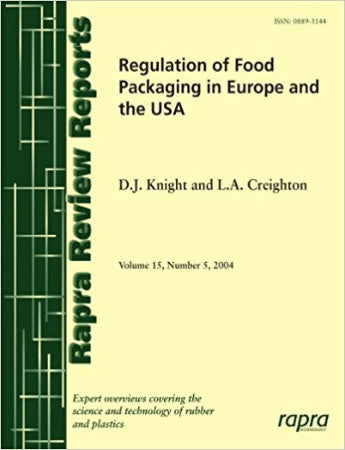
Regulation of Food Pac...
$125.00
{"id":11242214212,"title":"Regulation of Food Packaging in Europe and the USA","handle":"978-1-85957-471-3","description":"\u003ch5\u003eDescription\u003c\/h5\u003e\nAuthor: Derek J Knight and Lesley A Creighton \u003cbr\u003eISBN 978-1-85957-471-3 \u003cbr\u003e\u003cbr\u003eSafePharm Laboratories Ltd.\u003cbr\u003e\u003cbr\u003e\u003cmeta charset=\"utf-8\"\u003e\u003cspan\u003ePublished: 2004\u003cbr\u003e\u003c\/span\u003eRapra Review Reports, Vol. 15, No. 5, Report 173\u003cbr\u003epages 120\u003cbr\u003e\u003cbr\u003e\n\u003ch5\u003eSummary\u003c\/h5\u003e\nA wide variety of plastics is used in food-contact applications and it is important that such plastics do not affect the food with which they come into contact. Given the obvious importance of producing safe and wholesome food, with adequate shelf life, it is not surprising that the food industry is heavily regulated. There is considerable public concern about the safety of food packaging, and one issue is the potential migration of compounding ingredients, monomers or additives from plastics into food. In general, food diffuses into plastic packaging, enhancing the migration of unreacted monomers and potentially mobile additives from the plastic into the food. \u003cbr\u003e\u003cbr\u003eThe objective of food packaging legislation is to protect the consumer by controlling the contamination of food by chemicals transferred from the packaging. Standard migration tests are available based on prescribed food simulants; these tests include overall migration testing and specific migration tests (for individual chemical species). The gradual development of lower detection limits for analytical methods has shown that many substances previously not considered as indirect food additives do actually migrate into food. \u003cbr\u003e\u003cbr\u003eFood packaging regulations are constantly under revision, and differ significantly between Europe and the USA – even between countries within the EU, although there is a strong harmonising influence from the Council of Europe and the European Commission. The regulation of food-contact materials in the EU is currently in a state of development, with various aspects still subject to national provisions until the European Commission has completed the harmonisation process. The US regulatory system is complex, with various approval and certification schemes. \u003cbr\u003e\u003cbr\u003eThis Rapra Review Report provides a clearly written summary of the current legislation surrounding the use of plastics in contact with food. It will be of interest to those working to formulate food-contact plastics, food processors and testing laboratories, packaging manufacturers and users, together with organisations working to ensure safe conditions for food production. \u003cbr\u003e\u003cbr\u003eThis review is accompanied by around 400 abstracts from papers and books in the Rapra Polymer Library database, to facilitate further reading on this subject. A subject index and a company index are included.\u003cbr\u003e\u003cbr\u003e\n\u003ch5\u003eTable of Contents\u003c\/h5\u003e\n1. INTRODUCTION AND OVERVIEW \u003cbr\u003e2. PLASTICS FOR USE IN PACKAGING\u003cbr\u003e2.1 Characteristics of Plastics\u003cbr\u003e2.2 Applications in Packaging\u003cbr\u003e2.2.1 Polymer Types\u003cbr\u003e2.2.2 Combination Products \u003cbr\u003e3. SAFETY EVALUATION OF FOOD PACKAGING\u003cbr\u003e3.1 Exposure Assessment\u003cbr\u003e3.1.1 Migration Evaluation\u003cbr\u003e3.1.2 Estimation of Dietary Exposure\u003cbr\u003e3.2 Toxicology Testing\u003cbr\u003e3.3 Risk Assessment \u003cbr\u003e4. CONTROL OF FOOD PACKAGING IN THE EU\u003cbr\u003e4.1 General Principles and the Framework Directive\u003cbr\u003e4.2 Food-Contact Plastics\u003cbr\u003e4.2.1 The Plastics Directive\u003cbr\u003e4.2.2 EU Lists of Substances for Plastics\u003cbr\u003e4.2.3 Safety Assessment of Additives and Starting Substances for Food-Contact Plastics\u003cbr\u003e4.2.4 Safety Assessment of Polymer Substances\u003cbr\u003e4.3 Future Developments for Food Plastics in the EU\u003cbr\u003e4.3.1 Introduction\u003cbr\u003e4.3.2 Proposed Introduction of a Revised Regulation to Council Directive 89\/109\/EC\u003cbr\u003e4.3.3 The Plastics Super Directive\u003cbr\u003e4.3.4 Active and Intelligent Packaging\u003cbr\u003e4.4 Other EU Food Packaging Measures\u003cbr\u003e4.4.1 Regenerated Cellulose Film\u003cbr\u003e4.4.2 Ceramic Articles\u003cbr\u003e4.4.3 Control of Vinyl Chloride from PVC\u003cbr\u003e4.4.4 Control of N-nitrosamines from Teats and Soothers\u003cbr\u003e4.4.5 Restrictions on Certain Epoxy Derivatives\u003cbr\u003e4.5 Disposal and Recycling of Plastics\u003cbr\u003e4.6 Strategy for Food-Contact Plastic Approval in the EU \u003cbr\u003e5. NATIONAL CONTROLS ON FOOD PACKAGING IN EU COUNTRIES\u003cbr\u003e5.1 Introduction\u003cbr\u003e5.2 Germany\u003cbr\u003e5.3 France\u003cbr\u003e5.4 The Netherlands\u003cbr\u003e5.5 Belgium\u003cbr\u003e5.6 Italy \u003cbr\u003e6. COUNCIL OF EUROPE WORK ON FOOD PACKAGING\u003cbr\u003e6.1 Introduction\u003cbr\u003e6.2 Completed Council of Europe Resolutions\u003cbr\u003e6.2.1 Colorants in Plastic Materials\u003cbr\u003e6.2.2 Polymerisation Aids\u003cbr\u003e6.2.3 Surface Coatings\u003cbr\u003e6.2.4 Ion Exchange and Absorbent Resins\u003cbr\u003e6.2.5 Silicones\u003cbr\u003e6.3 Council of Europe Ongoing Work\u003cbr\u003e6.3.1 Paper and Board\u003cbr\u003e6.3.2 Packaging Inks\u003cbr\u003e6.3.3 Rubber\u003cbr\u003e6.3.4 Other Draft Resolutions and Guidelines and Future Developments \u003cbr\u003e7. FOOD PACKAGING IN THE USA\u003cbr\u003e7.1 Introduction\u003cbr\u003e7.2 Development of US Food Packaging Legislation\u003cbr\u003e7.3 The Petition\u003cbr\u003e7.4 Threshold of Regulation Process\u003cbr\u003e7.5 The Pre-Marketing Notification Scheme \u003cbr\u003e8. CONCLUSIONS\u003cbr\u003eAcknowledgements\u003cbr\u003eAdditional References\u003cbr\u003eAbstracts from the Polymer Library Database\u003cbr\u003eSubject Index\u003cbr\u003eCompany Index\u003cbr\u003e\u003cbr\u003e\n\u003ch5\u003eAbout Author\u003c\/h5\u003e\nDerek J Knight is the Director of Regulatory Affairs at Safepharm Laboratories Ltd., a leading UK contract research organisation, specialising in safety assessments of chemicals, biocides, and agrochemical pesticides. He heads a team of regulatory affairs professionals who deal with a wide range of registration projects covering many product types for regulatory compliance in all the key markets globally. As such he has gained an overall perspective into commercial issues associated with the regulation of the chemical industry. He is a Fellow of the RSC and a Fellow of TOPRA. His doctoral studies at the University of Oxford were in organosulphur chemistry. \u003cbr\u003e\u003cbr\u003eLesley A Creighton has worked within SafePharm Laboratories for 13 years providing regulatory support to the chemical industry for the notification of new chemical substances, food contact materials, and cosmetic products. She has a combined science degree in chemistry and mathematics and is a member of both the RSC and TOPRA. 2004\u003cbr\u003e\u003cbr\u003e","published_at":"2017-06-22T21:13:21-04:00","created_at":"2017-06-22T21:13:21-04:00","vendor":"Chemtec Publishing","type":"Book","tags":["2004","acrylic polymers","book","cellulose","ceramic","epoxy derivatives","EU","exposure","film","food","materials","migration","p-applications","packaging","plastics","polymer","PVC","recycling","testing","toxicology"],"price":12500,"price_min":12500,"price_max":12500,"available":true,"price_varies":false,"compare_at_price":null,"compare_at_price_min":0,"compare_at_price_max":0,"compare_at_price_varies":false,"variants":[{"id":43378351300,"title":"Default Title","option1":"Default Title","option2":null,"option3":null,"sku":"","requires_shipping":true,"taxable":true,"featured_image":null,"available":true,"name":"Regulation of Food Packaging in Europe and the USA","public_title":null,"options":["Default Title"],"price":12500,"weight":1000,"compare_at_price":null,"inventory_quantity":1,"inventory_management":null,"inventory_policy":"continue","barcode":"978-1-85957-471-3","requires_selling_plan":false,"selling_plan_allocations":[],"quantity_rule":{"min":1,"max":null,"increment":1}}],"images":["\/\/chemtec.org\/cdn\/shop\/products\/978-1-85957-471-3.jpg?v=1499724997"],"featured_image":"\/\/chemtec.org\/cdn\/shop\/products\/978-1-85957-471-3.jpg?v=1499724997","options":["Title"],"media":[{"alt":null,"id":358733873245,"position":1,"preview_image":{"aspect_ratio":0.767,"height":450,"width":345,"src":"\/\/chemtec.org\/cdn\/shop\/products\/978-1-85957-471-3.jpg?v=1499724997"},"aspect_ratio":0.767,"height":450,"media_type":"image","src":"\/\/chemtec.org\/cdn\/shop\/products\/978-1-85957-471-3.jpg?v=1499724997","width":345}],"requires_selling_plan":false,"selling_plan_groups":[],"content":"\u003ch5\u003eDescription\u003c\/h5\u003e\nAuthor: Derek J Knight and Lesley A Creighton \u003cbr\u003eISBN 978-1-85957-471-3 \u003cbr\u003e\u003cbr\u003eSafePharm Laboratories Ltd.\u003cbr\u003e\u003cbr\u003e\u003cmeta charset=\"utf-8\"\u003e\u003cspan\u003ePublished: 2004\u003cbr\u003e\u003c\/span\u003eRapra Review Reports, Vol. 15, No. 5, Report 173\u003cbr\u003epages 120\u003cbr\u003e\u003cbr\u003e\n\u003ch5\u003eSummary\u003c\/h5\u003e\nA wide variety of plastics is used in food-contact applications and it is important that such plastics do not affect the food with which they come into contact. Given the obvious importance of producing safe and wholesome food, with adequate shelf life, it is not surprising that the food industry is heavily regulated. There is considerable public concern about the safety of food packaging, and one issue is the potential migration of compounding ingredients, monomers or additives from plastics into food. In general, food diffuses into plastic packaging, enhancing the migration of unreacted monomers and potentially mobile additives from the plastic into the food. \u003cbr\u003e\u003cbr\u003eThe objective of food packaging legislation is to protect the consumer by controlling the contamination of food by chemicals transferred from the packaging. Standard migration tests are available based on prescribed food simulants; these tests include overall migration testing and specific migration tests (for individual chemical species). The gradual development of lower detection limits for analytical methods has shown that many substances previously not considered as indirect food additives do actually migrate into food. \u003cbr\u003e\u003cbr\u003eFood packaging regulations are constantly under revision, and differ significantly between Europe and the USA – even between countries within the EU, although there is a strong harmonising influence from the Council of Europe and the European Commission. The regulation of food-contact materials in the EU is currently in a state of development, with various aspects still subject to national provisions until the European Commission has completed the harmonisation process. The US regulatory system is complex, with various approval and certification schemes. \u003cbr\u003e\u003cbr\u003eThis Rapra Review Report provides a clearly written summary of the current legislation surrounding the use of plastics in contact with food. It will be of interest to those working to formulate food-contact plastics, food processors and testing laboratories, packaging manufacturers and users, together with organisations working to ensure safe conditions for food production. \u003cbr\u003e\u003cbr\u003eThis review is accompanied by around 400 abstracts from papers and books in the Rapra Polymer Library database, to facilitate further reading on this subject. A subject index and a company index are included.\u003cbr\u003e\u003cbr\u003e\n\u003ch5\u003eTable of Contents\u003c\/h5\u003e\n1. INTRODUCTION AND OVERVIEW \u003cbr\u003e2. PLASTICS FOR USE IN PACKAGING\u003cbr\u003e2.1 Characteristics of Plastics\u003cbr\u003e2.2 Applications in Packaging\u003cbr\u003e2.2.1 Polymer Types\u003cbr\u003e2.2.2 Combination Products \u003cbr\u003e3. SAFETY EVALUATION OF FOOD PACKAGING\u003cbr\u003e3.1 Exposure Assessment\u003cbr\u003e3.1.1 Migration Evaluation\u003cbr\u003e3.1.2 Estimation of Dietary Exposure\u003cbr\u003e3.2 Toxicology Testing\u003cbr\u003e3.3 Risk Assessment \u003cbr\u003e4. CONTROL OF FOOD PACKAGING IN THE EU\u003cbr\u003e4.1 General Principles and the Framework Directive\u003cbr\u003e4.2 Food-Contact Plastics\u003cbr\u003e4.2.1 The Plastics Directive\u003cbr\u003e4.2.2 EU Lists of Substances for Plastics\u003cbr\u003e4.2.3 Safety Assessment of Additives and Starting Substances for Food-Contact Plastics\u003cbr\u003e4.2.4 Safety Assessment of Polymer Substances\u003cbr\u003e4.3 Future Developments for Food Plastics in the EU\u003cbr\u003e4.3.1 Introduction\u003cbr\u003e4.3.2 Proposed Introduction of a Revised Regulation to Council Directive 89\/109\/EC\u003cbr\u003e4.3.3 The Plastics Super Directive\u003cbr\u003e4.3.4 Active and Intelligent Packaging\u003cbr\u003e4.4 Other EU Food Packaging Measures\u003cbr\u003e4.4.1 Regenerated Cellulose Film\u003cbr\u003e4.4.2 Ceramic Articles\u003cbr\u003e4.4.3 Control of Vinyl Chloride from PVC\u003cbr\u003e4.4.4 Control of N-nitrosamines from Teats and Soothers\u003cbr\u003e4.4.5 Restrictions on Certain Epoxy Derivatives\u003cbr\u003e4.5 Disposal and Recycling of Plastics\u003cbr\u003e4.6 Strategy for Food-Contact Plastic Approval in the EU \u003cbr\u003e5. NATIONAL CONTROLS ON FOOD PACKAGING IN EU COUNTRIES\u003cbr\u003e5.1 Introduction\u003cbr\u003e5.2 Germany\u003cbr\u003e5.3 France\u003cbr\u003e5.4 The Netherlands\u003cbr\u003e5.5 Belgium\u003cbr\u003e5.6 Italy \u003cbr\u003e6. COUNCIL OF EUROPE WORK ON FOOD PACKAGING\u003cbr\u003e6.1 Introduction\u003cbr\u003e6.2 Completed Council of Europe Resolutions\u003cbr\u003e6.2.1 Colorants in Plastic Materials\u003cbr\u003e6.2.2 Polymerisation Aids\u003cbr\u003e6.2.3 Surface Coatings\u003cbr\u003e6.2.4 Ion Exchange and Absorbent Resins\u003cbr\u003e6.2.5 Silicones\u003cbr\u003e6.3 Council of Europe Ongoing Work\u003cbr\u003e6.3.1 Paper and Board\u003cbr\u003e6.3.2 Packaging Inks\u003cbr\u003e6.3.3 Rubber\u003cbr\u003e6.3.4 Other Draft Resolutions and Guidelines and Future Developments \u003cbr\u003e7. FOOD PACKAGING IN THE USA\u003cbr\u003e7.1 Introduction\u003cbr\u003e7.2 Development of US Food Packaging Legislation\u003cbr\u003e7.3 The Petition\u003cbr\u003e7.4 Threshold of Regulation Process\u003cbr\u003e7.5 The Pre-Marketing Notification Scheme \u003cbr\u003e8. CONCLUSIONS\u003cbr\u003eAcknowledgements\u003cbr\u003eAdditional References\u003cbr\u003eAbstracts from the Polymer Library Database\u003cbr\u003eSubject Index\u003cbr\u003eCompany Index\u003cbr\u003e\u003cbr\u003e\n\u003ch5\u003eAbout Author\u003c\/h5\u003e\nDerek J Knight is the Director of Regulatory Affairs at Safepharm Laboratories Ltd., a leading UK contract research organisation, specialising in safety assessments of chemicals, biocides, and agrochemical pesticides. He heads a team of regulatory affairs professionals who deal with a wide range of registration projects covering many product types for regulatory compliance in all the key markets globally. As such he has gained an overall perspective into commercial issues associated with the regulation of the chemical industry. He is a Fellow of the RSC and a Fellow of TOPRA. His doctoral studies at the University of Oxford were in organosulphur chemistry. \u003cbr\u003e\u003cbr\u003eLesley A Creighton has worked within SafePharm Laboratories for 13 years providing regulatory support to the chemical industry for the notification of new chemical substances, food contact materials, and cosmetic products. She has a combined science degree in chemistry and mathematics and is a member of both the RSC and TOPRA. 2004\u003cbr\u003e\u003cbr\u003e"}
Reinforced Thermoplast...
$75.00
{"id":11242254404,"title":"Reinforced Thermoplastics - Composition, Processing and Applications","handle":"978-0-902348-78-3","description":"\u003ch5\u003eDescription\u003c\/h5\u003e\nAuthor: P.G. Kelleher \u003cbr\u003eISBN 978-0-902348-78-3 \u003cbr\u003e\u003cbr\u003eNew Jersey Polymer Extension Center\u003cbr\u003e\u003cmeta charset=\"utf-8\"\u003e\u003cspan\u003ePublished: 1993\u003cbr\u003e\u003c\/span\u003eReview Report\u003cbr\u003e\n\u003ch5\u003eSummary\u003c\/h5\u003e\nThis report covers semi and non-crystalline thermoplastics, polymer blends, and various classes of reinforcing fibers and their properties which determine their suitability for specific applications. The long-term properties are discussed and effect of external forces, heat, weathering, chemical attack, and frictional wear. The uses in telecommunication, medical devices, sporting goods, and automotive applications provide an indication of the potential of these materials. \u003cbr\u003e\u003cbr\u003e\u003cstrong\u003eFibers:\u003c\/strong\u003e glass, ceramic, wollastonite, asbestos, carbon-graphite, aramid, UHMWPE, rigid rod \u003cbr\u003e\u003cbr\u003e\u003cstrong\u003eFrom the Table of Content:\u003c\/strong\u003e \u003cbr\u003e\n\u003cul\u003e\n\u003cli\u003eReinforcing Fibers\u003c\/li\u003e\n\u003cli\u003eEffect of Reinforcement\u003c\/li\u003e\n\u003cli\u003eTime-dependent Properties\u003c\/li\u003e\n\u003cli\u003eFactors Affecting Properties\u003c\/li\u003e\n\u003cli\u003eInjection Molding\u003c\/li\u003e\n\u003cli\u003eInfluence of Processing on Morphology\u003c\/li\u003e\n\u003cli\u003eApplications of Thermoplastic Composites\u003c\/li\u003e\n\u003c\/ul\u003e","published_at":"2017-06-22T21:15:28-04:00","created_at":"2017-06-22T21:15:28-04:00","vendor":"Chemtec Publishing","type":"Book","tags":["1993","aramid","asbestos","book","carbon-graphite","ceramic","composition","glass","p-structural","polymer","processing","rigid rod","thermoplastics","UHMWPE","wollastonite"],"price":7500,"price_min":7500,"price_max":7500,"available":true,"price_varies":false,"compare_at_price":null,"compare_at_price_min":0,"compare_at_price_max":0,"compare_at_price_varies":false,"variants":[{"id":43378489860,"title":"Default Title","option1":"Default Title","option2":null,"option3":null,"sku":"","requires_shipping":true,"taxable":true,"featured_image":null,"available":true,"name":"Reinforced Thermoplastics - Composition, Processing and Applications","public_title":null,"options":["Default Title"],"price":7500,"weight":1000,"compare_at_price":null,"inventory_quantity":1,"inventory_management":null,"inventory_policy":"continue","barcode":"978-0-902348-78-3","requires_selling_plan":false,"selling_plan_allocations":[],"quantity_rule":{"min":1,"max":null,"increment":1}}],"images":["\/\/chemtec.org\/cdn\/shop\/products\/978-0-902348-78-3.jpg?v=1499954163"],"featured_image":"\/\/chemtec.org\/cdn\/shop\/products\/978-0-902348-78-3.jpg?v=1499954163","options":["Title"],"media":[{"alt":null,"id":358734430301,"position":1,"preview_image":{"aspect_ratio":0.767,"height":450,"width":345,"src":"\/\/chemtec.org\/cdn\/shop\/products\/978-0-902348-78-3.jpg?v=1499954163"},"aspect_ratio":0.767,"height":450,"media_type":"image","src":"\/\/chemtec.org\/cdn\/shop\/products\/978-0-902348-78-3.jpg?v=1499954163","width":345}],"requires_selling_plan":false,"selling_plan_groups":[],"content":"\u003ch5\u003eDescription\u003c\/h5\u003e\nAuthor: P.G. Kelleher \u003cbr\u003eISBN 978-0-902348-78-3 \u003cbr\u003e\u003cbr\u003eNew Jersey Polymer Extension Center\u003cbr\u003e\u003cmeta charset=\"utf-8\"\u003e\u003cspan\u003ePublished: 1993\u003cbr\u003e\u003c\/span\u003eReview Report\u003cbr\u003e\n\u003ch5\u003eSummary\u003c\/h5\u003e\nThis report covers semi and non-crystalline thermoplastics, polymer blends, and various classes of reinforcing fibers and their properties which determine their suitability for specific applications. The long-term properties are discussed and effect of external forces, heat, weathering, chemical attack, and frictional wear. The uses in telecommunication, medical devices, sporting goods, and automotive applications provide an indication of the potential of these materials. \u003cbr\u003e\u003cbr\u003e\u003cstrong\u003eFibers:\u003c\/strong\u003e glass, ceramic, wollastonite, asbestos, carbon-graphite, aramid, UHMWPE, rigid rod \u003cbr\u003e\u003cbr\u003e\u003cstrong\u003eFrom the Table of Content:\u003c\/strong\u003e \u003cbr\u003e\n\u003cul\u003e\n\u003cli\u003eReinforcing Fibers\u003c\/li\u003e\n\u003cli\u003eEffect of Reinforcement\u003c\/li\u003e\n\u003cli\u003eTime-dependent Properties\u003c\/li\u003e\n\u003cli\u003eFactors Affecting Properties\u003c\/li\u003e\n\u003cli\u003eInjection Molding\u003c\/li\u003e\n\u003cli\u003eInfluence of Processing on Morphology\u003c\/li\u003e\n\u003cli\u003eApplications of Thermoplastic Composites\u003c\/li\u003e\n\u003c\/ul\u003e"}

Rheology and its Role ...
$72.00
{"id":11242256708,"title":"Rheology and its Role in Plastics Processing","handle":"978-1-85957-053-1","description":"\u003ch5\u003eDescription\u003c\/h5\u003e\nAuthor: P. Prentice \u003cbr\u003eISBN 978-1-85957-053-1 \u003cbr\u003e\u003cbr\u003eThe Nottingham Trent University\u003cbr\u003e\u003cbr\u003e\u003cmeta charset=\"utf-8\"\u003e\u003cspan\u003ePublished: 1995\u003cbr\u003e\u003c\/span\u003e94 pages, softbound\u003cbr\u003e\n\u003ch5\u003eSummary\u003c\/h5\u003e\nThis review encompases fundamental principles and rheological equations of state, polymer melt rheology (shear and extensional flow, viscoelasticity, die swell and melt fracture) and rheological measurement techniques. It describes the main plastics processing techniques and explains the influence of polymer melt rheology upon their operation. 48 figures and more than 80 equations enhance the review, which is also supported by extensive, indexed bibliography.\u003cbr\u003e\u003cbr\u003e\u003cstrong\u003eFrom the Table of Contents:\u003c\/strong\u003e \u003cbr\u003e\n\u003cul\u003e\n\u003cli\u003eRheological Equations of State\u003c\/li\u003e\n\u003cli\u003eFundamental Principles of Rheology\u003c\/li\u003e\n\u003cli\u003ePolymer Melt Rheology\u003c\/li\u003e\n\u003cli\u003eRheological Techniques\u003c\/li\u003e\n\u003cli\u003ePolymer Processing (extrusion, injection molding, calendering, rotational casting)\u003c\/li\u003e\n\u003cli\u003eThe Effect of Rheology on Polymer Processing\u003c\/li\u003e\n\u003cli\u003eRheology in the Design\u003c\/li\u003e\n\u003c\/ul\u003e","published_at":"2017-06-22T21:15:34-04:00","created_at":"2017-06-22T21:15:34-04:00","vendor":"Chemtec Publishing","type":"Book","tags":["1995","book","calendering","extrusion","injection molding","moulding","p-properties","plastics","polymer","polymers","processing","rheology","rotational casting"],"price":7200,"price_min":7200,"price_max":7200,"available":true,"price_varies":false,"compare_at_price":null,"compare_at_price_min":0,"compare_at_price_max":0,"compare_at_price_varies":false,"variants":[{"id":43378497860,"title":"Default Title","option1":"Default Title","option2":null,"option3":null,"sku":"","requires_shipping":true,"taxable":true,"featured_image":null,"available":true,"name":"Rheology and its Role in Plastics Processing","public_title":null,"options":["Default Title"],"price":7200,"weight":1000,"compare_at_price":null,"inventory_quantity":1,"inventory_management":null,"inventory_policy":"continue","barcode":"978-1-85957-053-1","requires_selling_plan":false,"selling_plan_allocations":[],"quantity_rule":{"min":1,"max":null,"increment":1}}],"images":["\/\/chemtec.org\/cdn\/shop\/products\/978-1-85957-053-1.jpg?v=1499954183"],"featured_image":"\/\/chemtec.org\/cdn\/shop\/products\/978-1-85957-053-1.jpg?v=1499954183","options":["Title"],"media":[{"alt":null,"id":358734987357,"position":1,"preview_image":{"aspect_ratio":0.767,"height":450,"width":345,"src":"\/\/chemtec.org\/cdn\/shop\/products\/978-1-85957-053-1.jpg?v=1499954183"},"aspect_ratio":0.767,"height":450,"media_type":"image","src":"\/\/chemtec.org\/cdn\/shop\/products\/978-1-85957-053-1.jpg?v=1499954183","width":345}],"requires_selling_plan":false,"selling_plan_groups":[],"content":"\u003ch5\u003eDescription\u003c\/h5\u003e\nAuthor: P. Prentice \u003cbr\u003eISBN 978-1-85957-053-1 \u003cbr\u003e\u003cbr\u003eThe Nottingham Trent University\u003cbr\u003e\u003cbr\u003e\u003cmeta charset=\"utf-8\"\u003e\u003cspan\u003ePublished: 1995\u003cbr\u003e\u003c\/span\u003e94 pages, softbound\u003cbr\u003e\n\u003ch5\u003eSummary\u003c\/h5\u003e\nThis review encompases fundamental principles and rheological equations of state, polymer melt rheology (shear and extensional flow, viscoelasticity, die swell and melt fracture) and rheological measurement techniques. It describes the main plastics processing techniques and explains the influence of polymer melt rheology upon their operation. 48 figures and more than 80 equations enhance the review, which is also supported by extensive, indexed bibliography.\u003cbr\u003e\u003cbr\u003e\u003cstrong\u003eFrom the Table of Contents:\u003c\/strong\u003e \u003cbr\u003e\n\u003cul\u003e\n\u003cli\u003eRheological Equations of State\u003c\/li\u003e\n\u003cli\u003eFundamental Principles of Rheology\u003c\/li\u003e\n\u003cli\u003ePolymer Melt Rheology\u003c\/li\u003e\n\u003cli\u003eRheological Techniques\u003c\/li\u003e\n\u003cli\u003ePolymer Processing (extrusion, injection molding, calendering, rotational casting)\u003c\/li\u003e\n\u003cli\u003eThe Effect of Rheology on Polymer Processing\u003c\/li\u003e\n\u003cli\u003eRheology in the Design\u003c\/li\u003e\n\u003c\/ul\u003e"}

Rheology Essentials of...
$150.00
{"id":11242232900,"title":"Rheology Essentials of Cosmetic and Food Emulsions","handle":"978-3-540-25553-6","description":"\u003ch5\u003eDescription\u003c\/h5\u003e\nAuthor: Rüdiger Brummer \u003cbr\u003eISBN 978-3-540-25553-6 \u003cbr\u003e\u003cbr\u003eSpringer Laboratory \u003cbr\u003e\u003cmeta charset=\"utf-8\"\u003e\u003cspan\u003ePublished: 2006\u003cbr\u003e\u003c\/span\u003epages 180, 184 illus., 139 in color., Hardcover\n\u003ch5\u003eSummary\u003c\/h5\u003e\n\u003cp\u003eCosmetic emulsions exist today in many forms for a wide variety of applications, including face and hand creams for normal, dry or oily skin, body milks, and lotions, as well as sun-block products. Keeping track of them and their properties are not always easy despite informative product names or partial names (e.g. hand or face cream) that clearly indicate their use and properties. This practical manual provides a detailed overview that describes the key properties and explains how to measure them using modern techniques. Written by expert inflows and flow properties, it focuses on the application of rheological (flow) measurements to cosmetic and food emulsions and the correlation of these results with findings from other tests.\u003c\/p\u003e\n\u003cp\u003eBeginning with a brief history of rheology and some fundamental principles, the manual describes in detail the use of modern viscometers and rheometers, including concise explanations of the different available instruments. But the focus remains on practical everyday lab procedures: how to characterize cosmetic and food emulsions with different rheological tests such as temperature, time, stress and strain, both static and dynamic. Also the critical topic of how the results correlate with other important product characteristics, for instance, skin sensation, pumping performance, stability etc. is carefully explored. Many pictures, illustrations, graphs, and tables help readers new to the measurement of cosmetic emulsions in their daily work as well as to the more experienced who seek additional special tips and tricks.\u003c\/p\u003e\n\u003ch5\u003eTable of Contents\u003c\/h5\u003e\n\u003cp\u003e1 INTRODUCTION (pg. 1) \u003cbr\u003e2 A TRIP BACK IN TIME (pg. 5)\u003cbr\u003e3 SKIN AND ITS CARE (pg. 15)\u003cbr\u003e\u003cb\u003e4 EMULSIONS – SOME THEORETICAL ASPECTS (pg. 17)\u003cbr\u003e\u003c\/b\u003e4.1 Physicochemical Structure of Cosmetic Products (pg.17)\u003cbr\u003e4.2 Modern Emulsifiers (pg. 19)\u003cbr\u003e4.3 Skin Care and Cleansing (pg. 19)\u003cbr\u003e4.4 Microemulsions (pg. 19)\u003cbr\u003e4.5 Emulsifier-Free Products (pg. 20)\u003cbr\u003e4.6 Production of Emulsions (pg.21)\u003cbr\u003e4.7 Processes occurring during Emulsification (pg. 21)\u003cbr\u003e4.8 Serrated Disc Disperser (pg. 22)\u003cbr\u003e\u003cb\u003e5 BASIC PHYSICAL AND MATHEMATICAL PRINCIPLES (pg. 25)\u003cbr\u003e\u003c\/b\u003e5.1 Important Definitions (pg. 25)\u003cbr\u003e5.2 One-Dimensional Parallel PlatesModel (pg. 28)\u003cbr\u003e5.3 Parallel PlateMeasuring System (pg. 30)\u003cbr\u003e5.4 Cone-PlateMeasuring System (pg. 31)\u003cbr\u003e5.5 Coaxial Cylinder Systems (pg. 32)\u003cbr\u003e5.6 Double GapMeasuring System (pg. 35)\u003cbr\u003e5.7 Flow Through Circular Capillary (pg. 36)\u003cbr\u003e5.8 CorrectionMethods (pg. 38)\u003cbr\u003e5.8.1 PPMeasurement System (pg. 39)\u003cbr\u003e5.8.2 Cylinder Measurement Systems (pg. 39)\u003cbr\u003e5.8.3 Circular Capillaries (pg. 39)\u003cbr\u003e5.9 Deformation and Relaxation 40)\u003cbr\u003e5.10 Thixotropy and Rheopexy (pg. 43)\u003cbr\u003e5.11 Vibration orOscillationMeasurements (pg. 44)\u003cbr\u003e5.11.1 Steady andDynamic Stress (pg. 45)\u003cbr\u003e5.11.2 Ideal Elastic Solids (pg. 46)\u003cbr\u003e5.11.3 IdealViscous Fluids (pg. 46)\u003cbr\u003e5.11.4 Real Solids (pg. 47)\u003cbr\u003e5.11.5 Complex Representation (pg. 48)\u003cbr\u003eXVI)\u003cbr\u003e\u003cb\u003e6 MEASURING INSTRUMENTS (pg. 51)\u003cbr\u003e\u003c\/b\u003e6.1 Modern Rheometer (pg. 52)\u003cbr\u003e6.2 High Shear Rheometer (pg. 54)\u003cbr\u003e6.3 StandardViscometer (pg. 55)\u003cbr\u003e6.4 OftenUsedViscometer (pg. 56)\u003cbr\u003e6.5 Automatic Sampler (pg. 57)\u003cbr\u003e6.6 In-process In-\/On-line Viscosity Measurements (pg. 58)\u003cbr\u003e6.7 Future Prospects (pg. 61)\u003cbr\u003e\u003cb\u003e7 MOST IMPORTANT TEST METHODS (pg. 63)\u003cbr\u003e\u003c\/b\u003e7.1 Stress Ramp Test (pg. 65)\u003cbr\u003e7.2 Newtonian Flow Behavior (pg. 67)\u003cbr\u003e7.3 Creep Test and Creep Recovery (pg. 67)\u003cbr\u003e7.4 The Ideal Elastic Behavior (pg. 68)\u003cbr\u003e7.5 The IdealViscous Behavior (pg. 68)\u003cbr\u003e7.6 RealViscoelastic Behavior (pg. 69)\u003cbr\u003e7.7 Steady Flow Curve (pg. 69)\u003cbr\u003e7.8 AmplitudeDependence (pg. 71)\u003cbr\u003e7.9 Structure Breakdown and BuildUp (pg. 73)\u003cbr\u003e7.10 TimeDependence (pg. 74)\u003cbr\u003e7.11 Frequency Test (pg. 75)\u003cbr\u003e7.12 Temperature Dependence (pg. 76)\u003cbr\u003e7.13 Combined Temperature-Time Test (pg. 77)\u003cbr\u003e\u003cb\u003e8 ANALYSIS OF MEASURING RESULTS AND CORRELATIONS)\u003cbr\u003eWITH OTHER TESTS (pg. 81)\u003cbr\u003e\u003c\/b\u003e8.1 Yield Stress (pg. 81)\u003cbr\u003e8.1.1 Correlations of the Yield Stress with the Primary Skin Feel (pg. 82)\u003cbr\u003e8.1.2 Optimization of the Stress Ramp Test (pg. 83)\u003cbr\u003e8.1.3 Residue Emptying (pg. 85)\u003cbr\u003e8.1.4 Energy Input (pg. 87)\u003cbr\u003e8.1.4.1 Measurement of the Energy Input (pg. 88)\u003cbr\u003e8.1.5 Droplet Sizes and their Distribution (pg. 90)\u003cbr\u003e8.1.6 Pumpability of Cosmetic Emulsions (pg. 92)\u003cbr\u003e8.1.6.1 Estimation of the Maximum Shear Rate (pg. 93)\u003cbr\u003e8.1.6.2 Calculation of the Shear Stress (pg. 94)\u003cbr\u003e8.1.7 Stability Studies Using Yield Stress Measurements (pg. 95)\u003cbr\u003e8.1.8 Results Obtained (pg. 96)\u003cbr\u003e8.2 Steady Flow (pg. 97)\u003cbr\u003e8.2.1 Determination of the Measuring Time (pg. 97)\u003cbr\u003e8.2.2 Temperature Dependence of the Dynamic Viscosity (pg. 98)\u003cbr\u003e8.2.3 Secondary Skin Feel (pg. 99)\u003cbr\u003e8.2.3.1 Investigation of the Secondary Skin Feel (pg. 100)\u003cbr\u003e8.3 OscillatoryMeasurements (pg. 101)\u003cbr\u003e8.3.1 Temperature Dependence of the Moduli (pg. 106)\u003cbr\u003e8.3.2 Temperature Stability (pg. 110)\u003cbr\u003e8.3.3 Rheological Swing Test for Temperature Stability (pg. 112)\u003cbr\u003e8.4 Time Temperature Superposition (TTS) (pg. 117)\u003cbr\u003e8.4.1 Softening Point (pg. 118)\u003cbr\u003e8.4.2 Freezing Point (pg. 118)\u003cbr\u003e8.4.3 Determination of the Master Curve at Constant Frequency (pg.118)\u003cbr\u003e8.4.3.1 Determination of the Activation Energy)\u003cbr\u003evia the Temperature (pg.119)\u003cbr\u003e8.4.3.2 Viscosity (pg. 119)\u003cbr\u003e8.4.3.3 Arrhenius Equation (pg. 120)\u003cbr\u003e8.4.3.4 WLF Equation (pg. 122)\u003cbr\u003e8.4.3.5 First Conclusion (pg. 122)\u003cbr\u003e8.4.3.6 Determination of the Master Curve)\u003cbr\u003ewith Variable Frequency (pg. 123)\u003cbr\u003e8.4.3.7 Final Conclusion (pg. 124)\u003cbr\u003e\u003cb\u003e9 INTERPRETATION (pg. 125)\u003cbr\u003e\u003c\/b\u003e9.1 Relationships for Polymers (pg. 125)\u003cbr\u003e9.2 General Statements for Cosmetic Emulsions (pg. 127)\u003cbr\u003e\u003cb\u003e10 CALIBRATION\/VALIDATION (pg. 131)\u003cbr\u003e\u003c\/b\u003e10.1 Basic Principles of Statistical Analysis (pg. 133)\u003cbr\u003e10.1.1 NormalDistribution (GaussianDistribution) (pg. 133)\u003cbr\u003e10.1.2 MeanValue (pg. 134)\u003cbr\u003e10.1.3 True Value (pg. 135)\u003cbr\u003e10.1.4 StandardDeviation andVariance (pg. 135)\u003cbr\u003e10.1.4.1 StandardDeviation (pg. 136)\u003cbr\u003e10.1.4.2 Coefficient ofVariation (pg. 136)\u003cbr\u003e10.1.5 MeasuredValue, Result, RandomVariable (pg. 136)\u003cbr\u003e10.1.6 Population, Series,MeasuredValue (pg. 137)\u003cbr\u003e10.1.7 Errors andDeviations (pg. 137)\u003cbr\u003e10.1.7.1 Error Types (pg. 137)\u003cbr\u003e10.1.8 Precision (pg. 138)\u003cbr\u003e10.1.9 Accuracy (pg. 139)\u003cbr\u003e10.1.10 Trueness (pg. 139)\u003cbr\u003e10.1.11 Repeatability (pg. 139)\u003cbr\u003e10.1.12 Reproducibility (pg. 140)\u003cbr\u003e10.1.13 Outliers (pg. 140)\u003cbr\u003e10.2 Back to the Laboratory (pg. 140)\u003cbr\u003e10.2.1 Calibration Test forOscillatoryMeasurements (pg. 143)\u003cbr\u003e10.2.2 Temperature (pg. 145)\u003cbr\u003e\u003cb\u003e11 TIPS AND TRICKS (pg. 147)\u003cbr\u003e\u003c\/b\u003e11.1 Materials for Geometric Systems (pg. 147)\u003cbr\u003e11.2 Cone-plate (pg. 147)\u003cbr\u003e11.3 Parallel Plate (pg. 148)\u003cbr\u003e11.4 Cylinder Systems (pg. 148)\u003cbr\u003e11.5 Cleaning Measuring Systems (pg. 148)\u003cbr\u003e11.6 Measurement Artifacts (pg. 149)\u003cbr\u003e11.7 Filling of Cone-plate and Parallel Plate Measuring Systems (pg. 150)\u003cbr\u003e11.8 Interpretation (pg. 152)\u003cbr\u003e\u003cb\u003e12 DEFINITION OF COSMETICS (pg. 155)\u003cbr\u003e\u003c\/b\u003e12.1 Cosmetics vs.Drugs (pg. 155)\u003cbr\u003e12.2 Production of Cosmetic Products (pg. 155)\u003cbr\u003e12.3 Naming, Trademark Law, Patents Law (pg. 156)\u003cbr\u003e12.4 Marketing of Cosmetic Products (pg. 156)\u003cbr\u003e12.5 Advertising Cosmetic Products (pg. 157)\u003cbr\u003e12.6 Comments (pg. 160)\u003cbr\u003e\u003cb\u003e13 EXCURSION IN THEWORLD OF FOOD RHEOLOGY (pg. 161)\u003cbr\u003e\u003c\/b\u003e13.1 AShort History of Food Rheology (pg. 161)\u003cbr\u003e13.1.1 TheOrigins of Food Rheology (pg. 163)\u003cbr\u003e13.2 Honey (pg. 163)\u003cbr\u003e13.3 Sandwich Spreads (pg. 164)\u003cbr\u003e13.4 Cheese (pg. 165)\u003cbr\u003e13.5 Ketchup (pg. 165)\u003cbr\u003e13.6 Yoghurt (pg. 166)\u003cbr\u003e13.7 Marzipan (pg. 166)\u003cbr\u003e13.8 Starch (pg. 168)\u003cbr\u003e13.9 Foams (pg. 169)\u003cbr\u003e13.10 Chocolate (pg. 170)\u003cbr\u003e13.11 Psychorheology (pg. 170)\u003cbr\u003e\u003cb\u003e14 LIST OF REFERENCES (pg. 173)\u003cbr\u003e15 SUBJECT INDEX (pg. 177)\u003cbr\u003e\u003c\/b\u003e\u003c\/p\u003e","published_at":"2017-06-22T21:14:22-04:00","created_at":"2017-06-22T21:14:22-04:00","vendor":"Chemtec Publishing","type":"Book","tags":["2006","analysis","book","cosmetic emulsions","cosmetics","emulsion","food technology","kosmetische emulsionen","p-properties","polymer","reology","rheologie","rheology","test methods","toiletries","toilettenartikel","viscosimetry"],"price":15000,"price_min":15000,"price_max":15000,"available":true,"price_varies":false,"compare_at_price":null,"compare_at_price_min":0,"compare_at_price_max":0,"compare_at_price_varies":false,"variants":[{"id":43378413188,"title":"Default Title","option1":"Default Title","option2":null,"option3":null,"sku":"","requires_shipping":true,"taxable":true,"featured_image":null,"available":true,"name":"Rheology Essentials of Cosmetic and Food Emulsions","public_title":null,"options":["Default Title"],"price":15000,"weight":1000,"compare_at_price":null,"inventory_quantity":1,"inventory_management":null,"inventory_policy":"continue","barcode":"978-3-540-25553-6","requires_selling_plan":false,"selling_plan_allocations":[],"quantity_rule":{"min":1,"max":null,"increment":1}}],"images":["\/\/chemtec.org\/cdn\/shop\/products\/978-3-540-25553-6.jpg?v=1499954205"],"featured_image":"\/\/chemtec.org\/cdn\/shop\/products\/978-3-540-25553-6.jpg?v=1499954205","options":["Title"],"media":[{"alt":null,"id":358737739869,"position":1,"preview_image":{"aspect_ratio":0.767,"height":450,"width":345,"src":"\/\/chemtec.org\/cdn\/shop\/products\/978-3-540-25553-6.jpg?v=1499954205"},"aspect_ratio":0.767,"height":450,"media_type":"image","src":"\/\/chemtec.org\/cdn\/shop\/products\/978-3-540-25553-6.jpg?v=1499954205","width":345}],"requires_selling_plan":false,"selling_plan_groups":[],"content":"\u003ch5\u003eDescription\u003c\/h5\u003e\nAuthor: Rüdiger Brummer \u003cbr\u003eISBN 978-3-540-25553-6 \u003cbr\u003e\u003cbr\u003eSpringer Laboratory \u003cbr\u003e\u003cmeta charset=\"utf-8\"\u003e\u003cspan\u003ePublished: 2006\u003cbr\u003e\u003c\/span\u003epages 180, 184 illus., 139 in color., Hardcover\n\u003ch5\u003eSummary\u003c\/h5\u003e\n\u003cp\u003eCosmetic emulsions exist today in many forms for a wide variety of applications, including face and hand creams for normal, dry or oily skin, body milks, and lotions, as well as sun-block products. Keeping track of them and their properties are not always easy despite informative product names or partial names (e.g. hand or face cream) that clearly indicate their use and properties. This practical manual provides a detailed overview that describes the key properties and explains how to measure them using modern techniques. Written by expert inflows and flow properties, it focuses on the application of rheological (flow) measurements to cosmetic and food emulsions and the correlation of these results with findings from other tests.\u003c\/p\u003e\n\u003cp\u003eBeginning with a brief history of rheology and some fundamental principles, the manual describes in detail the use of modern viscometers and rheometers, including concise explanations of the different available instruments. But the focus remains on practical everyday lab procedures: how to characterize cosmetic and food emulsions with different rheological tests such as temperature, time, stress and strain, both static and dynamic. Also the critical topic of how the results correlate with other important product characteristics, for instance, skin sensation, pumping performance, stability etc. is carefully explored. Many pictures, illustrations, graphs, and tables help readers new to the measurement of cosmetic emulsions in their daily work as well as to the more experienced who seek additional special tips and tricks.\u003c\/p\u003e\n\u003ch5\u003eTable of Contents\u003c\/h5\u003e\n\u003cp\u003e1 INTRODUCTION (pg. 1) \u003cbr\u003e2 A TRIP BACK IN TIME (pg. 5)\u003cbr\u003e3 SKIN AND ITS CARE (pg. 15)\u003cbr\u003e\u003cb\u003e4 EMULSIONS – SOME THEORETICAL ASPECTS (pg. 17)\u003cbr\u003e\u003c\/b\u003e4.1 Physicochemical Structure of Cosmetic Products (pg.17)\u003cbr\u003e4.2 Modern Emulsifiers (pg. 19)\u003cbr\u003e4.3 Skin Care and Cleansing (pg. 19)\u003cbr\u003e4.4 Microemulsions (pg. 19)\u003cbr\u003e4.5 Emulsifier-Free Products (pg. 20)\u003cbr\u003e4.6 Production of Emulsions (pg.21)\u003cbr\u003e4.7 Processes occurring during Emulsification (pg. 21)\u003cbr\u003e4.8 Serrated Disc Disperser (pg. 22)\u003cbr\u003e\u003cb\u003e5 BASIC PHYSICAL AND MATHEMATICAL PRINCIPLES (pg. 25)\u003cbr\u003e\u003c\/b\u003e5.1 Important Definitions (pg. 25)\u003cbr\u003e5.2 One-Dimensional Parallel PlatesModel (pg. 28)\u003cbr\u003e5.3 Parallel PlateMeasuring System (pg. 30)\u003cbr\u003e5.4 Cone-PlateMeasuring System (pg. 31)\u003cbr\u003e5.5 Coaxial Cylinder Systems (pg. 32)\u003cbr\u003e5.6 Double GapMeasuring System (pg. 35)\u003cbr\u003e5.7 Flow Through Circular Capillary (pg. 36)\u003cbr\u003e5.8 CorrectionMethods (pg. 38)\u003cbr\u003e5.8.1 PPMeasurement System (pg. 39)\u003cbr\u003e5.8.2 Cylinder Measurement Systems (pg. 39)\u003cbr\u003e5.8.3 Circular Capillaries (pg. 39)\u003cbr\u003e5.9 Deformation and Relaxation 40)\u003cbr\u003e5.10 Thixotropy and Rheopexy (pg. 43)\u003cbr\u003e5.11 Vibration orOscillationMeasurements (pg. 44)\u003cbr\u003e5.11.1 Steady andDynamic Stress (pg. 45)\u003cbr\u003e5.11.2 Ideal Elastic Solids (pg. 46)\u003cbr\u003e5.11.3 IdealViscous Fluids (pg. 46)\u003cbr\u003e5.11.4 Real Solids (pg. 47)\u003cbr\u003e5.11.5 Complex Representation (pg. 48)\u003cbr\u003eXVI)\u003cbr\u003e\u003cb\u003e6 MEASURING INSTRUMENTS (pg. 51)\u003cbr\u003e\u003c\/b\u003e6.1 Modern Rheometer (pg. 52)\u003cbr\u003e6.2 High Shear Rheometer (pg. 54)\u003cbr\u003e6.3 StandardViscometer (pg. 55)\u003cbr\u003e6.4 OftenUsedViscometer (pg. 56)\u003cbr\u003e6.5 Automatic Sampler (pg. 57)\u003cbr\u003e6.6 In-process In-\/On-line Viscosity Measurements (pg. 58)\u003cbr\u003e6.7 Future Prospects (pg. 61)\u003cbr\u003e\u003cb\u003e7 MOST IMPORTANT TEST METHODS (pg. 63)\u003cbr\u003e\u003c\/b\u003e7.1 Stress Ramp Test (pg. 65)\u003cbr\u003e7.2 Newtonian Flow Behavior (pg. 67)\u003cbr\u003e7.3 Creep Test and Creep Recovery (pg. 67)\u003cbr\u003e7.4 The Ideal Elastic Behavior (pg. 68)\u003cbr\u003e7.5 The IdealViscous Behavior (pg. 68)\u003cbr\u003e7.6 RealViscoelastic Behavior (pg. 69)\u003cbr\u003e7.7 Steady Flow Curve (pg. 69)\u003cbr\u003e7.8 AmplitudeDependence (pg. 71)\u003cbr\u003e7.9 Structure Breakdown and BuildUp (pg. 73)\u003cbr\u003e7.10 TimeDependence (pg. 74)\u003cbr\u003e7.11 Frequency Test (pg. 75)\u003cbr\u003e7.12 Temperature Dependence (pg. 76)\u003cbr\u003e7.13 Combined Temperature-Time Test (pg. 77)\u003cbr\u003e\u003cb\u003e8 ANALYSIS OF MEASURING RESULTS AND CORRELATIONS)\u003cbr\u003eWITH OTHER TESTS (pg. 81)\u003cbr\u003e\u003c\/b\u003e8.1 Yield Stress (pg. 81)\u003cbr\u003e8.1.1 Correlations of the Yield Stress with the Primary Skin Feel (pg. 82)\u003cbr\u003e8.1.2 Optimization of the Stress Ramp Test (pg. 83)\u003cbr\u003e8.1.3 Residue Emptying (pg. 85)\u003cbr\u003e8.1.4 Energy Input (pg. 87)\u003cbr\u003e8.1.4.1 Measurement of the Energy Input (pg. 88)\u003cbr\u003e8.1.5 Droplet Sizes and their Distribution (pg. 90)\u003cbr\u003e8.1.6 Pumpability of Cosmetic Emulsions (pg. 92)\u003cbr\u003e8.1.6.1 Estimation of the Maximum Shear Rate (pg. 93)\u003cbr\u003e8.1.6.2 Calculation of the Shear Stress (pg. 94)\u003cbr\u003e8.1.7 Stability Studies Using Yield Stress Measurements (pg. 95)\u003cbr\u003e8.1.8 Results Obtained (pg. 96)\u003cbr\u003e8.2 Steady Flow (pg. 97)\u003cbr\u003e8.2.1 Determination of the Measuring Time (pg. 97)\u003cbr\u003e8.2.2 Temperature Dependence of the Dynamic Viscosity (pg. 98)\u003cbr\u003e8.2.3 Secondary Skin Feel (pg. 99)\u003cbr\u003e8.2.3.1 Investigation of the Secondary Skin Feel (pg. 100)\u003cbr\u003e8.3 OscillatoryMeasurements (pg. 101)\u003cbr\u003e8.3.1 Temperature Dependence of the Moduli (pg. 106)\u003cbr\u003e8.3.2 Temperature Stability (pg. 110)\u003cbr\u003e8.3.3 Rheological Swing Test for Temperature Stability (pg. 112)\u003cbr\u003e8.4 Time Temperature Superposition (TTS) (pg. 117)\u003cbr\u003e8.4.1 Softening Point (pg. 118)\u003cbr\u003e8.4.2 Freezing Point (pg. 118)\u003cbr\u003e8.4.3 Determination of the Master Curve at Constant Frequency (pg.118)\u003cbr\u003e8.4.3.1 Determination of the Activation Energy)\u003cbr\u003evia the Temperature (pg.119)\u003cbr\u003e8.4.3.2 Viscosity (pg. 119)\u003cbr\u003e8.4.3.3 Arrhenius Equation (pg. 120)\u003cbr\u003e8.4.3.4 WLF Equation (pg. 122)\u003cbr\u003e8.4.3.5 First Conclusion (pg. 122)\u003cbr\u003e8.4.3.6 Determination of the Master Curve)\u003cbr\u003ewith Variable Frequency (pg. 123)\u003cbr\u003e8.4.3.7 Final Conclusion (pg. 124)\u003cbr\u003e\u003cb\u003e9 INTERPRETATION (pg. 125)\u003cbr\u003e\u003c\/b\u003e9.1 Relationships for Polymers (pg. 125)\u003cbr\u003e9.2 General Statements for Cosmetic Emulsions (pg. 127)\u003cbr\u003e\u003cb\u003e10 CALIBRATION\/VALIDATION (pg. 131)\u003cbr\u003e\u003c\/b\u003e10.1 Basic Principles of Statistical Analysis (pg. 133)\u003cbr\u003e10.1.1 NormalDistribution (GaussianDistribution) (pg. 133)\u003cbr\u003e10.1.2 MeanValue (pg. 134)\u003cbr\u003e10.1.3 True Value (pg. 135)\u003cbr\u003e10.1.4 StandardDeviation andVariance (pg. 135)\u003cbr\u003e10.1.4.1 StandardDeviation (pg. 136)\u003cbr\u003e10.1.4.2 Coefficient ofVariation (pg. 136)\u003cbr\u003e10.1.5 MeasuredValue, Result, RandomVariable (pg. 136)\u003cbr\u003e10.1.6 Population, Series,MeasuredValue (pg. 137)\u003cbr\u003e10.1.7 Errors andDeviations (pg. 137)\u003cbr\u003e10.1.7.1 Error Types (pg. 137)\u003cbr\u003e10.1.8 Precision (pg. 138)\u003cbr\u003e10.1.9 Accuracy (pg. 139)\u003cbr\u003e10.1.10 Trueness (pg. 139)\u003cbr\u003e10.1.11 Repeatability (pg. 139)\u003cbr\u003e10.1.12 Reproducibility (pg. 140)\u003cbr\u003e10.1.13 Outliers (pg. 140)\u003cbr\u003e10.2 Back to the Laboratory (pg. 140)\u003cbr\u003e10.2.1 Calibration Test forOscillatoryMeasurements (pg. 143)\u003cbr\u003e10.2.2 Temperature (pg. 145)\u003cbr\u003e\u003cb\u003e11 TIPS AND TRICKS (pg. 147)\u003cbr\u003e\u003c\/b\u003e11.1 Materials for Geometric Systems (pg. 147)\u003cbr\u003e11.2 Cone-plate (pg. 147)\u003cbr\u003e11.3 Parallel Plate (pg. 148)\u003cbr\u003e11.4 Cylinder Systems (pg. 148)\u003cbr\u003e11.5 Cleaning Measuring Systems (pg. 148)\u003cbr\u003e11.6 Measurement Artifacts (pg. 149)\u003cbr\u003e11.7 Filling of Cone-plate and Parallel Plate Measuring Systems (pg. 150)\u003cbr\u003e11.8 Interpretation (pg. 152)\u003cbr\u003e\u003cb\u003e12 DEFINITION OF COSMETICS (pg. 155)\u003cbr\u003e\u003c\/b\u003e12.1 Cosmetics vs.Drugs (pg. 155)\u003cbr\u003e12.2 Production of Cosmetic Products (pg. 155)\u003cbr\u003e12.3 Naming, Trademark Law, Patents Law (pg. 156)\u003cbr\u003e12.4 Marketing of Cosmetic Products (pg. 156)\u003cbr\u003e12.5 Advertising Cosmetic Products (pg. 157)\u003cbr\u003e12.6 Comments (pg. 160)\u003cbr\u003e\u003cb\u003e13 EXCURSION IN THEWORLD OF FOOD RHEOLOGY (pg. 161)\u003cbr\u003e\u003c\/b\u003e13.1 AShort History of Food Rheology (pg. 161)\u003cbr\u003e13.1.1 TheOrigins of Food Rheology (pg. 163)\u003cbr\u003e13.2 Honey (pg. 163)\u003cbr\u003e13.3 Sandwich Spreads (pg. 164)\u003cbr\u003e13.4 Cheese (pg. 165)\u003cbr\u003e13.5 Ketchup (pg. 165)\u003cbr\u003e13.6 Yoghurt (pg. 166)\u003cbr\u003e13.7 Marzipan (pg. 166)\u003cbr\u003e13.8 Starch (pg. 168)\u003cbr\u003e13.9 Foams (pg. 169)\u003cbr\u003e13.10 Chocolate (pg. 170)\u003cbr\u003e13.11 Psychorheology (pg. 170)\u003cbr\u003e\u003cb\u003e14 LIST OF REFERENCES (pg. 173)\u003cbr\u003e15 SUBJECT INDEX (pg. 177)\u003cbr\u003e\u003c\/b\u003e\u003c\/p\u003e"}

Rheology. Concepts, Me...
$299.00
{"id":11427417284,"title":"Rheology. Concepts, Methods, and Applications, 3rd Edition","handle":"rheology-concepts-methods-and-applications-3rd-edition","description":"\u003ch5\u003eDescription\u003c\/h5\u003e\n\u003cp\u003eAuthors: Prof. Dr. Alexander Ya. Malkin, Prof. Dr. Avraam I. Isayev \u003cbr\u003eISBN 978-1-927885-21-5 (hard copy)\u003cbr\u003e\u003cbr\u003ePublished: 2017\u003cbr\u003ePages 486+xiv\u003cbr\u003eFigures 265\u003c\/p\u003e\n\u003ch5\u003eSummary\u003c\/h5\u003e\n\u003cp\u003eThe third edition of this excellent book brings many new additions, which include new methods and applications based on the most recently published literature. The most notable new sections discuss heterogeneity in flow, rheology of highly concentrated emulsions and suspensions, viscosity and viscoelastic behavior of nanocomposites, the behavior of supramolecular solutions, rheology of gels, deformation-induced anisotropy, conformation changes during flow, and molecular orientation.\u003cbr\u003eThe first four chapters of this book discuss various aspects of the theoretical rheology and, by examples of many studies, show how particular theory, model, or equation can be used in solving different problems. The main emphasis is on liquids but solid materials are discussed in one full chapter.\u003cbr\u003eThe goal of the rheological studies is not to measure some rheological variables but to generate relevant data and this requires experience and understanding of theory. The authors share their experiences of many years of experimental studies and teaching to show the use of rheology in studies of materials. This is one very strong aspect of this book which will help to avert costly confusions - common when data are generated under wrong conditions or data are wrongly used.\u003cbr\u003eMethods of measurement and raw data treatment are included in one large chapter which constitutes over one-quarter of the book. Eight groups of methods are discussed here giving many choices for experimentation and guidance on where and how to use them properly.\u003cbr\u003eThe final chapter shows how to use rheological methods in different groups of products and methods of their manufacture. Usefulness of chemorheological (rheokinetical) measurements is also emphasized. This chapter continues with examples of purposeful applications in practical matters.\u003cbr\u003eThe authors are very meticulous in showing the historical sequence of developments which led to the present advancements in rheology. This aspect is of interest of specialists in rheology, professors, and their students because it shows in chronological order important events and teaches about their implications on further discoveries. References to various chapters and short summaries of achievements of many scientists give the essential historical background of contributors to rheology as a science and as the method of solving many practical problems.\u003cbr\u003eMany people need this book, ranging from students to accomplished rheologists because it contains expert advice of two very famous and accomplished scientists and teachers who know discoveries first-hand because they may have taken part in some of them and they intent to pass their knowledge to the next generations. Previous editions of this book are used as a textbook in many universities worldwide.\u003c\/p\u003e\n\u003cp\u003eThis book is very useful in industrial applications but it is invaluable as a teaching tool in universities and colleges because it is consistent with programs of rheology courses. The practicality of this book will prepare students for typical tasks in industry.\u003c\/p\u003e\n\u003cp\u003e \u003c\/p\u003e\n\u003ch5\u003eTable of Contents\u003c\/h5\u003e\n\u003cp\u003e\u003cstrong\u003eIntroduction. Rheology: Subject and Goals\u003c\/strong\u003e\u003cbr\u003e \u003cstrong\u003e1 Continuum Mechanics as a Foundation of Rheology \u003c\/strong\u003e\u003cbr\u003e1.2 Deformations \u003cbr\u003e1.3 Kinematics of deformations \u003cbr\u003e1.4 Heterogeneity on flow \u003cbr\u003e1.5 Summary − continuum mechanics in rheology\u003c\/p\u003e\n\u003cp\u003e\u003cstrong\u003e2 Viscoelasticity \u003c\/strong\u003e\u003cbr\u003e2.1 Basic experiments \u003cbr\u003e2.2 Relaxation and creep − spectral representation. Dynamic functions \u003cbr\u003e2.3 Model interpretations \u003cbr\u003e2.4 Superposition − The Boltzmann-Volterra Principle \u003cbr\u003e2.5 Relationships among viscoelastic functions \u003cbr\u003e2.6 Viscoelasticity and molecular models \u003cbr\u003e2.7 Time-temperature superposition. Reduced (“master”) viscoelastic curves \u003cbr\u003e2.8 Non-linear effects in viscoelasticity\u003c\/p\u003e\n\u003cp\u003e\u003cstrong\u003e3 Liquids \u003c\/strong\u003e\u003cbr\u003e3.1 Newtonian and non-Newtonian liquids. Definitions \u003cbr\u003e3.2 Non-Newtonian shear flow \u003cbr\u003e3.3 Equations for viscosity and flow curves \u003cbr\u003e3.4 Elasticity in shear flows \u003cbr\u003e3.5 Structure rearrangements induced by shear flow \u003cbr\u003e3.6 Limits of shear flow − instabilities \u003cbr\u003e3.7 Extensional flow \u003cbr\u003e3.8 Conclusions − real liquid is a complex liquid\u003c\/p\u003e\n\u003cp\u003e\u003cstrong\u003e4 Solids \u003c\/strong\u003e\u003cbr\u003e4.1 Introduction and definitions \u003cbr\u003e4.2 Linear elastic (Hookean) materials \u003cbr\u003e4.3 Linear anisotropic solids \u003cbr\u003e4.4 Large deformations in solids and non-linearity \u003cbr\u003e4.5 Limits of elasticity\u003c\/p\u003e\n\u003cp\u003e\u003cstrong\u003e5 Rheometry Experimental Methods \u003c\/strong\u003e\u003cbr\u003e5.1 Introduction − Classification of experimental methods \u003cbr\u003e5.2 Capillary viscometry \u003cbr\u003e5.3 Rotational rheometry \u003cbr\u003e5.4 Plastometers \u003cbr\u003e5.5 Method of falling sphere \u003cbr\u003e5.6 Extension \u003cbr\u003e5.7 Measurement of viscoelastic properties by dynamic (oscillation) methods \u003cbr\u003e5.8 Physical methods\u003c\/p\u003e\n\u003cp\u003e\u003cstrong\u003e6 Applications of Rheology \u003c\/strong\u003e\u003cbr\u003e6.1 Introduction \u003cbr\u003e6.2 Rheological properties of real materials and their characterization \u003cbr\u003e6.3 Rheokinetics (chemorheology) and rheokinetic liquids \u003cbr\u003e6.4 Solution of dynamic problems \u003cbr\u003e \u003cstrong\u003eNotation \u003c\/strong\u003e\u003cbr\u003e \u003cstrong\u003eSolutions \u003c\/strong\u003e\u003cbr\u003e \u003cstrong\u003eIndex \u003c\/strong\u003e\u003c\/p\u003e","published_at":"2017-07-13T17:21:03-04:00","created_at":"2017-07-13T17:22:34-04:00","vendor":"Chemtec Publishing","type":"Book","tags":["2017","boltzmann-volterra stresses","book","capillary viscometry","creep","deformation","elongation","equations","liquid","Newtonian liquids","non-Newtonian liquids","p-properties","plastometers","polymer","rheokinetics","rheological","rheology","rheometry","solids","viscoelasticity"],"price":29900,"price_min":29900,"price_max":29900,"available":true,"price_varies":false,"compare_at_price":null,"compare_at_price_min":0,"compare_at_price_max":0,"compare_at_price_varies":false,"variants":[{"id":45226298884,"title":"Default Title","option1":"Default Title","option2":null,"option3":null,"sku":"","requires_shipping":true,"taxable":true,"featured_image":null,"available":true,"name":"Rheology. Concepts, Methods, and Applications, 3rd Edition","public_title":null,"options":["Default Title"],"price":29900,"weight":1000,"compare_at_price":null,"inventory_quantity":1,"inventory_management":null,"inventory_policy":"deny","barcode":"978-1-927885-21-5","requires_selling_plan":false,"selling_plan_allocations":[],"quantity_rule":{"min":1,"max":null,"increment":1}}],"images":["\/\/chemtec.org\/cdn\/shop\/products\/978-1-927885-21-5.jpg?v=1504029062"],"featured_image":"\/\/chemtec.org\/cdn\/shop\/products\/978-1-927885-21-5.jpg?v=1504029062","options":["Title"],"media":[{"alt":null,"id":412845899869,"position":1,"preview_image":{"aspect_ratio":0.767,"height":450,"width":345,"src":"\/\/chemtec.org\/cdn\/shop\/products\/978-1-927885-21-5.jpg?v=1504029062"},"aspect_ratio":0.767,"height":450,"media_type":"image","src":"\/\/chemtec.org\/cdn\/shop\/products\/978-1-927885-21-5.jpg?v=1504029062","width":345}],"requires_selling_plan":false,"selling_plan_groups":[],"content":"\u003ch5\u003eDescription\u003c\/h5\u003e\n\u003cp\u003eAuthors: Prof. Dr. Alexander Ya. Malkin, Prof. Dr. Avraam I. Isayev \u003cbr\u003eISBN 978-1-927885-21-5 (hard copy)\u003cbr\u003e\u003cbr\u003ePublished: 2017\u003cbr\u003ePages 486+xiv\u003cbr\u003eFigures 265\u003c\/p\u003e\n\u003ch5\u003eSummary\u003c\/h5\u003e\n\u003cp\u003eThe third edition of this excellent book brings many new additions, which include new methods and applications based on the most recently published literature. The most notable new sections discuss heterogeneity in flow, rheology of highly concentrated emulsions and suspensions, viscosity and viscoelastic behavior of nanocomposites, the behavior of supramolecular solutions, rheology of gels, deformation-induced anisotropy, conformation changes during flow, and molecular orientation.\u003cbr\u003eThe first four chapters of this book discuss various aspects of the theoretical rheology and, by examples of many studies, show how particular theory, model, or equation can be used in solving different problems. The main emphasis is on liquids but solid materials are discussed in one full chapter.\u003cbr\u003eThe goal of the rheological studies is not to measure some rheological variables but to generate relevant data and this requires experience and understanding of theory. The authors share their experiences of many years of experimental studies and teaching to show the use of rheology in studies of materials. This is one very strong aspect of this book which will help to avert costly confusions - common when data are generated under wrong conditions or data are wrongly used.\u003cbr\u003eMethods of measurement and raw data treatment are included in one large chapter which constitutes over one-quarter of the book. Eight groups of methods are discussed here giving many choices for experimentation and guidance on where and how to use them properly.\u003cbr\u003eThe final chapter shows how to use rheological methods in different groups of products and methods of their manufacture. Usefulness of chemorheological (rheokinetical) measurements is also emphasized. This chapter continues with examples of purposeful applications in practical matters.\u003cbr\u003eThe authors are very meticulous in showing the historical sequence of developments which led to the present advancements in rheology. This aspect is of interest of specialists in rheology, professors, and their students because it shows in chronological order important events and teaches about their implications on further discoveries. References to various chapters and short summaries of achievements of many scientists give the essential historical background of contributors to rheology as a science and as the method of solving many practical problems.\u003cbr\u003eMany people need this book, ranging from students to accomplished rheologists because it contains expert advice of two very famous and accomplished scientists and teachers who know discoveries first-hand because they may have taken part in some of them and they intent to pass their knowledge to the next generations. Previous editions of this book are used as a textbook in many universities worldwide.\u003c\/p\u003e\n\u003cp\u003eThis book is very useful in industrial applications but it is invaluable as a teaching tool in universities and colleges because it is consistent with programs of rheology courses. The practicality of this book will prepare students for typical tasks in industry.\u003c\/p\u003e\n\u003cp\u003e \u003c\/p\u003e\n\u003ch5\u003eTable of Contents\u003c\/h5\u003e\n\u003cp\u003e\u003cstrong\u003eIntroduction. Rheology: Subject and Goals\u003c\/strong\u003e\u003cbr\u003e \u003cstrong\u003e1 Continuum Mechanics as a Foundation of Rheology \u003c\/strong\u003e\u003cbr\u003e1.2 Deformations \u003cbr\u003e1.3 Kinematics of deformations \u003cbr\u003e1.4 Heterogeneity on flow \u003cbr\u003e1.5 Summary − continuum mechanics in rheology\u003c\/p\u003e\n\u003cp\u003e\u003cstrong\u003e2 Viscoelasticity \u003c\/strong\u003e\u003cbr\u003e2.1 Basic experiments \u003cbr\u003e2.2 Relaxation and creep − spectral representation. Dynamic functions \u003cbr\u003e2.3 Model interpretations \u003cbr\u003e2.4 Superposition − The Boltzmann-Volterra Principle \u003cbr\u003e2.5 Relationships among viscoelastic functions \u003cbr\u003e2.6 Viscoelasticity and molecular models \u003cbr\u003e2.7 Time-temperature superposition. Reduced (“master”) viscoelastic curves \u003cbr\u003e2.8 Non-linear effects in viscoelasticity\u003c\/p\u003e\n\u003cp\u003e\u003cstrong\u003e3 Liquids \u003c\/strong\u003e\u003cbr\u003e3.1 Newtonian and non-Newtonian liquids. Definitions \u003cbr\u003e3.2 Non-Newtonian shear flow \u003cbr\u003e3.3 Equations for viscosity and flow curves \u003cbr\u003e3.4 Elasticity in shear flows \u003cbr\u003e3.5 Structure rearrangements induced by shear flow \u003cbr\u003e3.6 Limits of shear flow − instabilities \u003cbr\u003e3.7 Extensional flow \u003cbr\u003e3.8 Conclusions − real liquid is a complex liquid\u003c\/p\u003e\n\u003cp\u003e\u003cstrong\u003e4 Solids \u003c\/strong\u003e\u003cbr\u003e4.1 Introduction and definitions \u003cbr\u003e4.2 Linear elastic (Hookean) materials \u003cbr\u003e4.3 Linear anisotropic solids \u003cbr\u003e4.4 Large deformations in solids and non-linearity \u003cbr\u003e4.5 Limits of elasticity\u003c\/p\u003e\n\u003cp\u003e\u003cstrong\u003e5 Rheometry Experimental Methods \u003c\/strong\u003e\u003cbr\u003e5.1 Introduction − Classification of experimental methods \u003cbr\u003e5.2 Capillary viscometry \u003cbr\u003e5.3 Rotational rheometry \u003cbr\u003e5.4 Plastometers \u003cbr\u003e5.5 Method of falling sphere \u003cbr\u003e5.6 Extension \u003cbr\u003e5.7 Measurement of viscoelastic properties by dynamic (oscillation) methods \u003cbr\u003e5.8 Physical methods\u003c\/p\u003e\n\u003cp\u003e\u003cstrong\u003e6 Applications of Rheology \u003c\/strong\u003e\u003cbr\u003e6.1 Introduction \u003cbr\u003e6.2 Rheological properties of real materials and their characterization \u003cbr\u003e6.3 Rheokinetics (chemorheology) and rheokinetic liquids \u003cbr\u003e6.4 Solution of dynamic problems \u003cbr\u003e \u003cstrong\u003eNotation \u003c\/strong\u003e\u003cbr\u003e \u003cstrong\u003eSolutions \u003c\/strong\u003e\u003cbr\u003e \u003cstrong\u003eIndex \u003c\/strong\u003e\u003c\/p\u003e"}

Rheology. Concepts, Me...
$325.00
{"id":7289169084573,"title":"Rheology. Concepts, Methods, and Applications, 4th Edition","handle":"copy-of-rheology-concepts-methods-and-applications-4th-edition","description":"\u003ch5\u003eDescription\u003c\/h5\u003e\n\u003cp\u003eAuthors: Prof. Dr. Alexander Ya. Malkin, Prof. Dr. Avraam I. Isayev \u003cbr\u003eISBN 978-1-927885-93-2 (hard copy)\u003cbr\u003e\u003cbr\u003ePublished: 2022\u003cbr\u003ePages 520+xvi\u003cbr\u003eFigures 300\u003c\/p\u003e\n\u003ch5\u003eSummary\u003c\/h5\u003e\n\u003cp\u003e\u003cspan\u003eThe fourth edition of this excellent book, used by many universities and companies for teaching and research purposes, brings significant current information on new methods and applications based on recently published literature. The most notable new sections discuss non-Newtonian properties and their effect on material processing, heterogeneity in flow, rheology of highly concentrated emulsions and suspensions, viscosity and viscoelastic behavior of nanocomposites, the behavior of supramolecular solutions, rheology of gels, deformation-induced anisotropy, conformation changes during flow, and molecular orientation.\u003c\/span\u003e\u003c\/p\u003e\n\u003cp\u003e\u003cspan\u003eThe first four chapters of this book discuss various aspects of the theoretical rheology and, by examples of many studies, show how a particular theory, model, or equation can be used in solving different problems. The main emphasis is on liquids, but solid materials are also discussed in one full chapter.\u003c\/span\u003e\u003c\/p\u003e\n\u003cp\u003e\u003cspan\u003eThe rheological studies' goal is not to measure some rheological variables but to generate relevant data, which requires experience and understanding of theory. The authors share their experiences of many years of experimental studies and teaching to show the use of rheology in materials studies. This is one powerful aspect of this book, which will help to avert costly confusion - common when data are generated under wrong conditions or data are wrongly used.\u003c\/span\u003e\u003c\/p\u003e\n\u003cp\u003e\u003cspan\u003eMethods of measurement and raw data treatment are included in one large, chapter which constitutes over one-quarter of the book. Eight groups of methods are discussed here, giving many choices for experimentation and guidance on where and how to use them properly.\u003c\/span\u003e\u003c\/p\u003e\n\u003cp\u003e\u003cspan\u003eThe final chapter shows how to use rheological methods in different groups of products and methods of their manufacture. The usefulness of chemorheological (rheokinetical) measurements is also emphasized. This chapter continues with examples of purposeful applications in practical matters.\u003c\/span\u003e\u003c\/p\u003e\n\u003cp\u003e\u003cspan\u003eThe authors are very meticulous in showing the historical sequence of developments, which led to the present advancements in rheology. This aspect is of interest to specialists in rheology, professors, and their students because it shows in chronological order important events and teaches about their implications on further discoveries. References to various chapters and short summaries of many scientists' achievements give essential historical background of contributors to rheology as science and solve many practical problems.\u003c\/span\u003e\u003c\/p\u003e\n\u003cp\u003e\u003cspan\u003eMany people need this book, ranging from students to accomplished rheologists because it contains expert advice of two famous and accomplished scientists and teachers who know discoveries first-hand because they may have taken part in some of them. We are fortunate that they intend to pass their knowledge to the next generations. Previous editions of this book were used as a textbook in many universities worldwide.\u003c\/span\u003e\u003c\/p\u003e\n\u003cp\u003e\u003cspan\u003eThis book is instrumental in industrial applications, but it is invaluable as a teaching tool in universities and colleges because it is consistent with programs of rheology courses. The practicality of this book will prepare students for typical tasks in the industry.\u003c\/span\u003e\u003c\/p\u003e\n\u003ch5\u003eTable of Contents\u003c\/h5\u003e\n\u003cp\u003e\u003cstrong\u003e\u003cspan\u003eIntroduction. Rheology: Subject and Goals\u003c\/span\u003e\u003c\/strong\u003e\u003c\/p\u003e\n\u003cp\u003e\u003cstrong\u003e\u003cspan\u003e1 Continuum Mechanics as a Foundation of Rheology \u003c\/span\u003e\u003c\/strong\u003e\u003c\/p\u003e\n\u003cp\u003e\u003cspan\u003e1.2 Deformations \u003c\/span\u003e\u003c\/p\u003e\n\u003cp\u003e\u003cspan\u003e1.3 Kinematics of deformations \u003c\/span\u003e\u003c\/p\u003e\n\u003cp\u003e\u003cspan\u003e1.4 Heterogeneity on flow \u003c\/span\u003e\u003c\/p\u003e\n\u003cp\u003e\u003cspan\u003e1.5 Summary − continuum mechanics in rheology \u003c\/span\u003e\u003c\/p\u003e\n\u003cp\u003e\u003cspan\u003e \u003c\/span\u003e\u003c\/p\u003e\n\u003cp\u003e\u003cstrong\u003e\u003cspan\u003e2 Viscoelasticity \u003c\/span\u003e\u003c\/strong\u003e\u003c\/p\u003e\n\u003cp\u003e\u003cspan\u003e2.1 Basic experiments \u003c\/span\u003e\u003c\/p\u003e\n\u003cp\u003e\u003cspan\u003e2.2 Relaxation and creep − spectral representation. Dynamic functions \u003c\/span\u003e\u003c\/p\u003e\n\u003cp\u003e\u003cspan\u003e2.3 Model interpretations \u003c\/span\u003e\u003c\/p\u003e\n\u003cp\u003e\u003cspan\u003e2.4 Superposition − The Boltzmann-Volterra Principle \u003c\/span\u003e\u003c\/p\u003e\n\u003cp\u003e\u003cspan\u003e2.5 Relationships among viscoelastic functions \u003c\/span\u003e\u003c\/p\u003e\n\u003cp\u003e\u003cspan\u003e2.6 Viscoelasticity and molecular models \u003c\/span\u003e\u003c\/p\u003e\n\u003cp\u003e\u003cspan\u003e2.7 Time-temperature superposition. Reduced (“master”) viscoelastic curves \u003c\/span\u003e\u003c\/p\u003e\n\u003cp\u003e\u003cspan\u003e2.8 Non-linear effects in viscoelasticity \u003c\/span\u003e\u003c\/p\u003e\n\u003cp\u003e\u003cspan\u003e \u003c\/span\u003e\u003c\/p\u003e\n\u003cp\u003e\u003cstrong\u003e\u003cspan\u003e3 Liquids \u003c\/span\u003e\u003c\/strong\u003e\u003c\/p\u003e\n\u003cp\u003e\u003cspan\u003e3.1 Newtonian and non-Newtonian liquids. Definitions \u003c\/span\u003e\u003c\/p\u003e\n\u003cp\u003e\u003cspan\u003e3.2 Non-Newtonian shear flow \u003c\/span\u003e\u003c\/p\u003e\n\u003cp\u003e\u003cspan\u003e3.3 Equations for viscosity and flow curves \u003c\/span\u003e\u003c\/p\u003e\n\u003cp\u003e\u003cspan\u003e3.4 Elasticity in shear flows \u003c\/span\u003e\u003c\/p\u003e\n\u003cp\u003e\u003cspan\u003e3.5 Structure rearrangements induced by shear flow \u003c\/span\u003e\u003c\/p\u003e\n\u003cp\u003e\u003cspan\u003e3.6 Limits of shear flow − instabilities \u003c\/span\u003e\u003c\/p\u003e\n\u003cp\u003e\u003cspan\u003e3.7 Extensional flow \u003c\/span\u003e\u003c\/p\u003e\n\u003cp\u003e\u003cspan\u003e3.8 Conclusions − real liquid is a complex liquid \u003c\/span\u003e\u003c\/p\u003e\n\u003cp\u003e\u003cspan\u003e \u003c\/span\u003e\u003c\/p\u003e\n\u003cp\u003e\u003cstrong\u003e\u003cspan\u003e4 Solids \u003c\/span\u003e\u003c\/strong\u003e\u003c\/p\u003e\n\u003cp\u003e\u003cspan\u003e4.1 Introduction and definitions \u003c\/span\u003e\u003c\/p\u003e\n\u003cp\u003e\u003cspan\u003e4.2 Linear elastic (Hookean) materials \u003c\/span\u003e\u003c\/p\u003e\n\u003cp\u003e\u003cspan\u003e4.3 Linear anisotropic solids \u003c\/span\u003e\u003c\/p\u003e\n\u003cp\u003e\u003cspan\u003e4.4 Large deformations in solids and non-linearity \u003c\/span\u003e\u003c\/p\u003e\n\u003cp\u003e\u003cspan\u003e4.5 Limits of elasticity \u003c\/span\u003e\u003c\/p\u003e\n\u003cp\u003e\u003cspan\u003e \u003c\/span\u003e\u003c\/p\u003e\n\u003cp\u003e\u003cstrong\u003e\u003cspan\u003e5 Rheometry Experimental Methods \u003c\/span\u003e\u003c\/strong\u003e\u003c\/p\u003e\n\u003cp\u003e\u003cspan\u003e5.1 Introduction − Classification of experimental methods \u003c\/span\u003e\u003c\/p\u003e\n\u003cp\u003e\u003cspan\u003e5.2 Capillary viscometry \u003c\/span\u003e\u003c\/p\u003e\n\u003cp\u003e\u003cspan\u003e5.3 Rotational rheometry \u003c\/span\u003e\u003c\/p\u003e\n\u003cp\u003e\u003cspan\u003e5.4 Plastometers \u003c\/span\u003e\u003c\/p\u003e\n\u003cp\u003e\u003cspan\u003e5.5 Method of falling sphere \u003c\/span\u003e\u003c\/p\u003e\n\u003cp\u003e\u003cspan\u003e5.6 Extension \u003c\/span\u003e\u003c\/p\u003e\n\u003cp\u003e\u003cspan\u003e5.7 Measurement of viscoelastic properties by dynamic (oscillation) methods \u003c\/span\u003e\u003c\/p\u003e\n\u003cp\u003e\u003cspan\u003e5.8 Physical methods \u003c\/span\u003e\u003c\/p\u003e\n\u003cp\u003e\u003cspan\u003e \u003c\/span\u003e\u003c\/p\u003e\n\u003cp\u003e\u003cstrong\u003e\u003cspan\u003e6 Applications of Rheology \u003c\/span\u003e\u003c\/strong\u003e\u003c\/p\u003e\n\u003cp\u003e\u003cspan\u003e6.1 Introduction \u003c\/span\u003e\u003c\/p\u003e\n\u003cp\u003e\u003cspan\u003e6.2 Rheological properties of real materials and their characterization \u003c\/span\u003e\u003c\/p\u003e\n\u003cp\u003e\u003cspan\u003e6.3 Rheokinetics (chemorheology) and rheokinetic liquids \u003c\/span\u003e\u003c\/p\u003e\n\u003cp\u003e\u003cspan\u003e6.4 Solution of dynamic problems \u003c\/span\u003e\u003c\/p\u003e\n\u003cp\u003e\u003cstrong\u003e\u003cspan\u003eNotation \u003c\/span\u003e\u003c\/strong\u003e\u003c\/p\u003e\n\u003cp\u003e\u003cstrong\u003e\u003cspan\u003eSolutions \u003c\/span\u003e\u003c\/strong\u003e\u003c\/p\u003e\n\u003cp\u003e\u003cstrong\u003e\u003cspan\u003eIndex \u003c\/span\u003e\u003c\/strong\u003e\u003c\/p\u003e\n\n\u003ch5\u003eAbout Author\u003c\/h5\u003e\nProf. Dr. Alexander Ya. Malkin, Principal Research Fellow, Institute of Petrochemical Synthesis, Russian Academy of Sciences, Moscow, Russia \u003cbr\u003e\u003cbr\u003eProf. Dr. Avraam I. Isayev, Distinguished Professor, Institute of Polymer Engineering, The University of Akron, Akron, USA\u003cbr\u003e\u003cbr\u003e","published_at":"2022-02-21T11:26:15-05:00","created_at":"2022-02-21T11:11:16-05:00","vendor":"Chemtec Publishing","type":"Book","tags":["2022","boltzmann-volterra stresses","book","capillary viscometry","creep","deformation","elongation","equations","liquid","Newtonian liquids","non-Newtonian liquids","p-properties","plastometers","polymer","rheokinetics","rheological","rheology","rheometry","solids","viscoelasticity"],"price":32500,"price_min":32500,"price_max":32500,"available":true,"price_varies":false,"compare_at_price":null,"compare_at_price_min":0,"compare_at_price_max":0,"compare_at_price_varies":false,"variants":[{"id":41999155921053,"title":"Default Title","option1":"Default Title","option2":null,"option3":null,"sku":"","requires_shipping":true,"taxable":true,"featured_image":null,"available":true,"name":"Rheology. Concepts, Methods, and Applications, 4th Edition","public_title":null,"options":["Default Title"],"price":32500,"weight":1000,"compare_at_price":null,"inventory_quantity":0,"inventory_management":null,"inventory_policy":"deny","barcode":"978-1-927885-93-2","requires_selling_plan":false,"selling_plan_allocations":[],"quantity_rule":{"min":1,"max":null,"increment":1}}],"images":["\/\/chemtec.org\/cdn\/shop\/products\/9781927885932.png?v=1645460764"],"featured_image":"\/\/chemtec.org\/cdn\/shop\/products\/9781927885932.png?v=1645460764","options":["Title"],"media":[{"alt":null,"id":24441167478941,"position":1,"preview_image":{"aspect_ratio":0.658,"height":450,"width":296,"src":"\/\/chemtec.org\/cdn\/shop\/products\/9781927885932.png?v=1645460764"},"aspect_ratio":0.658,"height":450,"media_type":"image","src":"\/\/chemtec.org\/cdn\/shop\/products\/9781927885932.png?v=1645460764","width":296}],"requires_selling_plan":false,"selling_plan_groups":[],"content":"\u003ch5\u003eDescription\u003c\/h5\u003e\n\u003cp\u003eAuthors: Prof. Dr. Alexander Ya. Malkin, Prof. Dr. Avraam I. Isayev \u003cbr\u003eISBN 978-1-927885-93-2 (hard copy)\u003cbr\u003e\u003cbr\u003ePublished: 2022\u003cbr\u003ePages 520+xvi\u003cbr\u003eFigures 300\u003c\/p\u003e\n\u003ch5\u003eSummary\u003c\/h5\u003e\n\u003cp\u003e\u003cspan\u003eThe fourth edition of this excellent book, used by many universities and companies for teaching and research purposes, brings significant current information on new methods and applications based on recently published literature. The most notable new sections discuss non-Newtonian properties and their effect on material processing, heterogeneity in flow, rheology of highly concentrated emulsions and suspensions, viscosity and viscoelastic behavior of nanocomposites, the behavior of supramolecular solutions, rheology of gels, deformation-induced anisotropy, conformation changes during flow, and molecular orientation.\u003c\/span\u003e\u003c\/p\u003e\n\u003cp\u003e\u003cspan\u003eThe first four chapters of this book discuss various aspects of the theoretical rheology and, by examples of many studies, show how a particular theory, model, or equation can be used in solving different problems. The main emphasis is on liquids, but solid materials are also discussed in one full chapter.\u003c\/span\u003e\u003c\/p\u003e\n\u003cp\u003e\u003cspan\u003eThe rheological studies' goal is not to measure some rheological variables but to generate relevant data, which requires experience and understanding of theory. The authors share their experiences of many years of experimental studies and teaching to show the use of rheology in materials studies. This is one powerful aspect of this book, which will help to avert costly confusion - common when data are generated under wrong conditions or data are wrongly used.\u003c\/span\u003e\u003c\/p\u003e\n\u003cp\u003e\u003cspan\u003eMethods of measurement and raw data treatment are included in one large, chapter which constitutes over one-quarter of the book. Eight groups of methods are discussed here, giving many choices for experimentation and guidance on where and how to use them properly.\u003c\/span\u003e\u003c\/p\u003e\n\u003cp\u003e\u003cspan\u003eThe final chapter shows how to use rheological methods in different groups of products and methods of their manufacture. The usefulness of chemorheological (rheokinetical) measurements is also emphasized. This chapter continues with examples of purposeful applications in practical matters.\u003c\/span\u003e\u003c\/p\u003e\n\u003cp\u003e\u003cspan\u003eThe authors are very meticulous in showing the historical sequence of developments, which led to the present advancements in rheology. This aspect is of interest to specialists in rheology, professors, and their students because it shows in chronological order important events and teaches about their implications on further discoveries. References to various chapters and short summaries of many scientists' achievements give essential historical background of contributors to rheology as science and solve many practical problems.\u003c\/span\u003e\u003c\/p\u003e\n\u003cp\u003e\u003cspan\u003eMany people need this book, ranging from students to accomplished rheologists because it contains expert advice of two famous and accomplished scientists and teachers who know discoveries first-hand because they may have taken part in some of them. We are fortunate that they intend to pass their knowledge to the next generations. Previous editions of this book were used as a textbook in many universities worldwide.\u003c\/span\u003e\u003c\/p\u003e\n\u003cp\u003e\u003cspan\u003eThis book is instrumental in industrial applications, but it is invaluable as a teaching tool in universities and colleges because it is consistent with programs of rheology courses. The practicality of this book will prepare students for typical tasks in the industry.\u003c\/span\u003e\u003c\/p\u003e\n\u003ch5\u003eTable of Contents\u003c\/h5\u003e\n\u003cp\u003e\u003cstrong\u003e\u003cspan\u003eIntroduction. Rheology: Subject and Goals\u003c\/span\u003e\u003c\/strong\u003e\u003c\/p\u003e\n\u003cp\u003e\u003cstrong\u003e\u003cspan\u003e1 Continuum Mechanics as a Foundation of Rheology \u003c\/span\u003e\u003c\/strong\u003e\u003c\/p\u003e\n\u003cp\u003e\u003cspan\u003e1.2 Deformations \u003c\/span\u003e\u003c\/p\u003e\n\u003cp\u003e\u003cspan\u003e1.3 Kinematics of deformations \u003c\/span\u003e\u003c\/p\u003e\n\u003cp\u003e\u003cspan\u003e1.4 Heterogeneity on flow \u003c\/span\u003e\u003c\/p\u003e\n\u003cp\u003e\u003cspan\u003e1.5 Summary − continuum mechanics in rheology \u003c\/span\u003e\u003c\/p\u003e\n\u003cp\u003e\u003cspan\u003e \u003c\/span\u003e\u003c\/p\u003e\n\u003cp\u003e\u003cstrong\u003e\u003cspan\u003e2 Viscoelasticity \u003c\/span\u003e\u003c\/strong\u003e\u003c\/p\u003e\n\u003cp\u003e\u003cspan\u003e2.1 Basic experiments \u003c\/span\u003e\u003c\/p\u003e\n\u003cp\u003e\u003cspan\u003e2.2 Relaxation and creep − spectral representation. Dynamic functions \u003c\/span\u003e\u003c\/p\u003e\n\u003cp\u003e\u003cspan\u003e2.3 Model interpretations \u003c\/span\u003e\u003c\/p\u003e\n\u003cp\u003e\u003cspan\u003e2.4 Superposition − The Boltzmann-Volterra Principle \u003c\/span\u003e\u003c\/p\u003e\n\u003cp\u003e\u003cspan\u003e2.5 Relationships among viscoelastic functions \u003c\/span\u003e\u003c\/p\u003e\n\u003cp\u003e\u003cspan\u003e2.6 Viscoelasticity and molecular models \u003c\/span\u003e\u003c\/p\u003e\n\u003cp\u003e\u003cspan\u003e2.7 Time-temperature superposition. Reduced (“master”) viscoelastic curves \u003c\/span\u003e\u003c\/p\u003e\n\u003cp\u003e\u003cspan\u003e2.8 Non-linear effects in viscoelasticity \u003c\/span\u003e\u003c\/p\u003e\n\u003cp\u003e\u003cspan\u003e \u003c\/span\u003e\u003c\/p\u003e\n\u003cp\u003e\u003cstrong\u003e\u003cspan\u003e3 Liquids \u003c\/span\u003e\u003c\/strong\u003e\u003c\/p\u003e\n\u003cp\u003e\u003cspan\u003e3.1 Newtonian and non-Newtonian liquids. Definitions \u003c\/span\u003e\u003c\/p\u003e\n\u003cp\u003e\u003cspan\u003e3.2 Non-Newtonian shear flow \u003c\/span\u003e\u003c\/p\u003e\n\u003cp\u003e\u003cspan\u003e3.3 Equations for viscosity and flow curves \u003c\/span\u003e\u003c\/p\u003e\n\u003cp\u003e\u003cspan\u003e3.4 Elasticity in shear flows \u003c\/span\u003e\u003c\/p\u003e\n\u003cp\u003e\u003cspan\u003e3.5 Structure rearrangements induced by shear flow \u003c\/span\u003e\u003c\/p\u003e\n\u003cp\u003e\u003cspan\u003e3.6 Limits of shear flow − instabilities \u003c\/span\u003e\u003c\/p\u003e\n\u003cp\u003e\u003cspan\u003e3.7 Extensional flow \u003c\/span\u003e\u003c\/p\u003e\n\u003cp\u003e\u003cspan\u003e3.8 Conclusions − real liquid is a complex liquid \u003c\/span\u003e\u003c\/p\u003e\n\u003cp\u003e\u003cspan\u003e \u003c\/span\u003e\u003c\/p\u003e\n\u003cp\u003e\u003cstrong\u003e\u003cspan\u003e4 Solids \u003c\/span\u003e\u003c\/strong\u003e\u003c\/p\u003e\n\u003cp\u003e\u003cspan\u003e4.1 Introduction and definitions \u003c\/span\u003e\u003c\/p\u003e\n\u003cp\u003e\u003cspan\u003e4.2 Linear elastic (Hookean) materials \u003c\/span\u003e\u003c\/p\u003e\n\u003cp\u003e\u003cspan\u003e4.3 Linear anisotropic solids \u003c\/span\u003e\u003c\/p\u003e\n\u003cp\u003e\u003cspan\u003e4.4 Large deformations in solids and non-linearity \u003c\/span\u003e\u003c\/p\u003e\n\u003cp\u003e\u003cspan\u003e4.5 Limits of elasticity \u003c\/span\u003e\u003c\/p\u003e\n\u003cp\u003e\u003cspan\u003e \u003c\/span\u003e\u003c\/p\u003e\n\u003cp\u003e\u003cstrong\u003e\u003cspan\u003e5 Rheometry Experimental Methods \u003c\/span\u003e\u003c\/strong\u003e\u003c\/p\u003e\n\u003cp\u003e\u003cspan\u003e5.1 Introduction − Classification of experimental methods \u003c\/span\u003e\u003c\/p\u003e\n\u003cp\u003e\u003cspan\u003e5.2 Capillary viscometry \u003c\/span\u003e\u003c\/p\u003e\n\u003cp\u003e\u003cspan\u003e5.3 Rotational rheometry \u003c\/span\u003e\u003c\/p\u003e\n\u003cp\u003e\u003cspan\u003e5.4 Plastometers \u003c\/span\u003e\u003c\/p\u003e\n\u003cp\u003e\u003cspan\u003e5.5 Method of falling sphere \u003c\/span\u003e\u003c\/p\u003e\n\u003cp\u003e\u003cspan\u003e5.6 Extension \u003c\/span\u003e\u003c\/p\u003e\n\u003cp\u003e\u003cspan\u003e5.7 Measurement of viscoelastic properties by dynamic (oscillation) methods \u003c\/span\u003e\u003c\/p\u003e\n\u003cp\u003e\u003cspan\u003e5.8 Physical methods \u003c\/span\u003e\u003c\/p\u003e\n\u003cp\u003e\u003cspan\u003e \u003c\/span\u003e\u003c\/p\u003e\n\u003cp\u003e\u003cstrong\u003e\u003cspan\u003e6 Applications of Rheology \u003c\/span\u003e\u003c\/strong\u003e\u003c\/p\u003e\n\u003cp\u003e\u003cspan\u003e6.1 Introduction \u003c\/span\u003e\u003c\/p\u003e\n\u003cp\u003e\u003cspan\u003e6.2 Rheological properties of real materials and their characterization \u003c\/span\u003e\u003c\/p\u003e\n\u003cp\u003e\u003cspan\u003e6.3 Rheokinetics (chemorheology) and rheokinetic liquids \u003c\/span\u003e\u003c\/p\u003e\n\u003cp\u003e\u003cspan\u003e6.4 Solution of dynamic problems \u003c\/span\u003e\u003c\/p\u003e\n\u003cp\u003e\u003cstrong\u003e\u003cspan\u003eNotation \u003c\/span\u003e\u003c\/strong\u003e\u003c\/p\u003e\n\u003cp\u003e\u003cstrong\u003e\u003cspan\u003eSolutions \u003c\/span\u003e\u003c\/strong\u003e\u003c\/p\u003e\n\u003cp\u003e\u003cstrong\u003e\u003cspan\u003eIndex \u003c\/span\u003e\u003c\/strong\u003e\u003c\/p\u003e\n\n\u003ch5\u003eAbout Author\u003c\/h5\u003e\nProf. Dr. Alexander Ya. Malkin, Principal Research Fellow, Institute of Petrochemical Synthesis, Russian Academy of Sciences, Moscow, Russia \u003cbr\u003e\u003cbr\u003eProf. Dr. Avraam I. Isayev, Distinguished Professor, Institute of Polymer Engineering, The University of Akron, Akron, USA\u003cbr\u003e\u003cbr\u003e"}

Rheology. Fundamentals
$150.00
{"id":11242225604,"title":"Rheology. Fundamentals","handle":"1-895198-09-7","description":"\u003ch5\u003eDescription\u003c\/h5\u003e\nAuthor: Prof. Alexander Ya. Malkin \u003cbr\u003e10-ISBN 1-895198-09-7 \u003cbr\u003e\u003cspan\u003e13-ISBN 978-1-895198-09-6 \u003c\/span\u003e\u003cbr\u003e\u003cmeta charset=\"utf-8\"\u003e\u003cspan\u003ePublished: 1994\u003cbr\u003e\u003c\/span\u003e315 pages, 101 figures\n\u003ch5\u003eSummary\u003c\/h5\u003e\nMost technological improvements are realized through application of rheology used to modify properties of materials. At the same time, rheology is a complex discipline not fully understood by most researchers and engineers. It is not because rheology is too difficult to understand but mostly because the discipline uses its own language full of terms and models, understood by rheologists but not commonly used by others. ChemTec Publishing introduces a new series entitled Fundamental Topics in Rheology, designed to facilitate the conversion of rheology from a field familiar to a narrow group of specialists to a popularly applied science. The first book in the series was written by Prof. Malkin who is an accomplished researcher in the field. Prof. Malkin wrote one of the first books on polymer rheology together with his mentor and well-known Russian scientist Prof. Vinogradov. This book is still in a popular use in every major library. The present, difficult task to write on fundamental principles of rheology in an easy to understand way without losing its scientific content, Prof. Malkin fulfilled with accomplishment. It is only possible to write this book according to the previously defined prescription, if author can see nature as a complex but homogeneous entirety, divided to disciplines for the clarity of thought or simply to concentrate on one angle of observation at the time but with proper balance always maintained, and this was precisely achieved by the author.\n\u003ch5\u003eTable of Contents\u003c\/h5\u003e\n\u003cul\u003e\n\u003cli\u003e\u003cspan size=\"1\" color=\"#000031\" face=\"verdana,geneva\" style=\"color: #000031; font-family: verdana, geneva; font-size: xx-small;\"\u003eIntroduction \u003c\/span\u003e\u003c\/li\u003e\n\u003cli\u003e\u003cspan size=\"1\" color=\"#000031\" face=\"verdana,geneva\" style=\"color: #000031; font-family: verdana, geneva; font-size: xx-small;\"\u003eSubject and language of rheology \u003c\/span\u003e\u003c\/li\u003e\n\u003cli\u003e\u003cspan size=\"1\" color=\"#000031\" face=\"verdana,geneva\" style=\"color: #000031; font-family: verdana, geneva; font-size: xx-small;\"\u003eStress \u003c\/span\u003e\u003c\/li\u003e\n\u003cli\u003e\u003cspan size=\"1\" color=\"#000031\" face=\"verdana,geneva\" style=\"color: #000031; font-family: verdana, geneva; font-size: xx-small;\"\u003eDeformation and rate of deformation \u003c\/span\u003e\u003c\/li\u003e\n\u003cli\u003e\u003cspan size=\"1\" color=\"#000031\" face=\"verdana,geneva\" style=\"color: #000031; font-family: verdana, geneva; font-size: xx-small;\"\u003eRheological equations of state \u003c\/span\u003e\u003c\/li\u003e\n\u003cli\u003e\u003cspan size=\"1\" color=\"#000031\" face=\"verdana,geneva\" style=\"color: #000031; font-family: verdana, geneva; font-size: xx-small;\"\u003eRheological viscous fluids \u003c\/span\u003e\u003c\/li\u003e\n\u003cli\u003e\u003cspan size=\"1\" color=\"#000031\" face=\"verdana,geneva\" style=\"color: #000031; font-family: verdana, geneva; font-size: xx-small;\"\u003eElastic solids \u003c\/span\u003e\u003c\/li\u003e\n\u003cli\u003e\u003cspan size=\"1\" color=\"#000031\" face=\"verdana,geneva\" style=\"color: #000031; font-family: verdana, geneva; font-size: xx-small;\"\u003eViscoelasticity. \u003c\/span\u003e\u003c\/li\u003e\n\u003c\/ul\u003e\n\u003cp\u003e\u003cspan size=\"1\" face=\"verdana,geneva\" style=\"font-family: verdana, geneva; font-size: xx-small;\"\u003eEach chapter is completed by two sections: examples of practical application of theory and a review of the most important concepts introduced. Both sections of each chapter were designed to assure that the most important goal is achieved -- that the knowledge is absorbed by the reader rather than leaving the image of complexity and impenetrability of the topic. It is no exaggeration to say that this book should be available for anyone who wants to work with materials in any capacity would it be in research or production in any area of science or industry. This book is an invaluable source for students but is also to be found on the desk of rheologists. \u003cbr\u003e\u003c\/span\u003e\u003c\/p\u003e\n\u003ch5\u003eAbout Author\u003c\/h5\u003e\nProf. Dr. Alexander Ya. Malkin, Principal Research Fellow, Institute of Petrochemical Synthesis, Russian Academy of Sciences, Moscow, Russia","published_at":"2017-06-22T21:13:59-04:00","created_at":"2017-06-22T21:13:59-04:00","vendor":"Chemtec Publishing","type":"Book","tags":["1994","book","deformation","elastic solids","p-properties","polymer","rheological equations","rheology","stress","viscoelasticity","viscous fluids"],"price":15000,"price_min":15000,"price_max":15000,"available":true,"price_varies":false,"compare_at_price":null,"compare_at_price_min":0,"compare_at_price_max":0,"compare_at_price_varies":false,"variants":[{"id":43378391172,"title":"Default Title","option1":"Default Title","option2":null,"option3":null,"sku":"","requires_shipping":true,"taxable":true,"featured_image":null,"available":true,"name":"Rheology. Fundamentals","public_title":null,"options":["Default Title"],"price":15000,"weight":1000,"compare_at_price":null,"inventory_quantity":1,"inventory_management":null,"inventory_policy":"continue","barcode":"1-895198-09-7","requires_selling_plan":false,"selling_plan_allocations":[],"quantity_rule":{"min":1,"max":null,"increment":1}}],"images":["\/\/chemtec.org\/cdn\/shop\/products\/1-895198-09-7.jpg?v=1504029577"],"featured_image":"\/\/chemtec.org\/cdn\/shop\/products\/1-895198-09-7.jpg?v=1504029577","options":["Title"],"media":[{"alt":null,"id":412847112285,"position":1,"preview_image":{"aspect_ratio":0.767,"height":450,"width":345,"src":"\/\/chemtec.org\/cdn\/shop\/products\/1-895198-09-7.jpg?v=1504029577"},"aspect_ratio":0.767,"height":450,"media_type":"image","src":"\/\/chemtec.org\/cdn\/shop\/products\/1-895198-09-7.jpg?v=1504029577","width":345}],"requires_selling_plan":false,"selling_plan_groups":[],"content":"\u003ch5\u003eDescription\u003c\/h5\u003e\nAuthor: Prof. Alexander Ya. Malkin \u003cbr\u003e10-ISBN 1-895198-09-7 \u003cbr\u003e\u003cspan\u003e13-ISBN 978-1-895198-09-6 \u003c\/span\u003e\u003cbr\u003e\u003cmeta charset=\"utf-8\"\u003e\u003cspan\u003ePublished: 1994\u003cbr\u003e\u003c\/span\u003e315 pages, 101 figures\n\u003ch5\u003eSummary\u003c\/h5\u003e\nMost technological improvements are realized through application of rheology used to modify properties of materials. At the same time, rheology is a complex discipline not fully understood by most researchers and engineers. It is not because rheology is too difficult to understand but mostly because the discipline uses its own language full of terms and models, understood by rheologists but not commonly used by others. ChemTec Publishing introduces a new series entitled Fundamental Topics in Rheology, designed to facilitate the conversion of rheology from a field familiar to a narrow group of specialists to a popularly applied science. The first book in the series was written by Prof. Malkin who is an accomplished researcher in the field. Prof. Malkin wrote one of the first books on polymer rheology together with his mentor and well-known Russian scientist Prof. Vinogradov. This book is still in a popular use in every major library. The present, difficult task to write on fundamental principles of rheology in an easy to understand way without losing its scientific content, Prof. Malkin fulfilled with accomplishment. It is only possible to write this book according to the previously defined prescription, if author can see nature as a complex but homogeneous entirety, divided to disciplines for the clarity of thought or simply to concentrate on one angle of observation at the time but with proper balance always maintained, and this was precisely achieved by the author.\n\u003ch5\u003eTable of Contents\u003c\/h5\u003e\n\u003cul\u003e\n\u003cli\u003e\u003cspan size=\"1\" color=\"#000031\" face=\"verdana,geneva\" style=\"color: #000031; font-family: verdana, geneva; font-size: xx-small;\"\u003eIntroduction \u003c\/span\u003e\u003c\/li\u003e\n\u003cli\u003e\u003cspan size=\"1\" color=\"#000031\" face=\"verdana,geneva\" style=\"color: #000031; font-family: verdana, geneva; font-size: xx-small;\"\u003eSubject and language of rheology \u003c\/span\u003e\u003c\/li\u003e\n\u003cli\u003e\u003cspan size=\"1\" color=\"#000031\" face=\"verdana,geneva\" style=\"color: #000031; font-family: verdana, geneva; font-size: xx-small;\"\u003eStress \u003c\/span\u003e\u003c\/li\u003e\n\u003cli\u003e\u003cspan size=\"1\" color=\"#000031\" face=\"verdana,geneva\" style=\"color: #000031; font-family: verdana, geneva; font-size: xx-small;\"\u003eDeformation and rate of deformation \u003c\/span\u003e\u003c\/li\u003e\n\u003cli\u003e\u003cspan size=\"1\" color=\"#000031\" face=\"verdana,geneva\" style=\"color: #000031; font-family: verdana, geneva; font-size: xx-small;\"\u003eRheological equations of state \u003c\/span\u003e\u003c\/li\u003e\n\u003cli\u003e\u003cspan size=\"1\" color=\"#000031\" face=\"verdana,geneva\" style=\"color: #000031; font-family: verdana, geneva; font-size: xx-small;\"\u003eRheological viscous fluids \u003c\/span\u003e\u003c\/li\u003e\n\u003cli\u003e\u003cspan size=\"1\" color=\"#000031\" face=\"verdana,geneva\" style=\"color: #000031; font-family: verdana, geneva; font-size: xx-small;\"\u003eElastic solids \u003c\/span\u003e\u003c\/li\u003e\n\u003cli\u003e\u003cspan size=\"1\" color=\"#000031\" face=\"verdana,geneva\" style=\"color: #000031; font-family: verdana, geneva; font-size: xx-small;\"\u003eViscoelasticity. \u003c\/span\u003e\u003c\/li\u003e\n\u003c\/ul\u003e\n\u003cp\u003e\u003cspan size=\"1\" face=\"verdana,geneva\" style=\"font-family: verdana, geneva; font-size: xx-small;\"\u003eEach chapter is completed by two sections: examples of practical application of theory and a review of the most important concepts introduced. Both sections of each chapter were designed to assure that the most important goal is achieved -- that the knowledge is absorbed by the reader rather than leaving the image of complexity and impenetrability of the topic. It is no exaggeration to say that this book should be available for anyone who wants to work with materials in any capacity would it be in research or production in any area of science or industry. This book is an invaluable source for students but is also to be found on the desk of rheologists. \u003cbr\u003e\u003c\/span\u003e\u003c\/p\u003e\n\u003ch5\u003eAbout Author\u003c\/h5\u003e\nProf. Dr. Alexander Ya. Malkin, Principal Research Fellow, Institute of Petrochemical Synthesis, Russian Academy of Sciences, Moscow, Russia"}
Rotational Molding
$75.00
{"id":11242255812,"title":"Rotational Molding","handle":"978-1-85957-009-8","description":"\u003ch5\u003eDescription\u003c\/h5\u003e\nAuthor: R.J. Crawford \u003cbr\u003eISBN 978-1-85957-009-8 \u003cbr\u003e\u003cbr\u003eThe Queens University of Belfast\u003cbr\u003eReview Report\u003cbr\u003e\u003cbr\u003e\u003cmeta charset=\"utf-8\"\u003e\u003cspan\u003ePublished: 1993\u003cbr\u003e\u003c\/span\u003e86 pages, softbound\u003cbr\u003e\n\u003ch5\u003eSummary\u003c\/h5\u003e\nProf. Crawford explains the fundamentals of rotational molding, with particular reference to advances in the key areas of materials, machinery, molds, and process control. He considers relationships between processing conditions and product properties and looks at the future of the process and the likely advances still to be made. More than 350 abstracts were selected as references.","published_at":"2017-06-22T21:15:31-04:00","created_at":"2017-06-22T21:15:31-04:00","vendor":"Chemtec Publishing","type":"Book","tags":["1993","book","machinery","materials","molds","moulding","p-processing","polymer","process control","rotational molding"],"price":7500,"price_min":7500,"price_max":7500,"available":true,"price_varies":false,"compare_at_price":null,"compare_at_price_min":0,"compare_at_price_max":0,"compare_at_price_varies":false,"variants":[{"id":43378495556,"title":"Default Title","option1":"Default Title","option2":null,"option3":null,"sku":"","requires_shipping":true,"taxable":true,"featured_image":null,"available":true,"name":"Rotational Molding","public_title":null,"options":["Default Title"],"price":7500,"weight":1000,"compare_at_price":null,"inventory_quantity":1,"inventory_management":null,"inventory_policy":"continue","barcode":"978-1-85957-009-8","requires_selling_plan":false,"selling_plan_allocations":[],"quantity_rule":{"min":1,"max":null,"increment":1}}],"images":["\/\/chemtec.org\/cdn\/shop\/products\/978-1-85957-009-8.jpg?v=1499954895"],"featured_image":"\/\/chemtec.org\/cdn\/shop\/products\/978-1-85957-009-8.jpg?v=1499954895","options":["Title"],"media":[{"alt":null,"id":358738886749,"position":1,"preview_image":{"aspect_ratio":0.767,"height":450,"width":345,"src":"\/\/chemtec.org\/cdn\/shop\/products\/978-1-85957-009-8.jpg?v=1499954895"},"aspect_ratio":0.767,"height":450,"media_type":"image","src":"\/\/chemtec.org\/cdn\/shop\/products\/978-1-85957-009-8.jpg?v=1499954895","width":345}],"requires_selling_plan":false,"selling_plan_groups":[],"content":"\u003ch5\u003eDescription\u003c\/h5\u003e\nAuthor: R.J. Crawford \u003cbr\u003eISBN 978-1-85957-009-8 \u003cbr\u003e\u003cbr\u003eThe Queens University of Belfast\u003cbr\u003eReview Report\u003cbr\u003e\u003cbr\u003e\u003cmeta charset=\"utf-8\"\u003e\u003cspan\u003ePublished: 1993\u003cbr\u003e\u003c\/span\u003e86 pages, softbound\u003cbr\u003e\n\u003ch5\u003eSummary\u003c\/h5\u003e\nProf. Crawford explains the fundamentals of rotational molding, with particular reference to advances in the key areas of materials, machinery, molds, and process control. He considers relationships between processing conditions and product properties and looks at the future of the process and the likely advances still to be made. More than 350 abstracts were selected as references."}
Rotational Molding Tec...
$225.00
{"id":11242226564,"title":"Rotational Molding Technology","handle":"1-884207-85-5","description":"\u003ch5\u003eDescription\u003c\/h5\u003e\nAuthor: James L. Throne and R.J. Crawford \u003cbr\u003eISBN 1-884207-85-5 \u003cbr\u003e\u003cbr\u003ePages: 450\n\u003ch5\u003eSummary\u003c\/h5\u003e\nThis book clarifies and quantifies many of the technical interactions in the process. It distinguishes itself from other books on the subject by being a seamless story of the advanced aspects of the rotational molding process. There are seven chapters within the book.\u003cbr\u003eThe U.S. market for rotational molding products was one billion pounds in the year 2000. The growth of the rotational molding industry has grown at 10 to 15% per year. With this growth has come an increasing need for details on the complex, technical aspects of the process.\u003cbr\u003e\u003cbr\u003e\n\u003ch5\u003eTable of Contents\u003c\/h5\u003e\n\u003cul\u003e\n\u003cli\u003eIntroduction to Rotational Molding\u003c\/li\u003e\n\u003cli\u003eA brief overview of the process and a comparison of rotational molding versus blow molding and twin-sheet thermoforming.\u003c\/li\u003e\n\u003cli\u003eRotational Molding Polymers\u003c\/li\u003e\n\u003cli\u003eDescribes the characteristics of polyolefins, which are the major class of polymers used in the process. It includes descriptions of vinyls, nylons, PVC plastisols, silicones, and thermosetting polymers.\u003c\/li\u003e\n\u003cli\u003ePulverizing, Grinding and Attrition\u003c\/li\u003e\n\u003cli\u003eFocuses on the particle size of solid polymer powders, particle size distribution, particle analysis techniques, and optimum particle shape. It also details pigments and property enhancers.\u003c\/li\u003e\n\u003cli\u003eRotational Molding Machines\u003c\/li\u003e\n\u003cli\u003eAn overview of the myriad types of commercial rotational molding machines.\u003c\/li\u003e\n\u003cli\u003eMolds\u003c\/li\u003e\n\u003cli\u003eCompares materials such as steel, aluminum, and electroformed nickel in terms of their characteristic strength and thermal efficiencies. It also discusses mold design aspects and various mold releases.\u003c\/li\u003e\n\u003cli\u003eProcessing\u003c\/li\u003e\n\u003cli\u003eCovers powder flow behavior, particle-to-particle adhesion, and densification as well as bubble removal, oven cycle time, and other mechanisms.\u003c\/li\u003e\n\u003cli\u003ePart Design\u003c\/li\u003e\n\u003cli\u003eProvides an overview of the technical aspects that influence the part design, including powder flow into and out of acute angles, and the effect of processing on properties and polymer characteristics.\u003c\/li\u003e\n\u003c\/ul\u003e\n\u003cbr\u003e\n\u003ch5\u003eAbout Author\u003c\/h5\u003e\nR.J. Crawford is a Professor of Mechanical Engineering at the University of Auckland, New Zealand. He has published over 200 papers and is the author of five textbooks on plastics and engineering materials. He has been awarded numerous prizes for his research including the Netlon Medal from the Institute of Materials. James L. Throne is President of Sherwood Technologies, Inc., a polymer processing consulting firm he started in 1985. He has more than 20 years industrial experience, and taught for 10 years in universities. He has published nearly 200 technical papers, has nine patents, and has written eight books on polymer processing.","published_at":"2017-06-22T21:14:02-04:00","created_at":"2017-06-22T21:14:02-04:00","vendor":"Chemtec Publishing","type":"Book","tags":["2001","adhesion","attrition","book","bubbles","grinding","mold design","molds","nylons","p-processing","polymer","polyolefins","process","pulverizing","PVC plastisols","silicones","thermosetting polymers","vinyls"],"price":22500,"price_min":22500,"price_max":22500,"available":true,"price_varies":false,"compare_at_price":null,"compare_at_price_min":0,"compare_at_price_max":0,"compare_at_price_varies":false,"variants":[{"id":43378393732,"title":"Default Title","option1":"Default Title","option2":null,"option3":null,"sku":"","requires_shipping":true,"taxable":true,"featured_image":null,"available":true,"name":"Rotational Molding Technology","public_title":null,"options":["Default Title"],"price":22500,"weight":1000,"compare_at_price":null,"inventory_quantity":0,"inventory_management":null,"inventory_policy":"continue","barcode":"1-884207-85-5","requires_selling_plan":false,"selling_plan_allocations":[],"quantity_rule":{"min":1,"max":null,"increment":1}}],"images":["\/\/chemtec.org\/cdn\/shop\/products\/1-884207-85-5.jpg?v=1499954920"],"featured_image":"\/\/chemtec.org\/cdn\/shop\/products\/1-884207-85-5.jpg?v=1499954920","options":["Title"],"media":[{"alt":null,"id":358739673181,"position":1,"preview_image":{"aspect_ratio":0.767,"height":450,"width":345,"src":"\/\/chemtec.org\/cdn\/shop\/products\/1-884207-85-5.jpg?v=1499954920"},"aspect_ratio":0.767,"height":450,"media_type":"image","src":"\/\/chemtec.org\/cdn\/shop\/products\/1-884207-85-5.jpg?v=1499954920","width":345}],"requires_selling_plan":false,"selling_plan_groups":[],"content":"\u003ch5\u003eDescription\u003c\/h5\u003e\nAuthor: James L. Throne and R.J. Crawford \u003cbr\u003eISBN 1-884207-85-5 \u003cbr\u003e\u003cbr\u003ePages: 450\n\u003ch5\u003eSummary\u003c\/h5\u003e\nThis book clarifies and quantifies many of the technical interactions in the process. It distinguishes itself from other books on the subject by being a seamless story of the advanced aspects of the rotational molding process. There are seven chapters within the book.\u003cbr\u003eThe U.S. market for rotational molding products was one billion pounds in the year 2000. The growth of the rotational molding industry has grown at 10 to 15% per year. With this growth has come an increasing need for details on the complex, technical aspects of the process.\u003cbr\u003e\u003cbr\u003e\n\u003ch5\u003eTable of Contents\u003c\/h5\u003e\n\u003cul\u003e\n\u003cli\u003eIntroduction to Rotational Molding\u003c\/li\u003e\n\u003cli\u003eA brief overview of the process and a comparison of rotational molding versus blow molding and twin-sheet thermoforming.\u003c\/li\u003e\n\u003cli\u003eRotational Molding Polymers\u003c\/li\u003e\n\u003cli\u003eDescribes the characteristics of polyolefins, which are the major class of polymers used in the process. It includes descriptions of vinyls, nylons, PVC plastisols, silicones, and thermosetting polymers.\u003c\/li\u003e\n\u003cli\u003ePulverizing, Grinding and Attrition\u003c\/li\u003e\n\u003cli\u003eFocuses on the particle size of solid polymer powders, particle size distribution, particle analysis techniques, and optimum particle shape. It also details pigments and property enhancers.\u003c\/li\u003e\n\u003cli\u003eRotational Molding Machines\u003c\/li\u003e\n\u003cli\u003eAn overview of the myriad types of commercial rotational molding machines.\u003c\/li\u003e\n\u003cli\u003eMolds\u003c\/li\u003e\n\u003cli\u003eCompares materials such as steel, aluminum, and electroformed nickel in terms of their characteristic strength and thermal efficiencies. It also discusses mold design aspects and various mold releases.\u003c\/li\u003e\n\u003cli\u003eProcessing\u003c\/li\u003e\n\u003cli\u003eCovers powder flow behavior, particle-to-particle adhesion, and densification as well as bubble removal, oven cycle time, and other mechanisms.\u003c\/li\u003e\n\u003cli\u003ePart Design\u003c\/li\u003e\n\u003cli\u003eProvides an overview of the technical aspects that influence the part design, including powder flow into and out of acute angles, and the effect of processing on properties and polymer characteristics.\u003c\/li\u003e\n\u003c\/ul\u003e\n\u003cbr\u003e\n\u003ch5\u003eAbout Author\u003c\/h5\u003e\nR.J. Crawford is a Professor of Mechanical Engineering at the University of Auckland, New Zealand. He has published over 200 papers and is the author of five textbooks on plastics and engineering materials. He has been awarded numerous prizes for his research including the Netlon Medal from the Institute of Materials. James L. Throne is President of Sherwood Technologies, Inc., a polymer processing consulting firm he started in 1985. He has more than 20 years industrial experience, and taught for 10 years in universities. He has published nearly 200 technical papers, has nine patents, and has written eight books on polymer processing."}
Self-healing Materials...
$285.00
{"id":11340962436,"title":"Self-healing Materials. Principles \u0026 Technology","handle":"978-1-927885-23-9","description":"\u003ch5\u003eDescription\u003c\/h5\u003e\nAuthor: George Wypych\u003cbr\u003eISBN 978-1-927885-23-9 \u003cbr\u003e\u003cmeta charset=\"utf-8\"\u003e\u003cspan\u003e\u003cbr\u003ePublished: 2017 \u003cbr\u003e\u003c\/span\u003ePages: 256 + vi Figures: 203\n\u003ch5\u003eSummary\u003c\/h5\u003e\n\u003cp\u003e\u003cspan\u003eSelf-healing phenomenon, adapted from living things, was for a long time an interesting topic of discussion on the potential improvements of human-made products, but for quite a while it became applicable reality useful in many manufactured product. \u003c\/span\u003e\u003c\/p\u003e\n\u003cp\u003e\u003cspan\u003eThe book has three major sections organized in fifteen chapters. The first section contains chapter which discusses the well-established mechanisms of self-healing which can be potentially applied in the development of new materials that have an ability to repair themselves without or with minimal human intervention. All theoretical background required and known to-date to understand these principles is included in this section. The full chapter on chemical and physical changes which occur during self-healing are also discussed and it belongs to this section. \u003c\/span\u003e\u003c\/p\u003e\n\u003cp\u003e\u003cspan\u003eThe second part of this book compares parameters of different self-healing technological processes. The process parameters discussed include fault detection mechanisms, methods of triggering and tuning of the healing processes, activation energy of self-healing processes, the means and methods of delivery of the healing substances to the defect location, self-healing timescale (rate of self-healing), and the extent of self-healing (healing efficiency, recovery of properties, etc.). Each of these topics is discussed in a separate chapter.\u003c\/span\u003e\u003c\/p\u003e\n\u003cp\u003e\u003cspan\u003eThe third part is devoted to the mathematical modeling of the processes of self-healing (molecular dynamics simulation), the morphology of healed areas, and the discussion of application the most important analytical techniques to the evaluation of the self-healing process.\u003c\/span\u003e\u003c\/p\u003e\n\u003cp\u003e\u003cspan\u003eThe final section of the book includes practical advice on the selection of additives for self-healing formulation, methods of self-healing of different polymers and application of self-healing technology in different groups of the products. This part is based on the practical knowledge, the existing patents, the published paper, and the practical application notes. Thirty polymers and twenty-seven groups of products are selected for this discussion based on their frequency of application of the technology of self-healing.\u003c\/span\u003e\u003c\/p\u003e\n\u003cp\u003e\u003cspan\u003eThe expected audience for this book includes people working in the industries listed in chapter 15 and on the polymers listed in chapter 14 (see the table of contents below), university professors and students, those working on the reduction of wastes and recycling, and all environmental protection agencies. \u003c\/span\u003e\u003c\/p\u003e\n\u003ch5\u003eTable of Contents\u003c\/h5\u003e\n\u003cp\u003e1 Introduction. Lessons from Living Things \u003cbr\u003e\u003cbr\u003e2 Mechanisms of Self-healing \u003cbr\u003e2.1 Autonomic \u003cbr\u003e2.2 Click chemistry \u003cbr\u003e2.3 Crosslinking \u003cbr\u003e2.4 Hydrogen bonding \u003cbr\u003e2.5 Luminescence \u003cbr\u003e2.6 Morphological features and organization \u003cbr\u003e2.7 Shape memory \u003cbr\u003e2.8 Thermal healing \u003cbr\u003e2.9 UV \u003cbr\u003e2.10 Water \u003cbr\u003e2.11 Other mechanisms \u003cbr\u003e\u003cbr\u003e3 Chemical and Physical Processes Occurring During Self-healing of Polymers \u003cbr\u003e3.1 Chemical reactions \u003cbr\u003e3.2 Compositional changes \u003cbr\u003e3.3 Physical processes \u003cbr\u003e3.4 Self-assembly \u003cbr\u003e\u003cbr\u003e4 Fault Detection Mechanisms \u003cbr\u003e\u003cbr\u003e5 Triggering and Tuning the Healing Processes \u003cbr\u003e\u003cbr\u003e6 Activation Energy of Self-healing \u003cbr\u003e\u003cbr\u003e7 Means of Delivery of Healant to the Defect Location \u003cbr\u003e7.1 Autonomous \u003cbr\u003e7.2 Capsule and vascular carriers \u003cbr\u003e7.3 Environmental conditions \u003cbr\u003e7.4 Liquid flow \u003cbr\u003e7.5 Magnetic force \u003cbr\u003e7.6 Manual injection\u003c\/p\u003e\n\u003cp\u003e8 Self-healing Timescale \u003cbr\u003e\u003cbr\u003e9 Self-healing Extent \u003cbr\u003e\u003cbr\u003e10 Molecular Dynamics Simulation \u003cbr\u003e\u003cbr\u003e11 Morphology of Healing \u003cbr\u003e\u003cbr\u003e12 Selected Experimental Methods in Evaluation of Self-healing Efficiency \u003cbr\u003e12.1 X-ray computed tomography \u003cbr\u003e12.2 Raman correlation spectroscopy \u003cbr\u003e12.3 Raman spectroscopy \u003cbr\u003e12.4 Impedance spectroscopy \u003cbr\u003e12.5 Water permeability \u003cbr\u003e12.6 Surface energy \u003cbr\u003e\u003cbr\u003e13 Additives and Chemical Structures Used in Self-healing Technology \u003cbr\u003e13.1 Polymers \u003cbr\u003e13.1.1 Urea-formaldehyde resin \u003cbr\u003e13.1.2 Polydimethylsiloxane \u003cbr\u003e13.1.3 Ureidopyrimidinone derivatives \u003cbr\u003e13.1.4 Epoxy resins \u003cbr\u003e13.1.5 Polyaniline \u003cbr\u003e13.1.6 Polyurethane \u003cbr\u003e13.2 Capsule-based materials \u003cbr\u003e13.3 Catalysts \u003cbr\u003e13.4 Chemical structures \u003cbr\u003e13.5 Coupling agents \u003cbr\u003e13.6 Crosslinkers \u003cbr\u003e13.7 Fibers \u003cbr\u003e13.8 Magneto-responsive components \u003cbr\u003e13.9 Metal complexes \u003cbr\u003e13.10 Nanoparticles \u003cbr\u003e13.11 Plasticizers \u003cbr\u003e13.12 Solvents \u003cbr\u003e13.13 Vascular self-healing materials \u003cbr\u003e\u003cbr\u003e14 Self-healing of Different Polymers \u003cbr\u003e14.1 Acrylonitrile-butadiene-styrene \u003cbr\u003e14.2 Acrylic resin \u003cbr\u003e14.3 Alkyd resin \u003cbr\u003e14.4 Cellulose and its derivatives \u003cbr\u003e14.5 Chitosan \u003cbr\u003e14.6 Cyclodextrin \u003cbr\u003e14.7 Epoxy resin \u003cbr\u003e14.8 Ethylene-vinyl acetate \u003cbr\u003e14.9 Natural rubber \u003cbr\u003e14.10 Polybutadiene \u003cbr\u003e14.11 Poly(butyl acrylate) \u003cbr\u003e14.12 Polycyclooctene \u003cbr\u003e14.13 Poly(ε-caprolactone) \u003cbr\u003e14.14 Polydimethylsiloxane \u003cbr\u003e14.15 Poly(ethylene-co-methacrylic acid) \u003cbr\u003e14.16 Polyethylene \u003cbr\u003e14.17 Poly(2-hydroxyethyl methacrylate) \u003cbr\u003e14.18 Polyimide \u003cbr\u003e14.19 Polyisobutylene \u003cbr\u003e14.20 Poly(lactic acid) \u003cbr\u003e14.21 Polymethylmethacrylate \u003cbr\u003e14.22 Poly(phenylene oxide) \u003cbr\u003e14.23 Polyphosphazene \u003cbr\u003e14.24 Polypropylene \u003cbr\u003e14.25 Polystyrene \u003cbr\u003e14.26 Polysulfide \u003cbr\u003e14.27 Polyurethanes \u003cbr\u003e14.28 Poly(vinyl alcohol) \u003cbr\u003e14.29 Poly(vinyl butyral) \u003cbr\u003e14.30 Poly(vinylidene difluoride) \u003cbr\u003e\u003cbr\u003e15 Self-healing in Different Products \u003cbr\u003e15.1 Adhesives \u003cbr\u003e15.2 Aerospace \u003cbr\u003e15.3 Asphalt pavement \u003cbr\u003e15.4 Automotive \u003cbr\u003e15.5 Cementitious materials \u003cbr\u003e15.6 Ceramic materials \u003cbr\u003e15.7 Coatings \u003cbr\u003e15.8 Composites \u003cbr\u003e15.9 Corrosion prevention \u003cbr\u003e15.10 Dental \u003cbr\u003e15.11 Electrical insulation \u003cbr\u003e15.12 Electronics \u003cbr\u003e15.13 Fabrics \u003cbr\u003e15.14 Fibers \u003cbr\u003e15.15 Film \u003cbr\u003e15.16 Foam \u003cbr\u003e15.17 Hydrogels \u003cbr\u003e15.18 Laminates \u003cbr\u003e15.19 Lubricating oils \u003cbr\u003e15.20 Medical devices \u003cbr\u003e15.21 Membranes \u003cbr\u003e15.22 Mortars \u003cbr\u003e15.23 Pipes \u003cbr\u003e15.24 Sealants \u003cbr\u003e15.25 Solar cells \u003cbr\u003e15.26 Thermal barrier coatings \u003cbr\u003e15.27 Tires \u003cbr\u003e\u003cbr\u003eIndex \u003cbr\u003e\u003cbr\u003e\u003c\/p\u003e\n\u003cmeta charset=\"utf-8\"\u003e\n\u003ch5\u003eAbout Author\u003c\/h5\u003e\n\u003cp\u003e\u003cspan\u003eGeorge Wypych has a Ph. D. in chemical engineering. His professional expertise includes both university teaching (full professor) and research \u0026amp; development. He has published 17 books: PVC Plastisols, (University Press); Polyvinylchloride Degradation, (Elsevier); Polyvinylchloride Stabilization, (Elsevier); Polymer Modified Textile Materials, (Wiley \u0026amp; Sons); Handbook of Material Weathering, 1st, 2nd, 3rd, and 4th Editions, (ChemTec Publishing); Handbook of Fillers, 1st, 2nd and 3rd Editions, (ChemTec Publishing); Recycling of PVC, (ChemTec Publishing); Weathering of Plastics. Testing to Mirror Real Life Performance, (Plastics Design Library), Handbook of Solvents, Handbook of Plasticizers, Handbook of Antistatics, Handbook of Antiblocking, Release, and Slip Additives (1st and 2nd Editions), PVC Degradation \u0026amp; Stabilization, PVC Formulary, Handbook of UV Degradation and Stabilization, Handbook of Biodeterioration, Biodegradation and Biostabilization, and Handbook of Polymers (all by ChemTec Publishing), 47 scientific papers, and he has obtained 16 patents. He specializes in polymer additives, polymer processing and formulation, material durability, and the development of sealants and coatings. He is included in the Dictionary of International Biography, Who's Who in Plastics and Polymers, Who's Who in Engineering, and was selected International Man of the Year 1996-1997 in recognition for his services to education.\u003c\/span\u003e\u003c\/p\u003e","published_at":"2017-06-22T21:15:02-04:00","created_at":"2017-07-03T21:04:01-04:00","vendor":"Chemtec Publishing","type":"Book","tags":["2017","additives","book","healant","material","plastics","polymer","polymers","recovery","rubber","self-healing","self-repair"],"price":28500,"price_min":28500,"price_max":28500,"available":true,"price_varies":false,"compare_at_price":null,"compare_at_price_min":0,"compare_at_price_max":0,"compare_at_price_varies":false,"variants":[{"id":44391632260,"title":"Default Title","option1":"Default Title","option2":null,"option3":null,"sku":"","requires_shipping":true,"taxable":true,"featured_image":null,"available":true,"name":"Self-healing Materials. Principles \u0026 Technology","public_title":null,"options":["Default Title"],"price":28500,"weight":1000,"compare_at_price":null,"inventory_quantity":1,"inventory_management":null,"inventory_policy":"continue","barcode":"978-1-927885-23-9","requires_selling_plan":false,"selling_plan_allocations":[],"quantity_rule":{"min":1,"max":null,"increment":1}}],"images":["\/\/chemtec.org\/cdn\/shop\/products\/978-1-927885-23-9.jpg?v=1499132570"],"featured_image":"\/\/chemtec.org\/cdn\/shop\/products\/978-1-927885-23-9.jpg?v=1499132570","options":["Title"],"media":[{"alt":null,"id":353498071133,"position":1,"preview_image":{"aspect_ratio":0.767,"height":450,"width":345,"src":"\/\/chemtec.org\/cdn\/shop\/products\/978-1-927885-23-9.jpg?v=1499132570"},"aspect_ratio":0.767,"height":450,"media_type":"image","src":"\/\/chemtec.org\/cdn\/shop\/products\/978-1-927885-23-9.jpg?v=1499132570","width":345}],"requires_selling_plan":false,"selling_plan_groups":[],"content":"\u003ch5\u003eDescription\u003c\/h5\u003e\nAuthor: George Wypych\u003cbr\u003eISBN 978-1-927885-23-9 \u003cbr\u003e\u003cmeta charset=\"utf-8\"\u003e\u003cspan\u003e\u003cbr\u003ePublished: 2017 \u003cbr\u003e\u003c\/span\u003ePages: 256 + vi Figures: 203\n\u003ch5\u003eSummary\u003c\/h5\u003e\n\u003cp\u003e\u003cspan\u003eSelf-healing phenomenon, adapted from living things, was for a long time an interesting topic of discussion on the potential improvements of human-made products, but for quite a while it became applicable reality useful in many manufactured product. \u003c\/span\u003e\u003c\/p\u003e\n\u003cp\u003e\u003cspan\u003eThe book has three major sections organized in fifteen chapters. The first section contains chapter which discusses the well-established mechanisms of self-healing which can be potentially applied in the development of new materials that have an ability to repair themselves without or with minimal human intervention. All theoretical background required and known to-date to understand these principles is included in this section. The full chapter on chemical and physical changes which occur during self-healing are also discussed and it belongs to this section. \u003c\/span\u003e\u003c\/p\u003e\n\u003cp\u003e\u003cspan\u003eThe second part of this book compares parameters of different self-healing technological processes. The process parameters discussed include fault detection mechanisms, methods of triggering and tuning of the healing processes, activation energy of self-healing processes, the means and methods of delivery of the healing substances to the defect location, self-healing timescale (rate of self-healing), and the extent of self-healing (healing efficiency, recovery of properties, etc.). Each of these topics is discussed in a separate chapter.\u003c\/span\u003e\u003c\/p\u003e\n\u003cp\u003e\u003cspan\u003eThe third part is devoted to the mathematical modeling of the processes of self-healing (molecular dynamics simulation), the morphology of healed areas, and the discussion of application the most important analytical techniques to the evaluation of the self-healing process.\u003c\/span\u003e\u003c\/p\u003e\n\u003cp\u003e\u003cspan\u003eThe final section of the book includes practical advice on the selection of additives for self-healing formulation, methods of self-healing of different polymers and application of self-healing technology in different groups of the products. This part is based on the practical knowledge, the existing patents, the published paper, and the practical application notes. Thirty polymers and twenty-seven groups of products are selected for this discussion based on their frequency of application of the technology of self-healing.\u003c\/span\u003e\u003c\/p\u003e\n\u003cp\u003e\u003cspan\u003eThe expected audience for this book includes people working in the industries listed in chapter 15 and on the polymers listed in chapter 14 (see the table of contents below), university professors and students, those working on the reduction of wastes and recycling, and all environmental protection agencies. \u003c\/span\u003e\u003c\/p\u003e\n\u003ch5\u003eTable of Contents\u003c\/h5\u003e\n\u003cp\u003e1 Introduction. Lessons from Living Things \u003cbr\u003e\u003cbr\u003e2 Mechanisms of Self-healing \u003cbr\u003e2.1 Autonomic \u003cbr\u003e2.2 Click chemistry \u003cbr\u003e2.3 Crosslinking \u003cbr\u003e2.4 Hydrogen bonding \u003cbr\u003e2.5 Luminescence \u003cbr\u003e2.6 Morphological features and organization \u003cbr\u003e2.7 Shape memory \u003cbr\u003e2.8 Thermal healing \u003cbr\u003e2.9 UV \u003cbr\u003e2.10 Water \u003cbr\u003e2.11 Other mechanisms \u003cbr\u003e\u003cbr\u003e3 Chemical and Physical Processes Occurring During Self-healing of Polymers \u003cbr\u003e3.1 Chemical reactions \u003cbr\u003e3.2 Compositional changes \u003cbr\u003e3.3 Physical processes \u003cbr\u003e3.4 Self-assembly \u003cbr\u003e\u003cbr\u003e4 Fault Detection Mechanisms \u003cbr\u003e\u003cbr\u003e5 Triggering and Tuning the Healing Processes \u003cbr\u003e\u003cbr\u003e6 Activation Energy of Self-healing \u003cbr\u003e\u003cbr\u003e7 Means of Delivery of Healant to the Defect Location \u003cbr\u003e7.1 Autonomous \u003cbr\u003e7.2 Capsule and vascular carriers \u003cbr\u003e7.3 Environmental conditions \u003cbr\u003e7.4 Liquid flow \u003cbr\u003e7.5 Magnetic force \u003cbr\u003e7.6 Manual injection\u003c\/p\u003e\n\u003cp\u003e8 Self-healing Timescale \u003cbr\u003e\u003cbr\u003e9 Self-healing Extent \u003cbr\u003e\u003cbr\u003e10 Molecular Dynamics Simulation \u003cbr\u003e\u003cbr\u003e11 Morphology of Healing \u003cbr\u003e\u003cbr\u003e12 Selected Experimental Methods in Evaluation of Self-healing Efficiency \u003cbr\u003e12.1 X-ray computed tomography \u003cbr\u003e12.2 Raman correlation spectroscopy \u003cbr\u003e12.3 Raman spectroscopy \u003cbr\u003e12.4 Impedance spectroscopy \u003cbr\u003e12.5 Water permeability \u003cbr\u003e12.6 Surface energy \u003cbr\u003e\u003cbr\u003e13 Additives and Chemical Structures Used in Self-healing Technology \u003cbr\u003e13.1 Polymers \u003cbr\u003e13.1.1 Urea-formaldehyde resin \u003cbr\u003e13.1.2 Polydimethylsiloxane \u003cbr\u003e13.1.3 Ureidopyrimidinone derivatives \u003cbr\u003e13.1.4 Epoxy resins \u003cbr\u003e13.1.5 Polyaniline \u003cbr\u003e13.1.6 Polyurethane \u003cbr\u003e13.2 Capsule-based materials \u003cbr\u003e13.3 Catalysts \u003cbr\u003e13.4 Chemical structures \u003cbr\u003e13.5 Coupling agents \u003cbr\u003e13.6 Crosslinkers \u003cbr\u003e13.7 Fibers \u003cbr\u003e13.8 Magneto-responsive components \u003cbr\u003e13.9 Metal complexes \u003cbr\u003e13.10 Nanoparticles \u003cbr\u003e13.11 Plasticizers \u003cbr\u003e13.12 Solvents \u003cbr\u003e13.13 Vascular self-healing materials \u003cbr\u003e\u003cbr\u003e14 Self-healing of Different Polymers \u003cbr\u003e14.1 Acrylonitrile-butadiene-styrene \u003cbr\u003e14.2 Acrylic resin \u003cbr\u003e14.3 Alkyd resin \u003cbr\u003e14.4 Cellulose and its derivatives \u003cbr\u003e14.5 Chitosan \u003cbr\u003e14.6 Cyclodextrin \u003cbr\u003e14.7 Epoxy resin \u003cbr\u003e14.8 Ethylene-vinyl acetate \u003cbr\u003e14.9 Natural rubber \u003cbr\u003e14.10 Polybutadiene \u003cbr\u003e14.11 Poly(butyl acrylate) \u003cbr\u003e14.12 Polycyclooctene \u003cbr\u003e14.13 Poly(ε-caprolactone) \u003cbr\u003e14.14 Polydimethylsiloxane \u003cbr\u003e14.15 Poly(ethylene-co-methacrylic acid) \u003cbr\u003e14.16 Polyethylene \u003cbr\u003e14.17 Poly(2-hydroxyethyl methacrylate) \u003cbr\u003e14.18 Polyimide \u003cbr\u003e14.19 Polyisobutylene \u003cbr\u003e14.20 Poly(lactic acid) \u003cbr\u003e14.21 Polymethylmethacrylate \u003cbr\u003e14.22 Poly(phenylene oxide) \u003cbr\u003e14.23 Polyphosphazene \u003cbr\u003e14.24 Polypropylene \u003cbr\u003e14.25 Polystyrene \u003cbr\u003e14.26 Polysulfide \u003cbr\u003e14.27 Polyurethanes \u003cbr\u003e14.28 Poly(vinyl alcohol) \u003cbr\u003e14.29 Poly(vinyl butyral) \u003cbr\u003e14.30 Poly(vinylidene difluoride) \u003cbr\u003e\u003cbr\u003e15 Self-healing in Different Products \u003cbr\u003e15.1 Adhesives \u003cbr\u003e15.2 Aerospace \u003cbr\u003e15.3 Asphalt pavement \u003cbr\u003e15.4 Automotive \u003cbr\u003e15.5 Cementitious materials \u003cbr\u003e15.6 Ceramic materials \u003cbr\u003e15.7 Coatings \u003cbr\u003e15.8 Composites \u003cbr\u003e15.9 Corrosion prevention \u003cbr\u003e15.10 Dental \u003cbr\u003e15.11 Electrical insulation \u003cbr\u003e15.12 Electronics \u003cbr\u003e15.13 Fabrics \u003cbr\u003e15.14 Fibers \u003cbr\u003e15.15 Film \u003cbr\u003e15.16 Foam \u003cbr\u003e15.17 Hydrogels \u003cbr\u003e15.18 Laminates \u003cbr\u003e15.19 Lubricating oils \u003cbr\u003e15.20 Medical devices \u003cbr\u003e15.21 Membranes \u003cbr\u003e15.22 Mortars \u003cbr\u003e15.23 Pipes \u003cbr\u003e15.24 Sealants \u003cbr\u003e15.25 Solar cells \u003cbr\u003e15.26 Thermal barrier coatings \u003cbr\u003e15.27 Tires \u003cbr\u003e\u003cbr\u003eIndex \u003cbr\u003e\u003cbr\u003e\u003c\/p\u003e\n\u003cmeta charset=\"utf-8\"\u003e\n\u003ch5\u003eAbout Author\u003c\/h5\u003e\n\u003cp\u003e\u003cspan\u003eGeorge Wypych has a Ph. D. in chemical engineering. His professional expertise includes both university teaching (full professor) and research \u0026amp; development. He has published 17 books: PVC Plastisols, (University Press); Polyvinylchloride Degradation, (Elsevier); Polyvinylchloride Stabilization, (Elsevier); Polymer Modified Textile Materials, (Wiley \u0026amp; Sons); Handbook of Material Weathering, 1st, 2nd, 3rd, and 4th Editions, (ChemTec Publishing); Handbook of Fillers, 1st, 2nd and 3rd Editions, (ChemTec Publishing); Recycling of PVC, (ChemTec Publishing); Weathering of Plastics. Testing to Mirror Real Life Performance, (Plastics Design Library), Handbook of Solvents, Handbook of Plasticizers, Handbook of Antistatics, Handbook of Antiblocking, Release, and Slip Additives (1st and 2nd Editions), PVC Degradation \u0026amp; Stabilization, PVC Formulary, Handbook of UV Degradation and Stabilization, Handbook of Biodeterioration, Biodegradation and Biostabilization, and Handbook of Polymers (all by ChemTec Publishing), 47 scientific papers, and he has obtained 16 patents. He specializes in polymer additives, polymer processing and formulation, material durability, and the development of sealants and coatings. He is included in the Dictionary of International Biography, Who's Who in Plastics and Polymers, Who's Who in Engineering, and was selected International Man of the Year 1996-1997 in recognition for his services to education.\u003c\/span\u003e\u003c\/p\u003e"}
Shape Memory Polymers:...
$205.00
{"id":11242241156,"title":"Shape Memory Polymers: Fundamentals, Advances and Applications","handle":"9781909030329","description":"\u003ch5\u003eDescription\u003c\/h5\u003e\nAuthor: Jinlian Hu, The Hong Kong Polytechnic University \u003cbr\u003eISBN 9781909030329 \u003cbr\u003e\u003cbr\u003e\u003cmeta charset=\"utf-8\"\u003e\u003cspan\u003ePublished: 2014\u003cbr\u003e\u003c\/span\u003ePages:308\n\u003ch5\u003eSummary\u003c\/h5\u003e\nShape-memory polymers (SMP) are a unique branch of the smart materials family which are capable of changing shape on-demand upon exposure to the external stimulus. The discovery of SMP made a significant breakthrough in the developments of novel smart materials for a variety of engineering applications, superseded the traditional materials, and also influenced the current methods of product designing.\u003cbr\u003e\u003cbr\u003eThis book provides the latest advanced information on on-going research domains of SMP. This will certainly enlighten the reader to the achievements and tremendous potentials of SMP.\u003cbr\u003e\u003cbr\u003eThe basic fundamentals of SMP, including shape-memory mechanisms and mechanics, are described. This will aid the reader to become more familiar with SMP and the basic concepts, thus guiding them in undergoing independent research in the SMP field.\u003cbr\u003e\u003cbr\u003eThe book also provides the reader with associated challenges and existing application problems of SMP. This could assist the reader to focus more on these issues and further exploit their knowledge to look for innovative solutions. Future outlooks of SMP research are discussed as well.\u003cbr\u003e\u003cbr\u003eThis book should prove to be extremely useful for academics, R\u0026amp;D managers, researcher scientists, engineers, and all others related to the SMP research.\n\u003ch5\u003eTable of Contents\u003c\/h5\u003e\n\u003cp\u003e1 Shape-memory Polymers\u003cbr\u003e1.1 Introduction\u003cbr\u003e1.2 Shape-memory Effect\u003cbr\u003e1.2.1 Shape-memory Effect in Shape-memory Polymers\u003cbr\u003e1.2.2 Shape-memory Effect in Shape-memory Polymers and Shape-memory Alloys\u003cbr\u003e1.3 Structure of Shape-memory Polymers\u003cbr\u003e1.3.1 Thermally Induced Shape-memory Polymers\u003cbr\u003e1.3.2 Athermal Shape-memory Polymers \u003cbr\u003e1.4 Classification of Shape-memory Polymers \u003cbr\u003e1.5 Conclusions\u003cbr\u003e\u003cbr\u003e2 Shape-memory Polymers: Molecular Design, Shape-memory Functionality, and Programming\u003cbr\u003e2.1 Introduction\u003cbr\u003e2.2 Molecular Design of Shape-memory Polymers\u003cbr\u003e2.2.1 Thermally Sensitive Shape-memory Polymers\u003cbr\u003e2.2.1.1 Shape-memory Polymers based on the\u003cbr\u003eAmorphous Phase\u003cbr\u003e2.2.1.2 Shape-memory Polymers based on Semi-crystalline Phase \u003cbr\u003e2.2.1.3 Shape-memory Polymers based on Liquid Crystalline Phase\u003cbr\u003e2.2.2. Photosensitive Shape-memory Polymers\u003cbr\u003e2.2.3. Other Molecular Architectures of Shape-memory Polymers\u003cbr\u003e2.3 Shape-memory Programming\u003cbr\u003e2.3.1 \u003cspan\u003eProcessing One-way Shape-memory Effects \u003c\/span\u003e\u003cbr\u003e2.3.1.1 Dual-shape Creation Process for One-way Dual-shape Shape-memory Effects \u003cbr\u003e2.3.1.2 Programming for One-way Triple-shape Shape-memory Effects\u003cbr\u003e\u003cspan\u003e2.3.2 Processing One-way Shape-memory Effects \u003c\/span\u003e\u003cbr\u003e2.3.2.1 Programming for Two-way Dual-shape Shape-memory Effects\u003cbr\u003e2.3.2.2 Programming for Two-way Triple-shape Shape-memory Effects\u003c\/p\u003e\n\u003cp\u003e\u003cspan\u003e2.3.3 Multiple Shape-memory Effects Programming\u003c\/span\u003e\u003c\/p\u003e\n\u003cp\u003e\u003cspan\u003e2.4 Shape-memory Functionality\u003c\/span\u003e\u003c\/p\u003e\n\u003cp\u003e2.4.1 \u003cspan\u003eOne-way Shape-memory Effects\u003c\/span\u003e\u003c\/p\u003e\n\u003cp\u003e2.4.2 \u003cspan\u003eTwo-way Shape-memory Effects\u003c\/span\u003e\u003c\/p\u003e\n\u003cp\u003e\u003cspan\u003e2.4.2.1 Liquid Crystalline Elastomers\u003c\/span\u003e\u003c\/p\u003e\n\u003cp\u003e\u003cspan\u003e2.4.2.2 Shape-memory Polymers having a\u003cbr\u003eSemi-crystalline Phase under Constant Stress \u003c\/span\u003e\u003cbr\u003e2.4.3 One-way Shape-memory Effects\u003cbr\u003e2.4 Shape-memory Functionality\u003cbr\u003e2.4.2.3 Shape-memory Polymer Laminated Composites\u003cbr\u003e2.4.3 Triple\/Multiple Shape-memory Effects\u003cbr\u003e2.4.4 Temperature-memory Effects \u003cbr\u003e\u003cbr\u003e2.5 Conclusions\u003cbr\u003e\u003cbr\u003e3 Shape-memory Polymer Composites \u003cbr\u003e3.1 Introduction\u003cbr\u003e3.2 Nanowhisker\/Shape-memory Polymer Composites \u003cbr\u003e3.2.1 Cellulose Nanowhiskers\u003cbr\u003e3.2.2 Integration of Cellulose Nanowhiskers \u003cbr\u003e3.3 Carbon\/Shape-memory Polymer Composites\u003cbr\u003e3.3.1 Carbon Nanotube and Carbon Nanofibre\/Shape-memory Polymer Composites\u003cbr\u003e3.3.2 Carbon Black\/Shape-memory Polymer Composites\u003cbr\u003e3.3.3 Electrically Sensitive Shape-memory Polymer Nanocomposites \u003cbr\u003e3.3.4 Light-sensitive Shape-memory Polymer Nanocomposites \u003cbr\u003e3.3.5 Enhanced General Shape-memory Effect\u003cbr\u003e3.4 Fibre\/Fabric-reinforced Shape-memory Polymer Composites \u003cbr\u003e3.4.1 Microfibre or Fabric\/Shape-memory Polymer Composites \u003cbr\u003e3.4.2 Electrospun Nanofibre Shape-memory Polymer Nanocomposites \u003cbr\u003e3.5 Metal and Metal Oxides\/Shape-memory Polymer Composites \u003cbr\u003e3.6 Other Shape-memory Polymer Composites \u003cbr\u003e3.6.1 Nanoclay\/Shape-memory Polymer Composites \u003cbr\u003e3.6.2 Other Inorganic Filler\/Shape-memory Polymer Composites \u003cbr\u003e3.6.3 Organic Filler\/Shape-memory Polymer Composites\u003cbr\u003e3.6.4 Shape-memory Polymer Composites with Special Function\u003cbr\u003e3.7 Conclusions \u003cbr\u003e\u003cbr\u003e4 Shape-memory Polymer Blends \u003cbr\u003e4.1 Introduction\u003cbr\u003e4.2 Miscible Polymer Blends\u003cbr\u003e4.2.1 Shape-memory Polymer\/Polymer Blends \u003cbr\u003e4.2.2 Amorphous Polymer\/Crystalline Polymer Blends\u003cbr\u003e4.3 Immiscible Polymer Blends\u003cbr\u003e4.3.1 Elastomer\/Polymer Blends\u003cbr\u003e4.3.2 Other Types of Immiscible Blends\u003cbr\u003e4.4 Blending and Post-crosslinking Polymers Networks \u003cbr\u003e4.4.1 Interpenetrating Polymer Networks \u003cbr\u003e4.4.2 Crosslinked Polymer Blends.\u003cbr\u003e4.5 Conclusions \u003cbr\u003e\u003cbr\u003e5 Shape-memory Polymers Sensitive to Different Stimuli\u003cbr\u003e5.1 Introduction\u003cbr\u003e5.2 Thermally sensitive Shape-memory Polymers\u003cbr\u003e5.2.1 Shape-memory Effect based on Conventional Glass or Melting Transition \u003cbr\u003e5.2.2 Shape-memory Effect by Indirect Heating \u003cbr\u003e5.2.3 Shape-memory Effect based on a Thermally Reversible Reaction\u003cbr\u003e5.2.4 Shape-memory Effect based on Supermolecular Structure\u003cbr\u003e5.2.5 Two-way Shape-memory Effect based on Change in the Conformation of Anisotropic Chains\u003cbr\u003e5.2.6 Two-way Shape-memory Effect based on Cooling-induced Crystallisation Elongation\u003cbr\u003e5.2.7 Two-way Shape-memory Effect based on Shape-memory Polymer\/Carbon Nanotube Composites \u003cbr\u003e5.2.8 Multiple Shape-memory Effect based on Combined Switches\u003cbr\u003e5.2.9 Thermally active and pH-active Polymeric Hydrogels\u003cbr\u003e5.3 Light-sensitive Shape-memory Polymers\u003cbr\u003e5.3.1 Photodeformability Induced by Photoisomerisation\u003cbr\u003e5.3.2 Photodeformability induced by Photoreactive Molecules\u003cbr\u003e5.3.3 Photoactive Effect from the Addition–fragmentation Chain Transfer Reaction\u003cbr\u003e5.3.4 Light-active Polymeric Hydrogels \u003cbr\u003e5.4 Magnetic-sensitive Shape-memory Polymers \u003cbr\u003e5.4.1 Shape-memory Polymer Matrices filled with Magnetic Particles \u003cbr\u003e5.4.2 Magnetic-active polymeric gels \u003cbr\u003e5.5 Water\/solvent-sensitive Shape-memory Polymers \u003cbr\u003e5.6 Electric-sensitive Shape-memory Polymers \u003cbr\u003e5.7 Conclusions\u003cbr\u003e\u003cbr\u003e6 Modelling of Shape-memory Polymers\u003cbr\u003e6.1 Introduction\u003cbr\u003e6.2 Macroscale Constitutive Modelling\u003cbr\u003e6.2.1 Stress–strain Characteristics\u003cbr\u003e6.2.2 Shape-memory Properties \u003cbr\u003e6.3 Mesoscale Modelling\u003cbr\u003e6.4 Microscale Modelling \u003cbr\u003e6.5 Molecular Dynamics and Monte Carlo Simulations\u003cbr\u003e6.5.1 Reaction Characteristics\u003cbr\u003e6.5.2 Physical Properties \u003cbr\u003e6.5.3 Microstructure \u003cbr\u003e6.5.4 Hydrogen bonding Interactions \u003cbr\u003e6.5.5 Mechanical Properties\u003cbr\u003e6.6 Mathematical Modelling\u003cbr\u003e6.7 Modelling of Device Structures\u003cbr\u003e6.8 Modelling of Light-sensitive Shape-memory Polymers \u003cbr\u003e6.8.1 Three-dimensional Finite Deformation Modelling\u003cbr\u003e6.8.2 Multiple Natural Configurations Modelling \u003cbr\u003e6.8.3 Multi-scale Modelling\u003cbr\u003e6.9 Conclusions\u003cbr\u003e\u003cbr\u003e7 Supramolecular Shape-memory Polymers\u003cbr\u003e7.1 Introduction\u003cbr\u003e7.2 Supramolecular Chemistry \u003cbr\u003e7.2.1 Hydrogen Bonding\u003cbr\u003e7.2.2 Relationship between Shape-memory Polymers and Supramolecular Polymer Networks\u003cbr\u003e7.3 Polymers Containing Pyridine Moieties: a Pathway to Achieve Supramolecular Networks\u003cbr\u003e7.3.1 Function of Pyridine Moieties in Supramolecular Chemistry\u003cbr\u003e7.3.2 Supramolecular Pyridine-containing Polymers \u003cbr\u003e7.3.3 Supramolecular Liquid Crystalline Polymer-containing Pyridine Moieties\u003cbr\u003e7.4 Supramolecular Shape-memory Polymers based on Pyridine Moieties\u003cbr\u003e7.4.1 Synthesis\u003cbr\u003e7.4.2 Structure and Morphology\u003cbr\u003e7.4.3 Thermally induced Shape-memory Effect\u003cbr\u003e7.4.4 Moisture-sensitive Shape-memory Effect\u003cbr\u003e7.5 Supramolecular Shape-memory Polymers based on Cyclodextrins\u003cbr\u003e7.5.1 Cyclodextrins\u003cbr\u003e7.5.2 Thermally induced Shape-memory Effect\u003cbr\u003e7.5.3 Non-thermally Induced Shape-memory Effects \u003cbr\u003e7.6 Potential Applications\u003cbr\u003e7.6.1 Reshape Applications\u003cbr\u003e7.6.2 Shape-memory Effect for Hairstyles in Beauty Care\u003cbr\u003e7.6.3 Two-way Shape-memory Polymer Laminates\u003cbr\u003e7.6.4 Medical Application: Antibacterial \u003cbr\u003e7.6.5 Intelligent Windows for Smart Textile Applications \u003cbr\u003e7.7 Conclusions \u003cbr\u003e\u003cbr\u003e8 Applications of Shape-memory Polymers \u003cbr\u003e8.1 Introduction\u003cbr\u003e8.2 Applications of Bulk Shape-memory Polymers\u003cbr\u003e8.2.1\u003cbr\u003e8.2.2\u003cbr\u003eFixation\u003cbr\u003e8.2.1.1 Orthodontic Wires\u003cbr\u003e8.2.1.2 Medical Casts \u003cbr\u003eActuation\u003cbr\u003e8.2.2.1 Actuation Realised by Combining Shape-memory Polymers with Specific Structures\u003cbr\u003e8.2.2.2 Actuation arising from a Two-way Shape-memory Effect Deployment \u003cbr\u003e8.2.3.1 Cold Hibernated Elastic Memory of Shape- memory Polymer Foams\u003cbr\u003e8.2.3.2 Expandable Stents\u003cbr\u003e8.2.3.3 Deployable Dialysis Needles, Coils, and Neuronal Electrodes \u003cbr\u003e8.2.3\u003cbr\u003e8.2.4\u003cbr\u003e8.3.3 Adaptable Biological Devices for Modulating Cellular– substrate Interactions\u003cbr\u003e8.3.4 Biosensor and Micro-systems\u003cbr\u003e8.3.5 Programmable Surface Pattern\u003cbr\u003e8.3.6 No-programming Reversible Shape-memory Surface Patterns\u003cbr\u003e8.4 Applications in Textiles\u003cbr\u003e8.4.1 Shape-memory Polymer Fibres\u003cbr\u003e8.4.2 Shape-memory Polymer Yarns and Fabrics\u003cbr\u003e8.4.3 Shape-memory Polymer Solutions for Finishing Fabrics \u003cbr\u003e8.4.4 Shape-memory Polymer Nanofibres and their Nonwovens\u003cbr\u003e8.4.5 Shape-memory Polymer Film\/Foam and Laminated Textiles \u003cbr\u003e8.5 Engineering Applications\u003cbr\u003e8.5.1 Transportation\u003cbr\u003e8.5.2 Sensors and Actuators\u003cbr\u003e8.5.3 Filtration\u003cbr\u003eSelf-healing \u003cbr\u003e8.2.4.1 Confined Shape-recovery Self-healing\u003cbr\u003e8.2.5 Fitting \u003cbr\u003e8.3 Applications in Surface Wrinkling and Patterning \u003cbr\u003e8.3.1 Principe of Surface Wrinkling \u003cbr\u003e8.3.2 Wetting and Spreading\u003cbr\u003e\u003cbr\u003e9 Future\u003cbr\u003eOutlook\u003cbr\u003e9.1 Introduction\u003cbr\u003e9.2 New Shape-memory Polymers with Novel Structures and Diversified Functionalities\u003cbr\u003e9.2.1 New Stimulus Switches \u003cbr\u003e9.2.2 Intrinsic Athermal Switches\u003cbr\u003e9.2.3 Multi-responsive and Multi-functional Switches\u003cbr\u003e9.3 Development Trends of Shape-memory Polymer Composites and Blends \u003cbr\u003e9.3.1 Electric-Sensitive Shape-memory Effect\u003cbr\u003e9.3.2 Light-Sensitive Shape-memory Effect \u003cbr\u003e9.3.3 Magnetic-Sensitive Shape-memory Effect\u003cbr\u003e9.3.4 Water\/Solvent-Sensitive Shape-memory Effect \u003cbr\u003e9.3.5 Shape-memory Effect based on Non-thermal Phase Transitions\u003cbr\u003e9.4 Versatile Shape-memory Effects by Novel Programming Protocols\u003cbr\u003e9.4.1 Programmability \u003cbr\u003e9.4.2 Imperfection or a New Shape-memory Effect\u003cbr\u003e9.5 Fundamental Understanding \u003cbr\u003e9.6 Comprehensive Study of Structure-property Relationships \u003cbr\u003e9.7 Modelling\u003cbr\u003e9.8 Application in Textiles \u003cbr\u003e9.9 Biomedical Applications \u003cbr\u003e9.10 Applications toward Commercial Success \u003cbr\u003e9.10.1 Maturing and Broadening of Applications.\u003cbr\u003e9.10.1.1 Existing Widely Researched Areas\u003cbr\u003e9.10.1.2 Broadening Areas\u003cbr\u003e9.10.1.3 Untouched Areas\u003cbr\u003e9.10.2 Integrated Approaches\u003cbr\u003e9.10.3 Challenging Issues in Applications\u003cbr\u003e9.11 Supramolecular Shape-memory Polymers\u003cbr\u003e9.12 Conclusions\u003cbr\u003eAbbreviations\u003cbr\u003eIndex\u003c\/p\u003e","published_at":"2017-06-22T21:14:47-04:00","created_at":"2017-06-22T21:14:47-04:00","vendor":"Chemtec Publishing","type":"Book","tags":["2014","blends","book","mechanical properties","medical applications","modelling","morphology","p-applications","p-structural","polymer","polymer composite","polymers","shape-memory","structure","textile applications"],"price":20500,"price_min":20500,"price_max":20500,"available":true,"price_varies":false,"compare_at_price":null,"compare_at_price_min":0,"compare_at_price_max":0,"compare_at_price_varies":false,"variants":[{"id":43378436868,"title":"Default Title","option1":"Default Title","option2":null,"option3":null,"sku":"","requires_shipping":true,"taxable":true,"featured_image":null,"available":true,"name":"Shape Memory Polymers: Fundamentals, Advances and Applications","public_title":null,"options":["Default Title"],"price":20500,"weight":1000,"compare_at_price":null,"inventory_quantity":1,"inventory_management":null,"inventory_policy":"continue","barcode":"9781909030329","requires_selling_plan":false,"selling_plan_allocations":[],"quantity_rule":{"min":1,"max":null,"increment":1}}],"images":["\/\/chemtec.org\/cdn\/shop\/products\/9781909030329.jpg?v=1499955459"],"featured_image":"\/\/chemtec.org\/cdn\/shop\/products\/9781909030329.jpg?v=1499955459","options":["Title"],"media":[{"alt":null,"id":358743539805,"position":1,"preview_image":{"aspect_ratio":0.767,"height":450,"width":345,"src":"\/\/chemtec.org\/cdn\/shop\/products\/9781909030329.jpg?v=1499955459"},"aspect_ratio":0.767,"height":450,"media_type":"image","src":"\/\/chemtec.org\/cdn\/shop\/products\/9781909030329.jpg?v=1499955459","width":345}],"requires_selling_plan":false,"selling_plan_groups":[],"content":"\u003ch5\u003eDescription\u003c\/h5\u003e\nAuthor: Jinlian Hu, The Hong Kong Polytechnic University \u003cbr\u003eISBN 9781909030329 \u003cbr\u003e\u003cbr\u003e\u003cmeta charset=\"utf-8\"\u003e\u003cspan\u003ePublished: 2014\u003cbr\u003e\u003c\/span\u003ePages:308\n\u003ch5\u003eSummary\u003c\/h5\u003e\nShape-memory polymers (SMP) are a unique branch of the smart materials family which are capable of changing shape on-demand upon exposure to the external stimulus. The discovery of SMP made a significant breakthrough in the developments of novel smart materials for a variety of engineering applications, superseded the traditional materials, and also influenced the current methods of product designing.\u003cbr\u003e\u003cbr\u003eThis book provides the latest advanced information on on-going research domains of SMP. This will certainly enlighten the reader to the achievements and tremendous potentials of SMP.\u003cbr\u003e\u003cbr\u003eThe basic fundamentals of SMP, including shape-memory mechanisms and mechanics, are described. This will aid the reader to become more familiar with SMP and the basic concepts, thus guiding them in undergoing independent research in the SMP field.\u003cbr\u003e\u003cbr\u003eThe book also provides the reader with associated challenges and existing application problems of SMP. This could assist the reader to focus more on these issues and further exploit their knowledge to look for innovative solutions. Future outlooks of SMP research are discussed as well.\u003cbr\u003e\u003cbr\u003eThis book should prove to be extremely useful for academics, R\u0026amp;D managers, researcher scientists, engineers, and all others related to the SMP research.\n\u003ch5\u003eTable of Contents\u003c\/h5\u003e\n\u003cp\u003e1 Shape-memory Polymers\u003cbr\u003e1.1 Introduction\u003cbr\u003e1.2 Shape-memory Effect\u003cbr\u003e1.2.1 Shape-memory Effect in Shape-memory Polymers\u003cbr\u003e1.2.2 Shape-memory Effect in Shape-memory Polymers and Shape-memory Alloys\u003cbr\u003e1.3 Structure of Shape-memory Polymers\u003cbr\u003e1.3.1 Thermally Induced Shape-memory Polymers\u003cbr\u003e1.3.2 Athermal Shape-memory Polymers \u003cbr\u003e1.4 Classification of Shape-memory Polymers \u003cbr\u003e1.5 Conclusions\u003cbr\u003e\u003cbr\u003e2 Shape-memory Polymers: Molecular Design, Shape-memory Functionality, and Programming\u003cbr\u003e2.1 Introduction\u003cbr\u003e2.2 Molecular Design of Shape-memory Polymers\u003cbr\u003e2.2.1 Thermally Sensitive Shape-memory Polymers\u003cbr\u003e2.2.1.1 Shape-memory Polymers based on the\u003cbr\u003eAmorphous Phase\u003cbr\u003e2.2.1.2 Shape-memory Polymers based on Semi-crystalline Phase \u003cbr\u003e2.2.1.3 Shape-memory Polymers based on Liquid Crystalline Phase\u003cbr\u003e2.2.2. Photosensitive Shape-memory Polymers\u003cbr\u003e2.2.3. Other Molecular Architectures of Shape-memory Polymers\u003cbr\u003e2.3 Shape-memory Programming\u003cbr\u003e2.3.1 \u003cspan\u003eProcessing One-way Shape-memory Effects \u003c\/span\u003e\u003cbr\u003e2.3.1.1 Dual-shape Creation Process for One-way Dual-shape Shape-memory Effects \u003cbr\u003e2.3.1.2 Programming for One-way Triple-shape Shape-memory Effects\u003cbr\u003e\u003cspan\u003e2.3.2 Processing One-way Shape-memory Effects \u003c\/span\u003e\u003cbr\u003e2.3.2.1 Programming for Two-way Dual-shape Shape-memory Effects\u003cbr\u003e2.3.2.2 Programming for Two-way Triple-shape Shape-memory Effects\u003c\/p\u003e\n\u003cp\u003e\u003cspan\u003e2.3.3 Multiple Shape-memory Effects Programming\u003c\/span\u003e\u003c\/p\u003e\n\u003cp\u003e\u003cspan\u003e2.4 Shape-memory Functionality\u003c\/span\u003e\u003c\/p\u003e\n\u003cp\u003e2.4.1 \u003cspan\u003eOne-way Shape-memory Effects\u003c\/span\u003e\u003c\/p\u003e\n\u003cp\u003e2.4.2 \u003cspan\u003eTwo-way Shape-memory Effects\u003c\/span\u003e\u003c\/p\u003e\n\u003cp\u003e\u003cspan\u003e2.4.2.1 Liquid Crystalline Elastomers\u003c\/span\u003e\u003c\/p\u003e\n\u003cp\u003e\u003cspan\u003e2.4.2.2 Shape-memory Polymers having a\u003cbr\u003eSemi-crystalline Phase under Constant Stress \u003c\/span\u003e\u003cbr\u003e2.4.3 One-way Shape-memory Effects\u003cbr\u003e2.4 Shape-memory Functionality\u003cbr\u003e2.4.2.3 Shape-memory Polymer Laminated Composites\u003cbr\u003e2.4.3 Triple\/Multiple Shape-memory Effects\u003cbr\u003e2.4.4 Temperature-memory Effects \u003cbr\u003e\u003cbr\u003e2.5 Conclusions\u003cbr\u003e\u003cbr\u003e3 Shape-memory Polymer Composites \u003cbr\u003e3.1 Introduction\u003cbr\u003e3.2 Nanowhisker\/Shape-memory Polymer Composites \u003cbr\u003e3.2.1 Cellulose Nanowhiskers\u003cbr\u003e3.2.2 Integration of Cellulose Nanowhiskers \u003cbr\u003e3.3 Carbon\/Shape-memory Polymer Composites\u003cbr\u003e3.3.1 Carbon Nanotube and Carbon Nanofibre\/Shape-memory Polymer Composites\u003cbr\u003e3.3.2 Carbon Black\/Shape-memory Polymer Composites\u003cbr\u003e3.3.3 Electrically Sensitive Shape-memory Polymer Nanocomposites \u003cbr\u003e3.3.4 Light-sensitive Shape-memory Polymer Nanocomposites \u003cbr\u003e3.3.5 Enhanced General Shape-memory Effect\u003cbr\u003e3.4 Fibre\/Fabric-reinforced Shape-memory Polymer Composites \u003cbr\u003e3.4.1 Microfibre or Fabric\/Shape-memory Polymer Composites \u003cbr\u003e3.4.2 Electrospun Nanofibre Shape-memory Polymer Nanocomposites \u003cbr\u003e3.5 Metal and Metal Oxides\/Shape-memory Polymer Composites \u003cbr\u003e3.6 Other Shape-memory Polymer Composites \u003cbr\u003e3.6.1 Nanoclay\/Shape-memory Polymer Composites \u003cbr\u003e3.6.2 Other Inorganic Filler\/Shape-memory Polymer Composites \u003cbr\u003e3.6.3 Organic Filler\/Shape-memory Polymer Composites\u003cbr\u003e3.6.4 Shape-memory Polymer Composites with Special Function\u003cbr\u003e3.7 Conclusions \u003cbr\u003e\u003cbr\u003e4 Shape-memory Polymer Blends \u003cbr\u003e4.1 Introduction\u003cbr\u003e4.2 Miscible Polymer Blends\u003cbr\u003e4.2.1 Shape-memory Polymer\/Polymer Blends \u003cbr\u003e4.2.2 Amorphous Polymer\/Crystalline Polymer Blends\u003cbr\u003e4.3 Immiscible Polymer Blends\u003cbr\u003e4.3.1 Elastomer\/Polymer Blends\u003cbr\u003e4.3.2 Other Types of Immiscible Blends\u003cbr\u003e4.4 Blending and Post-crosslinking Polymers Networks \u003cbr\u003e4.4.1 Interpenetrating Polymer Networks \u003cbr\u003e4.4.2 Crosslinked Polymer Blends.\u003cbr\u003e4.5 Conclusions \u003cbr\u003e\u003cbr\u003e5 Shape-memory Polymers Sensitive to Different Stimuli\u003cbr\u003e5.1 Introduction\u003cbr\u003e5.2 Thermally sensitive Shape-memory Polymers\u003cbr\u003e5.2.1 Shape-memory Effect based on Conventional Glass or Melting Transition \u003cbr\u003e5.2.2 Shape-memory Effect by Indirect Heating \u003cbr\u003e5.2.3 Shape-memory Effect based on a Thermally Reversible Reaction\u003cbr\u003e5.2.4 Shape-memory Effect based on Supermolecular Structure\u003cbr\u003e5.2.5 Two-way Shape-memory Effect based on Change in the Conformation of Anisotropic Chains\u003cbr\u003e5.2.6 Two-way Shape-memory Effect based on Cooling-induced Crystallisation Elongation\u003cbr\u003e5.2.7 Two-way Shape-memory Effect based on Shape-memory Polymer\/Carbon Nanotube Composites \u003cbr\u003e5.2.8 Multiple Shape-memory Effect based on Combined Switches\u003cbr\u003e5.2.9 Thermally active and pH-active Polymeric Hydrogels\u003cbr\u003e5.3 Light-sensitive Shape-memory Polymers\u003cbr\u003e5.3.1 Photodeformability Induced by Photoisomerisation\u003cbr\u003e5.3.2 Photodeformability induced by Photoreactive Molecules\u003cbr\u003e5.3.3 Photoactive Effect from the Addition–fragmentation Chain Transfer Reaction\u003cbr\u003e5.3.4 Light-active Polymeric Hydrogels \u003cbr\u003e5.4 Magnetic-sensitive Shape-memory Polymers \u003cbr\u003e5.4.1 Shape-memory Polymer Matrices filled with Magnetic Particles \u003cbr\u003e5.4.2 Magnetic-active polymeric gels \u003cbr\u003e5.5 Water\/solvent-sensitive Shape-memory Polymers \u003cbr\u003e5.6 Electric-sensitive Shape-memory Polymers \u003cbr\u003e5.7 Conclusions\u003cbr\u003e\u003cbr\u003e6 Modelling of Shape-memory Polymers\u003cbr\u003e6.1 Introduction\u003cbr\u003e6.2 Macroscale Constitutive Modelling\u003cbr\u003e6.2.1 Stress–strain Characteristics\u003cbr\u003e6.2.2 Shape-memory Properties \u003cbr\u003e6.3 Mesoscale Modelling\u003cbr\u003e6.4 Microscale Modelling \u003cbr\u003e6.5 Molecular Dynamics and Monte Carlo Simulations\u003cbr\u003e6.5.1 Reaction Characteristics\u003cbr\u003e6.5.2 Physical Properties \u003cbr\u003e6.5.3 Microstructure \u003cbr\u003e6.5.4 Hydrogen bonding Interactions \u003cbr\u003e6.5.5 Mechanical Properties\u003cbr\u003e6.6 Mathematical Modelling\u003cbr\u003e6.7 Modelling of Device Structures\u003cbr\u003e6.8 Modelling of Light-sensitive Shape-memory Polymers \u003cbr\u003e6.8.1 Three-dimensional Finite Deformation Modelling\u003cbr\u003e6.8.2 Multiple Natural Configurations Modelling \u003cbr\u003e6.8.3 Multi-scale Modelling\u003cbr\u003e6.9 Conclusions\u003cbr\u003e\u003cbr\u003e7 Supramolecular Shape-memory Polymers\u003cbr\u003e7.1 Introduction\u003cbr\u003e7.2 Supramolecular Chemistry \u003cbr\u003e7.2.1 Hydrogen Bonding\u003cbr\u003e7.2.2 Relationship between Shape-memory Polymers and Supramolecular Polymer Networks\u003cbr\u003e7.3 Polymers Containing Pyridine Moieties: a Pathway to Achieve Supramolecular Networks\u003cbr\u003e7.3.1 Function of Pyridine Moieties in Supramolecular Chemistry\u003cbr\u003e7.3.2 Supramolecular Pyridine-containing Polymers \u003cbr\u003e7.3.3 Supramolecular Liquid Crystalline Polymer-containing Pyridine Moieties\u003cbr\u003e7.4 Supramolecular Shape-memory Polymers based on Pyridine Moieties\u003cbr\u003e7.4.1 Synthesis\u003cbr\u003e7.4.2 Structure and Morphology\u003cbr\u003e7.4.3 Thermally induced Shape-memory Effect\u003cbr\u003e7.4.4 Moisture-sensitive Shape-memory Effect\u003cbr\u003e7.5 Supramolecular Shape-memory Polymers based on Cyclodextrins\u003cbr\u003e7.5.1 Cyclodextrins\u003cbr\u003e7.5.2 Thermally induced Shape-memory Effect\u003cbr\u003e7.5.3 Non-thermally Induced Shape-memory Effects \u003cbr\u003e7.6 Potential Applications\u003cbr\u003e7.6.1 Reshape Applications\u003cbr\u003e7.6.2 Shape-memory Effect for Hairstyles in Beauty Care\u003cbr\u003e7.6.3 Two-way Shape-memory Polymer Laminates\u003cbr\u003e7.6.4 Medical Application: Antibacterial \u003cbr\u003e7.6.5 Intelligent Windows for Smart Textile Applications \u003cbr\u003e7.7 Conclusions \u003cbr\u003e\u003cbr\u003e8 Applications of Shape-memory Polymers \u003cbr\u003e8.1 Introduction\u003cbr\u003e8.2 Applications of Bulk Shape-memory Polymers\u003cbr\u003e8.2.1\u003cbr\u003e8.2.2\u003cbr\u003eFixation\u003cbr\u003e8.2.1.1 Orthodontic Wires\u003cbr\u003e8.2.1.2 Medical Casts \u003cbr\u003eActuation\u003cbr\u003e8.2.2.1 Actuation Realised by Combining Shape-memory Polymers with Specific Structures\u003cbr\u003e8.2.2.2 Actuation arising from a Two-way Shape-memory Effect Deployment \u003cbr\u003e8.2.3.1 Cold Hibernated Elastic Memory of Shape- memory Polymer Foams\u003cbr\u003e8.2.3.2 Expandable Stents\u003cbr\u003e8.2.3.3 Deployable Dialysis Needles, Coils, and Neuronal Electrodes \u003cbr\u003e8.2.3\u003cbr\u003e8.2.4\u003cbr\u003e8.3.3 Adaptable Biological Devices for Modulating Cellular– substrate Interactions\u003cbr\u003e8.3.4 Biosensor and Micro-systems\u003cbr\u003e8.3.5 Programmable Surface Pattern\u003cbr\u003e8.3.6 No-programming Reversible Shape-memory Surface Patterns\u003cbr\u003e8.4 Applications in Textiles\u003cbr\u003e8.4.1 Shape-memory Polymer Fibres\u003cbr\u003e8.4.2 Shape-memory Polymer Yarns and Fabrics\u003cbr\u003e8.4.3 Shape-memory Polymer Solutions for Finishing Fabrics \u003cbr\u003e8.4.4 Shape-memory Polymer Nanofibres and their Nonwovens\u003cbr\u003e8.4.5 Shape-memory Polymer Film\/Foam and Laminated Textiles \u003cbr\u003e8.5 Engineering Applications\u003cbr\u003e8.5.1 Transportation\u003cbr\u003e8.5.2 Sensors and Actuators\u003cbr\u003e8.5.3 Filtration\u003cbr\u003eSelf-healing \u003cbr\u003e8.2.4.1 Confined Shape-recovery Self-healing\u003cbr\u003e8.2.5 Fitting \u003cbr\u003e8.3 Applications in Surface Wrinkling and Patterning \u003cbr\u003e8.3.1 Principe of Surface Wrinkling \u003cbr\u003e8.3.2 Wetting and Spreading\u003cbr\u003e\u003cbr\u003e9 Future\u003cbr\u003eOutlook\u003cbr\u003e9.1 Introduction\u003cbr\u003e9.2 New Shape-memory Polymers with Novel Structures and Diversified Functionalities\u003cbr\u003e9.2.1 New Stimulus Switches \u003cbr\u003e9.2.2 Intrinsic Athermal Switches\u003cbr\u003e9.2.3 Multi-responsive and Multi-functional Switches\u003cbr\u003e9.3 Development Trends of Shape-memory Polymer Composites and Blends \u003cbr\u003e9.3.1 Electric-Sensitive Shape-memory Effect\u003cbr\u003e9.3.2 Light-Sensitive Shape-memory Effect \u003cbr\u003e9.3.3 Magnetic-Sensitive Shape-memory Effect\u003cbr\u003e9.3.4 Water\/Solvent-Sensitive Shape-memory Effect \u003cbr\u003e9.3.5 Shape-memory Effect based on Non-thermal Phase Transitions\u003cbr\u003e9.4 Versatile Shape-memory Effects by Novel Programming Protocols\u003cbr\u003e9.4.1 Programmability \u003cbr\u003e9.4.2 Imperfection or a New Shape-memory Effect\u003cbr\u003e9.5 Fundamental Understanding \u003cbr\u003e9.6 Comprehensive Study of Structure-property Relationships \u003cbr\u003e9.7 Modelling\u003cbr\u003e9.8 Application in Textiles \u003cbr\u003e9.9 Biomedical Applications \u003cbr\u003e9.10 Applications toward Commercial Success \u003cbr\u003e9.10.1 Maturing and Broadening of Applications.\u003cbr\u003e9.10.1.1 Existing Widely Researched Areas\u003cbr\u003e9.10.1.2 Broadening Areas\u003cbr\u003e9.10.1.3 Untouched Areas\u003cbr\u003e9.10.2 Integrated Approaches\u003cbr\u003e9.10.3 Challenging Issues in Applications\u003cbr\u003e9.11 Supramolecular Shape-memory Polymers\u003cbr\u003e9.12 Conclusions\u003cbr\u003eAbbreviations\u003cbr\u003eIndex\u003c\/p\u003e"}

Shreir's Corrosion
$2,475.00
{"id":11242218692,"title":"Shreir's Corrosion","handle":"978-0-444-52788-2","description":"\u003ch5\u003eDescription\u003c\/h5\u003e\nAuthor: Various \u003cbr\u003eISBN 978-0-444-52788-2 \u003cbr\u003e\u003cbr\u003e\u003cmeta charset=\"utf-8\"\u003e\u003cspan\u003ePublished: 2010\u003cbr\u003e\u003c\/span\u003eApproximately 4,000 pages\n\u003ch5\u003eSummary\u003c\/h5\u003e\n\u003cp\u003eCoverage of all aspects of the corrosion phenomenon from the science behind corrosion of metallic and non-metallic materials in liquids and gases to the management of corrosion in specific industries and applications is given full attention. This multivolume book, containing approximately 4,000 pages, features cutting-edge topics such as medical applications, metal matrix composites, and corrosion modeling and it covers the benefits and limitations of techniques from scanning probes to electrochemical noise and impedance spectroscopy.\u003c\/p\u003e\n\u003cp\u003eAudience \u003c\/p\u003e\nIndustry professionals and academics working in areas such as materials\u003cbr\u003escience, chemical\/mechanical\/metallurgical engineering, and design\u003cbr\u003e\u003cbr\u003e\n\u003ch5\u003eTable of Contents\u003c\/h5\u003e\nVol. 1: Basic Concepts, High-Temperature Corrosion \u003cbr\u003eVol. 2: Corrosion in Liquids, Experimental Evaluation \u0026amp; Modelling of\u003cbr\u003eCorrosion V\u003cbr\u003eVol. 3: Corrosion of Engineering Materials \u003cbr\u003eVol. 4: Management and Control of Corrosion\u003cbr\u003e\u003cbr\u003e\u003cbr\u003e\n\u003ch5\u003eAbout Author\u003c\/h5\u003e\nEdited by: Tony Richardson, (Coordinating Editor), Anticorrosion Consulting,\u003cbr\u003eDurham, UK, Bob Cottis, Rob Lindsay, Stuart Lyon, David Scantlebury, \u003cbr\u003eHoward Stott, Corrosion and Protection Centre, School of Materials,\u003cbr\u003eUniversity of Manchester, Manchester, UK\u003cbr\u003eMike Graham, National Research Council, Institute for Microstructural\u003cbr\u003eSciences, Ontario, Canada\u003cbr\u003e\u003cbr\u003e\u003cbr\u003e","published_at":"2017-06-22T21:13:37-04:00","created_at":"2017-06-22T21:13:37-04:00","vendor":"Chemtec Publishing","type":"Book","tags":["2010","aspects of the corrosion phenomenon","book","corrosion","corrosion of metallic materials","Covers the benefits and limitations of techniques from scanning probes to electrochemical noise and impedance spectroscopy","engineering materials","general","material","medical applications","metal matrix composites","non-metallic materials","p-applications","polymer"],"price":247500,"price_min":247500,"price_max":247500,"available":true,"price_varies":false,"compare_at_price":null,"compare_at_price_min":0,"compare_at_price_max":0,"compare_at_price_varies":false,"variants":[{"id":43378364036,"title":"Default Title","option1":"Default Title","option2":null,"option3":null,"sku":"","requires_shipping":true,"taxable":true,"featured_image":null,"available":true,"name":"Shreir's Corrosion","public_title":null,"options":["Default Title"],"price":247500,"weight":1000,"compare_at_price":null,"inventory_quantity":1,"inventory_management":null,"inventory_policy":"continue","barcode":"978-0-444-52788-2","requires_selling_plan":false,"selling_plan_allocations":[],"quantity_rule":{"min":1,"max":null,"increment":1}}],"images":["\/\/chemtec.org\/cdn\/shop\/products\/978-0-444-52788-2.jpg?v=1504196733"],"featured_image":"\/\/chemtec.org\/cdn\/shop\/products\/978-0-444-52788-2.jpg?v=1504196733","options":["Title"],"media":[{"alt":null,"id":413504045149,"position":1,"preview_image":{"aspect_ratio":0.767,"height":450,"width":345,"src":"\/\/chemtec.org\/cdn\/shop\/products\/978-0-444-52788-2.jpg?v=1504196733"},"aspect_ratio":0.767,"height":450,"media_type":"image","src":"\/\/chemtec.org\/cdn\/shop\/products\/978-0-444-52788-2.jpg?v=1504196733","width":345}],"requires_selling_plan":false,"selling_plan_groups":[],"content":"\u003ch5\u003eDescription\u003c\/h5\u003e\nAuthor: Various \u003cbr\u003eISBN 978-0-444-52788-2 \u003cbr\u003e\u003cbr\u003e\u003cmeta charset=\"utf-8\"\u003e\u003cspan\u003ePublished: 2010\u003cbr\u003e\u003c\/span\u003eApproximately 4,000 pages\n\u003ch5\u003eSummary\u003c\/h5\u003e\n\u003cp\u003eCoverage of all aspects of the corrosion phenomenon from the science behind corrosion of metallic and non-metallic materials in liquids and gases to the management of corrosion in specific industries and applications is given full attention. This multivolume book, containing approximately 4,000 pages, features cutting-edge topics such as medical applications, metal matrix composites, and corrosion modeling and it covers the benefits and limitations of techniques from scanning probes to electrochemical noise and impedance spectroscopy.\u003c\/p\u003e\n\u003cp\u003eAudience \u003c\/p\u003e\nIndustry professionals and academics working in areas such as materials\u003cbr\u003escience, chemical\/mechanical\/metallurgical engineering, and design\u003cbr\u003e\u003cbr\u003e\n\u003ch5\u003eTable of Contents\u003c\/h5\u003e\nVol. 1: Basic Concepts, High-Temperature Corrosion \u003cbr\u003eVol. 2: Corrosion in Liquids, Experimental Evaluation \u0026amp; Modelling of\u003cbr\u003eCorrosion V\u003cbr\u003eVol. 3: Corrosion of Engineering Materials \u003cbr\u003eVol. 4: Management and Control of Corrosion\u003cbr\u003e\u003cbr\u003e\u003cbr\u003e\n\u003ch5\u003eAbout Author\u003c\/h5\u003e\nEdited by: Tony Richardson, (Coordinating Editor), Anticorrosion Consulting,\u003cbr\u003eDurham, UK, Bob Cottis, Rob Lindsay, Stuart Lyon, David Scantlebury, \u003cbr\u003eHoward Stott, Corrosion and Protection Centre, School of Materials,\u003cbr\u003eUniversity of Manchester, Manchester, UK\u003cbr\u003eMike Graham, National Research Council, Institute for Microstructural\u003cbr\u003eSciences, Ontario, Canada\u003cbr\u003e\u003cbr\u003e\u003cbr\u003e"}
Silicon Based Polymers...
$249.00
{"id":11242249348,"title":"Silicon Based Polymers Advances in Synthesis and Supramolecular Organization","handle":"978-1-4020-8527-7","description":"\u003ch5\u003eDescription\u003c\/h5\u003e\nAuthor: Ganachaud, François; Boileau, Sylvie; Boury, Bruno (Eds.) \u003cbr\u003eISBN 978-1-4020-8527-7 \u003cbr\u003e\u003cbr\u003e\u003cmeta charset=\"utf-8\"\u003e\u003cspan\u003ePublished: 2008 \u003cbr\u003e\u003c\/span\u003e285 p. 70 illus., Hardcover\n\u003ch5\u003eSummary\u003c\/h5\u003e\nSilicon Based Polymers presents highlights in advanced research and technological innovations using macromolecular organosilicon compounds and systems, as presented in the 2007 ISPO congress. Silicon-containing materials and polymers are used all over the world and in a variety of industries, domestic products, and high technology applications. \u003cbr\u003e\u003cbr\u003e\u003cbr\u003eAmong them, silicones are certainly the most well–known, however, there are still new properties discovered and preparative processes developed all the time, therefore adding to their potential. Less known, but in preparation for the future, are other silicon containing-polymers which are now close to maturity and in fact, some are already available like polysilsesquioxanes and polysilanes.\u003cbr\u003e\u003cbr\u003e\u003cbr\u003eAll these silicon-based materials can adopt very different structures like chains, dendrimers, hyperbranched and networks, physical and chemical gels. The result is a vast array of materials with applications in various areas such as optics, electronics, ionic electrolytes, liquid crystals, biomaterials, ceramics and concrete, paints and coatings … all needed to face the environmental, energetical and technological issues of today. Some industrial aspects of the applications of these materials will also be presented.\u003cbr\u003e\u003cbr\u003e\n\u003ch5\u003eTable of Contents\u003c\/h5\u003e\nPreface\u003cbr\u003e\u003cbr\u003eChapter 1 – Functional Polysiloxanes\u003cbr\u003e\u003cbr\u003e1 - New Avenues, New Outcomes: Nanoparticle Catalysis for Polymer Makeovers\u003cbr\u003eBhanu P. S. Chauhan, Bharathi Balagam, Jitendra S. Rathore and Alok Sarkar\u003cbr\u003e\u003cbr\u003e2 - Polysiloxane based Interpenetrating Polymer networks: synthesis and properties\u003cbr\u003eOdile Fichet, Frédéric Vidal, Vincent Darras, Sylvie Boileau and Dominique Teyssié\u003cbr\u003e\u003cbr\u003e3 - Simple Strategies to Manipulate Hydrophilic Domains in Silicones\u003cbr\u003eDavid B. Thompson, Amanda S. Fawcett, and Michael A. Brook\u003cbr\u003e\u003cbr\u003e4 - Aldehyde and Carboxy Functional Polysiloxanes\u003cbr\u003eElke Fritz-Langhals\u003cbr\u003e\u003cbr\u003e5 - Molecular Devices. Chiral, Bichromophoric Silicones: Ordering Principles in Complex Molecules\u003cbr\u003eHeinz Langhals\u003cbr\u003e\u003cbr\u003e6 - Modified azo-polysiloxanes for complex photo-sensible supramolecular systems\u003cbr\u003eNicolae Hurduc, Ramona Enea, Ana-Maria Resmerita, Ioana Moleavin, Mariana Cristea, Dan Scutaru\u003cbr\u003e\u003cbr\u003e7 - Thermoreversible crosslinking of silicones using acceptor-donor interactions\u003cbr\u003eEmmanuel Pouget, François Ganachaud, and Bernard Boutevin\u003cbr\u003e\u003cbr\u003e8 - Star-shape Poly(methylvinyl-co-dimethyl)siloxanes with Carbosilane Core – Synthesis and Application\u003cbr\u003eAnna Kowalewska and Bogumila Delczyk\u003cbr\u003e\u003cbr\u003e9 - Copolycondensation of functional silanes and siloxanes in solution using tris(pentafluorophenyl)borane as a catalyst in a view to generate hybrid silicones\u003cbr\u003eClaire Longuet and François Ganachaud\u003cbr\u003e\u003cbr\u003e10 - Hydrosilylation of polymethylhydrogenosiloxanes in the presence of functional molecules such as amines, esters or alcohols\u003cbr\u003eCorinne Binet, Mathieu Dumont, Juliette Fitremann, Stéphane Gineste, Elisabeth Laurent, Jean-Daniel Marty, Monique Mauzac, Anne-Françoise Mingotaud, Waêl Moukarzel, Guillaume Palaprat and Lacramioara Zadoina\u003cbr\u003e\u003cbr\u003e11 - High Refraction Index Polysiloxanes via Organometallic Routes - an Overview.\u003cbr\u003eWlodzimierz A. Stanczyk, Anna Czech, Wojciech Duczmal, Tomasz Ganicz, Malgorzata Noskowska and Anna Szelag\u003cbr\u003e\u003cbr\u003e12 - Grafting ß-cyclodextrins to silicone, formulation of emulsions and encapsulation of antifungal drug\u003cbr\u003eAhlem Noomen, Alexandra Penciu, Souhaira Hbaieb, Rafik Kalfat, Hélène Parrot-Lopez, Noureddine Amdouni and Yves Chevalier\u003cbr\u003e\u003cbr\u003e13 - Glycosilicones\u003cbr\u003eJuliette Fitremann, Waêl Moukarzel and Monique Mauzac\u003cbr\u003e\u003cbr\u003e\u003cbr\u003eChapter 2 – Functional Polysilsesquioxanes \u003cbr\u003e\u003cbr\u003e1 - Silsesquioxane-based Polymers: Synthesis of Phenylsilsesquioxanes with Double-decker Structure and Their Polymers\u003cbr\u003eKazuhiro Yoshida, Takayuki Hattori, and Nobumasa Ootake\u003cbr\u003e\u003cbr\u003e2 - Organosilica Mesoporous Materials With Double Functionality Amino Groups and b-cyclodextrine –Synthesis and Properties\u003cbr\u003eMaryse Bacquet, Stéphanie Willai, Michel Morcellet\u003cbr\u003e\u003cbr\u003e3 - Direct synthesis of mesoporous hybrid organic-inorganic silica powders and thin films for potential nonlinear optic applications\u003cbr\u003eEric Besson, Ahmad Mehdi, Catherine Réyé, Alain Gibaud and Robert J. P. Corriu\u003cbr\u003e\u003cbr\u003e4 - Self-association in hybrid organic-inorganic silicon-based material prepared by surfactant-free sol-gel of organosilane.\u003cbr\u003eBruno Boury\u003cbr\u003e\u003cbr\u003eChapter 3 - Polysilanes\u003cbr\u003e\u003cbr\u003e1 - The Synthesis, Self-Assembly, and Self-Organisation of Polysilane Block Copolymers\u003cbr\u003eSimon J. Holder and Richard G. Jones\u003cbr\u003e\u003cbr\u003e","published_at":"2017-06-22T21:15:12-04:00","created_at":"2017-06-22T21:15:13-04:00","vendor":"Chemtec Publishing","type":"Book","tags":["2008","book","glycosilicones","Industrial Applications","Macromolecular","nanoparticles","Organosilicon","p-chemistry","polymer","polysiloxanes","silica","Silicon Chemistry","silicones","Sol-Gel Chemistry","Supramolecular"],"price":24900,"price_min":24900,"price_max":24900,"available":true,"price_varies":false,"compare_at_price":null,"compare_at_price_min":0,"compare_at_price_max":0,"compare_at_price_varies":false,"variants":[{"id":43378468740,"title":"Default Title","option1":"Default Title","option2":null,"option3":null,"sku":"","requires_shipping":true,"taxable":true,"featured_image":null,"available":true,"name":"Silicon Based Polymers Advances in Synthesis and Supramolecular Organization","public_title":null,"options":["Default Title"],"price":24900,"weight":1000,"compare_at_price":null,"inventory_quantity":1,"inventory_management":null,"inventory_policy":"continue","barcode":"978-1-4020-8527-7","requires_selling_plan":false,"selling_plan_allocations":[],"quantity_rule":{"min":1,"max":null,"increment":1}}],"images":["\/\/chemtec.org\/cdn\/shop\/products\/978-1-4020-8527-7.jpg?v=1499955518"],"featured_image":"\/\/chemtec.org\/cdn\/shop\/products\/978-1-4020-8527-7.jpg?v=1499955518","options":["Title"],"media":[{"alt":null,"id":358749470813,"position":1,"preview_image":{"aspect_ratio":0.767,"height":450,"width":345,"src":"\/\/chemtec.org\/cdn\/shop\/products\/978-1-4020-8527-7.jpg?v=1499955518"},"aspect_ratio":0.767,"height":450,"media_type":"image","src":"\/\/chemtec.org\/cdn\/shop\/products\/978-1-4020-8527-7.jpg?v=1499955518","width":345}],"requires_selling_plan":false,"selling_plan_groups":[],"content":"\u003ch5\u003eDescription\u003c\/h5\u003e\nAuthor: Ganachaud, François; Boileau, Sylvie; Boury, Bruno (Eds.) \u003cbr\u003eISBN 978-1-4020-8527-7 \u003cbr\u003e\u003cbr\u003e\u003cmeta charset=\"utf-8\"\u003e\u003cspan\u003ePublished: 2008 \u003cbr\u003e\u003c\/span\u003e285 p. 70 illus., Hardcover\n\u003ch5\u003eSummary\u003c\/h5\u003e\nSilicon Based Polymers presents highlights in advanced research and technological innovations using macromolecular organosilicon compounds and systems, as presented in the 2007 ISPO congress. Silicon-containing materials and polymers are used all over the world and in a variety of industries, domestic products, and high technology applications. \u003cbr\u003e\u003cbr\u003e\u003cbr\u003eAmong them, silicones are certainly the most well–known, however, there are still new properties discovered and preparative processes developed all the time, therefore adding to their potential. Less known, but in preparation for the future, are other silicon containing-polymers which are now close to maturity and in fact, some are already available like polysilsesquioxanes and polysilanes.\u003cbr\u003e\u003cbr\u003e\u003cbr\u003eAll these silicon-based materials can adopt very different structures like chains, dendrimers, hyperbranched and networks, physical and chemical gels. The result is a vast array of materials with applications in various areas such as optics, electronics, ionic electrolytes, liquid crystals, biomaterials, ceramics and concrete, paints and coatings … all needed to face the environmental, energetical and technological issues of today. Some industrial aspects of the applications of these materials will also be presented.\u003cbr\u003e\u003cbr\u003e\n\u003ch5\u003eTable of Contents\u003c\/h5\u003e\nPreface\u003cbr\u003e\u003cbr\u003eChapter 1 – Functional Polysiloxanes\u003cbr\u003e\u003cbr\u003e1 - New Avenues, New Outcomes: Nanoparticle Catalysis for Polymer Makeovers\u003cbr\u003eBhanu P. S. Chauhan, Bharathi Balagam, Jitendra S. Rathore and Alok Sarkar\u003cbr\u003e\u003cbr\u003e2 - Polysiloxane based Interpenetrating Polymer networks: synthesis and properties\u003cbr\u003eOdile Fichet, Frédéric Vidal, Vincent Darras, Sylvie Boileau and Dominique Teyssié\u003cbr\u003e\u003cbr\u003e3 - Simple Strategies to Manipulate Hydrophilic Domains in Silicones\u003cbr\u003eDavid B. Thompson, Amanda S. Fawcett, and Michael A. Brook\u003cbr\u003e\u003cbr\u003e4 - Aldehyde and Carboxy Functional Polysiloxanes\u003cbr\u003eElke Fritz-Langhals\u003cbr\u003e\u003cbr\u003e5 - Molecular Devices. Chiral, Bichromophoric Silicones: Ordering Principles in Complex Molecules\u003cbr\u003eHeinz Langhals\u003cbr\u003e\u003cbr\u003e6 - Modified azo-polysiloxanes for complex photo-sensible supramolecular systems\u003cbr\u003eNicolae Hurduc, Ramona Enea, Ana-Maria Resmerita, Ioana Moleavin, Mariana Cristea, Dan Scutaru\u003cbr\u003e\u003cbr\u003e7 - Thermoreversible crosslinking of silicones using acceptor-donor interactions\u003cbr\u003eEmmanuel Pouget, François Ganachaud, and Bernard Boutevin\u003cbr\u003e\u003cbr\u003e8 - Star-shape Poly(methylvinyl-co-dimethyl)siloxanes with Carbosilane Core – Synthesis and Application\u003cbr\u003eAnna Kowalewska and Bogumila Delczyk\u003cbr\u003e\u003cbr\u003e9 - Copolycondensation of functional silanes and siloxanes in solution using tris(pentafluorophenyl)borane as a catalyst in a view to generate hybrid silicones\u003cbr\u003eClaire Longuet and François Ganachaud\u003cbr\u003e\u003cbr\u003e10 - Hydrosilylation of polymethylhydrogenosiloxanes in the presence of functional molecules such as amines, esters or alcohols\u003cbr\u003eCorinne Binet, Mathieu Dumont, Juliette Fitremann, Stéphane Gineste, Elisabeth Laurent, Jean-Daniel Marty, Monique Mauzac, Anne-Françoise Mingotaud, Waêl Moukarzel, Guillaume Palaprat and Lacramioara Zadoina\u003cbr\u003e\u003cbr\u003e11 - High Refraction Index Polysiloxanes via Organometallic Routes - an Overview.\u003cbr\u003eWlodzimierz A. Stanczyk, Anna Czech, Wojciech Duczmal, Tomasz Ganicz, Malgorzata Noskowska and Anna Szelag\u003cbr\u003e\u003cbr\u003e12 - Grafting ß-cyclodextrins to silicone, formulation of emulsions and encapsulation of antifungal drug\u003cbr\u003eAhlem Noomen, Alexandra Penciu, Souhaira Hbaieb, Rafik Kalfat, Hélène Parrot-Lopez, Noureddine Amdouni and Yves Chevalier\u003cbr\u003e\u003cbr\u003e13 - Glycosilicones\u003cbr\u003eJuliette Fitremann, Waêl Moukarzel and Monique Mauzac\u003cbr\u003e\u003cbr\u003e\u003cbr\u003eChapter 2 – Functional Polysilsesquioxanes \u003cbr\u003e\u003cbr\u003e1 - Silsesquioxane-based Polymers: Synthesis of Phenylsilsesquioxanes with Double-decker Structure and Their Polymers\u003cbr\u003eKazuhiro Yoshida, Takayuki Hattori, and Nobumasa Ootake\u003cbr\u003e\u003cbr\u003e2 - Organosilica Mesoporous Materials With Double Functionality Amino Groups and b-cyclodextrine –Synthesis and Properties\u003cbr\u003eMaryse Bacquet, Stéphanie Willai, Michel Morcellet\u003cbr\u003e\u003cbr\u003e3 - Direct synthesis of mesoporous hybrid organic-inorganic silica powders and thin films for potential nonlinear optic applications\u003cbr\u003eEric Besson, Ahmad Mehdi, Catherine Réyé, Alain Gibaud and Robert J. P. Corriu\u003cbr\u003e\u003cbr\u003e4 - Self-association in hybrid organic-inorganic silicon-based material prepared by surfactant-free sol-gel of organosilane.\u003cbr\u003eBruno Boury\u003cbr\u003e\u003cbr\u003eChapter 3 - Polysilanes\u003cbr\u003e\u003cbr\u003e1 - The Synthesis, Self-Assembly, and Self-Organisation of Polysilane Block Copolymers\u003cbr\u003eSimon J. Holder and Richard G. Jones\u003cbr\u003e\u003cbr\u003e"}
Silicone Elastomers
$125.00
{"id":11242214916,"title":"Silicone Elastomers","handle":"978-1-85957-297-9","description":"\u003ch5\u003eDescription\u003c\/h5\u003e\nAuthor: Dr. P. Jershow, Wacker-Chemie GmbH \u003cbr\u003eISBN 978-1-85957-297-9 \u003cbr\u003e\u003cbr\u003e\u003cmeta charset=\"utf-8\"\u003e\u003cspan\u003ePublished: 2002\u003cbr\u003e\u003c\/span\u003ePages: 164\n\u003ch5\u003eSummary\u003c\/h5\u003e\nSilicone elastomers are important materials for many application areas such as automotive, electric and electronics, domestic appliances and medical. They are increasingly being used to substitute for organic rubbers, because of their advantageous properties. \u003cbr\u003e\u003cbr\u003eThis is a very comprehensive review of the state-of-the-art in silicone elastomers. It deals with the advantages of using silicone rubbers, such as high temperature and chemical resistance, pigmentability and transparency, combined with good electrical properties. \u003cbr\u003e\u003cbr\u003eIt describes processing by extrusion, injection moulding and calendering, and the use of silicones inflexible and rigid mould making. The key issues concerning the processing of silicones are addressed here. \u003cbr\u003e\u003cbr\u003eThe key material types and the nomenclature used to describe silicones are explained. Room temperature vulcanised (RTV), high temperature vulcanised (HTV) and liquid silicone rubbers (LSR) are all discussed. \u003cbr\u003e\u003cbr\u003eSpeciality silicones are continually being developed to meet specific application requirements, for example, standard silicone is a good electrical insulator and is used in cable coverings, however, conductive silicones are now available. These new grades of silicones are described and compared to standard grades for key performance issues. \u003cbr\u003e\u003cbr\u003eThis review is packed with details on specific silicone materials, containing over 50 tables of information together with useful graphs. It is much longer than the usual reviews in this series. \u003cbr\u003e\u003cbr\u003eThe review is accompanied by around 400 abstracts from the Rapra Abstracts database, to facilitate further reading on this subject.\u003cbr\u003e\u003cbr\u003e\n\u003ch5\u003eTable of Contents\u003c\/h5\u003e\n1. Introduction \u003cbr\u003e1.1 Nomenclature \u003cbr\u003e2. Silicone Elastomers Market \u003cbr\u003e3. Applications for Silicone Elastomers \u003cbr\u003e3.1 Automotive \u003cbr\u003e3.2 Healthcare and Medical \u003cbr\u003e3.3 Wire and Cable \u003cbr\u003e3.4 Sanitary, Household, and Leisure \u003cbr\u003e3.5 Transmission and Distribution \u003cbr\u003e3.6 Electronics \u003cbr\u003e3.7 Mould Making \u003cbr\u003e3.8 Food Sector \u003cbr\u003e3.9 Other \u003cbr\u003e4. Composition and Function of Silicone Elastomers \u003cbr\u003e4.1 Introduction and Classifications \u003cbr\u003e4.2 Properties of Silicone Elastomers \u003cbr\u003e4.3 Chemistry and Curing Mechanisms of Silicone Elastomers \u003cbr\u003e\u003cbr\u003e5. RTV - Room Temperature Vulcanising Silicone Elastomers \u003cbr\u003e5.1 General \u003cbr\u003e5.2 Condensation Curing RTVs \u003cbr\u003e5.3 RTV-1 for CIPG and FIPG \u003cbr\u003e5.4 RTV-1 for Baking Tray Coatings \u003cbr\u003e5.5 Adhesive RTV-1 Materials \u003cbr\u003e5.6 Condensation Curing RTV-2 Systems \u003cbr\u003e5.7 Mould Making Condensation Curing RTV-2 Materials \u003cbr\u003e5.8 Condensation Curing RTV-2 Compounds for Encapsulation \u003cbr\u003e5.9 Adhesives and Sealants Based on Condensation Curing RTV-2 Compounds \u003cbr\u003e5.10 Addition Curing RTV-2 Systems \u003cbr\u003e5.11 Silicone Gels \u003cbr\u003e5.12 Addition Curing Systems for Mould Making \u003cbr\u003e5.13 Addition Cured RTV-2 Systems for Encapsulation \u003cbr\u003e5.14 Addition Cured RTV-2 Adhesives and Sealants \u003cbr\u003e5.15 Addition Cured RTV-2 Sponge for Compressible Gaskets \u003cbr\u003e6. Liquid Silicone Rubber \u003cbr\u003e6.1 General \u003cbr\u003e6.2 Curing Mechanism of Liquid Silicone Rubbers \u003cbr\u003e6.3 Standard Liquid Silicone Rubbers \u003cbr\u003e6.4 Speciality LRs \u003cbr\u003e6.5 Pigment Pastes \u003cbr\u003e7. Solid Silicone Rubber \u003cbr\u003e7.1 General \u003cbr\u003e7.2 Curing Mechanisms of Solid Silicone Rubbers \u003cbr\u003e7.3 Standard Solid Silicone Rubbers \u003cbr\u003e7.4 Speciality HTV (all peroxide) \u003cbr\u003e7.5 Addition Cured HTV \u003cbr\u003e8. Processing Silicone Elastomers \u003cbr\u003e8.1 RTV-1 Systems \u003cbr\u003e8.2 RTV-2 Systems \u003cbr\u003e8.3 LR and HTV\u003cbr\u003e\u003cbr\u003e\n\u003ch5\u003eAbout Author\u003c\/h5\u003e\nDr. Jerschow is a leading scientist in the field of silicone elastomers having written papers on processing, properties and applications and also on bonding. He works for Wacker-Chemie GmbH, a leading silicone elastomer manufacturer, hence examples in the text are drawn from the Wacker-Chemie repertoire of material grades.","published_at":"2017-06-22T21:13:24-04:00","created_at":"2017-06-22T21:13:24-04:00","vendor":"Chemtec Publishing","type":"Book","tags":["2002","adhesives","automotive","book","cable","cost management","cured RTV-2","curing","electronics","healthcare","household","leisure","medical","mold","mould","p-chemistry","plastics","polymer","processing","sanitary","sealants","sponge","transmission","wire"],"price":12500,"price_min":12500,"price_max":12500,"available":true,"price_varies":false,"compare_at_price":null,"compare_at_price_min":0,"compare_at_price_max":0,"compare_at_price_varies":false,"variants":[{"id":43378354308,"title":"Default Title","option1":"Default Title","option2":null,"option3":null,"sku":"","requires_shipping":true,"taxable":true,"featured_image":null,"available":true,"name":"Silicone Elastomers","public_title":null,"options":["Default Title"],"price":12500,"weight":1000,"compare_at_price":null,"inventory_quantity":1,"inventory_management":null,"inventory_policy":"continue","barcode":"978-1-85957-297-9","requires_selling_plan":false,"selling_plan_allocations":[],"quantity_rule":{"min":1,"max":null,"increment":1}}],"images":["\/\/chemtec.org\/cdn\/shop\/products\/978-1-85957-297-9.jpg?v=1499955539"],"featured_image":"\/\/chemtec.org\/cdn\/shop\/products\/978-1-85957-297-9.jpg?v=1499955539","options":["Title"],"media":[{"alt":null,"id":358750453853,"position":1,"preview_image":{"aspect_ratio":0.767,"height":450,"width":345,"src":"\/\/chemtec.org\/cdn\/shop\/products\/978-1-85957-297-9.jpg?v=1499955539"},"aspect_ratio":0.767,"height":450,"media_type":"image","src":"\/\/chemtec.org\/cdn\/shop\/products\/978-1-85957-297-9.jpg?v=1499955539","width":345}],"requires_selling_plan":false,"selling_plan_groups":[],"content":"\u003ch5\u003eDescription\u003c\/h5\u003e\nAuthor: Dr. P. Jershow, Wacker-Chemie GmbH \u003cbr\u003eISBN 978-1-85957-297-9 \u003cbr\u003e\u003cbr\u003e\u003cmeta charset=\"utf-8\"\u003e\u003cspan\u003ePublished: 2002\u003cbr\u003e\u003c\/span\u003ePages: 164\n\u003ch5\u003eSummary\u003c\/h5\u003e\nSilicone elastomers are important materials for many application areas such as automotive, electric and electronics, domestic appliances and medical. They are increasingly being used to substitute for organic rubbers, because of their advantageous properties. \u003cbr\u003e\u003cbr\u003eThis is a very comprehensive review of the state-of-the-art in silicone elastomers. It deals with the advantages of using silicone rubbers, such as high temperature and chemical resistance, pigmentability and transparency, combined with good electrical properties. \u003cbr\u003e\u003cbr\u003eIt describes processing by extrusion, injection moulding and calendering, and the use of silicones inflexible and rigid mould making. The key issues concerning the processing of silicones are addressed here. \u003cbr\u003e\u003cbr\u003eThe key material types and the nomenclature used to describe silicones are explained. Room temperature vulcanised (RTV), high temperature vulcanised (HTV) and liquid silicone rubbers (LSR) are all discussed. \u003cbr\u003e\u003cbr\u003eSpeciality silicones are continually being developed to meet specific application requirements, for example, standard silicone is a good electrical insulator and is used in cable coverings, however, conductive silicones are now available. These new grades of silicones are described and compared to standard grades for key performance issues. \u003cbr\u003e\u003cbr\u003eThis review is packed with details on specific silicone materials, containing over 50 tables of information together with useful graphs. It is much longer than the usual reviews in this series. \u003cbr\u003e\u003cbr\u003eThe review is accompanied by around 400 abstracts from the Rapra Abstracts database, to facilitate further reading on this subject.\u003cbr\u003e\u003cbr\u003e\n\u003ch5\u003eTable of Contents\u003c\/h5\u003e\n1. Introduction \u003cbr\u003e1.1 Nomenclature \u003cbr\u003e2. Silicone Elastomers Market \u003cbr\u003e3. Applications for Silicone Elastomers \u003cbr\u003e3.1 Automotive \u003cbr\u003e3.2 Healthcare and Medical \u003cbr\u003e3.3 Wire and Cable \u003cbr\u003e3.4 Sanitary, Household, and Leisure \u003cbr\u003e3.5 Transmission and Distribution \u003cbr\u003e3.6 Electronics \u003cbr\u003e3.7 Mould Making \u003cbr\u003e3.8 Food Sector \u003cbr\u003e3.9 Other \u003cbr\u003e4. Composition and Function of Silicone Elastomers \u003cbr\u003e4.1 Introduction and Classifications \u003cbr\u003e4.2 Properties of Silicone Elastomers \u003cbr\u003e4.3 Chemistry and Curing Mechanisms of Silicone Elastomers \u003cbr\u003e\u003cbr\u003e5. RTV - Room Temperature Vulcanising Silicone Elastomers \u003cbr\u003e5.1 General \u003cbr\u003e5.2 Condensation Curing RTVs \u003cbr\u003e5.3 RTV-1 for CIPG and FIPG \u003cbr\u003e5.4 RTV-1 for Baking Tray Coatings \u003cbr\u003e5.5 Adhesive RTV-1 Materials \u003cbr\u003e5.6 Condensation Curing RTV-2 Systems \u003cbr\u003e5.7 Mould Making Condensation Curing RTV-2 Materials \u003cbr\u003e5.8 Condensation Curing RTV-2 Compounds for Encapsulation \u003cbr\u003e5.9 Adhesives and Sealants Based on Condensation Curing RTV-2 Compounds \u003cbr\u003e5.10 Addition Curing RTV-2 Systems \u003cbr\u003e5.11 Silicone Gels \u003cbr\u003e5.12 Addition Curing Systems for Mould Making \u003cbr\u003e5.13 Addition Cured RTV-2 Systems for Encapsulation \u003cbr\u003e5.14 Addition Cured RTV-2 Adhesives and Sealants \u003cbr\u003e5.15 Addition Cured RTV-2 Sponge for Compressible Gaskets \u003cbr\u003e6. Liquid Silicone Rubber \u003cbr\u003e6.1 General \u003cbr\u003e6.2 Curing Mechanism of Liquid Silicone Rubbers \u003cbr\u003e6.3 Standard Liquid Silicone Rubbers \u003cbr\u003e6.4 Speciality LRs \u003cbr\u003e6.5 Pigment Pastes \u003cbr\u003e7. Solid Silicone Rubber \u003cbr\u003e7.1 General \u003cbr\u003e7.2 Curing Mechanisms of Solid Silicone Rubbers \u003cbr\u003e7.3 Standard Solid Silicone Rubbers \u003cbr\u003e7.4 Speciality HTV (all peroxide) \u003cbr\u003e7.5 Addition Cured HTV \u003cbr\u003e8. Processing Silicone Elastomers \u003cbr\u003e8.1 RTV-1 Systems \u003cbr\u003e8.2 RTV-2 Systems \u003cbr\u003e8.3 LR and HTV\u003cbr\u003e\u003cbr\u003e\n\u003ch5\u003eAbout Author\u003c\/h5\u003e\nDr. Jerschow is a leading scientist in the field of silicone elastomers having written papers on processing, properties and applications and also on bonding. He works for Wacker-Chemie GmbH, a leading silicone elastomer manufacturer, hence examples in the text are drawn from the Wacker-Chemie repertoire of material grades."}
Silicone Elastomers 2006
$140.00
{"id":11242237892,"title":"Silicone Elastomers 2006","handle":"978-1-84735-002-2","description":"\u003ch5\u003eDescription\u003c\/h5\u003e\nAuthor: Report \u003cbr\u003eISBN 978-1-84735-002-2 \u003cbr\u003e\u003cbr\u003eFrankfurt, Germany, 19-20 September 2006\n\u003ch5\u003eSummary\u003c\/h5\u003e\nSilicone elastomers are important materials for many application areas such as automotive, electric and electronics, gaskets, domestic appliances, fabric coatings (e.g. airbags), baby bottle teats, and medical devices. They are increasingly being used to substitute for organic rubbers, because of their advantageous properties, such as high and low temperature stability, inertness (no smell or taste), low toxicity, colorability, and transparency, combined with good electrical properties. The hardness range is wide, from 10-80 Shore A. \u003cbr\u003e\u003cbr\u003eSilicones have been in use in medical applications for over 30 years because of their long-term stability and biocompatibility. High gas permeability is a positive property in many medical devices; silicones have up to 400 times the permeability of butyl rubber at room temperature. They are also used in cosmetic applications, where their colorability and sensory properties are important (a soft, skin-like touch and appearance can be achieved). \u003cbr\u003e\u003cbr\u003eThese proceedings from Rapra’s first international conference on Silicone Elastomers will be of interest to rubber manufacturers and technologists, with a common interest in silicone elastomer materials, applications, and technology.\u003cbr\u003e\u003cbr\u003e\n\u003ch5\u003eTable of Contents\u003c\/h5\u003e\n\u003cstrong\u003eSESSION 1:\u003c\/strong\u003e TRENDS AND GROWTH IN SILICONE ELASTOMERS \u003cbr\u003ePaper 1 Silicone elastomers: introduction and basic considerations\u003cbr\u003eBarry Statham, Polymer Consultant, UK \u003cbr\u003ePaper 2 Silicone expansion: trend indicators for growth in the silicone elastomer market\u003cbr\u003eThomas Tangney \u0026amp; Rachelle Jacques, Dow Corning Corporation, Germany \u003cbr\u003e\u003cstrong\u003e\u003cbr\u003eSESSION 2:\u003c\/strong\u003e FOOD CONTACT STUDIES \u003cbr\u003ePaper 3 The use of GCXGC-TOFMS and LC-MS for the determination of migrants from silicone rubbers into food simulants and food products\u003cbr\u003eDr. Martin Forrest, Dr. SR Holding, D Howells and M Eardley Rapra Technology, UK \u003cbr\u003e\u003cstrong\u003e\u003cbr\u003eSESSION 3:\u003c\/strong\u003e SILICONE ELASTOMER MATERIALS \u003cbr\u003ePaper 4 Silicone rubber: the material of choice to meet new challenges\u003cbr\u003eDr. Hans Peter Wolf, Dow Corning Corporation, Germany \u003cbr\u003ePaper 5 Fluorinated silicone elastomers in automotive applications\u003cbr\u003eOliver Franssen \u0026amp; Dr. Stephan Boßhammer, GE Bayer Silicones GmbH \u0026amp; Co.KG, Germany \u003cbr\u003ePaper 6 Influence of the network structure of silicone rubber on time-dependent autohesion as mechanism for self-healing\u003cbr\u003eMarek Mikrut \u0026amp; JWM Noordermeer, University of Twente \u0026amp; G Verbeek, Océ Technologies BV, The Netherlands \u003cbr\u003e\u003cstrong\u003e\u003cbr\u003eSESSION 4:\u003c\/strong\u003e LIQUID SILICONE RUBBER \u003cbr\u003ePaper 7 The five elements to run a successful LSR process\u003cbr\u003eKurt Manigatter, ELMET Elastomere Produktions und Dienstleistungs GmbH, Germany \u003cbr\u003ePaper 8 2-Component injection moulding of LSR\u003cbr\u003eClemens Trumm, GE Bayer Silicones GmbH \u0026amp; Co. KG, Germany \u003cbr\u003ePaper 9 Machine technology for processing LSR\u003cbr\u003eDipl Ing Wolfgang Roth, Battenfeld, GmbH, Austria \u003cbr\u003ePaper 10 LSR processing with electric driven injection moulding machines - application and experiences\u003cbr\u003eDipl Ing (FH) Martin Neff, ARBURG GmbH \u0026amp; Co. KG, Germany \u003cbr\u003ePaper 11 Innovative machine systems for moulding LSR components\u003cbr\u003eIng. Leo Praher, ENGEL Austria GmbH, Austria \u003cbr\u003e\u003cstrong\u003e\u003cbr\u003eSESSION 5:\u003c\/strong\u003e PROCESSING SILICONE ELASTOMERS \u003cbr\u003ePaper 12 New developments in silicone processing\u003cbr\u003eUbaldo Colombo, Colmec SpA, Italy \u003cbr\u003ePaper 13 Machine, mould and process technology for processing HTV silicones\u003cbr\u003eManfred Arning, Esitec, Germany \u003cbr\u003e\u003cstrong\u003e\u003cbr\u003eSESSION 6:\u003c\/strong\u003e ADDITIVES AND FINISHING FOR SILICONE ELASTOMERS \u003cbr\u003ePaper 14 New opportunities for using silicone rubber\u003cbr\u003eDr. Maike Benter, Nanon A\/S, Denmark \u003cbr\u003ePaper 15 Colours in silicone: the visible additive\u003cbr\u003eThomas Klehr, Holland Colours, The Netherlands \u003cbr\u003ePaper 16 Bonding silicone elastomers\u003cbr\u003eAissa Benarous \u0026amp; Dr. Keith Worthington, Technical Advisor, Chemical Innovations Ltd, UK \u003cbr\u003ePaper 17 Acetone cure 1-part RTVs – non-corrosive silicone adhesives that perform\u003cbr\u003eSean Stoodley, ACC Silicones Europe, UK \u003cbr\u003e\u003cbr\u003e\u003cstrong\u003eSESSION 7:\u003c\/strong\u003e MEDICAL APPLICATIONS OF SILICONE ELASTOMERS \u003cbr\u003ePaper 18 Pharmaceutical and medical device applications of novel silicones\u003cbr\u003eProf David S Jones, Queen’s University of Belfast, UK \u003cbr\u003ePaper 19 Silicone elastomer gels for medical devices: viscoelasticity and performance\u003cbr\u003eDr. Gilles Lorentz, Delphine Blanc \u0026amp; Ludovic Odoni, Rhodia Research \u0026amp; Technology CRTL, France \u003cbr\u003ePaper 20 Hydrophilization of silicone rubber for biomedical applications\u003cbr\u003eFarhang Abbasi \u0026amp; Kyoumars Jalili, Sahand University of Technology, Iran\u003cbr\u003e\u003cbr\u003e","published_at":"2017-06-22T21:14:37-04:00","created_at":"2017-06-22T21:14:37-04:00","vendor":"Chemtec Publishing","type":"Book","tags":["2006","applications","biocompatibility","book","colorability","cosmetics","determination","fluorinated silicone","food","hardness","medical","migrants","p-chemistry","polymer","rubber","silicone elastomer","stability","technology"],"price":14000,"price_min":14000,"price_max":14000,"available":true,"price_varies":false,"compare_at_price":null,"compare_at_price_min":0,"compare_at_price_max":0,"compare_at_price_varies":false,"variants":[{"id":43378425540,"title":"Default Title","option1":"Default Title","option2":null,"option3":null,"sku":"","requires_shipping":true,"taxable":true,"featured_image":null,"available":true,"name":"Silicone Elastomers 2006","public_title":null,"options":["Default Title"],"price":14000,"weight":1000,"compare_at_price":null,"inventory_quantity":1,"inventory_management":null,"inventory_policy":"continue","barcode":"978-1-84735-002-2","requires_selling_plan":false,"selling_plan_allocations":[],"quantity_rule":{"min":1,"max":null,"increment":1}}],"images":["\/\/chemtec.org\/cdn\/shop\/products\/978-1-84735-002-2.jpg?v=1504198889"],"featured_image":"\/\/chemtec.org\/cdn\/shop\/products\/978-1-84735-002-2.jpg?v=1504198889","options":["Title"],"media":[{"alt":null,"id":413511286877,"position":1,"preview_image":{"aspect_ratio":0.767,"height":450,"width":345,"src":"\/\/chemtec.org\/cdn\/shop\/products\/978-1-84735-002-2.jpg?v=1504198889"},"aspect_ratio":0.767,"height":450,"media_type":"image","src":"\/\/chemtec.org\/cdn\/shop\/products\/978-1-84735-002-2.jpg?v=1504198889","width":345}],"requires_selling_plan":false,"selling_plan_groups":[],"content":"\u003ch5\u003eDescription\u003c\/h5\u003e\nAuthor: Report \u003cbr\u003eISBN 978-1-84735-002-2 \u003cbr\u003e\u003cbr\u003eFrankfurt, Germany, 19-20 September 2006\n\u003ch5\u003eSummary\u003c\/h5\u003e\nSilicone elastomers are important materials for many application areas such as automotive, electric and electronics, gaskets, domestic appliances, fabric coatings (e.g. airbags), baby bottle teats, and medical devices. They are increasingly being used to substitute for organic rubbers, because of their advantageous properties, such as high and low temperature stability, inertness (no smell or taste), low toxicity, colorability, and transparency, combined with good electrical properties. The hardness range is wide, from 10-80 Shore A. \u003cbr\u003e\u003cbr\u003eSilicones have been in use in medical applications for over 30 years because of their long-term stability and biocompatibility. High gas permeability is a positive property in many medical devices; silicones have up to 400 times the permeability of butyl rubber at room temperature. They are also used in cosmetic applications, where their colorability and sensory properties are important (a soft, skin-like touch and appearance can be achieved). \u003cbr\u003e\u003cbr\u003eThese proceedings from Rapra’s first international conference on Silicone Elastomers will be of interest to rubber manufacturers and technologists, with a common interest in silicone elastomer materials, applications, and technology.\u003cbr\u003e\u003cbr\u003e\n\u003ch5\u003eTable of Contents\u003c\/h5\u003e\n\u003cstrong\u003eSESSION 1:\u003c\/strong\u003e TRENDS AND GROWTH IN SILICONE ELASTOMERS \u003cbr\u003ePaper 1 Silicone elastomers: introduction and basic considerations\u003cbr\u003eBarry Statham, Polymer Consultant, UK \u003cbr\u003ePaper 2 Silicone expansion: trend indicators for growth in the silicone elastomer market\u003cbr\u003eThomas Tangney \u0026amp; Rachelle Jacques, Dow Corning Corporation, Germany \u003cbr\u003e\u003cstrong\u003e\u003cbr\u003eSESSION 2:\u003c\/strong\u003e FOOD CONTACT STUDIES \u003cbr\u003ePaper 3 The use of GCXGC-TOFMS and LC-MS for the determination of migrants from silicone rubbers into food simulants and food products\u003cbr\u003eDr. Martin Forrest, Dr. SR Holding, D Howells and M Eardley Rapra Technology, UK \u003cbr\u003e\u003cstrong\u003e\u003cbr\u003eSESSION 3:\u003c\/strong\u003e SILICONE ELASTOMER MATERIALS \u003cbr\u003ePaper 4 Silicone rubber: the material of choice to meet new challenges\u003cbr\u003eDr. Hans Peter Wolf, Dow Corning Corporation, Germany \u003cbr\u003ePaper 5 Fluorinated silicone elastomers in automotive applications\u003cbr\u003eOliver Franssen \u0026amp; Dr. Stephan Boßhammer, GE Bayer Silicones GmbH \u0026amp; Co.KG, Germany \u003cbr\u003ePaper 6 Influence of the network structure of silicone rubber on time-dependent autohesion as mechanism for self-healing\u003cbr\u003eMarek Mikrut \u0026amp; JWM Noordermeer, University of Twente \u0026amp; G Verbeek, Océ Technologies BV, The Netherlands \u003cbr\u003e\u003cstrong\u003e\u003cbr\u003eSESSION 4:\u003c\/strong\u003e LIQUID SILICONE RUBBER \u003cbr\u003ePaper 7 The five elements to run a successful LSR process\u003cbr\u003eKurt Manigatter, ELMET Elastomere Produktions und Dienstleistungs GmbH, Germany \u003cbr\u003ePaper 8 2-Component injection moulding of LSR\u003cbr\u003eClemens Trumm, GE Bayer Silicones GmbH \u0026amp; Co. KG, Germany \u003cbr\u003ePaper 9 Machine technology for processing LSR\u003cbr\u003eDipl Ing Wolfgang Roth, Battenfeld, GmbH, Austria \u003cbr\u003ePaper 10 LSR processing with electric driven injection moulding machines - application and experiences\u003cbr\u003eDipl Ing (FH) Martin Neff, ARBURG GmbH \u0026amp; Co. KG, Germany \u003cbr\u003ePaper 11 Innovative machine systems for moulding LSR components\u003cbr\u003eIng. Leo Praher, ENGEL Austria GmbH, Austria \u003cbr\u003e\u003cstrong\u003e\u003cbr\u003eSESSION 5:\u003c\/strong\u003e PROCESSING SILICONE ELASTOMERS \u003cbr\u003ePaper 12 New developments in silicone processing\u003cbr\u003eUbaldo Colombo, Colmec SpA, Italy \u003cbr\u003ePaper 13 Machine, mould and process technology for processing HTV silicones\u003cbr\u003eManfred Arning, Esitec, Germany \u003cbr\u003e\u003cstrong\u003e\u003cbr\u003eSESSION 6:\u003c\/strong\u003e ADDITIVES AND FINISHING FOR SILICONE ELASTOMERS \u003cbr\u003ePaper 14 New opportunities for using silicone rubber\u003cbr\u003eDr. Maike Benter, Nanon A\/S, Denmark \u003cbr\u003ePaper 15 Colours in silicone: the visible additive\u003cbr\u003eThomas Klehr, Holland Colours, The Netherlands \u003cbr\u003ePaper 16 Bonding silicone elastomers\u003cbr\u003eAissa Benarous \u0026amp; Dr. Keith Worthington, Technical Advisor, Chemical Innovations Ltd, UK \u003cbr\u003ePaper 17 Acetone cure 1-part RTVs – non-corrosive silicone adhesives that perform\u003cbr\u003eSean Stoodley, ACC Silicones Europe, UK \u003cbr\u003e\u003cbr\u003e\u003cstrong\u003eSESSION 7:\u003c\/strong\u003e MEDICAL APPLICATIONS OF SILICONE ELASTOMERS \u003cbr\u003ePaper 18 Pharmaceutical and medical device applications of novel silicones\u003cbr\u003eProf David S Jones, Queen’s University of Belfast, UK \u003cbr\u003ePaper 19 Silicone elastomer gels for medical devices: viscoelasticity and performance\u003cbr\u003eDr. Gilles Lorentz, Delphine Blanc \u0026amp; Ludovic Odoni, Rhodia Research \u0026amp; Technology CRTL, France \u003cbr\u003ePaper 20 Hydrophilization of silicone rubber for biomedical applications\u003cbr\u003eFarhang Abbasi \u0026amp; Kyoumars Jalili, Sahand University of Technology, Iran\u003cbr\u003e\u003cbr\u003e"}
Silicone Elastomers 2009
$135.00
{"id":11242237252,"title":"Silicone Elastomers 2009","handle":"978-1-84735-395-5","description":"\u003ch5\u003eDescription\u003c\/h5\u003e\nAuthor: Conference Proceedings \u003cbr\u003eISBN 978-1-84735-395-5 \u003cbr\u003e\u003cbr\u003e\u003cmeta charset=\"utf-8\"\u003e\u003cspan\u003ePublished: 2009 \u003cbr\u003e\u003c\/span\u003ePages: 20 papers\u003cbr\u003eFormat: Soft-backed\u003cbr\u003e\u003cbr\u003e\n\u003ch5\u003eSummary\u003c\/h5\u003e\nThe third international conference on silicone elastomers informed the length and breadth of the silicone elastomers supply chain on current research developments and new applications. The application areas of silicone elastomers are widespread due to their wide spectrum of high performance qualities; temperature stability, electrical resistance, chemical inertia and high biocompatibility. Medical, healthcare, food, automotive, electrical, electronic and domestic appliance industries all require silicone elastomer blends that meet individual criteria.\u003cbr\u003e\u003cbr\u003eOrganisations that work with fluorosilicone, silicone composites, thermoplastic silicones, bonding agents, epoxy silicone blends, carbon nanotubes, medical grade silicones, extrusion, mixing or fine mesh straining will all benefit from these proceedings. The conference informed delegates on silicone elastomer market trends, materials, applications, testing, additives, fillers, and processing.\u003cbr\u003e\u003cbr\u003e\n\u003ch5\u003eTable of Contents\u003c\/h5\u003e\n\u003cstrong\u003eSESSION 1: MARKET TRENDS FOR SILICONE ELASTOMERS\u003cbr\u003e\u003cbr\u003ePaper 1: Silicone elastomers – solutions for the future\u003c\/strong\u003e\u003cbr\u003e\u003cbr\u003eDr. Hans Peter Wolf, Fabien Virlogeux \u0026amp; E Gerlach, Dow Corning GmbH, Germany\u003cbr\u003e\u003cbr\u003e\u003cstrong\u003eSESSION 2: SILICONE ELASTOMER MATERIALS\u003cbr\u003ePaper 2: Fluoro technologies created new dimensions for liquid silicone rubber \u003cbr\u003e\u003c\/strong\u003eFabien Virlogeux, HP Wolf \u0026amp; E Gerlach, Dow Corning GmbH, Germany\u003cbr\u003e\n\u003cp\u003e\u003cstrong\u003ePaper 3: Silicone elastomers – clear as glass\u003c\/strong\u003e\u003c\/p\u003e\n\u003cp\u003eDip –Ing Oliver Franssen \u0026amp; H Bayerl, Momentive Performance Materials GmbH, Germany\u003c\/p\u003e\n\u003cp\u003e\u003cstrong\u003ePaper 4: Formulation of two-part elastomer systems: From theory to practice\u003c\/strong\u003e\u003c\/p\u003e\n\u003cp\u003eDelphine Blanc \u0026amp; Caroline Moine, Bluestar Silicones, France\u003c\/p\u003e\n\u003cbr\u003e\u003cstrong\u003ePaper 5: Contribution of soft segment entanglements on thermomechanical properties of silicone-urea copolymers\u003c\/strong\u003e\u003cbr\u003e\u003cbr\u003eIskender Yiglor, T Eynur, M Bakan \u0026amp; E Yilgor, Koc University, Turkey\u003cbr\u003e \u003cbr\u003e\u003cbr\u003e\u003cstrong\u003ePaper 6: Mechanical and thermal properties of epoxy silicone blends synthesized in supercritical carbon dioxide\u003cbr\u003e\u003cbr\u003e\u003c\/strong\u003eM G H Zaidi, A Tiwari, T Agarwal, V Kumar, P L Sah, G B Pant University, India \u0026amp; S Alam, Defense Material Stores Research \u0026amp; Development Establishment, India\u003cbr\u003e\u003cbr\u003e \u003cbr\u003e\u003cbr\u003e\u003cstrong\u003eSESSION 3: APPLICATIONS FOR SILICONE ELASTOMERS\u003cbr\u003e\u003cbr\u003ePaper 7: Advances in silicone elastomers for healthcare applications\u003c\/strong\u003e\u003cbr\u003e\u003cbr\u003eBurkhard Ledig, Momentive Performance Materials GmbH, Germany\u003cbr\u003e\u003cbr\u003e \u003cbr\u003e\u003cbr\u003e\u003cstrong\u003ePaper 8: Silicone elastomers in medical applications: Recent developments\u003c\/strong\u003e\u003cbr\u003e\u003cbr\u003eDr. Andre Colas \u0026amp; X Thomas, Dow Corning SA, Belgium\u003cbr\u003e\u003cbr\u003e \u003cbr\u003e\u003cstrong\u003eSESSION 4: TESTING SILICONE ELASTOMERS\u003cbr\u003e\u003cbr\u003ePaper 9: Determination of the overall migration from silicone elastomers into stimulants and foodstuffs using H-NMR techniques\u003c\/strong\u003e\u003cbr\u003e\u003cbr\u003eProf Dr. Thomas Simat, Dresden University of Technology, Germany \u0026amp; R Helling, Saxon Institute for Public and Veterinary Health, Germany\u003cbr\u003e\u003cbr\u003e \u003cbr\u003e\u003cstrong\u003ePaper 10: Claim and benefit –based approaches for assessing the antimicrobial performance of silicone elastomer formulations\u003c\/strong\u003e\u003cbr\u003e\u003cbr\u003ePeter D Askew, Industrial Microbiological Services Ltd (IMSL), UK\u003cbr\u003e\u003cbr\u003e \u003cbr\u003e\u003cbr\u003e\u003cstrong\u003eSESSION 5: ADDITIVES FOR SILICONE ELASTOMERS\u003cbr\u003e\u003cbr\u003ePaper 11: Microbial biofilm inhibitor for silicone elastomers\u003c\/strong\u003e\u003cbr\u003e\u003cbr\u003eSvoboda Tabakova \u0026amp; V Mircheva, Bulgarian Academy of Sciences, Bulgaria\u003cbr\u003e\u003cbr\u003e \u003cbr\u003e\u003cstrong\u003e\u003cbr\u003eSESSION 6: FILLERS FOR SILICONE ELASTOMERS\u003cbr\u003e\u003cbr\u003ePaper 12: Silicones and carbon nanotubes – from antistatic to fire barrier and fouling release coatings\u003c\/strong\u003e\u003cbr\u003e\u003cbr\u003eDr. Michel Mahy, Nanocyl SA, Belgium\u003cbr\u003e\u003cbr\u003e \u003cbr\u003e\u003cbr\u003e\u003cstrong\u003ePaper 13: Fumed silica – more than just a powder\u003c\/strong\u003e\u003cbr\u003e\u003cbr\u003eMario Scholz, Evonik Degussa GmbH, Germany\u003cbr\u003e\u003cbr\u003e \u003cbr\u003e\u003cbr\u003e\u003cstrong\u003ePaper 14: Fillers for silicone elastomers – non-silica alternatives\u003c\/strong\u003e\u003cbr\u003e\u003cbr\u003ei V Dr. Thomas Doege, Quarzwerke GmbH, Germany \u003cbr\u003e\u003cbr\u003e+++ Paper unavailable at time of print +++\u003cbr\u003e\u003cbr\u003e \u003cbr\u003e\u003cbr\u003e\u003cstrong\u003ePaper 15: Collapse resistant extrusions and further benefits with Neuburg Siliceous Earth in peroxide cured high consistency silicone rubber\u003c\/strong\u003e\u003cbr\u003e\u003cbr\u003eHubert Oggermüller, Nicole Westhaus, Rainer Lüttich, Hoffmann Mineral GmbH \u0026amp; Co KG, Germany\u003cbr\u003e\u003cbr\u003e \u003cbr\u003e\u003cbr\u003e\u003cstrong\u003eSESSION 7: PROCESSING SILICONE ELASTOMERS\u003cbr\u003e\u003cbr\u003ePaper 16: Recent advances in bonding agents for silicone elastomers\u003c\/strong\u003e\u003cbr\u003e\u003cbr\u003eAlbert Achen, LORD Germany GmbH, Germany \u0026amp; Patrick Warren, LORD Corporation, USA\u003cbr\u003e\u003cbr\u003e \u003cbr\u003e\u003cbr\u003e\u003cstrong\u003ePaper 17: Recent advances in silicone mixing and extrusion processing\u003c\/strong\u003e\u003cbr\u003e\u003cbr\u003eDr. Ubaldo Colombo, Colmec SpA, Italy\u003cbr\u003e\u003cbr\u003e \u003cbr\u003e\u003cbr\u003e\u003cstrong\u003ePaper 18: Fine mesh straining and extrusion applications with gear pump systems for silicone elastomers\u003cbr\u003e\u003cbr\u003e\u003c\/strong\u003eWinfried Trost \u0026amp; H Hain, Uth GmbH, Germany\u003cbr\u003e\u003cbr\u003e \u003cbr\u003e\u003cbr\u003e\u003cstrong\u003ePaper 19: Elastomer multi component moulding\u003c\/strong\u003e\u003cbr\u003e\u003cbr\u003eIng Leopol Praher, Engel Austria GmbH, Austria\u003cbr\u003e\u003cbr\u003e \u003cbr\u003e\u003cbr\u003e\u003cstrong\u003ePaper 20: LSR tooling at its best, what are the main factors for efficient and economic production?\u003c\/strong\u003e\u003cbr\u003e\u003cbr\u003eKurt Manigatter, Elmet GmbH, Austria\u003cbr\u003e\u003cbr\u003e \u003cbr\u003e\u003cbr\u003e","published_at":"2017-06-22T21:14:34-04:00","created_at":"2017-06-22T21:14:35-04:00","vendor":"Chemtec Publishing","type":"Book","tags":["2009","application","book","carbon nanotubes","elastomers","epoxy silicone","formulation","fumed silica","p-chemistry","polymer","properties","rubber","Silicone","silicone-urea"],"price":13500,"price_min":13500,"price_max":13500,"available":true,"price_varies":false,"compare_at_price":null,"compare_at_price_min":0,"compare_at_price_max":0,"compare_at_price_varies":false,"variants":[{"id":43378424772,"title":"Default Title","option1":"Default Title","option2":null,"option3":null,"sku":"","requires_shipping":true,"taxable":true,"featured_image":null,"available":true,"name":"Silicone Elastomers 2009","public_title":null,"options":["Default Title"],"price":13500,"weight":1000,"compare_at_price":null,"inventory_quantity":1,"inventory_management":null,"inventory_policy":"continue","barcode":"978-1-84735-395-5","requires_selling_plan":false,"selling_plan_allocations":[],"quantity_rule":{"min":1,"max":null,"increment":1}}],"images":["\/\/chemtec.org\/cdn\/shop\/products\/978-1-84735-395-5.jpg?v=1499955602"],"featured_image":"\/\/chemtec.org\/cdn\/shop\/products\/978-1-84735-395-5.jpg?v=1499955602","options":["Title"],"media":[{"alt":null,"id":358752125021,"position":1,"preview_image":{"aspect_ratio":0.767,"height":450,"width":345,"src":"\/\/chemtec.org\/cdn\/shop\/products\/978-1-84735-395-5.jpg?v=1499955602"},"aspect_ratio":0.767,"height":450,"media_type":"image","src":"\/\/chemtec.org\/cdn\/shop\/products\/978-1-84735-395-5.jpg?v=1499955602","width":345}],"requires_selling_plan":false,"selling_plan_groups":[],"content":"\u003ch5\u003eDescription\u003c\/h5\u003e\nAuthor: Conference Proceedings \u003cbr\u003eISBN 978-1-84735-395-5 \u003cbr\u003e\u003cbr\u003e\u003cmeta charset=\"utf-8\"\u003e\u003cspan\u003ePublished: 2009 \u003cbr\u003e\u003c\/span\u003ePages: 20 papers\u003cbr\u003eFormat: Soft-backed\u003cbr\u003e\u003cbr\u003e\n\u003ch5\u003eSummary\u003c\/h5\u003e\nThe third international conference on silicone elastomers informed the length and breadth of the silicone elastomers supply chain on current research developments and new applications. The application areas of silicone elastomers are widespread due to their wide spectrum of high performance qualities; temperature stability, electrical resistance, chemical inertia and high biocompatibility. Medical, healthcare, food, automotive, electrical, electronic and domestic appliance industries all require silicone elastomer blends that meet individual criteria.\u003cbr\u003e\u003cbr\u003eOrganisations that work with fluorosilicone, silicone composites, thermoplastic silicones, bonding agents, epoxy silicone blends, carbon nanotubes, medical grade silicones, extrusion, mixing or fine mesh straining will all benefit from these proceedings. The conference informed delegates on silicone elastomer market trends, materials, applications, testing, additives, fillers, and processing.\u003cbr\u003e\u003cbr\u003e\n\u003ch5\u003eTable of Contents\u003c\/h5\u003e\n\u003cstrong\u003eSESSION 1: MARKET TRENDS FOR SILICONE ELASTOMERS\u003cbr\u003e\u003cbr\u003ePaper 1: Silicone elastomers – solutions for the future\u003c\/strong\u003e\u003cbr\u003e\u003cbr\u003eDr. Hans Peter Wolf, Fabien Virlogeux \u0026amp; E Gerlach, Dow Corning GmbH, Germany\u003cbr\u003e\u003cbr\u003e\u003cstrong\u003eSESSION 2: SILICONE ELASTOMER MATERIALS\u003cbr\u003ePaper 2: Fluoro technologies created new dimensions for liquid silicone rubber \u003cbr\u003e\u003c\/strong\u003eFabien Virlogeux, HP Wolf \u0026amp; E Gerlach, Dow Corning GmbH, Germany\u003cbr\u003e\n\u003cp\u003e\u003cstrong\u003ePaper 3: Silicone elastomers – clear as glass\u003c\/strong\u003e\u003c\/p\u003e\n\u003cp\u003eDip –Ing Oliver Franssen \u0026amp; H Bayerl, Momentive Performance Materials GmbH, Germany\u003c\/p\u003e\n\u003cp\u003e\u003cstrong\u003ePaper 4: Formulation of two-part elastomer systems: From theory to practice\u003c\/strong\u003e\u003c\/p\u003e\n\u003cp\u003eDelphine Blanc \u0026amp; Caroline Moine, Bluestar Silicones, France\u003c\/p\u003e\n\u003cbr\u003e\u003cstrong\u003ePaper 5: Contribution of soft segment entanglements on thermomechanical properties of silicone-urea copolymers\u003c\/strong\u003e\u003cbr\u003e\u003cbr\u003eIskender Yiglor, T Eynur, M Bakan \u0026amp; E Yilgor, Koc University, Turkey\u003cbr\u003e \u003cbr\u003e\u003cbr\u003e\u003cstrong\u003ePaper 6: Mechanical and thermal properties of epoxy silicone blends synthesized in supercritical carbon dioxide\u003cbr\u003e\u003cbr\u003e\u003c\/strong\u003eM G H Zaidi, A Tiwari, T Agarwal, V Kumar, P L Sah, G B Pant University, India \u0026amp; S Alam, Defense Material Stores Research \u0026amp; Development Establishment, India\u003cbr\u003e\u003cbr\u003e \u003cbr\u003e\u003cbr\u003e\u003cstrong\u003eSESSION 3: APPLICATIONS FOR SILICONE ELASTOMERS\u003cbr\u003e\u003cbr\u003ePaper 7: Advances in silicone elastomers for healthcare applications\u003c\/strong\u003e\u003cbr\u003e\u003cbr\u003eBurkhard Ledig, Momentive Performance Materials GmbH, Germany\u003cbr\u003e\u003cbr\u003e \u003cbr\u003e\u003cbr\u003e\u003cstrong\u003ePaper 8: Silicone elastomers in medical applications: Recent developments\u003c\/strong\u003e\u003cbr\u003e\u003cbr\u003eDr. Andre Colas \u0026amp; X Thomas, Dow Corning SA, Belgium\u003cbr\u003e\u003cbr\u003e \u003cbr\u003e\u003cstrong\u003eSESSION 4: TESTING SILICONE ELASTOMERS\u003cbr\u003e\u003cbr\u003ePaper 9: Determination of the overall migration from silicone elastomers into stimulants and foodstuffs using H-NMR techniques\u003c\/strong\u003e\u003cbr\u003e\u003cbr\u003eProf Dr. Thomas Simat, Dresden University of Technology, Germany \u0026amp; R Helling, Saxon Institute for Public and Veterinary Health, Germany\u003cbr\u003e\u003cbr\u003e \u003cbr\u003e\u003cstrong\u003ePaper 10: Claim and benefit –based approaches for assessing the antimicrobial performance of silicone elastomer formulations\u003c\/strong\u003e\u003cbr\u003e\u003cbr\u003ePeter D Askew, Industrial Microbiological Services Ltd (IMSL), UK\u003cbr\u003e\u003cbr\u003e \u003cbr\u003e\u003cbr\u003e\u003cstrong\u003eSESSION 5: ADDITIVES FOR SILICONE ELASTOMERS\u003cbr\u003e\u003cbr\u003ePaper 11: Microbial biofilm inhibitor for silicone elastomers\u003c\/strong\u003e\u003cbr\u003e\u003cbr\u003eSvoboda Tabakova \u0026amp; V Mircheva, Bulgarian Academy of Sciences, Bulgaria\u003cbr\u003e\u003cbr\u003e \u003cbr\u003e\u003cstrong\u003e\u003cbr\u003eSESSION 6: FILLERS FOR SILICONE ELASTOMERS\u003cbr\u003e\u003cbr\u003ePaper 12: Silicones and carbon nanotubes – from antistatic to fire barrier and fouling release coatings\u003c\/strong\u003e\u003cbr\u003e\u003cbr\u003eDr. Michel Mahy, Nanocyl SA, Belgium\u003cbr\u003e\u003cbr\u003e \u003cbr\u003e\u003cbr\u003e\u003cstrong\u003ePaper 13: Fumed silica – more than just a powder\u003c\/strong\u003e\u003cbr\u003e\u003cbr\u003eMario Scholz, Evonik Degussa GmbH, Germany\u003cbr\u003e\u003cbr\u003e \u003cbr\u003e\u003cbr\u003e\u003cstrong\u003ePaper 14: Fillers for silicone elastomers – non-silica alternatives\u003c\/strong\u003e\u003cbr\u003e\u003cbr\u003ei V Dr. Thomas Doege, Quarzwerke GmbH, Germany \u003cbr\u003e\u003cbr\u003e+++ Paper unavailable at time of print +++\u003cbr\u003e\u003cbr\u003e \u003cbr\u003e\u003cbr\u003e\u003cstrong\u003ePaper 15: Collapse resistant extrusions and further benefits with Neuburg Siliceous Earth in peroxide cured high consistency silicone rubber\u003c\/strong\u003e\u003cbr\u003e\u003cbr\u003eHubert Oggermüller, Nicole Westhaus, Rainer Lüttich, Hoffmann Mineral GmbH \u0026amp; Co KG, Germany\u003cbr\u003e\u003cbr\u003e \u003cbr\u003e\u003cbr\u003e\u003cstrong\u003eSESSION 7: PROCESSING SILICONE ELASTOMERS\u003cbr\u003e\u003cbr\u003ePaper 16: Recent advances in bonding agents for silicone elastomers\u003c\/strong\u003e\u003cbr\u003e\u003cbr\u003eAlbert Achen, LORD Germany GmbH, Germany \u0026amp; Patrick Warren, LORD Corporation, USA\u003cbr\u003e\u003cbr\u003e \u003cbr\u003e\u003cbr\u003e\u003cstrong\u003ePaper 17: Recent advances in silicone mixing and extrusion processing\u003c\/strong\u003e\u003cbr\u003e\u003cbr\u003eDr. Ubaldo Colombo, Colmec SpA, Italy\u003cbr\u003e\u003cbr\u003e \u003cbr\u003e\u003cbr\u003e\u003cstrong\u003ePaper 18: Fine mesh straining and extrusion applications with gear pump systems for silicone elastomers\u003cbr\u003e\u003cbr\u003e\u003c\/strong\u003eWinfried Trost \u0026amp; H Hain, Uth GmbH, Germany\u003cbr\u003e\u003cbr\u003e \u003cbr\u003e\u003cbr\u003e\u003cstrong\u003ePaper 19: Elastomer multi component moulding\u003c\/strong\u003e\u003cbr\u003e\u003cbr\u003eIng Leopol Praher, Engel Austria GmbH, Austria\u003cbr\u003e\u003cbr\u003e \u003cbr\u003e\u003cbr\u003e\u003cstrong\u003ePaper 20: LSR tooling at its best, what are the main factors for efficient and economic production?\u003c\/strong\u003e\u003cbr\u003e\u003cbr\u003eKurt Manigatter, Elmet GmbH, Austria\u003cbr\u003e\u003cbr\u003e \u003cbr\u003e\u003cbr\u003e"}
Silicone Elastomers 2011
$165.00
{"id":11242230852,"title":"Silicone Elastomers 2011","handle":"978-1-84735-627-7","description":"\u003ch5\u003eDescription\u003c\/h5\u003e\nAuthor: Conference Proceedings \u003cbr\u003eISBN 978-1-84735-627-7\u003cbr\u003e\u003cbr\u003e\u003cmeta charset=\"utf-8\"\u003e\u003cspan\u003ePublished: 2011\u003c\/span\u003e \u003cbr\u003e\u003cbr\u003e\n\u003ch5\u003eSummary\u003c\/h5\u003e\nSilicone elastomers have a unique combination of properties not found with organic elastomers, such as stability over a very wide temperature range, good electrical properties and environmental resistance, no smell or taste, high biocompatibility, low softness without plasticizers, and high colourability and transparency. Despite their relatively high cost, silicone elastomers are being increasingly used for applications where durability and safety in use are particularly important such as; automotive, electrical and electronic, domestic appliances, food processing, medical devices and baby bottle teats.\u003cbr\u003e\u003cbr\u003eThese proceedings cover all the presentations from the conference which covered the whole range of silicone elastomer materials, including high temperature vulcanised (HTV), room temperature vulcanised (RTV) and liquid silicone rubber (LSR).\u003cbr\u003e\u003cbr\u003e\n\u003ch5\u003eTable of Contents\u003c\/h5\u003e\n\u003cb\u003eSESSION 1 MARKET TRENDS FOR SILICONE ELASTOMERS\u003c\/b\u003e\u003cbr\u003ePaper 1 Silicone elastomers – from innovation to function\u003cbr\u003eHans Winkelbach, Momentive Performance Materials GmbH, Germany\u003cbr\u003ePaper 2 Building the future on silicone elastomers – sustainable innovation\u003cbr\u003eDr. Hans Peter Wolf, Dow Corning GmbH, Germany\u003cbr\u003e\u003cb\u003eSESSION 2 SILICONE ELASTOMER MATERIALS\u003c\/b\u003e\u003cbr\u003ePaper 3 Silicone elastomers beyond traditional self bonding and self lubricating technology\u003cbr\u003eDr. Jürgen Ismeier \u0026amp; Axel Schmidt, Wacker Chemie AG, Germany\u003cbr\u003ePaper 4 Innovations in silicone rubber technologies\u003cbr\u003eFabien Virlogeux, Dr. H P Wolf \u0026amp; P Beyer, Dow Corning France SaS, France\u003cbr\u003ePaper 5 Novel silicone rubber curing technology with UV light\u003cbr\u003eClemens Trumm, Momentive Performance Materials GmbH, Germany\u003cbr\u003ePaper 6 Effect of electron beam irradiation on structure-property relationship of compatible blends of LLDPE and PDMS rubber\u003cbr\u003eRadhasvam Giri, K Naskar \u0026amp; Prof G B Nando, Rubber Technology Centre, Indian Institute of Technology, India\u003cbr\u003e\u003cb\u003eSESSION 3 APPLICATIONS FOR SILICONE ELASTOMERS\u003c\/b\u003e\u003cbr\u003ePaper 7 High-temperature silicone elastomers for rolling stock cables\u003cbr\u003eDr. Bernard Dalbe, Nexans Research Centre, France\u003cbr\u003ePaper 8 New high modulus silicone elastomer – fibre reinforced LSR\u003cbr\u003eOliver Franssen, Momentive Performance Materials GmbH, Germany \u0026amp; Alexander Widmayr Woco Industrietechnik GmbH, Germany\u003cbr\u003ePaper 9 Lighting applications for silicones\u003cbr\u003eMariusz Kalecinski, Philips Lighting Poland SA, Poland\u003cbr\u003ePAPER UNAVAILABLE Paper 10 Silicone soft skin adhesive technology\u003cbr\u003eAudrey Wipret, Dow Corning Europe SA, Belgium\u003cbr\u003e\u003cb\u003eSESSION 4 TESTING SILICONE ELASTOMERS\u003c\/b\u003e\u003cbr\u003ePaper 11 Are silicone elastomers suitable for all food contact applications? Migration properties and durability of silicone elastomers in food contact\u003cbr\u003eRuediger Helling, Saxon Institute for Public and Veterinary Health \u0026amp; Prof Dr. Thomas J Simat, University of Technology Dresden, Germany\u003cbr\u003e\u003cb\u003eSESSION 5 FILLERS FOR SILICONE ELASTOMERS\u003c\/b\u003e\u003cbr\u003ePaper 12 New and tailor-made precipitated silica grades for high performance silicone rubber\u003cbr\u003eDr. Mario Scholz, Evonik Degussa GmbH, Germany\u003cbr\u003ePaper 13 Preparation and structure-property behaviour of silica modified silicone-urea copolymers\u003cbr\u003eIskender Yilgor \u0026amp; Emel Yilgor, Koc University, Turkey\u003cbr\u003e\u003cb\u003eSESSION 6 PROCESSING SILICONE ELASTOMERS\u003c\/b\u003e\u003cbr\u003ePaper 14 Bonding capabilities of a new agent for silicone elastomers\u003cbr\u003eAissa Benarous, Chemical Innovations Ltd, UK\u003cbr\u003ePaper 15 Innovation in silicone processing equipment\u003cbr\u003eDr. Fabio Belotti, Battaggion SpA, Italy\u003cbr\u003ePaper 16 The latest technical advances in mixing and extrusion of silicone compounds\u003cbr\u003eDr. Ubaldo Colombo, Colmec SpA, Italy\u003cbr\u003ePaper 17 Quality requirements and economic aspects for the production of high-quality silicone elastomers\u003cbr\u003eHorst Hain, Uth GmbH, Germany\u003cbr\u003ePaper 18 2K solutions for thermoplastics and LSR\u003cbr\u003eDaniel Schölmberger, Elmet GmbH, Austria\u003cbr\u003ePaper 19 HTV\/LSR machinery and equipment, highest accuracy and lowest energy consumption\u003cbr\u003eArmin Mattes, Engel Austria GmbH, Austria\u003cbr\u003ePaper 20 State of the art dosing technology for LSR\u003cbr\u003eKurt Manigatter, Elmet GmbH, Austria","published_at":"2017-06-22T21:14:16-04:00","created_at":"2017-06-22T21:14:16-04:00","vendor":"Chemtec Publishing","type":"Book","tags":["2011","application","biocompatibility","bonding","book","environmental resistance","fillers","food contact","high temperature vulcanised (HTV)","medical devices","p-chemistry","plasticizers","polymer","room temperature vulcanised (RTV)","rubber","Silicone elastomers","silicone rubber","testing"],"price":16500,"price_min":16500,"price_max":16500,"available":true,"price_varies":false,"compare_at_price":null,"compare_at_price_min":0,"compare_at_price_max":0,"compare_at_price_varies":false,"variants":[{"id":43378402948,"title":"Default Title","option1":"Default Title","option2":null,"option3":null,"sku":"","requires_shipping":true,"taxable":true,"featured_image":null,"available":true,"name":"Silicone Elastomers 2011","public_title":null,"options":["Default Title"],"price":16500,"weight":1000,"compare_at_price":null,"inventory_quantity":1,"inventory_management":null,"inventory_policy":"continue","barcode":"978-1-84735-627-7","requires_selling_plan":false,"selling_plan_allocations":[],"quantity_rule":{"min":1,"max":null,"increment":1}}],"images":["\/\/chemtec.org\/cdn\/shop\/products\/978-1-84735-627-7.jpg?v=1499727957"],"featured_image":"\/\/chemtec.org\/cdn\/shop\/products\/978-1-84735-627-7.jpg?v=1499727957","options":["Title"],"media":[{"alt":null,"id":358752190557,"position":1,"preview_image":{"aspect_ratio":0.767,"height":450,"width":345,"src":"\/\/chemtec.org\/cdn\/shop\/products\/978-1-84735-627-7.jpg?v=1499727957"},"aspect_ratio":0.767,"height":450,"media_type":"image","src":"\/\/chemtec.org\/cdn\/shop\/products\/978-1-84735-627-7.jpg?v=1499727957","width":345}],"requires_selling_plan":false,"selling_plan_groups":[],"content":"\u003ch5\u003eDescription\u003c\/h5\u003e\nAuthor: Conference Proceedings \u003cbr\u003eISBN 978-1-84735-627-7\u003cbr\u003e\u003cbr\u003e\u003cmeta charset=\"utf-8\"\u003e\u003cspan\u003ePublished: 2011\u003c\/span\u003e \u003cbr\u003e\u003cbr\u003e\n\u003ch5\u003eSummary\u003c\/h5\u003e\nSilicone elastomers have a unique combination of properties not found with organic elastomers, such as stability over a very wide temperature range, good electrical properties and environmental resistance, no smell or taste, high biocompatibility, low softness without plasticizers, and high colourability and transparency. Despite their relatively high cost, silicone elastomers are being increasingly used for applications where durability and safety in use are particularly important such as; automotive, electrical and electronic, domestic appliances, food processing, medical devices and baby bottle teats.\u003cbr\u003e\u003cbr\u003eThese proceedings cover all the presentations from the conference which covered the whole range of silicone elastomer materials, including high temperature vulcanised (HTV), room temperature vulcanised (RTV) and liquid silicone rubber (LSR).\u003cbr\u003e\u003cbr\u003e\n\u003ch5\u003eTable of Contents\u003c\/h5\u003e\n\u003cb\u003eSESSION 1 MARKET TRENDS FOR SILICONE ELASTOMERS\u003c\/b\u003e\u003cbr\u003ePaper 1 Silicone elastomers – from innovation to function\u003cbr\u003eHans Winkelbach, Momentive Performance Materials GmbH, Germany\u003cbr\u003ePaper 2 Building the future on silicone elastomers – sustainable innovation\u003cbr\u003eDr. Hans Peter Wolf, Dow Corning GmbH, Germany\u003cbr\u003e\u003cb\u003eSESSION 2 SILICONE ELASTOMER MATERIALS\u003c\/b\u003e\u003cbr\u003ePaper 3 Silicone elastomers beyond traditional self bonding and self lubricating technology\u003cbr\u003eDr. Jürgen Ismeier \u0026amp; Axel Schmidt, Wacker Chemie AG, Germany\u003cbr\u003ePaper 4 Innovations in silicone rubber technologies\u003cbr\u003eFabien Virlogeux, Dr. H P Wolf \u0026amp; P Beyer, Dow Corning France SaS, France\u003cbr\u003ePaper 5 Novel silicone rubber curing technology with UV light\u003cbr\u003eClemens Trumm, Momentive Performance Materials GmbH, Germany\u003cbr\u003ePaper 6 Effect of electron beam irradiation on structure-property relationship of compatible blends of LLDPE and PDMS rubber\u003cbr\u003eRadhasvam Giri, K Naskar \u0026amp; Prof G B Nando, Rubber Technology Centre, Indian Institute of Technology, India\u003cbr\u003e\u003cb\u003eSESSION 3 APPLICATIONS FOR SILICONE ELASTOMERS\u003c\/b\u003e\u003cbr\u003ePaper 7 High-temperature silicone elastomers for rolling stock cables\u003cbr\u003eDr. Bernard Dalbe, Nexans Research Centre, France\u003cbr\u003ePaper 8 New high modulus silicone elastomer – fibre reinforced LSR\u003cbr\u003eOliver Franssen, Momentive Performance Materials GmbH, Germany \u0026amp; Alexander Widmayr Woco Industrietechnik GmbH, Germany\u003cbr\u003ePaper 9 Lighting applications for silicones\u003cbr\u003eMariusz Kalecinski, Philips Lighting Poland SA, Poland\u003cbr\u003ePAPER UNAVAILABLE Paper 10 Silicone soft skin adhesive technology\u003cbr\u003eAudrey Wipret, Dow Corning Europe SA, Belgium\u003cbr\u003e\u003cb\u003eSESSION 4 TESTING SILICONE ELASTOMERS\u003c\/b\u003e\u003cbr\u003ePaper 11 Are silicone elastomers suitable for all food contact applications? Migration properties and durability of silicone elastomers in food contact\u003cbr\u003eRuediger Helling, Saxon Institute for Public and Veterinary Health \u0026amp; Prof Dr. Thomas J Simat, University of Technology Dresden, Germany\u003cbr\u003e\u003cb\u003eSESSION 5 FILLERS FOR SILICONE ELASTOMERS\u003c\/b\u003e\u003cbr\u003ePaper 12 New and tailor-made precipitated silica grades for high performance silicone rubber\u003cbr\u003eDr. Mario Scholz, Evonik Degussa GmbH, Germany\u003cbr\u003ePaper 13 Preparation and structure-property behaviour of silica modified silicone-urea copolymers\u003cbr\u003eIskender Yilgor \u0026amp; Emel Yilgor, Koc University, Turkey\u003cbr\u003e\u003cb\u003eSESSION 6 PROCESSING SILICONE ELASTOMERS\u003c\/b\u003e\u003cbr\u003ePaper 14 Bonding capabilities of a new agent for silicone elastomers\u003cbr\u003eAissa Benarous, Chemical Innovations Ltd, UK\u003cbr\u003ePaper 15 Innovation in silicone processing equipment\u003cbr\u003eDr. Fabio Belotti, Battaggion SpA, Italy\u003cbr\u003ePaper 16 The latest technical advances in mixing and extrusion of silicone compounds\u003cbr\u003eDr. Ubaldo Colombo, Colmec SpA, Italy\u003cbr\u003ePaper 17 Quality requirements and economic aspects for the production of high-quality silicone elastomers\u003cbr\u003eHorst Hain, Uth GmbH, Germany\u003cbr\u003ePaper 18 2K solutions for thermoplastics and LSR\u003cbr\u003eDaniel Schölmberger, Elmet GmbH, Austria\u003cbr\u003ePaper 19 HTV\/LSR machinery and equipment, highest accuracy and lowest energy consumption\u003cbr\u003eArmin Mattes, Engel Austria GmbH, Austria\u003cbr\u003ePaper 20 State of the art dosing technology for LSR\u003cbr\u003eKurt Manigatter, Elmet GmbH, Austria"}
Silicone Products for ...
$125.00
{"id":11242215492,"title":"Silicone Products for Food Contact Applications","handle":"978-1-84735-097-8","description":"\u003ch5\u003eDescription\u003c\/h5\u003e\nAuthor: Martin Forrest \u003cbr\u003eISBN 978-1-84735-097-8 \u003cbr\u003e\u003cbr\u003e\u003cmeta charset=\"utf-8\"\u003e\u003cspan\u003ePublished: 2008\u003c\/span\u003e\u003cbr\u003eRapra Review Report\u003cbr\u003eVol. 16, No. 8, Report 188\u003cbr\u003eSoft-backed, 297 x 210 mm, 124 pages.\u003cbr\u003e\u003cbr\u003e\n\u003ch5\u003eSummary\u003c\/h5\u003e\nin a variety of different food contact situations and conditions. \u003cbr\u003e\u003cbr\u003eThe origin of this review report was a Food Standards Agency (FSA) project on food contact silicone based materials that was carried out at Rapra from 2003 until 2005. The objective of this project was to provide detailed information on the types and composition of silicone based products that are used in contact with food and to identify the extent to which the migration of specific constituents into food could occur. In addition to giving a summary of the findings of this extensive FSA project, this review report also provides an extensive overview of the principal types of silicone products that are used in food contact situations, from a description of their manufacture and chemical composition, to a detailed review of the potential migrants and their migration behaviour. It also covers the relevant national and EU food contact legislation and describes recent, food related technological developments. \u003cbr\u003e\u003cbr\u003eThis report is the final one of a trilogy that has addressed food contact materials. It joins a report summarising the current situation with respect to the use of rubber products for food applications (Review Report No. 182) and one reviewing the use of coatings and inks (Review Report No. 186). \u003cbr\u003e\u003cbr\u003eThe review is accompanied by around 230 abstracts compiled from the Polymer Library, to facilitate further reading on this subject. A subject index and a company index are included.\u003cbr\u003e\u003cbr\u003e\n\u003ch5\u003eTable of Contents\u003c\/h5\u003e\n\u003cstrong\u003e1. Introduction\u003c\/strong\u003e \u003cbr\u003e\u003cbr\u003e\u003cstrong\u003e2. Silicone Products for Food Contact Applications\u003c\/strong\u003e \u003cbr\u003e2.1 Silicone Polymers – Chemistry, Structure, and Properties \u003cbr\u003e2.1.1 Definition of a Silicone Polymer \u003cbr\u003e2.1.2 Chemical Bonding in Silicones \u003cbr\u003e2.1.3 Physical Characteristics \u003cbr\u003e2.1.4 Chemical Properties \u003cbr\u003e2.2 Food Contact Silicone Products – Manufacture and Composition \u003cbr\u003e2.2.1 Introduction \u003cbr\u003e2.2.2 Manufacture of Silicone Polymers and Their Precursors \u003cbr\u003e2.2.3 Silicone Fluids and Silicone Gums \u003cbr\u003e2.2.4 Silicone Rubbers – from High MW Gums \u003cbr\u003e2.2.5 Silicone Rubbers – From Relatively Low MW Liquids \u003cbr\u003e2.2.6 Silicone Resins \u003cbr\u003e2.2.7 Silicone Greases \u003cbr\u003e2.2.8 Copolymers \u003cbr\u003e2.2.9 Silicone Surfactants \u003cbr\u003e2.3 Food Contact and Food Related Applications \u003cbr\u003e2.3.1 Release Agents \u003cbr\u003e2.3.2 Silicone Rubbers \u003cbr\u003e2.3.3 Silicones as Additives for Polymers \u003cbr\u003e2.3.4 Silicones in Food Processing \u003cbr\u003e\u003cbr\u003e\u003cstrong\u003e3. Regulations Covering the Use of Silicones With Food\u003c\/strong\u003e \u003cbr\u003e3.1 Existing EU Legislation and Guideline Documents \u003cbr\u003e3.2 Council of Europe Resolution on Silicones (Resolution AP (2004)) \u003cbr\u003e3.3 German Recommendation XV from the BfR \u003cbr\u003e3.4 Other National Legislation in the EU \u003cbr\u003e3.4.1 Belgium \u003cbr\u003e3.4.2 Italy \u003cbr\u003e3.4.3 Netherlands \u003cbr\u003e3.4.4 United Kingdom \u003cbr\u003e3.5 The US Food and Drug Administration (FDA) \u003cbr\u003e\u003cbr\u003e\u003cstrong\u003e4. Assessing the Safety of Silicone Materials and Articles for Food Applications\u003c\/strong\u003e \u003cbr\u003e4.1 Fingerprinting of Potential Migrants from Silicone Products \u003cbr\u003e4.1.1 Multi-element Semi-quantitative Inductively Coupled Plasma Scan \u003cbr\u003e4.1.2 Targeting of Specific Species \u003cbr\u003e4.1.3 Identification of Low MW Potential Migrants \u003cbr\u003e4.2 Overall Migration Tests \u003cbr\u003e4.2.1 FDA Regulations for Rubbers \u003cbr\u003e4.2.2 Council of Europe Silicone Resolution \u003cbr\u003e4.3 Determination of Specific Species in Food Simulants and Foods \u003cbr\u003e4.3.1 Determination of Specific Elements \u003cbr\u003e4.3.2 Determination of Formaldehyde \u003cbr\u003e4.3.3 Determination of Low MW Species Using GC-MS and LC-MS \u003cbr\u003e\u003cbr\u003e\u003cstrong\u003e5. Foods Standards Agency Silicone Project – Contract Number A03046\u003c\/strong\u003e \u003cbr\u003e5.1 Silicone Products Studied in the Project \u003cbr\u003e5.1.1 Silicone Rubbers \u003cbr\u003e5.1.2 Silicone Fluids \u003cbr\u003e5.1.3 Silicone Resins – Uncured Products \u003cbr\u003e5.1.4 Silicon Resin Coated Bakeware from Supermarkets \u003cbr\u003e5.1.5 Compositional Fingerprinting Work \u003cbr\u003e5.2 Migration Experiments with Food Simulants \u003cbr\u003e5.2.1 Overall Migration Work \u003cbr\u003e5.2.2 Specific Migration Work \u003cbr\u003e5.3 Migration Experiments with Food Products \u003cbr\u003e5.3.1 Contact Tests Performed on the Silicone Products \u003cbr\u003e5.3.2 Determination of Specific Migrants in Food Products \u003cbr\u003e5.4 Summary of Project Results \u003cbr\u003e5.4.1 Summary of the Data Obtained on the Silicone Rubber Samples \u003cbr\u003e5.4.2 Summary of the Data Obtained on the Silicone Fluids \u003cbr\u003e5.4.3 Summary of the Data Obtained on the Silicone Resin Samples \u003cbr\u003e5.4.4 Overall Summary of the Project and the Results Obtained \u003cbr\u003e\u003cbr\u003e\u003cstrong\u003e6. Migration Mechanisms, Potential Migrants, and Published Migration Data\u003c\/strong\u003e \u003cbr\u003e6.1 Possible Migration Mechanisms for Chemical Species from Silicone Products \u003cbr\u003e6.1.1 Migration to Air (Volatilisation) \u003cbr\u003e6.1.2 Migration into Fluids \u003cbr\u003e6.1.3 Migration into Foodstuffs \u003cbr\u003e6.2 Potential Migrants from Silicone Products \u003cbr\u003e6.2.1 Summary of Potential Migrants \u003cbr\u003e6.2.2 Specific Potential Migrants \u003cbr\u003e6.3 Published Migration Data \u003cbr\u003e6.3.1 Silicone Rubber Study \u003cbr\u003e6.3.2 Silicone Rubber Teats and Soothers \u003cbr\u003e6.3.3 Peroxide Breakdown Products \u003cbr\u003e6.3.4 Polydimethylsiloxane Oligomers \u003cbr\u003e6.3.5 General Assessment of Silicone Rubbers \u003cbr\u003e\u003cbr\u003e\u003cstrong\u003e7. Improving the Safety of Silicones for Food Use and Future Trends\u003c\/strong\u003e \u003cbr\u003e7.1 Silicone Foams \u003cbr\u003e7.2 Antibacterial Additives and Coatings \u003cbr\u003e7.3 Intelligent Packaging \u003cbr\u003e7.4 Barrier Coatings \u003cbr\u003e7.5 Non-stick Additives \u003cbr\u003e7.6 Nanoparticulate Silicones \u003cbr\u003e7.7 Inks and Varnishes \u003cbr\u003e7.8 Radiation-cured Release Coatings \u003cbr\u003e\u003cbr\u003e\u003cstrong\u003e8. Conclusion\u003c\/strong\u003e \u003cbr\u003e\u003cbr\u003eReferences \u003cbr\u003eAcknowledgements \u003cbr\u003eAbbreviations and Acronyms \u003cbr\u003eStructural Assignments for Silicone Polymers and Oligomers \u003cbr\u003eReferences from the Polymer Library Database \u003cbr\u003eSubject Index \u003cbr\u003eCompany Index\u003cbr\u003e\u003cbr\u003e\n\u003ch5\u003eAbout Author\u003c\/h5\u003e\nDr. Martin Forrest started his career in 1977 with James Walkers \u0026amp; Co. Ltd, and during this time he progressed to the position of Rubber Technologist, having obtained his first degree in Polymer Technology at the London School of Polymer Technology (LSPT). In 1983 he started a full time Master of Science course in Polymer Science and Technology at the LSPT. After being awarded his MSc in 1984, he completed a Ph.D. in Polymer Chemistry at Loughborough University in 1988. He then joined Rapra Technology as a Consultant in the Polymer Analysis section and remained in that section until 2006, rising to the position of Principal Consultant. During his time in the Polymer Analysis section, Dr. Forrest was the main contact at Rapra for consultancy projects involving the analysis of rubber compounds and rubber based products. During his 20 years at Rapra he has also managed a number of FSA, TSB, and EU funded research projects, and since 2006 he has been a Project Manager for the Research Projects Group.","published_at":"2017-06-22T21:13:26-04:00","created_at":"2017-06-22T21:13:26-04:00","vendor":"Chemtec Publishing","type":"Book","tags":["2008","acrylic polymers","additives","book","food","food contact","p-chemistry","polymer","resins","silicone","silicone fluids","silicone gums","silicone rubbers"],"price":12500,"price_min":12500,"price_max":12500,"available":true,"price_varies":false,"compare_at_price":null,"compare_at_price_min":0,"compare_at_price_max":0,"compare_at_price_varies":false,"variants":[{"id":43378355140,"title":"Default Title","option1":"Default Title","option2":null,"option3":null,"sku":"","requires_shipping":true,"taxable":true,"featured_image":null,"available":true,"name":"Silicone Products for Food Contact Applications","public_title":null,"options":["Default Title"],"price":12500,"weight":1000,"compare_at_price":null,"inventory_quantity":1,"inventory_management":null,"inventory_policy":"continue","barcode":"978-1-84735-097-8","requires_selling_plan":false,"selling_plan_allocations":[],"quantity_rule":{"min":1,"max":null,"increment":1}}],"images":["\/\/chemtec.org\/cdn\/shop\/products\/978-1-84735-097-8.jpg?v=1499725036"],"featured_image":"\/\/chemtec.org\/cdn\/shop\/products\/978-1-84735-097-8.jpg?v=1499725036","options":["Title"],"media":[{"alt":null,"id":358752714845,"position":1,"preview_image":{"aspect_ratio":0.767,"height":450,"width":345,"src":"\/\/chemtec.org\/cdn\/shop\/products\/978-1-84735-097-8.jpg?v=1499725036"},"aspect_ratio":0.767,"height":450,"media_type":"image","src":"\/\/chemtec.org\/cdn\/shop\/products\/978-1-84735-097-8.jpg?v=1499725036","width":345}],"requires_selling_plan":false,"selling_plan_groups":[],"content":"\u003ch5\u003eDescription\u003c\/h5\u003e\nAuthor: Martin Forrest \u003cbr\u003eISBN 978-1-84735-097-8 \u003cbr\u003e\u003cbr\u003e\u003cmeta charset=\"utf-8\"\u003e\u003cspan\u003ePublished: 2008\u003c\/span\u003e\u003cbr\u003eRapra Review Report\u003cbr\u003eVol. 16, No. 8, Report 188\u003cbr\u003eSoft-backed, 297 x 210 mm, 124 pages.\u003cbr\u003e\u003cbr\u003e\n\u003ch5\u003eSummary\u003c\/h5\u003e\nin a variety of different food contact situations and conditions. \u003cbr\u003e\u003cbr\u003eThe origin of this review report was a Food Standards Agency (FSA) project on food contact silicone based materials that was carried out at Rapra from 2003 until 2005. The objective of this project was to provide detailed information on the types and composition of silicone based products that are used in contact with food and to identify the extent to which the migration of specific constituents into food could occur. In addition to giving a summary of the findings of this extensive FSA project, this review report also provides an extensive overview of the principal types of silicone products that are used in food contact situations, from a description of their manufacture and chemical composition, to a detailed review of the potential migrants and their migration behaviour. It also covers the relevant national and EU food contact legislation and describes recent, food related technological developments. \u003cbr\u003e\u003cbr\u003eThis report is the final one of a trilogy that has addressed food contact materials. It joins a report summarising the current situation with respect to the use of rubber products for food applications (Review Report No. 182) and one reviewing the use of coatings and inks (Review Report No. 186). \u003cbr\u003e\u003cbr\u003eThe review is accompanied by around 230 abstracts compiled from the Polymer Library, to facilitate further reading on this subject. A subject index and a company index are included.\u003cbr\u003e\u003cbr\u003e\n\u003ch5\u003eTable of Contents\u003c\/h5\u003e\n\u003cstrong\u003e1. Introduction\u003c\/strong\u003e \u003cbr\u003e\u003cbr\u003e\u003cstrong\u003e2. Silicone Products for Food Contact Applications\u003c\/strong\u003e \u003cbr\u003e2.1 Silicone Polymers – Chemistry, Structure, and Properties \u003cbr\u003e2.1.1 Definition of a Silicone Polymer \u003cbr\u003e2.1.2 Chemical Bonding in Silicones \u003cbr\u003e2.1.3 Physical Characteristics \u003cbr\u003e2.1.4 Chemical Properties \u003cbr\u003e2.2 Food Contact Silicone Products – Manufacture and Composition \u003cbr\u003e2.2.1 Introduction \u003cbr\u003e2.2.2 Manufacture of Silicone Polymers and Their Precursors \u003cbr\u003e2.2.3 Silicone Fluids and Silicone Gums \u003cbr\u003e2.2.4 Silicone Rubbers – from High MW Gums \u003cbr\u003e2.2.5 Silicone Rubbers – From Relatively Low MW Liquids \u003cbr\u003e2.2.6 Silicone Resins \u003cbr\u003e2.2.7 Silicone Greases \u003cbr\u003e2.2.8 Copolymers \u003cbr\u003e2.2.9 Silicone Surfactants \u003cbr\u003e2.3 Food Contact and Food Related Applications \u003cbr\u003e2.3.1 Release Agents \u003cbr\u003e2.3.2 Silicone Rubbers \u003cbr\u003e2.3.3 Silicones as Additives for Polymers \u003cbr\u003e2.3.4 Silicones in Food Processing \u003cbr\u003e\u003cbr\u003e\u003cstrong\u003e3. Regulations Covering the Use of Silicones With Food\u003c\/strong\u003e \u003cbr\u003e3.1 Existing EU Legislation and Guideline Documents \u003cbr\u003e3.2 Council of Europe Resolution on Silicones (Resolution AP (2004)) \u003cbr\u003e3.3 German Recommendation XV from the BfR \u003cbr\u003e3.4 Other National Legislation in the EU \u003cbr\u003e3.4.1 Belgium \u003cbr\u003e3.4.2 Italy \u003cbr\u003e3.4.3 Netherlands \u003cbr\u003e3.4.4 United Kingdom \u003cbr\u003e3.5 The US Food and Drug Administration (FDA) \u003cbr\u003e\u003cbr\u003e\u003cstrong\u003e4. Assessing the Safety of Silicone Materials and Articles for Food Applications\u003c\/strong\u003e \u003cbr\u003e4.1 Fingerprinting of Potential Migrants from Silicone Products \u003cbr\u003e4.1.1 Multi-element Semi-quantitative Inductively Coupled Plasma Scan \u003cbr\u003e4.1.2 Targeting of Specific Species \u003cbr\u003e4.1.3 Identification of Low MW Potential Migrants \u003cbr\u003e4.2 Overall Migration Tests \u003cbr\u003e4.2.1 FDA Regulations for Rubbers \u003cbr\u003e4.2.2 Council of Europe Silicone Resolution \u003cbr\u003e4.3 Determination of Specific Species in Food Simulants and Foods \u003cbr\u003e4.3.1 Determination of Specific Elements \u003cbr\u003e4.3.2 Determination of Formaldehyde \u003cbr\u003e4.3.3 Determination of Low MW Species Using GC-MS and LC-MS \u003cbr\u003e\u003cbr\u003e\u003cstrong\u003e5. Foods Standards Agency Silicone Project – Contract Number A03046\u003c\/strong\u003e \u003cbr\u003e5.1 Silicone Products Studied in the Project \u003cbr\u003e5.1.1 Silicone Rubbers \u003cbr\u003e5.1.2 Silicone Fluids \u003cbr\u003e5.1.3 Silicone Resins – Uncured Products \u003cbr\u003e5.1.4 Silicon Resin Coated Bakeware from Supermarkets \u003cbr\u003e5.1.5 Compositional Fingerprinting Work \u003cbr\u003e5.2 Migration Experiments with Food Simulants \u003cbr\u003e5.2.1 Overall Migration Work \u003cbr\u003e5.2.2 Specific Migration Work \u003cbr\u003e5.3 Migration Experiments with Food Products \u003cbr\u003e5.3.1 Contact Tests Performed on the Silicone Products \u003cbr\u003e5.3.2 Determination of Specific Migrants in Food Products \u003cbr\u003e5.4 Summary of Project Results \u003cbr\u003e5.4.1 Summary of the Data Obtained on the Silicone Rubber Samples \u003cbr\u003e5.4.2 Summary of the Data Obtained on the Silicone Fluids \u003cbr\u003e5.4.3 Summary of the Data Obtained on the Silicone Resin Samples \u003cbr\u003e5.4.4 Overall Summary of the Project and the Results Obtained \u003cbr\u003e\u003cbr\u003e\u003cstrong\u003e6. Migration Mechanisms, Potential Migrants, and Published Migration Data\u003c\/strong\u003e \u003cbr\u003e6.1 Possible Migration Mechanisms for Chemical Species from Silicone Products \u003cbr\u003e6.1.1 Migration to Air (Volatilisation) \u003cbr\u003e6.1.2 Migration into Fluids \u003cbr\u003e6.1.3 Migration into Foodstuffs \u003cbr\u003e6.2 Potential Migrants from Silicone Products \u003cbr\u003e6.2.1 Summary of Potential Migrants \u003cbr\u003e6.2.2 Specific Potential Migrants \u003cbr\u003e6.3 Published Migration Data \u003cbr\u003e6.3.1 Silicone Rubber Study \u003cbr\u003e6.3.2 Silicone Rubber Teats and Soothers \u003cbr\u003e6.3.3 Peroxide Breakdown Products \u003cbr\u003e6.3.4 Polydimethylsiloxane Oligomers \u003cbr\u003e6.3.5 General Assessment of Silicone Rubbers \u003cbr\u003e\u003cbr\u003e\u003cstrong\u003e7. Improving the Safety of Silicones for Food Use and Future Trends\u003c\/strong\u003e \u003cbr\u003e7.1 Silicone Foams \u003cbr\u003e7.2 Antibacterial Additives and Coatings \u003cbr\u003e7.3 Intelligent Packaging \u003cbr\u003e7.4 Barrier Coatings \u003cbr\u003e7.5 Non-stick Additives \u003cbr\u003e7.6 Nanoparticulate Silicones \u003cbr\u003e7.7 Inks and Varnishes \u003cbr\u003e7.8 Radiation-cured Release Coatings \u003cbr\u003e\u003cbr\u003e\u003cstrong\u003e8. Conclusion\u003c\/strong\u003e \u003cbr\u003e\u003cbr\u003eReferences \u003cbr\u003eAcknowledgements \u003cbr\u003eAbbreviations and Acronyms \u003cbr\u003eStructural Assignments for Silicone Polymers and Oligomers \u003cbr\u003eReferences from the Polymer Library Database \u003cbr\u003eSubject Index \u003cbr\u003eCompany Index\u003cbr\u003e\u003cbr\u003e\n\u003ch5\u003eAbout Author\u003c\/h5\u003e\nDr. Martin Forrest started his career in 1977 with James Walkers \u0026amp; Co. Ltd, and during this time he progressed to the position of Rubber Technologist, having obtained his first degree in Polymer Technology at the London School of Polymer Technology (LSPT). In 1983 he started a full time Master of Science course in Polymer Science and Technology at the LSPT. After being awarded his MSc in 1984, he completed a Ph.D. in Polymer Chemistry at Loughborough University in 1988. He then joined Rapra Technology as a Consultant in the Polymer Analysis section and remained in that section until 2006, rising to the position of Principal Consultant. During his time in the Polymer Analysis section, Dr. Forrest was the main contact at Rapra for consultancy projects involving the analysis of rubber compounds and rubber based products. During his 20 years at Rapra he has also managed a number of FSA, TSB, and EU funded research projects, and since 2006 he has been a Project Manager for the Research Projects Group."}

Sittig's Handbook of T...
$655.00
{"id":11242226948,"title":"Sittig's Handbook of Toxic and Hazardous Chemicals and Carcinogens","handle":"978-0-8155-1553-1","description":"\u003ch5\u003eDescription\u003c\/h5\u003e\nAuthor: Richard P. Pohanish \u003cbr\u003eISBN 978-0-8155-1553-1 \u003cbr\u003e\u003cbr\u003e\u003cmeta charset=\"utf-8\"\u003e\u003cspan\u003ePublished: 2008 \u003cbr\u003e\u003c\/span\u003e5th Edition, 3,000 pages\n\u003ch5\u003eSummary\u003c\/h5\u003e\nFor more than a quarter-century, \u003cstrong\u003eSittig’s Handbook of Toxic and Hazardous Chemicals and Carcinogens\u003c\/strong\u003e has continued to gather an ever-widening audience of users because it has proven to be among the most reliable, easy-to-use and essential reference works on hazardous materials. \u003cstrong\u003eSittig’s 5th Edition\u003c\/strong\u003e remains the lone comprehensive work providing a vast array of critical information on the 2,100 most heavily used, transported, and regulated chemical substances of both occupational and environmental concern.\n\u003cp class=\"style5\"\u003eEach year in the United States alone, over 350 billion pounds of toxic chemicals are manufactured and more than 8 billion pounds of these hazardous materials are transported through populated areas. It is not surprising that commercial chemical incidents occur tens of thousands of times each year, often with devastating and exorbitantly expensive consequences.\u003c\/p\u003e\n\u003cp\u003eGiven the reality of problems related to chemical hazards, including accidents and spills, the advent of new threats to our way of life, and the challenges of communicating complex data; \u003cstrong\u003eSittig’s Handbook of Toxic and Hazardous Chemicals and Carcinogens, 5th Edition\u003c\/strong\u003e provides data so that responsible decisions can be made by all who may have contact with the chemicals covered in this reference work.\u003c\/p\u003e\n\u003cp\u003eInformation is the most vital resource anyone can have when dealing with potential hazardous substance accidents or acts of terror. \u003cstrong\u003eSittig’s \u003c\/strong\u003eprovides extensive data for each of the 2,100 chemicals in a uniform format, enabling fast and accurate decisions in any situation. The chemicals are presented alphabetically and classified as a carcinogen, hazardous substance, hazardous waste, or toxic pollutant. This new edition contains extensively expanded information in all 28 fields for each chemical \u003cem\u003e(see the table of contents)\u003c\/em\u003e and has been updated to keep pace with world events. Chemicals classified as WMD have been included in the new edition as has more information frequently queried by first responders and frontline industrial safety personnel.\u003c\/p\u003e\n\u003cp\u003eToxic and hazardous chemicals are manufactured in nearly every country in the world. They are a critical part of the global economy and also one of the greatest threats to our safety and security. \u003cstrong\u003eSittig’s Handbook\u003c\/strong\u003e has proven itself, year after year, to be one of the most important major references anyone dealing with these substances can have at their disposal. This \u003cstrong\u003e5th Edition\u003c\/strong\u003e will prove that it is, once again, the lone comprehensive work available.\u003c\/p\u003e\n\u003cbr\u003e\n\u003ch5\u003eTable of Contents\u003c\/h5\u003e\n\u003cul type=\"disc\"\u003e\n\u003cli\u003eMolecular Formula\u003c\/li\u003e\n\u003cli\u003eCommon Formula\u003c\/li\u003e\n\u003cli\u003eSynonyms\u003c\/li\u003e\n\u003cli\u003eCAS Registry Number\n\u003cul type=\"circle\"\u003e\n\u003cli\u003eWhen alternate numbers exist, these have been added to the 5th Edition and will also appear in the CAS Index.\u003c\/li\u003e\n\u003c\/ul\u003e\n\u003c\/li\u003e\n\u003cli\u003eDOT ID\n\u003cul type=\"circle\"\u003e\n\u003cli\u003eDOT information has been updated to comply with the 2004 US Department of Transportation (DOT) \u003cem\u003eEmergency Response Guide\u003c\/em\u003e and classifications.\u003c\/li\u003e\n\u003c\/ul\u003e\n\u003c\/li\u003e\n\u003cli\u003eEEC Number\u003c\/li\u003e\n\u003cli\u003eRegulatory Authority\n\u003cul type=\"circle\"\u003e\n\u003cli\u003e\n\u003cp\u003eThe \u003cem\u003eCarcinogenicity\u003c\/em\u003e subsection has been simplified to contain the latest information from the National Cancer Institute (NCI), the National Toxicology Program (NCP), and the International Agency for Research on Cancer (IARC) with assessments and Cancer Groups 1 – 4. This is fortified with additional information on cancer in the Permissible Exposure in Air section (see below) as OSHA, NIOSH, ACGIH (American Conference of Governmental Hygienists) and the German Research Society (Deutsche Forchungsgemeinshaft) list their assessments.\u003c\/p\u003e\n\u003cul type=\"square\"\u003e\n\u003cli\u003eTesting information from the EPA follows carcinogen information.\u003c\/li\u003e\n\u003cli\u003eIf the chemical is used as a pesticide, the EPA status is listed as supported, canceled, etc.\u003c\/li\u003e\n\u003cli\u003eCanada’s Workplace Hazardous Material Information System (WHMIS) values have been added.\u003c\/li\u003e\n\u003c\/ul\u003e\n\u003c\/li\u003e\n\u003c\/ul\u003e\n\u003c\/li\u003e\n\u003cli\u003eCited in U.S. State Regulations\u003c\/li\u003e\n\u003cli\u003eDescription\n\u003cul type=\"circle\"\u003e\n\u003cli\u003eAdditional Physical Properties information has been added. Molecular weights are now present, as is vapor pressure, specific gravity, vapor density, and more.\u003c\/li\u003e\n\u003c\/ul\u003e\n\u003c\/li\u003e\n\u003cli\u003ePotential Exposure\n\u003cul type=\"circle\"\u003e\n\u003cli\u003eNow Contains the RTECS Compound Description, and more precise usage information has been added to most entries. Also in this section, the top 50 chemicals and some production figures have been added. For example, Phenol is shown as “Top 50 chemical production; 3.71 billion pounds in 1992, 3.60 billion pounds in 1991.”\u003c\/li\u003e\n\u003c\/ul\u003e\n\u003c\/li\u003e\n\u003cli\u003eIncompatibilities\u003c\/li\u003e\n\u003cli\u003ePermissible Exposure Limits in Air\n\u003cul type=\"circle\"\u003e\n\u003cli\u003eThis section has been completely reorganized and rewritten to harmonize with the various agencies and advisory providers. It is much more readable than the 4th Edition and now shows OSHA PELs, NIOSH RELs, ACGIH TLVs and Germany’s MAKs and BATs, and NIOSH IDLHs (levels at which chemicals are immediately dangerous to life and health). This section also contains updated permissible exposure limits for countries around the world.\u003c\/li\u003e\n\u003c\/ul\u003e\n\u003c\/li\u003e\n\u003cli\u003eDetermination in Air\n\u003cul type=\"circle\"\u003e\n\u003cli\u003eThis has been updated with more OSHA and NIOSH testing information.\u003c\/li\u003e\n\u003c\/ul\u003e\n\u003c\/li\u003e\n\u003cli\u003ePermissible Concentration in Water\u003c\/li\u003e\n\u003cli\u003eDetermination in Water\n\u003cul type=\"circle\"\u003e\n\u003cli\u003eThe Log Kow (Octanol\/water partition coefficient) has been added to this section. This is a simple, easily understood number and an indicator of potential pollution. Also, where there is information on Fish Toxicity numerical levels and ratings (LOW, INTERMEDIATE, HIGH, EXTRA HIGH) from the \u003cem\u003eNational Agricultural Risk Analysis Database\u003c\/em\u003e, it is included here.\u003c\/li\u003e\n\u003c\/ul\u003e\n\u003c\/li\u003e\n\u003cli\u003eRoutes of Entry\u003c\/li\u003e\n\u003cli\u003eHarmful Effects and Symptoms\n\u003cul type=\"circle\"\u003e\n\u003cli\u003eShort Term Exposure\u003c\/li\u003e\n\u003cli\u003eLong Term Exposure\n\u003cul type=\"square\"\u003e\n\u003cli\u003eNow contains Human Toxicity numerical levels and ratings (LOW, INTERMEDIATE, HIGH, EXTRA HIGH) from the \u003cem\u003eNational Agricultural Risk Analysis Database.\u003c\/em\u003e\n\u003c\/li\u003e\n\u003c\/ul\u003e\n\u003c\/li\u003e\n\u003cli\u003ePoints of Attack\u003c\/li\u003e\n\u003cli\u003eMedical Surveillance\n\u003cul type=\"square\"\u003e\n\u003cli\u003eNow contains recommended testing from NIOSH and \u003cu\u003erequired\u003c\/u\u003e testing mandated by OSHA.\u003c\/li\u003e\n\u003c\/ul\u003e\n\u003c\/li\u003e\n\u003cli\u003ePersonal Protective Methods\n\u003cul type=\"square\"\u003e\n\u003cli\u003eNow contains more specific information on protective materials for suits and gloves.\u003c\/li\u003e\n\u003c\/ul\u003e\n\u003c\/li\u003e\n\u003cli\u003eRespirator Selection\n\u003cul type=\"square\"\u003e\n\u003cli\u003eThis section has been brought up-to-date extensively with information from the NIOSH Pocket Guide (2006 edition).\u003c\/li\u003e\n\u003c\/ul\u003e\n\u003c\/li\u003e\n\u003c\/ul\u003e\n\u003c\/li\u003e\n\u003cli\u003eStorage\u003c\/li\u003e\n\u003cli\u003eShipping\n\u003cul type=\"circle\"\u003e\n\u003cli\u003eDOT information has been updated to comply with the 2004 US Department of Transportation (DOT) \u003cem\u003eEmergency Response Guide\u003c\/em\u003e and classifications.\u003c\/li\u003e\n\u003c\/ul\u003e\n\u003c\/li\u003e\n\u003cli\u003eSpill Handling\n\u003cul type=\"circle\"\u003e\n\u003cli\u003eNow contains the Soil Absorption Index from the \u003cem\u003eEPA National Agricultural Risk Analysis Database\u003c\/em\u003e.\u003c\/li\u003e\n\u003c\/ul\u003e\n\u003c\/li\u003e\n\u003cli\u003eFire Extinguishing\n\u003cul type=\"circle\"\u003e\n\u003cli\u003eNow contains information on specific products of combustion. For example, many otherwise mildly hazardous chemicals can emit highly toxic fumes and gasses in the heat of fire such as sulfur oxides, nitrogen oxides, arsenic, mercury, nickel, etc.\u003c\/li\u003e\n\u003c\/ul\u003e\n\u003c\/li\u003e\n\u003cli\u003eDisposal Method Suggested\u003c\/li\u003e\n\u003cli\u003eReferences\u003c\/li\u003e\n\u003c\/ul\u003e\n\u003ch5\u003eAbout Author\u003c\/h5\u003e\nRichard P. Pohanish is the author of numerous articles and professional reference works including (with Stanley Greene) four books and two CD-ROMs for the environmental, health and safety field. Mr. Pohanish has been active in the environmental field since 1980, is the President and Publisher of Chem-Data Systems, cofounder of Chemtox, Inc., and co-author of Sittig’s Pesticides and Agricultural Chemicals (2005).","published_at":"2017-06-22T21:14:03-04:00","created_at":"2017-06-22T21:14:03-04:00","vendor":"Chemtec Publishing","type":"Book","tags":["2008","ACGIH","arsenic","book","cancer","carcinogens","CAS","chemicals","disposal","DOT","EEC","effects","EINECS","environment","environmental","EPA","equipment manufacturers","exposure limits","firefighters","first aid","gasses","Germany’s MAKs and BATs","gloves","harmful","harmful effects","hazardous","hazardous waste","health","hygienists","long exposure","mercury","nickel","NIOSH","nitrogen oxides","OSHA","paramedics","police","polymer","protective materials","respiratory","routes of entry","RTECS Number","s hipping","safety","short exposure","storage","suits","sulfur oxides","symptoms","toxic","toxic fumes","toxic pollutant","toxicologists","waste disposal","WHMIS"],"price":65500,"price_min":65500,"price_max":65500,"available":true,"price_varies":false,"compare_at_price":null,"compare_at_price_min":0,"compare_at_price_max":0,"compare_at_price_varies":false,"variants":[{"id":43378394116,"title":"Default Title","option1":"Default Title","option2":null,"option3":null,"sku":"","requires_shipping":true,"taxable":true,"featured_image":null,"available":true,"name":"Sittig's Handbook of Toxic and Hazardous Chemicals and Carcinogens","public_title":null,"options":["Default Title"],"price":65500,"weight":1000,"compare_at_price":null,"inventory_quantity":1,"inventory_management":null,"inventory_policy":"continue","barcode":"978-0-8155-1553-1","requires_selling_plan":false,"selling_plan_allocations":[],"quantity_rule":{"min":1,"max":null,"increment":1}}],"images":["\/\/chemtec.org\/cdn\/shop\/products\/978-0-8155-1553-1.jpg?v=1499955671"],"featured_image":"\/\/chemtec.org\/cdn\/shop\/products\/978-0-8155-1553-1.jpg?v=1499955671","options":["Title"],"media":[{"alt":null,"id":358754156637,"position":1,"preview_image":{"aspect_ratio":0.767,"height":450,"width":345,"src":"\/\/chemtec.org\/cdn\/shop\/products\/978-0-8155-1553-1.jpg?v=1499955671"},"aspect_ratio":0.767,"height":450,"media_type":"image","src":"\/\/chemtec.org\/cdn\/shop\/products\/978-0-8155-1553-1.jpg?v=1499955671","width":345}],"requires_selling_plan":false,"selling_plan_groups":[],"content":"\u003ch5\u003eDescription\u003c\/h5\u003e\nAuthor: Richard P. Pohanish \u003cbr\u003eISBN 978-0-8155-1553-1 \u003cbr\u003e\u003cbr\u003e\u003cmeta charset=\"utf-8\"\u003e\u003cspan\u003ePublished: 2008 \u003cbr\u003e\u003c\/span\u003e5th Edition, 3,000 pages\n\u003ch5\u003eSummary\u003c\/h5\u003e\nFor more than a quarter-century, \u003cstrong\u003eSittig’s Handbook of Toxic and Hazardous Chemicals and Carcinogens\u003c\/strong\u003e has continued to gather an ever-widening audience of users because it has proven to be among the most reliable, easy-to-use and essential reference works on hazardous materials. \u003cstrong\u003eSittig’s 5th Edition\u003c\/strong\u003e remains the lone comprehensive work providing a vast array of critical information on the 2,100 most heavily used, transported, and regulated chemical substances of both occupational and environmental concern.\n\u003cp class=\"style5\"\u003eEach year in the United States alone, over 350 billion pounds of toxic chemicals are manufactured and more than 8 billion pounds of these hazardous materials are transported through populated areas. It is not surprising that commercial chemical incidents occur tens of thousands of times each year, often with devastating and exorbitantly expensive consequences.\u003c\/p\u003e\n\u003cp\u003eGiven the reality of problems related to chemical hazards, including accidents and spills, the advent of new threats to our way of life, and the challenges of communicating complex data; \u003cstrong\u003eSittig’s Handbook of Toxic and Hazardous Chemicals and Carcinogens, 5th Edition\u003c\/strong\u003e provides data so that responsible decisions can be made by all who may have contact with the chemicals covered in this reference work.\u003c\/p\u003e\n\u003cp\u003eInformation is the most vital resource anyone can have when dealing with potential hazardous substance accidents or acts of terror. \u003cstrong\u003eSittig’s \u003c\/strong\u003eprovides extensive data for each of the 2,100 chemicals in a uniform format, enabling fast and accurate decisions in any situation. The chemicals are presented alphabetically and classified as a carcinogen, hazardous substance, hazardous waste, or toxic pollutant. This new edition contains extensively expanded information in all 28 fields for each chemical \u003cem\u003e(see the table of contents)\u003c\/em\u003e and has been updated to keep pace with world events. Chemicals classified as WMD have been included in the new edition as has more information frequently queried by first responders and frontline industrial safety personnel.\u003c\/p\u003e\n\u003cp\u003eToxic and hazardous chemicals are manufactured in nearly every country in the world. They are a critical part of the global economy and also one of the greatest threats to our safety and security. \u003cstrong\u003eSittig’s Handbook\u003c\/strong\u003e has proven itself, year after year, to be one of the most important major references anyone dealing with these substances can have at their disposal. This \u003cstrong\u003e5th Edition\u003c\/strong\u003e will prove that it is, once again, the lone comprehensive work available.\u003c\/p\u003e\n\u003cbr\u003e\n\u003ch5\u003eTable of Contents\u003c\/h5\u003e\n\u003cul type=\"disc\"\u003e\n\u003cli\u003eMolecular Formula\u003c\/li\u003e\n\u003cli\u003eCommon Formula\u003c\/li\u003e\n\u003cli\u003eSynonyms\u003c\/li\u003e\n\u003cli\u003eCAS Registry Number\n\u003cul type=\"circle\"\u003e\n\u003cli\u003eWhen alternate numbers exist, these have been added to the 5th Edition and will also appear in the CAS Index.\u003c\/li\u003e\n\u003c\/ul\u003e\n\u003c\/li\u003e\n\u003cli\u003eDOT ID\n\u003cul type=\"circle\"\u003e\n\u003cli\u003eDOT information has been updated to comply with the 2004 US Department of Transportation (DOT) \u003cem\u003eEmergency Response Guide\u003c\/em\u003e and classifications.\u003c\/li\u003e\n\u003c\/ul\u003e\n\u003c\/li\u003e\n\u003cli\u003eEEC Number\u003c\/li\u003e\n\u003cli\u003eRegulatory Authority\n\u003cul type=\"circle\"\u003e\n\u003cli\u003e\n\u003cp\u003eThe \u003cem\u003eCarcinogenicity\u003c\/em\u003e subsection has been simplified to contain the latest information from the National Cancer Institute (NCI), the National Toxicology Program (NCP), and the International Agency for Research on Cancer (IARC) with assessments and Cancer Groups 1 – 4. This is fortified with additional information on cancer in the Permissible Exposure in Air section (see below) as OSHA, NIOSH, ACGIH (American Conference of Governmental Hygienists) and the German Research Society (Deutsche Forchungsgemeinshaft) list their assessments.\u003c\/p\u003e\n\u003cul type=\"square\"\u003e\n\u003cli\u003eTesting information from the EPA follows carcinogen information.\u003c\/li\u003e\n\u003cli\u003eIf the chemical is used as a pesticide, the EPA status is listed as supported, canceled, etc.\u003c\/li\u003e\n\u003cli\u003eCanada’s Workplace Hazardous Material Information System (WHMIS) values have been added.\u003c\/li\u003e\n\u003c\/ul\u003e\n\u003c\/li\u003e\n\u003c\/ul\u003e\n\u003c\/li\u003e\n\u003cli\u003eCited in U.S. State Regulations\u003c\/li\u003e\n\u003cli\u003eDescription\n\u003cul type=\"circle\"\u003e\n\u003cli\u003eAdditional Physical Properties information has been added. Molecular weights are now present, as is vapor pressure, specific gravity, vapor density, and more.\u003c\/li\u003e\n\u003c\/ul\u003e\n\u003c\/li\u003e\n\u003cli\u003ePotential Exposure\n\u003cul type=\"circle\"\u003e\n\u003cli\u003eNow Contains the RTECS Compound Description, and more precise usage information has been added to most entries. Also in this section, the top 50 chemicals and some production figures have been added. For example, Phenol is shown as “Top 50 chemical production; 3.71 billion pounds in 1992, 3.60 billion pounds in 1991.”\u003c\/li\u003e\n\u003c\/ul\u003e\n\u003c\/li\u003e\n\u003cli\u003eIncompatibilities\u003c\/li\u003e\n\u003cli\u003ePermissible Exposure Limits in Air\n\u003cul type=\"circle\"\u003e\n\u003cli\u003eThis section has been completely reorganized and rewritten to harmonize with the various agencies and advisory providers. It is much more readable than the 4th Edition and now shows OSHA PELs, NIOSH RELs, ACGIH TLVs and Germany’s MAKs and BATs, and NIOSH IDLHs (levels at which chemicals are immediately dangerous to life and health). This section also contains updated permissible exposure limits for countries around the world.\u003c\/li\u003e\n\u003c\/ul\u003e\n\u003c\/li\u003e\n\u003cli\u003eDetermination in Air\n\u003cul type=\"circle\"\u003e\n\u003cli\u003eThis has been updated with more OSHA and NIOSH testing information.\u003c\/li\u003e\n\u003c\/ul\u003e\n\u003c\/li\u003e\n\u003cli\u003ePermissible Concentration in Water\u003c\/li\u003e\n\u003cli\u003eDetermination in Water\n\u003cul type=\"circle\"\u003e\n\u003cli\u003eThe Log Kow (Octanol\/water partition coefficient) has been added to this section. This is a simple, easily understood number and an indicator of potential pollution. Also, where there is information on Fish Toxicity numerical levels and ratings (LOW, INTERMEDIATE, HIGH, EXTRA HIGH) from the \u003cem\u003eNational Agricultural Risk Analysis Database\u003c\/em\u003e, it is included here.\u003c\/li\u003e\n\u003c\/ul\u003e\n\u003c\/li\u003e\n\u003cli\u003eRoutes of Entry\u003c\/li\u003e\n\u003cli\u003eHarmful Effects and Symptoms\n\u003cul type=\"circle\"\u003e\n\u003cli\u003eShort Term Exposure\u003c\/li\u003e\n\u003cli\u003eLong Term Exposure\n\u003cul type=\"square\"\u003e\n\u003cli\u003eNow contains Human Toxicity numerical levels and ratings (LOW, INTERMEDIATE, HIGH, EXTRA HIGH) from the \u003cem\u003eNational Agricultural Risk Analysis Database.\u003c\/em\u003e\n\u003c\/li\u003e\n\u003c\/ul\u003e\n\u003c\/li\u003e\n\u003cli\u003ePoints of Attack\u003c\/li\u003e\n\u003cli\u003eMedical Surveillance\n\u003cul type=\"square\"\u003e\n\u003cli\u003eNow contains recommended testing from NIOSH and \u003cu\u003erequired\u003c\/u\u003e testing mandated by OSHA.\u003c\/li\u003e\n\u003c\/ul\u003e\n\u003c\/li\u003e\n\u003cli\u003ePersonal Protective Methods\n\u003cul type=\"square\"\u003e\n\u003cli\u003eNow contains more specific information on protective materials for suits and gloves.\u003c\/li\u003e\n\u003c\/ul\u003e\n\u003c\/li\u003e\n\u003cli\u003eRespirator Selection\n\u003cul type=\"square\"\u003e\n\u003cli\u003eThis section has been brought up-to-date extensively with information from the NIOSH Pocket Guide (2006 edition).\u003c\/li\u003e\n\u003c\/ul\u003e\n\u003c\/li\u003e\n\u003c\/ul\u003e\n\u003c\/li\u003e\n\u003cli\u003eStorage\u003c\/li\u003e\n\u003cli\u003eShipping\n\u003cul type=\"circle\"\u003e\n\u003cli\u003eDOT information has been updated to comply with the 2004 US Department of Transportation (DOT) \u003cem\u003eEmergency Response Guide\u003c\/em\u003e and classifications.\u003c\/li\u003e\n\u003c\/ul\u003e\n\u003c\/li\u003e\n\u003cli\u003eSpill Handling\n\u003cul type=\"circle\"\u003e\n\u003cli\u003eNow contains the Soil Absorption Index from the \u003cem\u003eEPA National Agricultural Risk Analysis Database\u003c\/em\u003e.\u003c\/li\u003e\n\u003c\/ul\u003e\n\u003c\/li\u003e\n\u003cli\u003eFire Extinguishing\n\u003cul type=\"circle\"\u003e\n\u003cli\u003eNow contains information on specific products of combustion. For example, many otherwise mildly hazardous chemicals can emit highly toxic fumes and gasses in the heat of fire such as sulfur oxides, nitrogen oxides, arsenic, mercury, nickel, etc.\u003c\/li\u003e\n\u003c\/ul\u003e\n\u003c\/li\u003e\n\u003cli\u003eDisposal Method Suggested\u003c\/li\u003e\n\u003cli\u003eReferences\u003c\/li\u003e\n\u003c\/ul\u003e\n\u003ch5\u003eAbout Author\u003c\/h5\u003e\nRichard P. Pohanish is the author of numerous articles and professional reference works including (with Stanley Greene) four books and two CD-ROMs for the environmental, health and safety field. Mr. Pohanish has been active in the environmental field since 1980, is the President and Publisher of Chem-Data Systems, cofounder of Chemtox, Inc., and co-author of Sittig’s Pesticides and Agricultural Chemicals (2005)."}
Smart Polymer Systems ...
$135.00
{"id":11242250500,"title":"Smart Polymer Systems 2010","handle":"978-1-84735-494-5","description":"\u003ch5\u003eDescription\u003c\/h5\u003e\nAuthor: Conference Proceedings \u003cbr\u003eISBN 978-1-84735-494-5 \u003cbr\u003e\u003cmeta charset=\"utf-8\"\u003e\u003cspan\u003e\u003cbr\u003ePublished: 2010 \u003c\/span\u003e\u003cbr\u003e\u003cbr\u003e\n\u003ch5\u003eSummary\u003c\/h5\u003e\nSmart Polymer Systems 2010 was iSmithers’ inaugural international conference on stimuli-responsive polymers. These material systems repeatedly dramatically react to small changes in their external environment in a predictable manner.\u003cbr\u003e\u003cbr\u003eWith an immensely wide range of potential applications; biomembranes, intelligent textiles, tissue engineering and smart coatings to name a few – the same thing that makes these materials so exciting, is also the barrier to their commercialisation. \u003cbr\u003e\u003cbr\u003eThe conference highlighted the most recent advances and developments in this rapidly evolving field and provided attendees with a broad and comprehensive outlook on the emerging trends, perspectives, and limitations of the technological applications of various classes of stimuli-responsive polymer materials.\u003cbr\u003e\u003cbr\u003eThese proceedings cover presentations from an impressive panel of speakers from industry and academia including Unilever, Procter \u0026amp; Gamble, DSM, MIT, Duke, Stanford and Clarkson Universities who showcased the scope of these \"smart\" materials, their potential applications and how you might capitalise on this emerging technology.\u003cbr\u003e\u003cbr\u003e\n\u003ch5\u003eTable of Contents\u003c\/h5\u003e\nSESSION 1: RESPONSIVE COATINGS\u003cbr\u003ePaper 1 \u003cbr\u003eStimuli-responsive polyelectrolyte multilayers: from pH and temperature-sensitive\u003cbr\u003enanotube surface arrays to living cells with functional synthetic backpacks\u003cbr\u003eDr. Michael Rubner, Department of Materials Science \u0026amp; Engineering, Massachusetts Institute\u003cbr\u003eof Technology, US (Paper unavailable at the time of print)\u003cbr\u003e\u003cbr\u003ePaper 2 \u003cbr\u003eSelf-repairing polymeric films\u003cbr\u003eDr. Marek W Urban, School of Polymers \u0026amp; High Performance Materials, University of\u003cbr\u003eSouthern Mississippi, US (Paper unavailable at time of print)\u003cbr\u003e\u003cbr\u003ePaper 3 \u003cbr\u003eInteractive polymer substrates via polymer grafting\u003cbr\u003eDr. Igor Luzinov, School of Materials Science \u0026amp; Engineering, Clemson University, US\u003cbr\u003ePaper 4 Hybrid materials for application in anti-reflective coatings\u003cbr\u003eDr. Pascal Buskens, N Arfsten, R Habets, H Langermans, A Overbeek, B Plum, R de Rijk \u0026amp; J\u003cbr\u003eScheerder, DSM Research, The Netherlands\u003cbr\u003e\u003cbr\u003eSESSION 2: SMART TEXTILES\u003cbr\u003ePaper 5 \u003cbr\u003ePreparation and application of responsive coatings prepared on textile fibers\u003cbr\u003eProf Jan Genzer \u0026amp; Kiran K Goli, North Carolina State University, US\u003cbr\u003e(Paper unavailable at time of print)\u003cbr\u003e\u003cbr\u003ePaper 6 \u003cbr\u003eResponsive coating design on substrates\/ particles\u003cbr\u003eDr Maxim Orlov, D Salloum, R Sheparovych, V Gartstein \u0026amp; F Sherman, The Procter \u0026amp;\u003cbr\u003eGamble Company, US \u0026amp; S Minko, M Motornov \u0026amp; R Lupitskyy, Clarkson University, US\u003cbr\u003ePaper unavailable at time of print\u003cbr\u003e\u003cbr\u003eSESSION 3: RESPONSIVE COMPOSITES\u003cbr\u003ePaper 7 \u003cbr\u003eNew microfluidic elastomer composites with switchable shape, stiffness, and color\u003cbr\u003eProf. Orlin D Velev, Department of Chemical \u0026amp; Biomolecular Engineering, North Carolina\u003cbr\u003eState University, US\u003cbr\u003e\u003cbr\u003ePaper 8 \u003cbr\u003eNew smart plastic with reversible and tunable transparent to opaque transition\u003cbr\u003eDr. Chris DeArmitt, Phantom Plastics, US\u003cbr\u003e\u003cbr\u003eSESSION 4: BIOINTERFACES, CAPSULES, SENSORS AND SEPARATION DEVICES\u003cbr\u003ePaper 9 \u003cbr\u003e“Smart” (bio) polymeric surfaces: fabrication and characterization\u003cbr\u003eProf Stefan Zauscher, Department of Mechanical Engineering \u0026amp; Materials Science, Duke\u003cbr\u003eUniversity, US\u003cbr\u003e\u003cbr\u003ePaper 10 \u003cbr\u003eEmulsions-templated assembly of stimulus-responsive particles: smart colloidosomes\u003cbr\u003ewith tunable permeability and dissolution trigger\u003cbr\u003eDr. Sven Holger Behrens, School of Chemical \u0026amp; Biomolecular Engineering, Georgia Institute\u003cbr\u003eof Technology, US\u003cbr\u003e\u003cbr\u003ePaper 11 \u003cbr\u003eMultifunctional layer-by-layer tailored capsules: delivery nanosystems with externally\u003cbr\u003etriggered properties\u003cbr\u003eProf Gleb B Sukhorukov, Centre for Materials Research, Queen Mary University of London,\u003cbr\u003eUK\u003cbr\u003e\u003cbr\u003ePaper 12 \u003cbr\u003eStimuli-responsive thin hydrogel films and membranes\u003cbr\u003eDr. Sergiy Minko, Department of Chemistry \u0026amp; Biomolecular Science, Clarkson University, US\u003cbr\u003e\u003cbr\u003eSESSION 5: SMART COLLOIDS AND HYDROGELS\u003cbr\u003ePaper 13 \u003cbr\u003eBiopolymer-based colloidal delivery systems\u003cbr\u003eDr. Ashok Patel, Unilever R\u0026amp;D Vlaardingen, The Netherlands\u003cbr\u003e(Paper unavailable at time of print)\u003cbr\u003e\u003cbr\u003ePaper 14 \u003cbr\u003eAutonomic self-healing in hydrogel thin films\u003cbr\u003eProf Andrew Lyon \u0026amp; Antoinette B South, Georgia Institute of Technology, US\u003cbr\u003e\u003cbr\u003ePaper 15 \u003cbr\u003eDevelopments in “smart” temperature-responsive chromatographic resins\u003cbr\u003eDr. Brad Woonton, K De Silva, P Maharjan, CSIRO, Australia \u0026amp; M Hearn \u0026amp; W Jackson, ARC\u003cbr\u003eSpecial Research Centre for Green Chemistry, Australia\u003cbr\u003e\u003cbr\u003eSESSION 6: CELL INTERACTIONS WITH RESPONSIVE BIOMATERIALS\u003cbr\u003ePaper 16 \u003cbr\u003eCell-responsive biomaterials for regenerative medicine applications\u003cbr\u003eProf Sarah Heilshorn, Stanford University, US\u003cbr\u003e\u003cbr\u003ePaper 17 \u003cbr\u003eMicropatterned poly (NIPAM) for engineering cell sheets with defined structural\u003cbr\u003eorganization\u003cbr\u003eProf Joyce Y Wong, BC Isenberg, C Williams, Y Tsuda, T Shimizu, M Yamato \u0026amp; T Okano,\u003cbr\u003eDepartment of Biomedical Engineering, Boston University College of Engineering, US\u003cbr\u003e(Paper unavailable at time of print)\u003cbr\u003e\u003cbr\u003eSESSION 7: GENETICALLY ENGINEERED “SMART” POLYPEPTIDES\u003cbr\u003ePaper 18 \u003cbr\u003eBioengineering of elastin-mimetic smart materials\u003cbr\u003eProf Vincent P Conticello, M Patterson, S Payne, W Kim, A McMillan \u0026amp; E Wright, Department\u003cbr\u003eof Chemistry, Emory University, US\u003cbr\u003e\u003cbr\u003ePaper 19 \u003cbr\u003eRecombinamers and derived functional systems: from nano-objects to macro gels\u003cbr\u003eProf J Carlos Rodriguez-Cabello, GIR BIOFORGE, University of Valladolid, Spain\u003cbr\u003e\u003cbr\u003ePaper 20\u003cbr\u003eThermally targeted delivery of therapeutic peptides\u003cbr\u003eProf Drazen Raucher \u0026amp; Gene L Bidwell III, Department of Biochemistry, University of\u003cbr\u003eMississippi Medical Center, US\u003cbr\u003e\u003cbr\u003e\u003cbr\u003e","published_at":"2017-06-22T21:15:16-04:00","created_at":"2017-06-22T21:15:16-04:00","vendor":"Chemtec Publishing","type":"Book","tags":["2010","biointerfaces","book","coatings","colloids","composites","elastomer","general","hydrogels","peptides","plastic","polymeric fims","polymers","textiles"],"price":13500,"price_min":13500,"price_max":13500,"available":true,"price_varies":false,"compare_at_price":null,"compare_at_price_min":0,"compare_at_price_max":0,"compare_at_price_varies":false,"variants":[{"id":43378471812,"title":"Default Title","option1":"Default Title","option2":null,"option3":null,"sku":"","requires_shipping":true,"taxable":true,"featured_image":null,"available":true,"name":"Smart Polymer Systems 2010","public_title":null,"options":["Default Title"],"price":13500,"weight":1000,"compare_at_price":null,"inventory_quantity":1,"inventory_management":null,"inventory_policy":"continue","barcode":"978-1-84735-494-5","requires_selling_plan":false,"selling_plan_allocations":[],"quantity_rule":{"min":1,"max":null,"increment":1}}],"images":["\/\/chemtec.org\/cdn\/shop\/products\/978-1-84735-494-5.jpg?v=1499955744"],"featured_image":"\/\/chemtec.org\/cdn\/shop\/products\/978-1-84735-494-5.jpg?v=1499955744","options":["Title"],"media":[{"alt":null,"id":358755237981,"position":1,"preview_image":{"aspect_ratio":0.767,"height":450,"width":345,"src":"\/\/chemtec.org\/cdn\/shop\/products\/978-1-84735-494-5.jpg?v=1499955744"},"aspect_ratio":0.767,"height":450,"media_type":"image","src":"\/\/chemtec.org\/cdn\/shop\/products\/978-1-84735-494-5.jpg?v=1499955744","width":345}],"requires_selling_plan":false,"selling_plan_groups":[],"content":"\u003ch5\u003eDescription\u003c\/h5\u003e\nAuthor: Conference Proceedings \u003cbr\u003eISBN 978-1-84735-494-5 \u003cbr\u003e\u003cmeta charset=\"utf-8\"\u003e\u003cspan\u003e\u003cbr\u003ePublished: 2010 \u003c\/span\u003e\u003cbr\u003e\u003cbr\u003e\n\u003ch5\u003eSummary\u003c\/h5\u003e\nSmart Polymer Systems 2010 was iSmithers’ inaugural international conference on stimuli-responsive polymers. These material systems repeatedly dramatically react to small changes in their external environment in a predictable manner.\u003cbr\u003e\u003cbr\u003eWith an immensely wide range of potential applications; biomembranes, intelligent textiles, tissue engineering and smart coatings to name a few – the same thing that makes these materials so exciting, is also the barrier to their commercialisation. \u003cbr\u003e\u003cbr\u003eThe conference highlighted the most recent advances and developments in this rapidly evolving field and provided attendees with a broad and comprehensive outlook on the emerging trends, perspectives, and limitations of the technological applications of various classes of stimuli-responsive polymer materials.\u003cbr\u003e\u003cbr\u003eThese proceedings cover presentations from an impressive panel of speakers from industry and academia including Unilever, Procter \u0026amp; Gamble, DSM, MIT, Duke, Stanford and Clarkson Universities who showcased the scope of these \"smart\" materials, their potential applications and how you might capitalise on this emerging technology.\u003cbr\u003e\u003cbr\u003e\n\u003ch5\u003eTable of Contents\u003c\/h5\u003e\nSESSION 1: RESPONSIVE COATINGS\u003cbr\u003ePaper 1 \u003cbr\u003eStimuli-responsive polyelectrolyte multilayers: from pH and temperature-sensitive\u003cbr\u003enanotube surface arrays to living cells with functional synthetic backpacks\u003cbr\u003eDr. Michael Rubner, Department of Materials Science \u0026amp; Engineering, Massachusetts Institute\u003cbr\u003eof Technology, US (Paper unavailable at the time of print)\u003cbr\u003e\u003cbr\u003ePaper 2 \u003cbr\u003eSelf-repairing polymeric films\u003cbr\u003eDr. Marek W Urban, School of Polymers \u0026amp; High Performance Materials, University of\u003cbr\u003eSouthern Mississippi, US (Paper unavailable at time of print)\u003cbr\u003e\u003cbr\u003ePaper 3 \u003cbr\u003eInteractive polymer substrates via polymer grafting\u003cbr\u003eDr. Igor Luzinov, School of Materials Science \u0026amp; Engineering, Clemson University, US\u003cbr\u003ePaper 4 Hybrid materials for application in anti-reflective coatings\u003cbr\u003eDr. Pascal Buskens, N Arfsten, R Habets, H Langermans, A Overbeek, B Plum, R de Rijk \u0026amp; J\u003cbr\u003eScheerder, DSM Research, The Netherlands\u003cbr\u003e\u003cbr\u003eSESSION 2: SMART TEXTILES\u003cbr\u003ePaper 5 \u003cbr\u003ePreparation and application of responsive coatings prepared on textile fibers\u003cbr\u003eProf Jan Genzer \u0026amp; Kiran K Goli, North Carolina State University, US\u003cbr\u003e(Paper unavailable at time of print)\u003cbr\u003e\u003cbr\u003ePaper 6 \u003cbr\u003eResponsive coating design on substrates\/ particles\u003cbr\u003eDr Maxim Orlov, D Salloum, R Sheparovych, V Gartstein \u0026amp; F Sherman, The Procter \u0026amp;\u003cbr\u003eGamble Company, US \u0026amp; S Minko, M Motornov \u0026amp; R Lupitskyy, Clarkson University, US\u003cbr\u003ePaper unavailable at time of print\u003cbr\u003e\u003cbr\u003eSESSION 3: RESPONSIVE COMPOSITES\u003cbr\u003ePaper 7 \u003cbr\u003eNew microfluidic elastomer composites with switchable shape, stiffness, and color\u003cbr\u003eProf. Orlin D Velev, Department of Chemical \u0026amp; Biomolecular Engineering, North Carolina\u003cbr\u003eState University, US\u003cbr\u003e\u003cbr\u003ePaper 8 \u003cbr\u003eNew smart plastic with reversible and tunable transparent to opaque transition\u003cbr\u003eDr. Chris DeArmitt, Phantom Plastics, US\u003cbr\u003e\u003cbr\u003eSESSION 4: BIOINTERFACES, CAPSULES, SENSORS AND SEPARATION DEVICES\u003cbr\u003ePaper 9 \u003cbr\u003e“Smart” (bio) polymeric surfaces: fabrication and characterization\u003cbr\u003eProf Stefan Zauscher, Department of Mechanical Engineering \u0026amp; Materials Science, Duke\u003cbr\u003eUniversity, US\u003cbr\u003e\u003cbr\u003ePaper 10 \u003cbr\u003eEmulsions-templated assembly of stimulus-responsive particles: smart colloidosomes\u003cbr\u003ewith tunable permeability and dissolution trigger\u003cbr\u003eDr. Sven Holger Behrens, School of Chemical \u0026amp; Biomolecular Engineering, Georgia Institute\u003cbr\u003eof Technology, US\u003cbr\u003e\u003cbr\u003ePaper 11 \u003cbr\u003eMultifunctional layer-by-layer tailored capsules: delivery nanosystems with externally\u003cbr\u003etriggered properties\u003cbr\u003eProf Gleb B Sukhorukov, Centre for Materials Research, Queen Mary University of London,\u003cbr\u003eUK\u003cbr\u003e\u003cbr\u003ePaper 12 \u003cbr\u003eStimuli-responsive thin hydrogel films and membranes\u003cbr\u003eDr. Sergiy Minko, Department of Chemistry \u0026amp; Biomolecular Science, Clarkson University, US\u003cbr\u003e\u003cbr\u003eSESSION 5: SMART COLLOIDS AND HYDROGELS\u003cbr\u003ePaper 13 \u003cbr\u003eBiopolymer-based colloidal delivery systems\u003cbr\u003eDr. Ashok Patel, Unilever R\u0026amp;D Vlaardingen, The Netherlands\u003cbr\u003e(Paper unavailable at time of print)\u003cbr\u003e\u003cbr\u003ePaper 14 \u003cbr\u003eAutonomic self-healing in hydrogel thin films\u003cbr\u003eProf Andrew Lyon \u0026amp; Antoinette B South, Georgia Institute of Technology, US\u003cbr\u003e\u003cbr\u003ePaper 15 \u003cbr\u003eDevelopments in “smart” temperature-responsive chromatographic resins\u003cbr\u003eDr. Brad Woonton, K De Silva, P Maharjan, CSIRO, Australia \u0026amp; M Hearn \u0026amp; W Jackson, ARC\u003cbr\u003eSpecial Research Centre for Green Chemistry, Australia\u003cbr\u003e\u003cbr\u003eSESSION 6: CELL INTERACTIONS WITH RESPONSIVE BIOMATERIALS\u003cbr\u003ePaper 16 \u003cbr\u003eCell-responsive biomaterials for regenerative medicine applications\u003cbr\u003eProf Sarah Heilshorn, Stanford University, US\u003cbr\u003e\u003cbr\u003ePaper 17 \u003cbr\u003eMicropatterned poly (NIPAM) for engineering cell sheets with defined structural\u003cbr\u003eorganization\u003cbr\u003eProf Joyce Y Wong, BC Isenberg, C Williams, Y Tsuda, T Shimizu, M Yamato \u0026amp; T Okano,\u003cbr\u003eDepartment of Biomedical Engineering, Boston University College of Engineering, US\u003cbr\u003e(Paper unavailable at time of print)\u003cbr\u003e\u003cbr\u003eSESSION 7: GENETICALLY ENGINEERED “SMART” POLYPEPTIDES\u003cbr\u003ePaper 18 \u003cbr\u003eBioengineering of elastin-mimetic smart materials\u003cbr\u003eProf Vincent P Conticello, M Patterson, S Payne, W Kim, A McMillan \u0026amp; E Wright, Department\u003cbr\u003eof Chemistry, Emory University, US\u003cbr\u003e\u003cbr\u003ePaper 19 \u003cbr\u003eRecombinamers and derived functional systems: from nano-objects to macro gels\u003cbr\u003eProf J Carlos Rodriguez-Cabello, GIR BIOFORGE, University of Valladolid, Spain\u003cbr\u003e\u003cbr\u003ePaper 20\u003cbr\u003eThermally targeted delivery of therapeutic peptides\u003cbr\u003eProf Drazen Raucher \u0026amp; Gene L Bidwell III, Department of Biochemistry, University of\u003cbr\u003eMississippi Medical Center, US\u003cbr\u003e\u003cbr\u003e\u003cbr\u003e"}