

Chemtec Publishing offers a large collection of books on polymers, plastics, and rubber.
- Grid List
Filter
Plasticisers: Selectio...
$72.00
{"id":11242257156,"title":"Plasticisers: Selection, Applications and Implications","handle":"978-1-85957-063-0","description":"\u003ch5\u003eDescription\u003c\/h5\u003e\nAuthor: A.S. Wilson \u003cbr\u003eISBN 978-1-85957-063-0 \u003cbr\u003e\u003cbr\u003e\n\u003ch5\u003eSummary\u003c\/h5\u003e\nThis report considers the whole subject of external plasticizers. The following topics are included: function, mechanism and performance criteria, types, selection for application, health and safety issues. The abstract section is also included which contains the most relevant publications.","published_at":"2017-06-22T21:15:35-04:00","created_at":"2017-06-22T21:15:35-04:00","vendor":"Chemtec Publishing","type":"Book","tags":["1995","acrylics","additives","adipates","alkyl sulphonate esters","automotive","azelates","benzoates","book","cellulose esters","chlorinated paraffins","citrates","criteria","epoxies","esters glycols","external plasticizers. function","health","hydrocarbons","mechanism","p-additives","phosphates","phthalates","plasticizing","polyesters","polyhydric alcohols","polymer","polysulphides","polyurethanes","polyvinyl acetate","polyvinyl butyral","PVC","rubber","safety","sebacates","trimellitates","types"],"price":7200,"price_min":7200,"price_max":7200,"available":true,"price_varies":false,"compare_at_price":null,"compare_at_price_min":0,"compare_at_price_max":0,"compare_at_price_varies":false,"variants":[{"id":43378498564,"title":"Default Title","option1":"Default Title","option2":null,"option3":null,"sku":"","requires_shipping":true,"taxable":true,"featured_image":null,"available":true,"name":"Plasticisers: Selection, Applications and Implications","public_title":null,"options":["Default Title"],"price":7200,"weight":1000,"compare_at_price":null,"inventory_quantity":1,"inventory_management":null,"inventory_policy":"continue","barcode":"978-1-85957-063-0","requires_selling_plan":false,"selling_plan_allocations":[],"quantity_rule":{"min":1,"max":null,"increment":1}}],"images":["\/\/chemtec.org\/cdn\/shop\/products\/978-1-85957-063-0.jpg?v=1499727801"],"featured_image":"\/\/chemtec.org\/cdn\/shop\/products\/978-1-85957-063-0.jpg?v=1499727801","options":["Title"],"media":[{"alt":null,"id":358532612189,"position":1,"preview_image":{"aspect_ratio":0.767,"height":450,"width":345,"src":"\/\/chemtec.org\/cdn\/shop\/products\/978-1-85957-063-0.jpg?v=1499727801"},"aspect_ratio":0.767,"height":450,"media_type":"image","src":"\/\/chemtec.org\/cdn\/shop\/products\/978-1-85957-063-0.jpg?v=1499727801","width":345}],"requires_selling_plan":false,"selling_plan_groups":[],"content":"\u003ch5\u003eDescription\u003c\/h5\u003e\nAuthor: A.S. Wilson \u003cbr\u003eISBN 978-1-85957-063-0 \u003cbr\u003e\u003cbr\u003e\n\u003ch5\u003eSummary\u003c\/h5\u003e\nThis report considers the whole subject of external plasticizers. The following topics are included: function, mechanism and performance criteria, types, selection for application, health and safety issues. The abstract section is also included which contains the most relevant publications."}

Ring Opening Polymeriz...
$75.00
{"id":11242256772,"title":"Ring Opening Polymerization","handle":"978-1-85957-057-9","description":"\u003ch5\u003eDescription\u003c\/h5\u003e\nAuthor: N. Spassky \u003cbr\u003eISBN 978-1-85957-057-9 \u003cbr\u003e\u003cbr\u003e\u003cmeta charset=\"utf-8\"\u003e\u003cspan\u003ePublished: 1995\u003cbr\u003e\u003c\/span\u003eUniversite Pierre et Marie Curie\u003cbr\u003eReview Report\u003cbr\u003e\u003cbr\u003e101 pages, softbound\u003cbr\u003e\n\u003ch5\u003eSummary\u003c\/h5\u003e\nThe dependence of polymerizability upon ring strain, the significance of ring-chain equilibria, and the potential for formation of cyclic oligomers are outlined. The mechanism and implementation of anionic ring-opening polymerization, cationic ring-opening polymerization, stereospecific coordinated anionic polymerization, free radical ring-opening polymerization, and ionic ring-opening copolymerization are described. A final section on ring-opening metathesis polymerization includes a brief discussion of catalysts, thermodynamics, stereochemistry, kinetics, and applications.","published_at":"2017-06-22T21:15:34-04:00","created_at":"2017-06-22T21:15:34-04:00","vendor":"Chemtec Publishing","type":"Book","tags":["1995","acrylic polymers","book","catalysts","kinetics","p-chemistry","ring opening polymerization","stereochemistry","thermodynamics"],"price":7500,"price_min":7500,"price_max":7500,"available":true,"price_varies":false,"compare_at_price":null,"compare_at_price_min":0,"compare_at_price_max":0,"compare_at_price_varies":false,"variants":[{"id":43378497924,"title":"Default Title","option1":"Default Title","option2":null,"option3":null,"sku":"","requires_shipping":true,"taxable":true,"featured_image":null,"available":true,"name":"Ring Opening Polymerization","public_title":null,"options":["Default Title"],"price":7500,"weight":1000,"compare_at_price":null,"inventory_quantity":1,"inventory_management":null,"inventory_policy":"continue","barcode":"978-1-85957-057-9","requires_selling_plan":false,"selling_plan_allocations":[],"quantity_rule":{"min":1,"max":null,"increment":1}}],"images":[],"featured_image":null,"options":["Title"],"requires_selling_plan":false,"selling_plan_groups":[],"content":"\u003ch5\u003eDescription\u003c\/h5\u003e\nAuthor: N. Spassky \u003cbr\u003eISBN 978-1-85957-057-9 \u003cbr\u003e\u003cbr\u003e\u003cmeta charset=\"utf-8\"\u003e\u003cspan\u003ePublished: 1995\u003cbr\u003e\u003c\/span\u003eUniversite Pierre et Marie Curie\u003cbr\u003eReview Report\u003cbr\u003e\u003cbr\u003e101 pages, softbound\u003cbr\u003e\n\u003ch5\u003eSummary\u003c\/h5\u003e\nThe dependence of polymerizability upon ring strain, the significance of ring-chain equilibria, and the potential for formation of cyclic oligomers are outlined. The mechanism and implementation of anionic ring-opening polymerization, cationic ring-opening polymerization, stereospecific coordinated anionic polymerization, free radical ring-opening polymerization, and ionic ring-opening copolymerization are described. A final section on ring-opening metathesis polymerization includes a brief discussion of catalysts, thermodynamics, stereochemistry, kinetics, and applications."}

Rheology and its Role ...
$72.00
{"id":11242256708,"title":"Rheology and its Role in Plastics Processing","handle":"978-1-85957-053-1","description":"\u003ch5\u003eDescription\u003c\/h5\u003e\nAuthor: P. Prentice \u003cbr\u003eISBN 978-1-85957-053-1 \u003cbr\u003e\u003cbr\u003eThe Nottingham Trent University\u003cbr\u003e\u003cbr\u003e\u003cmeta charset=\"utf-8\"\u003e\u003cspan\u003ePublished: 1995\u003cbr\u003e\u003c\/span\u003e94 pages, softbound\u003cbr\u003e\n\u003ch5\u003eSummary\u003c\/h5\u003e\nThis review encompases fundamental principles and rheological equations of state, polymer melt rheology (shear and extensional flow, viscoelasticity, die swell and melt fracture) and rheological measurement techniques. It describes the main plastics processing techniques and explains the influence of polymer melt rheology upon their operation. 48 figures and more than 80 equations enhance the review, which is also supported by extensive, indexed bibliography.\u003cbr\u003e\u003cbr\u003e\u003cstrong\u003eFrom the Table of Contents:\u003c\/strong\u003e \u003cbr\u003e\n\u003cul\u003e\n\u003cli\u003eRheological Equations of State\u003c\/li\u003e\n\u003cli\u003eFundamental Principles of Rheology\u003c\/li\u003e\n\u003cli\u003ePolymer Melt Rheology\u003c\/li\u003e\n\u003cli\u003eRheological Techniques\u003c\/li\u003e\n\u003cli\u003ePolymer Processing (extrusion, injection molding, calendering, rotational casting)\u003c\/li\u003e\n\u003cli\u003eThe Effect of Rheology on Polymer Processing\u003c\/li\u003e\n\u003cli\u003eRheology in the Design\u003c\/li\u003e\n\u003c\/ul\u003e","published_at":"2017-06-22T21:15:34-04:00","created_at":"2017-06-22T21:15:34-04:00","vendor":"Chemtec Publishing","type":"Book","tags":["1995","book","calendering","extrusion","injection molding","moulding","p-properties","plastics","polymer","polymers","processing","rheology","rotational casting"],"price":7200,"price_min":7200,"price_max":7200,"available":true,"price_varies":false,"compare_at_price":null,"compare_at_price_min":0,"compare_at_price_max":0,"compare_at_price_varies":false,"variants":[{"id":43378497860,"title":"Default Title","option1":"Default Title","option2":null,"option3":null,"sku":"","requires_shipping":true,"taxable":true,"featured_image":null,"available":true,"name":"Rheology and its Role in Plastics Processing","public_title":null,"options":["Default Title"],"price":7200,"weight":1000,"compare_at_price":null,"inventory_quantity":1,"inventory_management":null,"inventory_policy":"continue","barcode":"978-1-85957-053-1","requires_selling_plan":false,"selling_plan_allocations":[],"quantity_rule":{"min":1,"max":null,"increment":1}}],"images":["\/\/chemtec.org\/cdn\/shop\/products\/978-1-85957-053-1.jpg?v=1499954183"],"featured_image":"\/\/chemtec.org\/cdn\/shop\/products\/978-1-85957-053-1.jpg?v=1499954183","options":["Title"],"media":[{"alt":null,"id":358734987357,"position":1,"preview_image":{"aspect_ratio":0.767,"height":450,"width":345,"src":"\/\/chemtec.org\/cdn\/shop\/products\/978-1-85957-053-1.jpg?v=1499954183"},"aspect_ratio":0.767,"height":450,"media_type":"image","src":"\/\/chemtec.org\/cdn\/shop\/products\/978-1-85957-053-1.jpg?v=1499954183","width":345}],"requires_selling_plan":false,"selling_plan_groups":[],"content":"\u003ch5\u003eDescription\u003c\/h5\u003e\nAuthor: P. Prentice \u003cbr\u003eISBN 978-1-85957-053-1 \u003cbr\u003e\u003cbr\u003eThe Nottingham Trent University\u003cbr\u003e\u003cbr\u003e\u003cmeta charset=\"utf-8\"\u003e\u003cspan\u003ePublished: 1995\u003cbr\u003e\u003c\/span\u003e94 pages, softbound\u003cbr\u003e\n\u003ch5\u003eSummary\u003c\/h5\u003e\nThis review encompases fundamental principles and rheological equations of state, polymer melt rheology (shear and extensional flow, viscoelasticity, die swell and melt fracture) and rheological measurement techniques. It describes the main plastics processing techniques and explains the influence of polymer melt rheology upon their operation. 48 figures and more than 80 equations enhance the review, which is also supported by extensive, indexed bibliography.\u003cbr\u003e\u003cbr\u003e\u003cstrong\u003eFrom the Table of Contents:\u003c\/strong\u003e \u003cbr\u003e\n\u003cul\u003e\n\u003cli\u003eRheological Equations of State\u003c\/li\u003e\n\u003cli\u003eFundamental Principles of Rheology\u003c\/li\u003e\n\u003cli\u003ePolymer Melt Rheology\u003c\/li\u003e\n\u003cli\u003eRheological Techniques\u003c\/li\u003e\n\u003cli\u003ePolymer Processing (extrusion, injection molding, calendering, rotational casting)\u003c\/li\u003e\n\u003cli\u003eThe Effect of Rheology on Polymer Processing\u003c\/li\u003e\n\u003cli\u003eRheology in the Design\u003c\/li\u003e\n\u003c\/ul\u003e"}
Emissions from Process...
$190.00
{"id":11242256452,"title":"Emissions from Processing Thermoplastics","handle":"978-1-85957-041-8","description":"\u003ch5\u003eDescription\u003c\/h5\u003e\nAuthor: M.J. Forrest, A.M. Jolly, S.R. Holding, S. J. Richards \u003cbr\u003eISBN 978-1-85957-041-8 \u003cbr\u003e\u003cbr\u003e62 pages, softbound\n\u003ch5\u003eSummary\u003c\/h5\u003e\n\u003cp\u003eA broad range of bulk thermoplastic materials were studied by monitoring real processing situations (both moulding and extrusion). Materials studied included PVC, nylon 6, ABS, HIPS, LDPE and HDPE. Emissions collected during standard processing and purging operations were analysed by thermal desorption gas chromatography-mass spectrometry.\u003c\/p\u003e","published_at":"2017-06-22T21:15:33-04:00","created_at":"2017-06-22T21:15:33-04:00","vendor":"Chemtec Publishing","type":"Book","tags":["1995","ABS","blow molding","blown film","book","cable","chromatography","environment","extrusion","HDPE","HIPS","injection molding","LDPE","LDPE\/LLDPE","PA-6","PP","PVC","SA","sheet extrusion","spectrometry","tape"],"price":19000,"price_min":19000,"price_max":19000,"available":true,"price_varies":false,"compare_at_price":null,"compare_at_price_min":0,"compare_at_price_max":0,"compare_at_price_varies":false,"variants":[{"id":43378497412,"title":"Default Title","option1":"Default Title","option2":null,"option3":null,"sku":"","requires_shipping":true,"taxable":true,"featured_image":null,"available":true,"name":"Emissions from Processing Thermoplastics","public_title":null,"options":["Default Title"],"price":19000,"weight":1000,"compare_at_price":null,"inventory_quantity":1,"inventory_management":null,"inventory_policy":"continue","barcode":"978-1-85957-041-8","requires_selling_plan":false,"selling_plan_allocations":[],"quantity_rule":{"min":1,"max":null,"increment":1}}],"images":["\/\/chemtec.org\/cdn\/shop\/products\/978-1-85957-041-8.jpg?v=1499913691"],"featured_image":"\/\/chemtec.org\/cdn\/shop\/products\/978-1-85957-041-8.jpg?v=1499913691","options":["Title"],"media":[{"alt":null,"id":361594650717,"position":1,"preview_image":{"aspect_ratio":0.767,"height":450,"width":345,"src":"\/\/chemtec.org\/cdn\/shop\/products\/978-1-85957-041-8.jpg?v=1499913691"},"aspect_ratio":0.767,"height":450,"media_type":"image","src":"\/\/chemtec.org\/cdn\/shop\/products\/978-1-85957-041-8.jpg?v=1499913691","width":345}],"requires_selling_plan":false,"selling_plan_groups":[],"content":"\u003ch5\u003eDescription\u003c\/h5\u003e\nAuthor: M.J. Forrest, A.M. Jolly, S.R. Holding, S. J. Richards \u003cbr\u003eISBN 978-1-85957-041-8 \u003cbr\u003e\u003cbr\u003e62 pages, softbound\n\u003ch5\u003eSummary\u003c\/h5\u003e\n\u003cp\u003eA broad range of bulk thermoplastic materials were studied by monitoring real processing situations (both moulding and extrusion). Materials studied included PVC, nylon 6, ABS, HIPS, LDPE and HDPE. Emissions collected during standard processing and purging operations were analysed by thermal desorption gas chromatography-mass spectrometry.\u003c\/p\u003e"}

AddCon '95
$72.00
{"id":11242256388,"title":"AddCon '95","handle":"978-1-85957-037-1","description":"\u003ch5\u003eDescription\u003c\/h5\u003e\nAuthor: Conference \u003cbr\u003eISBN 978-1-85957-037-1 \u003cbr\u003e\u003cbr\u003eWorlwide Additives and Polymer Modifiers Conference Basel, Switzerland\u003cbr\u003e\u003cbr\u003e22 papers, softbound\n\u003ch5\u003eSummary\u003c\/h5\u003e\nList of papers: \u003cbr\u003e\u003cbr\u003ePlastics Material Trends and their Effects upon Additive Consumption, Richard Hudson, Rapra Technology Limited, UK \u003cbr\u003e\u003cbr\u003eVitamin E: A New Primary Antioxidant, Terry Young, Hoffmann-La Roche Inc., USA \u003cbr\u003e\u003cbr\u003eThe Technology of Halogen-Free Flame Retardant Additives tor Polymeric Systems, John Davis, Albright \u0026amp; Wilson UK Ltd., UK \u003cbr\u003e\u003cbr\u003eFR-1808: A Novel Flame Retardant for Environmentally Friendly Applications, Richard Smith, Eurobrom BV, Netherlands \u003cbr\u003e\u003cbr\u003eComparison and Performance of Hydrotalcite Acid Neutralizers in Thermoplastics, Phil Klepak, Reheis Inc., USA \u003cbr\u003e\u003cbr\u003eNext Generation UV Absorbers tor Plastics, R. D. Cody, Cytec Industries, USA \u003cbr\u003e\u003cbr\u003eThe Next Step - Development of a Polymerizable Benzotriazole Stabilizer, Daniel Aultz, Noramco Inc., USA \u003cbr\u003e\u003cbr\u003ePhosphite Stabilizers tor Polyolefins, Don R. Stevenson, Dover Chemical Corporation, USA \u003cbr\u003e\u003cbr\u003eN-Alkoxy Hindered Amines - A New Class of Radical Scavengers, Ravi Ravichandran, Ciba Geigy Corp, USA \u003cbr\u003e\u003cbr\u003eA Universal HALS for the UV Stabilization of Polypropylene, Franco Gratani, Great Lakes Chemical Italia Srl, Italy \u003cbr\u003e\u003cbr\u003eSearch for Stabilizing Effects of Fullerenes in Polymeric Systems, G. David Mendenhall, Michigan Technical University, USA \u003cbr\u003e\u003cbr\u003eFine Particle Titanium Dioxide - Its Properties and Applications in Plastics, Donald R. Robertson, Tioxide Group R \u0026amp; T Plastics, UK \u003cbr\u003e\u003cbr\u003eTougheners Enable New Applications tor PET, J.-P. Meyer, Rohm \u0026amp; Haas France SA, France \u003cbr\u003e\u003cbr\u003eA Synergistic Liquid Antioxidant Blend tor Stabilization of Polyolefins, Steve Pontiff, Synergistic Polymer Systems Inc., USA \u003cbr\u003e\u003cbr\u003eOptimized Stabilizer Systems tor Polyolefins, Francois Gugumus, CIBA Additives, Switzerland \u003cbr\u003e\u003cbr\u003eAdditive Masterbatches Necessary Intermediates in a Quality World, Leopold Katzmayer, Gabriel-Chemie GmbH, Austria \u003cbr\u003e\u003cbr\u003eWire and Cable Compounds Using a Mixture of Chlorinated Organic and Inorganic Flame Retardants, Ronald L Markezich, Occidental Chemical Corporation, USA \u003cbr\u003e\u003cbr\u003eProcessing Additives in Compounding Olefin Polymers, John Vander Kool, Structol Company of America, USA \u003cbr\u003e\u003cbr\u003eFluoropolymer-based Additives Improve Efficiency of Polyolefin Processing and Product Characteristics, Koen Focquet, 3M Specialty Fluoropolymer Dept, Belgium \u003cbr\u003e\u003cbr\u003eSynergistic Stabilizer Blends Containing Novel Phosphite Processing Stabilizers, J. R. Pauquet, Ciba Geigy AG, Switzerland \u003cbr\u003e\u003cbr\u003eBroad Spectrum Processing Aids Based on Multi-Functional Segments Jean-Claude Cardinal, DuPont de Nemours International, Switzerland \u003cbr\u003e\u003cbr\u003eA Study of the Effect of Processing Conditions on the Degradation of Polypropylene, Paul Tock, GE Specialty Chemicals Europe, Netherlands \u003cbr\u003e\u003cbr\u003ePrediction of Nonlinear Viscoelastic Creep in Thin Polyethylene Film from Dynamic Mechanical Data, Alan Letton, Tuskegee University, USA\u003cbr\u003e\u003cbr\u003e\u003cbr\u003e","published_at":"2017-06-22T21:15:33-04:00","created_at":"2017-06-22T21:15:33-04:00","vendor":"Chemtec Publishing","type":"Book","tags":["1995","additives","book","conference","modifiers","plastic","polymer","polymers","stabilizers"],"price":7200,"price_min":7200,"price_max":7200,"available":true,"price_varies":false,"compare_at_price":null,"compare_at_price_min":0,"compare_at_price_max":0,"compare_at_price_varies":false,"variants":[{"id":43378496964,"title":"Default Title","option1":"Default Title","option2":null,"option3":null,"sku":"","requires_shipping":true,"taxable":true,"featured_image":null,"available":true,"name":"AddCon '95","public_title":null,"options":["Default Title"],"price":7200,"weight":1000,"compare_at_price":null,"inventory_quantity":0,"inventory_management":null,"inventory_policy":"continue","barcode":"978-1-85957-037-1","requires_selling_plan":false,"selling_plan_allocations":[],"quantity_rule":{"min":1,"max":null,"increment":1}}],"images":["\/\/chemtec.org\/cdn\/shop\/products\/978-1-85957-037-1.jpg?v=1498183829"],"featured_image":"\/\/chemtec.org\/cdn\/shop\/products\/978-1-85957-037-1.jpg?v=1498183829","options":["Title"],"media":[{"alt":null,"id":350137548893,"position":1,"preview_image":{"aspect_ratio":0.767,"height":450,"width":345,"src":"\/\/chemtec.org\/cdn\/shop\/products\/978-1-85957-037-1.jpg?v=1498183829"},"aspect_ratio":0.767,"height":450,"media_type":"image","src":"\/\/chemtec.org\/cdn\/shop\/products\/978-1-85957-037-1.jpg?v=1498183829","width":345}],"requires_selling_plan":false,"selling_plan_groups":[],"content":"\u003ch5\u003eDescription\u003c\/h5\u003e\nAuthor: Conference \u003cbr\u003eISBN 978-1-85957-037-1 \u003cbr\u003e\u003cbr\u003eWorlwide Additives and Polymer Modifiers Conference Basel, Switzerland\u003cbr\u003e\u003cbr\u003e22 papers, softbound\n\u003ch5\u003eSummary\u003c\/h5\u003e\nList of papers: \u003cbr\u003e\u003cbr\u003ePlastics Material Trends and their Effects upon Additive Consumption, Richard Hudson, Rapra Technology Limited, UK \u003cbr\u003e\u003cbr\u003eVitamin E: A New Primary Antioxidant, Terry Young, Hoffmann-La Roche Inc., USA \u003cbr\u003e\u003cbr\u003eThe Technology of Halogen-Free Flame Retardant Additives tor Polymeric Systems, John Davis, Albright \u0026amp; Wilson UK Ltd., UK \u003cbr\u003e\u003cbr\u003eFR-1808: A Novel Flame Retardant for Environmentally Friendly Applications, Richard Smith, Eurobrom BV, Netherlands \u003cbr\u003e\u003cbr\u003eComparison and Performance of Hydrotalcite Acid Neutralizers in Thermoplastics, Phil Klepak, Reheis Inc., USA \u003cbr\u003e\u003cbr\u003eNext Generation UV Absorbers tor Plastics, R. D. Cody, Cytec Industries, USA \u003cbr\u003e\u003cbr\u003eThe Next Step - Development of a Polymerizable Benzotriazole Stabilizer, Daniel Aultz, Noramco Inc., USA \u003cbr\u003e\u003cbr\u003ePhosphite Stabilizers tor Polyolefins, Don R. Stevenson, Dover Chemical Corporation, USA \u003cbr\u003e\u003cbr\u003eN-Alkoxy Hindered Amines - A New Class of Radical Scavengers, Ravi Ravichandran, Ciba Geigy Corp, USA \u003cbr\u003e\u003cbr\u003eA Universal HALS for the UV Stabilization of Polypropylene, Franco Gratani, Great Lakes Chemical Italia Srl, Italy \u003cbr\u003e\u003cbr\u003eSearch for Stabilizing Effects of Fullerenes in Polymeric Systems, G. David Mendenhall, Michigan Technical University, USA \u003cbr\u003e\u003cbr\u003eFine Particle Titanium Dioxide - Its Properties and Applications in Plastics, Donald R. Robertson, Tioxide Group R \u0026amp; T Plastics, UK \u003cbr\u003e\u003cbr\u003eTougheners Enable New Applications tor PET, J.-P. Meyer, Rohm \u0026amp; Haas France SA, France \u003cbr\u003e\u003cbr\u003eA Synergistic Liquid Antioxidant Blend tor Stabilization of Polyolefins, Steve Pontiff, Synergistic Polymer Systems Inc., USA \u003cbr\u003e\u003cbr\u003eOptimized Stabilizer Systems tor Polyolefins, Francois Gugumus, CIBA Additives, Switzerland \u003cbr\u003e\u003cbr\u003eAdditive Masterbatches Necessary Intermediates in a Quality World, Leopold Katzmayer, Gabriel-Chemie GmbH, Austria \u003cbr\u003e\u003cbr\u003eWire and Cable Compounds Using a Mixture of Chlorinated Organic and Inorganic Flame Retardants, Ronald L Markezich, Occidental Chemical Corporation, USA \u003cbr\u003e\u003cbr\u003eProcessing Additives in Compounding Olefin Polymers, John Vander Kool, Structol Company of America, USA \u003cbr\u003e\u003cbr\u003eFluoropolymer-based Additives Improve Efficiency of Polyolefin Processing and Product Characteristics, Koen Focquet, 3M Specialty Fluoropolymer Dept, Belgium \u003cbr\u003e\u003cbr\u003eSynergistic Stabilizer Blends Containing Novel Phosphite Processing Stabilizers, J. R. Pauquet, Ciba Geigy AG, Switzerland \u003cbr\u003e\u003cbr\u003eBroad Spectrum Processing Aids Based on Multi-Functional Segments Jean-Claude Cardinal, DuPont de Nemours International, Switzerland \u003cbr\u003e\u003cbr\u003eA Study of the Effect of Processing Conditions on the Degradation of Polypropylene, Paul Tock, GE Specialty Chemicals Europe, Netherlands \u003cbr\u003e\u003cbr\u003ePrediction of Nonlinear Viscoelastic Creep in Thin Polyethylene Film from Dynamic Mechanical Data, Alan Letton, Tuskegee University, USA\u003cbr\u003e\u003cbr\u003e\u003cbr\u003e"}
Reactive Processing of...
$72.00
{"id":11242255940,"title":"Reactive Processing of Polymers, 1994","handle":"978-1-85957-011-1","description":"\u003ch5\u003eDescription\u003c\/h5\u003e\nAuthor: A.F. Johnson, P.D. Coates, M.W.R. Brown \u003cbr\u003eISBN 978-1-85957-011-1 \u003cbr\u003e\u003cbr\u003e\u003cmeta charset=\"utf-8\"\u003e\u003cspan\u003ePublished: 1994\u003cbr\u003e\u003c\/span\u003e136 pages, softbound\n\u003ch5\u003eSummary\u003c\/h5\u003e\nThe authors survey progress made in the two types of reactive processing: batch and continuous. Developments in machinery, materials, and applications are outlined in the context of commercial considerations and advances in fundamental understanding. The principles and benefits of polymer modification and blending via reactive extrusion are explained. A number of novel techniques are also described. \u003cbr\u003e\u003cbr\u003e\u003cstrong\u003eFrom the Table of Contents:\u003c\/strong\u003e \u003cbr\u003e\n\u003cul\u003e\n\u003cli\u003eReaction Injection molding\u003c\/li\u003e\n\u003cli\u003eReinforced Reaction Injection Molding\u003c\/li\u003e\n\u003cli\u003eStructural Reaction Injection Molding\u003c\/li\u003e\n\u003cli\u003eResin Transfer Molding\u003c\/li\u003e\n\u003cli\u003eReactive Extrusion\u003c\/li\u003e\n\u003cli\u003eMachinery\u003c\/li\u003e\n\u003cli\u003eMaterials\u003c\/li\u003e\n\u003cli\u003eBlends\u003c\/li\u003e\n\u003cli\u003ePolymerization\u003c\/li\u003e\n\u003cli\u003eOther Reactive Processing Technologies\u003c\/li\u003e\n\u003cli\u003eConcluding Comments\u003c\/li\u003e\n\u003c\/ul\u003e","published_at":"2017-06-22T21:15:32-04:00","created_at":"2017-06-22T21:15:32-04:00","vendor":"Chemtec Publishing","type":"Book","tags":["1994","blends","book","chain","crosslinking","extension","extrusion","injection molding","p-processing","poly","polymerisation","polymerization","polymers","processes","processing","production","reactions","resin"],"price":7200,"price_min":7200,"price_max":7200,"available":true,"price_varies":false,"compare_at_price":null,"compare_at_price_min":0,"compare_at_price_max":0,"compare_at_price_varies":false,"variants":[{"id":43378496260,"title":"Default Title","option1":"Default Title","option2":null,"option3":null,"sku":"","requires_shipping":true,"taxable":true,"featured_image":null,"available":true,"name":"Reactive Processing of Polymers, 1994","public_title":null,"options":["Default Title"],"price":7200,"weight":1000,"compare_at_price":null,"inventory_quantity":1,"inventory_management":null,"inventory_policy":"continue","barcode":"978-1-85957-011-1","requires_selling_plan":false,"selling_plan_allocations":[],"quantity_rule":{"min":1,"max":null,"increment":1}}],"images":[],"featured_image":null,"options":["Title"],"requires_selling_plan":false,"selling_plan_groups":[],"content":"\u003ch5\u003eDescription\u003c\/h5\u003e\nAuthor: A.F. Johnson, P.D. Coates, M.W.R. Brown \u003cbr\u003eISBN 978-1-85957-011-1 \u003cbr\u003e\u003cbr\u003e\u003cmeta charset=\"utf-8\"\u003e\u003cspan\u003ePublished: 1994\u003cbr\u003e\u003c\/span\u003e136 pages, softbound\n\u003ch5\u003eSummary\u003c\/h5\u003e\nThe authors survey progress made in the two types of reactive processing: batch and continuous. Developments in machinery, materials, and applications are outlined in the context of commercial considerations and advances in fundamental understanding. The principles and benefits of polymer modification and blending via reactive extrusion are explained. A number of novel techniques are also described. \u003cbr\u003e\u003cbr\u003e\u003cstrong\u003eFrom the Table of Contents:\u003c\/strong\u003e \u003cbr\u003e\n\u003cul\u003e\n\u003cli\u003eReaction Injection molding\u003c\/li\u003e\n\u003cli\u003eReinforced Reaction Injection Molding\u003c\/li\u003e\n\u003cli\u003eStructural Reaction Injection Molding\u003c\/li\u003e\n\u003cli\u003eResin Transfer Molding\u003c\/li\u003e\n\u003cli\u003eReactive Extrusion\u003c\/li\u003e\n\u003cli\u003eMachinery\u003c\/li\u003e\n\u003cli\u003eMaterials\u003c\/li\u003e\n\u003cli\u003eBlends\u003c\/li\u003e\n\u003cli\u003ePolymerization\u003c\/li\u003e\n\u003cli\u003eOther Reactive Processing Technologies\u003c\/li\u003e\n\u003cli\u003eConcluding Comments\u003c\/li\u003e\n\u003c\/ul\u003e"}
PVC - Compounds, Proce...
$72.00
{"id":11242256068,"title":"PVC - Compounds, Processing and Applications","handle":"978-1-85957-029-6","description":"\u003ch5\u003eDescription\u003c\/h5\u003e\nAuthor: J. Leadbitter, J.A. Day, J.L. Ryan \u003cbr\u003eISBN 978-1-85957-029-6 \u003cbr\u003e\u003cbr\u003eHydro Polymer Ltd.\u003cbr\u003eReview Report\u003cbr\u003e\u003cmeta charset=\"utf-8\"\u003e\u003cspan\u003ePublished: 1994\u003cbr\u003e\u003c\/span\u003e120 pages, softbound\u003cbr\u003e\n\u003ch5\u003eSummary\u003c\/h5\u003e\nThis report reviews the composition and synthesis of PVC, composition and formulation technology, compounding and manufacturing technology, materials obtained by blending. 500 abstracts outlines suggested references which contain required data. \u003cbr\u003e\u003cbr\u003eFrom the Table of Contents: \u003cbr\u003ePVC Resins \u003cbr\u003eHomopolymers \u003cbr\u003eCopolymers \u003cbr\u003eTerpolymers \u003cbr\u003eChlorinated PVC \u003cbr\u003eCommercial Aspects of PVC \u003cbr\u003eComparison of Formulation Technology \u003cbr\u003eCompounding Technology \u003cbr\u003eProcess Technology \u003cbr\u003ePVC Blends and Alloys\u003cbr\u003e\u003cbr\u003e","published_at":"2017-06-22T21:15:32-04:00","created_at":"2017-06-22T21:15:32-04:00","vendor":"Chemtec Publishing","type":"Book","tags":["1994","alloys","blends","book","composition","copolymer","copolymers","homopolymers","p-chemistry","polymer","PVC compounds","pvc processing"],"price":7200,"price_min":7200,"price_max":7200,"available":true,"price_varies":false,"compare_at_price":null,"compare_at_price_min":0,"compare_at_price_max":0,"compare_at_price_varies":false,"variants":[{"id":43378496644,"title":"Default Title","option1":"Default Title","option2":null,"option3":null,"sku":"","requires_shipping":true,"taxable":true,"featured_image":null,"available":true,"name":"PVC - Compounds, Processing and Applications","public_title":null,"options":["Default Title"],"price":7200,"weight":1000,"compare_at_price":null,"inventory_quantity":0,"inventory_management":null,"inventory_policy":"continue","barcode":"978-1-85957-029-6","requires_selling_plan":false,"selling_plan_allocations":[],"quantity_rule":{"min":1,"max":null,"increment":1}}],"images":["\/\/chemtec.org\/cdn\/shop\/products\/978-1-85957-029-6.jpg?v=1504015574"],"featured_image":"\/\/chemtec.org\/cdn\/shop\/products\/978-1-85957-029-6.jpg?v=1504015574","options":["Title"],"media":[{"alt":null,"id":412810444893,"position":1,"preview_image":{"aspect_ratio":0.767,"height":450,"width":345,"src":"\/\/chemtec.org\/cdn\/shop\/products\/978-1-85957-029-6.jpg?v=1504015574"},"aspect_ratio":0.767,"height":450,"media_type":"image","src":"\/\/chemtec.org\/cdn\/shop\/products\/978-1-85957-029-6.jpg?v=1504015574","width":345}],"requires_selling_plan":false,"selling_plan_groups":[],"content":"\u003ch5\u003eDescription\u003c\/h5\u003e\nAuthor: J. Leadbitter, J.A. Day, J.L. Ryan \u003cbr\u003eISBN 978-1-85957-029-6 \u003cbr\u003e\u003cbr\u003eHydro Polymer Ltd.\u003cbr\u003eReview Report\u003cbr\u003e\u003cmeta charset=\"utf-8\"\u003e\u003cspan\u003ePublished: 1994\u003cbr\u003e\u003c\/span\u003e120 pages, softbound\u003cbr\u003e\n\u003ch5\u003eSummary\u003c\/h5\u003e\nThis report reviews the composition and synthesis of PVC, composition and formulation technology, compounding and manufacturing technology, materials obtained by blending. 500 abstracts outlines suggested references which contain required data. \u003cbr\u003e\u003cbr\u003eFrom the Table of Contents: \u003cbr\u003ePVC Resins \u003cbr\u003eHomopolymers \u003cbr\u003eCopolymers \u003cbr\u003eTerpolymers \u003cbr\u003eChlorinated PVC \u003cbr\u003eCommercial Aspects of PVC \u003cbr\u003eComparison of Formulation Technology \u003cbr\u003eCompounding Technology \u003cbr\u003eProcess Technology \u003cbr\u003ePVC Blends and Alloys\u003cbr\u003e\u003cbr\u003e"}
Plastics and the Envir...
$72.00
{"id":11242256004,"title":"Plastics and the Environment","handle":"978-1-85957-016-6","description":"\u003ch5\u003eDescription\u003c\/h5\u003e\nAuthor: I. Boustead \u003cbr\u003eISBN 978-1-85957-016-6 \u003cbr\u003e\u003cbr\u003e110 pages, softbound\n\u003ch5\u003eSummary\u003c\/h5\u003e\nThe plastics industry, like most others, was slow to respond to environmental pressures. Partly as a consequence of this it now faces irrational prejudices and demands which may lead to inappropriate decisions in response to undoubtedly real problems. Plastics possess some special characteristics but most of the potential environmental problems and their solutions are common to other materials and industries.\u003cbr\u003e\u003cbr\u003eThis review considers their environmental impact in terms of industrial systems (e.g. eco-profile and life-cycle systems) and looks at energy consumption and recovery, as well as recycling. It is supported by an extensive bibliography compiled from the Polymer Library.\u003cbr\u003e\u003cbr\u003e","published_at":"2017-06-22T21:15:32-04:00","created_at":"2017-06-22T21:15:32-04:00","vendor":"Chemtec Publishing","type":"Book","tags":["1994","book","energy consumption","environment","plastic","plastics","recovery","recycling"],"price":7200,"price_min":7200,"price_max":7200,"available":true,"price_varies":false,"compare_at_price":null,"compare_at_price_min":0,"compare_at_price_max":0,"compare_at_price_varies":false,"variants":[{"id":43378496580,"title":"Default Title","option1":"Default Title","option2":null,"option3":null,"sku":"","requires_shipping":true,"taxable":true,"featured_image":null,"available":true,"name":"Plastics and the Environment","public_title":null,"options":["Default Title"],"price":7200,"weight":1000,"compare_at_price":null,"inventory_quantity":1,"inventory_management":null,"inventory_policy":"continue","barcode":"978-1-85957-016-6","requires_selling_plan":false,"selling_plan_allocations":[],"quantity_rule":{"min":1,"max":null,"increment":1}}],"images":["\/\/chemtec.org\/cdn\/shop\/products\/978-1-85957-016-6.jpg?v=1499725948"],"featured_image":"\/\/chemtec.org\/cdn\/shop\/products\/978-1-85957-016-6.jpg?v=1499725948","options":["Title"],"media":[{"alt":null,"id":358535528541,"position":1,"preview_image":{"aspect_ratio":0.767,"height":450,"width":345,"src":"\/\/chemtec.org\/cdn\/shop\/products\/978-1-85957-016-6.jpg?v=1499725948"},"aspect_ratio":0.767,"height":450,"media_type":"image","src":"\/\/chemtec.org\/cdn\/shop\/products\/978-1-85957-016-6.jpg?v=1499725948","width":345}],"requires_selling_plan":false,"selling_plan_groups":[],"content":"\u003ch5\u003eDescription\u003c\/h5\u003e\nAuthor: I. Boustead \u003cbr\u003eISBN 978-1-85957-016-6 \u003cbr\u003e\u003cbr\u003e110 pages, softbound\n\u003ch5\u003eSummary\u003c\/h5\u003e\nThe plastics industry, like most others, was slow to respond to environmental pressures. Partly as a consequence of this it now faces irrational prejudices and demands which may lead to inappropriate decisions in response to undoubtedly real problems. Plastics possess some special characteristics but most of the potential environmental problems and their solutions are common to other materials and industries.\u003cbr\u003e\u003cbr\u003eThis review considers their environmental impact in terms of industrial systems (e.g. eco-profile and life-cycle systems) and looks at energy consumption and recovery, as well as recycling. It is supported by an extensive bibliography compiled from the Polymer Library.\u003cbr\u003e\u003cbr\u003e"}
Toxicity of Plastics a...
$75.00
{"id":11242255684,"title":"Toxicity of Plastics and Rubber in Fire","handle":"978-1-85957-001-2","description":"\u003ch5\u003eDescription\u003c\/h5\u003e\nAuthor: P.J. Fardell \u003cbr\u003eISBN 978-1-85957-001-2 \u003cbr\u003e\u003cbr\u003e\u003cmeta charset=\"utf-8\"\u003e\u003cspan\u003ePublished: 1993\u003cbr\u003e\u003c\/span\u003e101 pages, softbound\n\u003ch5\u003eSummary\u003c\/h5\u003e\nThis Rapra Review Report does not seek to single out synthetic polymers as a special case. It aims to provide an overview of the whole subject of combustion toxicity and a threat to life, whilst supplying specific information on the most frequently encountered polymeric materials, and combustion products such as dioxins which have received high levels of media attention. The coverage of the review includes the nature and types of fires, biological effects, explanations of combustion toxicity, toxic hazard, risk and life threat, and methods for their measurement or evaluation. Notes are provided on specific polymers, and much additional performance data and discussion are provided by the 423 abstracts of published papers, selected from the Polymer Library, which complete the report.","published_at":"2017-06-22T21:15:31-04:00","created_at":"2017-06-22T21:15:31-04:00","vendor":"Chemtec Publishing","type":"Book","tags":["1993","biological hazard","book","fire","life threat","plastics","polymers","r-health","rubber","toxic","toxicity"],"price":7500,"price_min":7500,"price_max":7500,"available":true,"price_varies":false,"compare_at_price":null,"compare_at_price_min":0,"compare_at_price_max":0,"compare_at_price_varies":false,"variants":[{"id":43378493828,"title":"Default Title","option1":"Default Title","option2":null,"option3":null,"sku":"","requires_shipping":true,"taxable":true,"featured_image":null,"available":true,"name":"Toxicity of Plastics and Rubber in Fire","public_title":null,"options":["Default Title"],"price":7500,"weight":1000,"compare_at_price":null,"inventory_quantity":1,"inventory_management":null,"inventory_policy":"continue","barcode":"978-1-85957-001-2","requires_selling_plan":false,"selling_plan_allocations":[],"quantity_rule":{"min":1,"max":null,"increment":1}}],"images":["\/\/chemtec.org\/cdn\/shop\/products\/978-1-85957-001-2_60e0eb86-a722-4850-826a-2f7f769241d5.jpg?v=1499728141"],"featured_image":"\/\/chemtec.org\/cdn\/shop\/products\/978-1-85957-001-2_60e0eb86-a722-4850-826a-2f7f769241d5.jpg?v=1499728141","options":["Title"],"media":[{"alt":null,"id":358827589725,"position":1,"preview_image":{"aspect_ratio":0.767,"height":450,"width":345,"src":"\/\/chemtec.org\/cdn\/shop\/products\/978-1-85957-001-2_60e0eb86-a722-4850-826a-2f7f769241d5.jpg?v=1499728141"},"aspect_ratio":0.767,"height":450,"media_type":"image","src":"\/\/chemtec.org\/cdn\/shop\/products\/978-1-85957-001-2_60e0eb86-a722-4850-826a-2f7f769241d5.jpg?v=1499728141","width":345}],"requires_selling_plan":false,"selling_plan_groups":[],"content":"\u003ch5\u003eDescription\u003c\/h5\u003e\nAuthor: P.J. Fardell \u003cbr\u003eISBN 978-1-85957-001-2 \u003cbr\u003e\u003cbr\u003e\u003cmeta charset=\"utf-8\"\u003e\u003cspan\u003ePublished: 1993\u003cbr\u003e\u003c\/span\u003e101 pages, softbound\n\u003ch5\u003eSummary\u003c\/h5\u003e\nThis Rapra Review Report does not seek to single out synthetic polymers as a special case. It aims to provide an overview of the whole subject of combustion toxicity and a threat to life, whilst supplying specific information on the most frequently encountered polymeric materials, and combustion products such as dioxins which have received high levels of media attention. The coverage of the review includes the nature and types of fires, biological effects, explanations of combustion toxicity, toxic hazard, risk and life threat, and methods for their measurement or evaluation. Notes are provided on specific polymers, and much additional performance data and discussion are provided by the 423 abstracts of published papers, selected from the Polymer Library, which complete the report."}
Rotational Molding
$75.00
{"id":11242255812,"title":"Rotational Molding","handle":"978-1-85957-009-8","description":"\u003ch5\u003eDescription\u003c\/h5\u003e\nAuthor: R.J. Crawford \u003cbr\u003eISBN 978-1-85957-009-8 \u003cbr\u003e\u003cbr\u003eThe Queens University of Belfast\u003cbr\u003eReview Report\u003cbr\u003e\u003cbr\u003e\u003cmeta charset=\"utf-8\"\u003e\u003cspan\u003ePublished: 1993\u003cbr\u003e\u003c\/span\u003e86 pages, softbound\u003cbr\u003e\n\u003ch5\u003eSummary\u003c\/h5\u003e\nProf. Crawford explains the fundamentals of rotational molding, with particular reference to advances in the key areas of materials, machinery, molds, and process control. He considers relationships between processing conditions and product properties and looks at the future of the process and the likely advances still to be made. More than 350 abstracts were selected as references.","published_at":"2017-06-22T21:15:31-04:00","created_at":"2017-06-22T21:15:31-04:00","vendor":"Chemtec Publishing","type":"Book","tags":["1993","book","machinery","materials","molds","moulding","p-processing","polymer","process control","rotational molding"],"price":7500,"price_min":7500,"price_max":7500,"available":true,"price_varies":false,"compare_at_price":null,"compare_at_price_min":0,"compare_at_price_max":0,"compare_at_price_varies":false,"variants":[{"id":43378495556,"title":"Default Title","option1":"Default Title","option2":null,"option3":null,"sku":"","requires_shipping":true,"taxable":true,"featured_image":null,"available":true,"name":"Rotational Molding","public_title":null,"options":["Default Title"],"price":7500,"weight":1000,"compare_at_price":null,"inventory_quantity":1,"inventory_management":null,"inventory_policy":"continue","barcode":"978-1-85957-009-8","requires_selling_plan":false,"selling_plan_allocations":[],"quantity_rule":{"min":1,"max":null,"increment":1}}],"images":["\/\/chemtec.org\/cdn\/shop\/products\/978-1-85957-009-8.jpg?v=1499954895"],"featured_image":"\/\/chemtec.org\/cdn\/shop\/products\/978-1-85957-009-8.jpg?v=1499954895","options":["Title"],"media":[{"alt":null,"id":358738886749,"position":1,"preview_image":{"aspect_ratio":0.767,"height":450,"width":345,"src":"\/\/chemtec.org\/cdn\/shop\/products\/978-1-85957-009-8.jpg?v=1499954895"},"aspect_ratio":0.767,"height":450,"media_type":"image","src":"\/\/chemtec.org\/cdn\/shop\/products\/978-1-85957-009-8.jpg?v=1499954895","width":345}],"requires_selling_plan":false,"selling_plan_groups":[],"content":"\u003ch5\u003eDescription\u003c\/h5\u003e\nAuthor: R.J. Crawford \u003cbr\u003eISBN 978-1-85957-009-8 \u003cbr\u003e\u003cbr\u003eThe Queens University of Belfast\u003cbr\u003eReview Report\u003cbr\u003e\u003cbr\u003e\u003cmeta charset=\"utf-8\"\u003e\u003cspan\u003ePublished: 1993\u003cbr\u003e\u003c\/span\u003e86 pages, softbound\u003cbr\u003e\n\u003ch5\u003eSummary\u003c\/h5\u003e\nProf. Crawford explains the fundamentals of rotational molding, with particular reference to advances in the key areas of materials, machinery, molds, and process control. He considers relationships between processing conditions and product properties and looks at the future of the process and the likely advances still to be made. More than 350 abstracts were selected as references."}
Cure Assessment by Phy...
$72.00
{"id":11242255556,"title":"Cure Assessment by Physical and Chemical Techniques","handle":"978-1-85957-000-5","description":"\u003ch5\u003eDescription\u003c\/h5\u003e\nAuthor: B.G. Willoughby \u003cbr\u003eISBN 978-1-85957-000-5 \u003cbr\u003e\u003cbr\u003eReview Report\u003cbr\u003e\u003cbr\u003e122 pages, softbound\u003cbr\u003e\n\u003ch5\u003eSummary\u003c\/h5\u003e\nCure process description is used for the review of the theory and implementation of a wide range of measuring techniques. Techniques include: modulus, hardness, viscosity \u0026amp; swelling, dielectric \u0026amp; ultrasonic techniques, IR, NMR, GC, DSC, and wet analytical techniques. There is also an index section of over 500 abstracts of relevant papers.","published_at":"2017-06-22T21:15:31-04:00","created_at":"2017-06-22T21:15:31-04:00","vendor":"Chemtec Publishing","type":"Book","tags":["1994","book","cure assessment","dielectric ultrasonic techniques","DSC","GC","hardness","IR","modulus","NMR","p-testing","polymer","polymers","viscosity swelling","wet analytical techniques"],"price":7200,"price_min":7200,"price_max":7200,"available":true,"price_varies":false,"compare_at_price":null,"compare_at_price_min":0,"compare_at_price_max":0,"compare_at_price_varies":false,"variants":[{"id":43378492804,"title":"Default Title","option1":"Default Title","option2":null,"option3":null,"sku":"","requires_shipping":true,"taxable":true,"featured_image":null,"available":true,"name":"Cure Assessment by Physical and Chemical Techniques","public_title":null,"options":["Default Title"],"price":7200,"weight":1000,"compare_at_price":null,"inventory_quantity":1,"inventory_management":null,"inventory_policy":"continue","barcode":"978-1-85957-000-5","requires_selling_plan":false,"selling_plan_allocations":[],"quantity_rule":{"min":1,"max":null,"increment":1}}],"images":["\/\/chemtec.org\/cdn\/shop\/products\/978-1-85957-000-5.jpg?v=1499212058"],"featured_image":"\/\/chemtec.org\/cdn\/shop\/products\/978-1-85957-000-5.jpg?v=1499212058","options":["Title"],"media":[{"alt":null,"id":353967702109,"position":1,"preview_image":{"aspect_ratio":0.767,"height":450,"width":345,"src":"\/\/chemtec.org\/cdn\/shop\/products\/978-1-85957-000-5.jpg?v=1499212058"},"aspect_ratio":0.767,"height":450,"media_type":"image","src":"\/\/chemtec.org\/cdn\/shop\/products\/978-1-85957-000-5.jpg?v=1499212058","width":345}],"requires_selling_plan":false,"selling_plan_groups":[],"content":"\u003ch5\u003eDescription\u003c\/h5\u003e\nAuthor: B.G. Willoughby \u003cbr\u003eISBN 978-1-85957-000-5 \u003cbr\u003e\u003cbr\u003eReview Report\u003cbr\u003e\u003cbr\u003e122 pages, softbound\u003cbr\u003e\n\u003ch5\u003eSummary\u003c\/h5\u003e\nCure process description is used for the review of the theory and implementation of a wide range of measuring techniques. Techniques include: modulus, hardness, viscosity \u0026amp; swelling, dielectric \u0026amp; ultrasonic techniques, IR, NMR, GC, DSC, and wet analytical techniques. There is also an index section of over 500 abstracts of relevant papers."}
Practical Guide to Smo...
$130.00
{"id":11242255172,"title":"Practical Guide to Smoke and Combustion Products from Burning PolymersGeneration, Assessment and Control","handle":"978-1-84735-442-6","description":"\u003ch5\u003eDescription\u003c\/h5\u003e\nAuthor: Sergei Levchik, Marcelo Hirschler and Edward Weil \u003cbr\u003eISBN 978-1-84735-442-6\u003cbr\u003e\u003cbr\u003e\u003cmeta charset=\"utf-8\"\u003e\u003cspan\u003ePublished: 2011\u003c\/span\u003e \u003cbr\u003e\u003cbr\u003e\n\u003ch5\u003eSummary\u003c\/h5\u003e\nThis Practical Guide presents one of the complete overviews of this important topic, covering smoke generation (including obscuration, toxicity, corrosivity), small and large scale smoke assessment, regulation of smoke, and methods of controlling smoke by plastics formulation. In particular, this book focuses on the assessment of fire hazard and fire risks from combustion products and is an important book for plastics processors, regulatory personnel, and fire research and safety engineers. \u003cbr\u003e\u003cbr\u003eThis book presents a state of the art overview of smoke formation from natural and synthetic polymeric materials. Also presented is a discussion on why different commercial polymers have different intrinsic tendencies to generate smoke and ways in which smoke generation can be assessed. Mechanisms and general approaches for decreasing smoke formation are examined.\u003cbr\u003e\u003cbr\u003eThis book also gives an overview of flammability tests for measuring smoke formation. In particular, the criticality of assessing smoke formation in realistic scale is discussed. An overview is provided of regulations, codes, and standards for critical application of polymeric materials where smoke generation is controlled. Common commercial approaches to decrease smoke formation in specific polymer systems and for specific applications are also presented. Finally, a balanced opinion on the controversial issue of smoke and associated combustion gases is given.\u003cbr\u003e\u003cbr\u003e","published_at":"2017-06-22T21:15:30-04:00","created_at":"2017-06-22T21:15:30-04:00","vendor":"Chemtec Publishing","type":"Book","tags":["2011","book","combustion","corrosivity","flammability","hazard","p-testing","plastics","polymer","smoke","toxicity"],"price":13000,"price_min":13000,"price_max":13000,"available":true,"price_varies":false,"compare_at_price":null,"compare_at_price_min":0,"compare_at_price_max":0,"compare_at_price_varies":false,"variants":[{"id":43378490692,"title":"Default Title","option1":"Default Title","option2":null,"option3":null,"sku":"","requires_shipping":true,"taxable":true,"featured_image":null,"available":true,"name":"Practical Guide to Smoke and Combustion Products from Burning PolymersGeneration, Assessment and Control","public_title":null,"options":["Default Title"],"price":13000,"weight":1000,"compare_at_price":null,"inventory_quantity":1,"inventory_management":null,"inventory_policy":"continue","barcode":"978-1-84735-442-6","requires_selling_plan":false,"selling_plan_allocations":[],"quantity_rule":{"min":1,"max":null,"increment":1}}],"images":["\/\/chemtec.org\/cdn\/shop\/products\/978-1-84735-442-6.jpg?v=1499644061"],"featured_image":"\/\/chemtec.org\/cdn\/shop\/products\/978-1-84735-442-6.jpg?v=1499644061","options":["Title"],"media":[{"alt":null,"id":358722928733,"position":1,"preview_image":{"aspect_ratio":0.667,"height":499,"width":333,"src":"\/\/chemtec.org\/cdn\/shop\/products\/978-1-84735-442-6.jpg?v=1499644061"},"aspect_ratio":0.667,"height":499,"media_type":"image","src":"\/\/chemtec.org\/cdn\/shop\/products\/978-1-84735-442-6.jpg?v=1499644061","width":333}],"requires_selling_plan":false,"selling_plan_groups":[],"content":"\u003ch5\u003eDescription\u003c\/h5\u003e\nAuthor: Sergei Levchik, Marcelo Hirschler and Edward Weil \u003cbr\u003eISBN 978-1-84735-442-6\u003cbr\u003e\u003cbr\u003e\u003cmeta charset=\"utf-8\"\u003e\u003cspan\u003ePublished: 2011\u003c\/span\u003e \u003cbr\u003e\u003cbr\u003e\n\u003ch5\u003eSummary\u003c\/h5\u003e\nThis Practical Guide presents one of the complete overviews of this important topic, covering smoke generation (including obscuration, toxicity, corrosivity), small and large scale smoke assessment, regulation of smoke, and methods of controlling smoke by plastics formulation. In particular, this book focuses on the assessment of fire hazard and fire risks from combustion products and is an important book for plastics processors, regulatory personnel, and fire research and safety engineers. \u003cbr\u003e\u003cbr\u003eThis book presents a state of the art overview of smoke formation from natural and synthetic polymeric materials. Also presented is a discussion on why different commercial polymers have different intrinsic tendencies to generate smoke and ways in which smoke generation can be assessed. Mechanisms and general approaches for decreasing smoke formation are examined.\u003cbr\u003e\u003cbr\u003eThis book also gives an overview of flammability tests for measuring smoke formation. In particular, the criticality of assessing smoke formation in realistic scale is discussed. An overview is provided of regulations, codes, and standards for critical application of polymeric materials where smoke generation is controlled. Common commercial approaches to decrease smoke formation in specific polymer systems and for specific applications are also presented. Finally, a balanced opinion on the controversial issue of smoke and associated combustion gases is given.\u003cbr\u003e\u003cbr\u003e"}
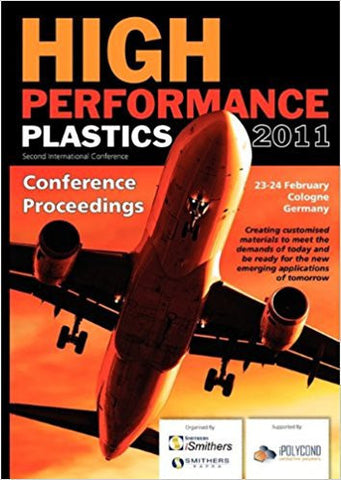
High Performance Plast...
$165.00
{"id":11242255364,"title":"High Performance Plastics 2011","handle":"978-1-84735-625-3","description":"\u003ch5\u003eDescription\u003c\/h5\u003e\nAuthor: Conference Proceedings \u003cbr\u003eISBN 978-1-84735-625-3 \u003cbr\u003e\u003cbr\u003eAvailable in April\n\u003ch5\u003eSummary\u003c\/h5\u003e\nThe event was dedicated to the advances in plastic materials that are tuned to excel even in harsh environments and tough service conditions. Some key driving factors for the continued growth of these materials include:\u003cbr\u003e\u003cbr\u003eOil and gas where the exploitation of hotter and deeper wells has necessitated the transition to new, higher performing plastics\u003cbr\u003eAerospace, a market which has seen the proliferation of lightweight composites to replace traditional materials like metal\u003cbr\u003eMicroelectronics and semiconductor applications where reliability, longevity and ultra-low contamination levels are needed for example in wafer and hard drive handling operations\u003cbr\u003eMembranes for water treatment, biomedical and fuel cell applications\u003cbr\u003ePhotovoltaics where extreme UV durability and inertness are prerequisites\u003cbr\u003eElectrical insulation for defense, aerospace and nuclear related applications\u003cbr\u003eWear resistant and self-lubricating materials for applications from CMP rings to gears and bearings\u003cbr\u003e \u003cbr\u003e\u003cbr\u003eThis exciting and dynamic area is characterised by differentiation and diversity. The challenge is to create customised materials to meet the demands of today and to be ready for the new emerging applications of tomorrow.\u003cbr\u003e\u003cbr\u003eThese proceedings cover all the presentations from the conference which covered all aspects from the resins to blends, specialty fillers, stabilisers, compatibilisers and other modifiers.\u003cbr\u003e\u003cbr\u003e","published_at":"2017-06-22T21:15:30-04:00","created_at":"2017-06-22T21:15:30-04:00","vendor":"Chemtec Publishing","type":"Book","tags":["2011","blends","book","compatibilisers","microelectronics","modifiers","p-additives","p-chemistry","plastics","polymer","resins","semiconductor","specialty fillers","stabilisers"],"price":16500,"price_min":16500,"price_max":16500,"available":true,"price_varies":false,"compare_at_price":null,"compare_at_price_min":0,"compare_at_price_max":0,"compare_at_price_varies":false,"variants":[{"id":43378491332,"title":"Default Title","option1":"Default Title","option2":null,"option3":null,"sku":"","requires_shipping":true,"taxable":true,"featured_image":null,"available":true,"name":"High Performance Plastics 2011","public_title":null,"options":["Default Title"],"price":16500,"weight":1000,"compare_at_price":null,"inventory_quantity":1,"inventory_management":null,"inventory_policy":"continue","barcode":"978-1-84735-625-3","requires_selling_plan":false,"selling_plan_allocations":[],"quantity_rule":{"min":1,"max":null,"increment":1}}],"images":["\/\/chemtec.org\/cdn\/shop\/products\/978-1-84735-625-3.jpg?v=1499477983"],"featured_image":"\/\/chemtec.org\/cdn\/shop\/products\/978-1-84735-625-3.jpg?v=1499477983","options":["Title"],"media":[{"alt":null,"id":356418551901,"position":1,"preview_image":{"aspect_ratio":0.709,"height":499,"width":354,"src":"\/\/chemtec.org\/cdn\/shop\/products\/978-1-84735-625-3.jpg?v=1499477983"},"aspect_ratio":0.709,"height":499,"media_type":"image","src":"\/\/chemtec.org\/cdn\/shop\/products\/978-1-84735-625-3.jpg?v=1499477983","width":354}],"requires_selling_plan":false,"selling_plan_groups":[],"content":"\u003ch5\u003eDescription\u003c\/h5\u003e\nAuthor: Conference Proceedings \u003cbr\u003eISBN 978-1-84735-625-3 \u003cbr\u003e\u003cbr\u003eAvailable in April\n\u003ch5\u003eSummary\u003c\/h5\u003e\nThe event was dedicated to the advances in plastic materials that are tuned to excel even in harsh environments and tough service conditions. Some key driving factors for the continued growth of these materials include:\u003cbr\u003e\u003cbr\u003eOil and gas where the exploitation of hotter and deeper wells has necessitated the transition to new, higher performing plastics\u003cbr\u003eAerospace, a market which has seen the proliferation of lightweight composites to replace traditional materials like metal\u003cbr\u003eMicroelectronics and semiconductor applications where reliability, longevity and ultra-low contamination levels are needed for example in wafer and hard drive handling operations\u003cbr\u003eMembranes for water treatment, biomedical and fuel cell applications\u003cbr\u003ePhotovoltaics where extreme UV durability and inertness are prerequisites\u003cbr\u003eElectrical insulation for defense, aerospace and nuclear related applications\u003cbr\u003eWear resistant and self-lubricating materials for applications from CMP rings to gears and bearings\u003cbr\u003e \u003cbr\u003e\u003cbr\u003eThis exciting and dynamic area is characterised by differentiation and diversity. The challenge is to create customised materials to meet the demands of today and to be ready for the new emerging applications of tomorrow.\u003cbr\u003e\u003cbr\u003eThese proceedings cover all the presentations from the conference which covered all aspects from the resins to blends, specialty fillers, stabilisers, compatibilisers and other modifiers.\u003cbr\u003e\u003cbr\u003e"}
Advances in Polymer Co...
$200.00
{"id":11242255236,"title":"Advances in Polymer Coated Textiles","handle":"978-1-84735-497-6","description":"\u003ch5\u003eDescription\u003c\/h5\u003e\nAuthor: Güneri Akovali, Bireswar Banerjee, A.K. Sen, Dipak K. Setua \u003cbr\u003eISBN 978-1-84735-497-6 \u003cbr\u003e\u003cbr\u003e\n\u003ch5\u003eSummary\u003c\/h5\u003e\nPolymer coated textiles are known as engineered composite materials at a macro scale. A coating can offer significant improvements to the substrate, mainly of the physical (like impermeability and fabric abrasion) and\/or of overall chemical properties; as well as the appearance, by combining advantages of the components.\u003cbr\u003e\u003cbr\u003ePolymer coated systems employ various kinds of textile substrate structures available, mostly of technical textiles. Since there are a number of possibilities for different types of polymers and their combinations, textile structures as well as their combinations are possible; it is widely open to creativities and almost every day some new innovative application is being introduced. Polymer coated textile industry, being parallel to the developments in the textile research, is so dynamic that, today, applications like reactive coatings with nanoparticles (with self-cleaning, self-sterilizing surfaces), systems with conductive polymer coatings to provide EM shielding, electronic textile systems -with body monitoring properties-, environmental responsive systems etc. are already somewhat classical and are considered almost left in the shade of incoming new developments.\u003cbr\u003e\u003cbr\u003eThis book is an up-to-date summary of the subject by considering the passage from conventional to emerging technologies. Criteria for selection of the coat and textile are considered and the manufacturing basics of the system are summarized. Emerging technologies and applications (including smart, intelligent and nanostructured applications) are completed by testing and quality control methods of these systems.\u003cbr\u003e\u003cbr\u003eThe book is written for all that are interested in this interdisciplinary area, it certainly will prove to be of great help to textile and polymer technologists, to engineers, to scientists, as well as to students.","published_at":"2017-06-22T21:15:30-04:00","created_at":"2017-06-22T21:15:30-04:00","vendor":"Chemtec Publishing","type":"Book","tags":["2012","applications of coated textiles","book","coated textiles","composite materils","p-applications","plastic","polymer","properties of coated textiles"],"price":20000,"price_min":20000,"price_max":20000,"available":true,"price_varies":false,"compare_at_price":null,"compare_at_price_min":0,"compare_at_price_max":0,"compare_at_price_varies":false,"variants":[{"id":43378490756,"title":"Default Title","option1":"Default Title","option2":null,"option3":null,"sku":"","requires_shipping":true,"taxable":true,"featured_image":null,"available":true,"name":"Advances in Polymer Coated Textiles","public_title":null,"options":["Default Title"],"price":20000,"weight":1000,"compare_at_price":null,"inventory_quantity":0,"inventory_management":null,"inventory_policy":"continue","barcode":"978-1-84735-497-6","requires_selling_plan":false,"selling_plan_allocations":[],"quantity_rule":{"min":1,"max":null,"increment":1}}],"images":["\/\/chemtec.org\/cdn\/shop\/products\/978-1-84735-497-6.jpg?v=1499718204"],"featured_image":"\/\/chemtec.org\/cdn\/shop\/products\/978-1-84735-497-6.jpg?v=1499718204","options":["Title"],"media":[{"alt":null,"id":350147215453,"position":1,"preview_image":{"aspect_ratio":0.767,"height":450,"width":345,"src":"\/\/chemtec.org\/cdn\/shop\/products\/978-1-84735-497-6.jpg?v=1499718204"},"aspect_ratio":0.767,"height":450,"media_type":"image","src":"\/\/chemtec.org\/cdn\/shop\/products\/978-1-84735-497-6.jpg?v=1499718204","width":345}],"requires_selling_plan":false,"selling_plan_groups":[],"content":"\u003ch5\u003eDescription\u003c\/h5\u003e\nAuthor: Güneri Akovali, Bireswar Banerjee, A.K. Sen, Dipak K. Setua \u003cbr\u003eISBN 978-1-84735-497-6 \u003cbr\u003e\u003cbr\u003e\n\u003ch5\u003eSummary\u003c\/h5\u003e\nPolymer coated textiles are known as engineered composite materials at a macro scale. A coating can offer significant improvements to the substrate, mainly of the physical (like impermeability and fabric abrasion) and\/or of overall chemical properties; as well as the appearance, by combining advantages of the components.\u003cbr\u003e\u003cbr\u003ePolymer coated systems employ various kinds of textile substrate structures available, mostly of technical textiles. Since there are a number of possibilities for different types of polymers and their combinations, textile structures as well as their combinations are possible; it is widely open to creativities and almost every day some new innovative application is being introduced. Polymer coated textile industry, being parallel to the developments in the textile research, is so dynamic that, today, applications like reactive coatings with nanoparticles (with self-cleaning, self-sterilizing surfaces), systems with conductive polymer coatings to provide EM shielding, electronic textile systems -with body monitoring properties-, environmental responsive systems etc. are already somewhat classical and are considered almost left in the shade of incoming new developments.\u003cbr\u003e\u003cbr\u003eThis book is an up-to-date summary of the subject by considering the passage from conventional to emerging technologies. Criteria for selection of the coat and textile are considered and the manufacturing basics of the system are summarized. Emerging technologies and applications (including smart, intelligent and nanostructured applications) are completed by testing and quality control methods of these systems.\u003cbr\u003e\u003cbr\u003eThe book is written for all that are interested in this interdisciplinary area, it certainly will prove to be of great help to textile and polymer technologists, to engineers, to scientists, as well as to students."}

Polysaccharides in Med...
$265.00
{"id":11242255108,"title":"Polysaccharides in Medicinal and Pharmaceutical Applications","handle":"978-1-84735-436-5","description":"\u003ch5\u003eDescription\u003c\/h5\u003e\nAuthor: Edited by Valentin Popa \u003cbr\u003eISBN 978-1-84735-436-5\u003cbr\u003e\u003cbr\u003e\u003cmeta charset=\"utf-8\"\u003e\u003cspan\u003ePublished: 2011\u003c\/span\u003e\u003cbr\u003e\u003cbr\u003e\n\u003ch5\u003eSummary\u003c\/h5\u003e\nThis book presents new and specific aspects in the field of polysaccharides and their derivatives recommended for use in medicine and pharmacy. At the same time, the aspects developed in this book will be useful to design new systems for drugs delivery, immunomodulation, and new materials based on polysaccharides isolated from different sources and their derivatives.\u003cbr\u003e\u003cbr\u003eThe structure and properties of polysaccharides from different sources with potential applications in the fields of medicine and pharmacy are discussed. Thus, the structural aspects concerning hyaluronic acids, fungal extracellular polysaccharides, celluloses, alginates, hemicelluloses, dextran, glyconjugates, and cyclodextrins are covered. The applications are described both for nonmodified and modified forms of polysaccharides for drug delivery, immunomodulation, tissue engineering and hydrogel preparation.\u003cbr\u003e\u003cbr\u003e","published_at":"2017-06-22T21:15:29-04:00","created_at":"2017-06-22T21:15:29-04:00","vendor":"Chemtec Publishing","type":"Book","tags":["2011","appilcation","book","drug delivery","hydrogel","immunomodulation","p-applications","polysaccharides","tissue"],"price":26500,"price_min":26500,"price_max":26500,"available":true,"price_varies":false,"compare_at_price":null,"compare_at_price_min":0,"compare_at_price_max":0,"compare_at_price_varies":false,"variants":[{"id":43378490628,"title":"Default Title","option1":"Default Title","option2":null,"option3":null,"sku":"","requires_shipping":true,"taxable":true,"featured_image":null,"available":true,"name":"Polysaccharides in Medicinal and Pharmaceutical Applications","public_title":null,"options":["Default Title"],"price":26500,"weight":1000,"compare_at_price":null,"inventory_quantity":1,"inventory_management":null,"inventory_policy":"continue","barcode":"978-1-84735-436-5","requires_selling_plan":false,"selling_plan_allocations":[],"quantity_rule":{"min":1,"max":null,"increment":1}}],"images":["\/\/chemtec.org\/cdn\/shop\/products\/978-1-84735-436-5.jpg?v=1499953417"],"featured_image":"\/\/chemtec.org\/cdn\/shop\/products\/978-1-84735-436-5.jpg?v=1499953417","options":["Title"],"media":[{"alt":null,"id":358712016989,"position":1,"preview_image":{"aspect_ratio":0.767,"height":450,"width":345,"src":"\/\/chemtec.org\/cdn\/shop\/products\/978-1-84735-436-5.jpg?v=1499953417"},"aspect_ratio":0.767,"height":450,"media_type":"image","src":"\/\/chemtec.org\/cdn\/shop\/products\/978-1-84735-436-5.jpg?v=1499953417","width":345}],"requires_selling_plan":false,"selling_plan_groups":[],"content":"\u003ch5\u003eDescription\u003c\/h5\u003e\nAuthor: Edited by Valentin Popa \u003cbr\u003eISBN 978-1-84735-436-5\u003cbr\u003e\u003cbr\u003e\u003cmeta charset=\"utf-8\"\u003e\u003cspan\u003ePublished: 2011\u003c\/span\u003e\u003cbr\u003e\u003cbr\u003e\n\u003ch5\u003eSummary\u003c\/h5\u003e\nThis book presents new and specific aspects in the field of polysaccharides and their derivatives recommended for use in medicine and pharmacy. At the same time, the aspects developed in this book will be useful to design new systems for drugs delivery, immunomodulation, and new materials based on polysaccharides isolated from different sources and their derivatives.\u003cbr\u003e\u003cbr\u003eThe structure and properties of polysaccharides from different sources with potential applications in the fields of medicine and pharmacy are discussed. Thus, the structural aspects concerning hyaluronic acids, fungal extracellular polysaccharides, celluloses, alginates, hemicelluloses, dextran, glyconjugates, and cyclodextrins are covered. The applications are described both for nonmodified and modified forms of polysaccharides for drug delivery, immunomodulation, tissue engineering and hydrogel preparation.\u003cbr\u003e\u003cbr\u003e"}
Characterisation of Po...
$260.00
{"id":11242254916,"title":"Characterisation of Polymers, Volume 1 \u0026 2","handle":"978-1-84735-132-6","description":"\u003ch5\u003eDescription\u003c\/h5\u003e\nAuthor: T.R.Crompton \u003cbr\u003eISBN 978-1-84735-132-6 \u003cbr\u003e\u003cbr\u003e\n\u003ch5\u003eSummary\u003c\/h5\u003e\n\u003cbr\u003eVolume 1 covers the methodology used for the determination of metals, non-metals and organic functional groups in polymers, and for the determination of the ratio in which different monomer units occur in copolymers. The techniques available for composition determination of homopolymers and copolymers and other recent modern techniques such as X-ray photoelectron spectroscopy, atomic force microscopy, microthermal analysis and scanning electron microscopy and energy dispersive analysis using X-rays are also included.The structure and microstructure of polymers, copolymers and rubbers are dealt with in Volume 2. More detailed aspects, such as sequencing of monomer units in copolymers, end-group analysis, tacticity and stereochemical determinations, are also dealt with in this subsequent volume.\u003cbr\u003e\u003cbr\u003e\u003ca href=\"\/products\/978-1-84735-123-4\"\u003eVOLUME 1\u003c\/a\u003e \u003cbr\u003e\u003cbr\u003e\u003ca href=\"\/products\/978-1-84735-126-5\"\u003eVOLUME 2\u003c\/a\u003e","published_at":"2017-06-22T21:15:29-04:00","created_at":"2017-06-22T21:15:29-04:00","vendor":"Chemtec Publishing","type":"Book","tags":["2009","analysis","Atomic Force Microscopy","book","cadmium","chromatography","Chromium","copolymers","Copper","destructive techniques","Determination of metals","determination of non-metallic elements","functional groups","hompolymers","Iron","Lead","Manganese","Microthermal Analysis","monomer ratios in copolymers","Nickel","NMR","p-chemical","Polarography","polymer","spectrometry","voltammetry","X-ray photoelectron spectroscopy","Zinc"],"price":26000,"price_min":26000,"price_max":35000,"available":true,"price_varies":true,"compare_at_price":null,"compare_at_price_min":0,"compare_at_price_max":0,"compare_at_price_varies":false,"variants":[{"id":43378490436,"title":"Hardcover","option1":"Hardcover","option2":null,"option3":null,"sku":"978-1-84735-132-6","requires_shipping":true,"taxable":true,"featured_image":null,"available":true,"name":"Characterisation of Polymers, Volume 1 \u0026 2 - Hardcover","public_title":"Hardcover","options":["Hardcover"],"price":35000,"weight":0,"compare_at_price":null,"inventory_quantity":1,"inventory_management":null,"inventory_policy":"continue","barcode":"978-1-84735-132-6","requires_selling_plan":false,"selling_plan_allocations":[],"quantity_rule":{"min":1,"max":null,"increment":1}},{"id":44462780612,"title":"Softcover","option1":"Softcover","option2":null,"option3":null,"sku":"978-1-84735-128-9","requires_shipping":true,"taxable":true,"featured_image":null,"available":true,"name":"Characterisation of Polymers, Volume 1 \u0026 2 - Softcover","public_title":"Softcover","options":["Softcover"],"price":26000,"weight":0,"compare_at_price":null,"inventory_quantity":1,"inventory_management":null,"inventory_policy":"continue","barcode":"978-1-84735-128-9","requires_selling_plan":false,"selling_plan_allocations":[],"quantity_rule":{"min":1,"max":null,"increment":1}}],"images":["\/\/chemtec.org\/cdn\/shop\/products\/978-1-84735-132-6.jpg?v=1499202976"],"featured_image":"\/\/chemtec.org\/cdn\/shop\/products\/978-1-84735-132-6.jpg?v=1499202976","options":["Cover"],"media":[{"alt":null,"id":353926316125,"position":1,"preview_image":{"aspect_ratio":0.767,"height":450,"width":345,"src":"\/\/chemtec.org\/cdn\/shop\/products\/978-1-84735-132-6.jpg?v=1499202976"},"aspect_ratio":0.767,"height":450,"media_type":"image","src":"\/\/chemtec.org\/cdn\/shop\/products\/978-1-84735-132-6.jpg?v=1499202976","width":345}],"requires_selling_plan":false,"selling_plan_groups":[],"content":"\u003ch5\u003eDescription\u003c\/h5\u003e\nAuthor: T.R.Crompton \u003cbr\u003eISBN 978-1-84735-132-6 \u003cbr\u003e\u003cbr\u003e\n\u003ch5\u003eSummary\u003c\/h5\u003e\n\u003cbr\u003eVolume 1 covers the methodology used for the determination of metals, non-metals and organic functional groups in polymers, and for the determination of the ratio in which different monomer units occur in copolymers. The techniques available for composition determination of homopolymers and copolymers and other recent modern techniques such as X-ray photoelectron spectroscopy, atomic force microscopy, microthermal analysis and scanning electron microscopy and energy dispersive analysis using X-rays are also included.The structure and microstructure of polymers, copolymers and rubbers are dealt with in Volume 2. More detailed aspects, such as sequencing of monomer units in copolymers, end-group analysis, tacticity and stereochemical determinations, are also dealt with in this subsequent volume.\u003cbr\u003e\u003cbr\u003e\u003ca href=\"\/products\/978-1-84735-123-4\"\u003eVOLUME 1\u003c\/a\u003e \u003cbr\u003e\u003cbr\u003e\u003ca href=\"\/products\/978-1-84735-126-5\"\u003eVOLUME 2\u003c\/a\u003e"}
Reinforced Thermoplast...
$75.00
{"id":11242254404,"title":"Reinforced Thermoplastics - Composition, Processing and Applications","handle":"978-0-902348-78-3","description":"\u003ch5\u003eDescription\u003c\/h5\u003e\nAuthor: P.G. Kelleher \u003cbr\u003eISBN 978-0-902348-78-3 \u003cbr\u003e\u003cbr\u003eNew Jersey Polymer Extension Center\u003cbr\u003e\u003cmeta charset=\"utf-8\"\u003e\u003cspan\u003ePublished: 1993\u003cbr\u003e\u003c\/span\u003eReview Report\u003cbr\u003e\n\u003ch5\u003eSummary\u003c\/h5\u003e\nThis report covers semi and non-crystalline thermoplastics, polymer blends, and various classes of reinforcing fibers and their properties which determine their suitability for specific applications. The long-term properties are discussed and effect of external forces, heat, weathering, chemical attack, and frictional wear. The uses in telecommunication, medical devices, sporting goods, and automotive applications provide an indication of the potential of these materials. \u003cbr\u003e\u003cbr\u003e\u003cstrong\u003eFibers:\u003c\/strong\u003e glass, ceramic, wollastonite, asbestos, carbon-graphite, aramid, UHMWPE, rigid rod \u003cbr\u003e\u003cbr\u003e\u003cstrong\u003eFrom the Table of Content:\u003c\/strong\u003e \u003cbr\u003e\n\u003cul\u003e\n\u003cli\u003eReinforcing Fibers\u003c\/li\u003e\n\u003cli\u003eEffect of Reinforcement\u003c\/li\u003e\n\u003cli\u003eTime-dependent Properties\u003c\/li\u003e\n\u003cli\u003eFactors Affecting Properties\u003c\/li\u003e\n\u003cli\u003eInjection Molding\u003c\/li\u003e\n\u003cli\u003eInfluence of Processing on Morphology\u003c\/li\u003e\n\u003cli\u003eApplications of Thermoplastic Composites\u003c\/li\u003e\n\u003c\/ul\u003e","published_at":"2017-06-22T21:15:28-04:00","created_at":"2017-06-22T21:15:28-04:00","vendor":"Chemtec Publishing","type":"Book","tags":["1993","aramid","asbestos","book","carbon-graphite","ceramic","composition","glass","p-structural","polymer","processing","rigid rod","thermoplastics","UHMWPE","wollastonite"],"price":7500,"price_min":7500,"price_max":7500,"available":true,"price_varies":false,"compare_at_price":null,"compare_at_price_min":0,"compare_at_price_max":0,"compare_at_price_varies":false,"variants":[{"id":43378489860,"title":"Default Title","option1":"Default Title","option2":null,"option3":null,"sku":"","requires_shipping":true,"taxable":true,"featured_image":null,"available":true,"name":"Reinforced Thermoplastics - Composition, Processing and Applications","public_title":null,"options":["Default Title"],"price":7500,"weight":1000,"compare_at_price":null,"inventory_quantity":1,"inventory_management":null,"inventory_policy":"continue","barcode":"978-0-902348-78-3","requires_selling_plan":false,"selling_plan_allocations":[],"quantity_rule":{"min":1,"max":null,"increment":1}}],"images":["\/\/chemtec.org\/cdn\/shop\/products\/978-0-902348-78-3.jpg?v=1499954163"],"featured_image":"\/\/chemtec.org\/cdn\/shop\/products\/978-0-902348-78-3.jpg?v=1499954163","options":["Title"],"media":[{"alt":null,"id":358734430301,"position":1,"preview_image":{"aspect_ratio":0.767,"height":450,"width":345,"src":"\/\/chemtec.org\/cdn\/shop\/products\/978-0-902348-78-3.jpg?v=1499954163"},"aspect_ratio":0.767,"height":450,"media_type":"image","src":"\/\/chemtec.org\/cdn\/shop\/products\/978-0-902348-78-3.jpg?v=1499954163","width":345}],"requires_selling_plan":false,"selling_plan_groups":[],"content":"\u003ch5\u003eDescription\u003c\/h5\u003e\nAuthor: P.G. Kelleher \u003cbr\u003eISBN 978-0-902348-78-3 \u003cbr\u003e\u003cbr\u003eNew Jersey Polymer Extension Center\u003cbr\u003e\u003cmeta charset=\"utf-8\"\u003e\u003cspan\u003ePublished: 1993\u003cbr\u003e\u003c\/span\u003eReview Report\u003cbr\u003e\n\u003ch5\u003eSummary\u003c\/h5\u003e\nThis report covers semi and non-crystalline thermoplastics, polymer blends, and various classes of reinforcing fibers and their properties which determine their suitability for specific applications. The long-term properties are discussed and effect of external forces, heat, weathering, chemical attack, and frictional wear. The uses in telecommunication, medical devices, sporting goods, and automotive applications provide an indication of the potential of these materials. \u003cbr\u003e\u003cbr\u003e\u003cstrong\u003eFibers:\u003c\/strong\u003e glass, ceramic, wollastonite, asbestos, carbon-graphite, aramid, UHMWPE, rigid rod \u003cbr\u003e\u003cbr\u003e\u003cstrong\u003eFrom the Table of Content:\u003c\/strong\u003e \u003cbr\u003e\n\u003cul\u003e\n\u003cli\u003eReinforcing Fibers\u003c\/li\u003e\n\u003cli\u003eEffect of Reinforcement\u003c\/li\u003e\n\u003cli\u003eTime-dependent Properties\u003c\/li\u003e\n\u003cli\u003eFactors Affecting Properties\u003c\/li\u003e\n\u003cli\u003eInjection Molding\u003c\/li\u003e\n\u003cli\u003eInfluence of Processing on Morphology\u003c\/li\u003e\n\u003cli\u003eApplications of Thermoplastic Composites\u003c\/li\u003e\n\u003c\/ul\u003e"}
Fire Retardancy of Pol...
$249.00
{"id":11242254340,"title":"Fire Retardancy of Polymers","handle":"978-0-85404-582-2","description":"\u003ch5\u003eDescription\u003c\/h5\u003e\nAuthor: Eds., M. Le Bras, C. Wilkie, S. Bourbigot \u003cbr\u003eISBN 978-0-85404-582-2 \u003cbr\u003e\u003cbr\u003epages 410, Hardcover\n\u003ch5\u003eSummary\u003c\/h5\u003e\nThe use of polymers is restricted by their flammability- they may indeed initiate or propagate fire. \u003cstrong\u003eFire Retardancy of Polymers\u003c\/strong\u003e focuses on mineral additives from either micro- or nano-composites for application in fire retardants. With the use of fire retardant additives containing halogen or phosphorus compounds in decline, the need for other systems is evident.\u003cbr\u003e\u003cbr\u003eThe major materials that are used as fire retardant fillers for polymers are alumina trihydrate or magnesium hydroxide, which account for more than 50% by weight of the worldwide sales of fire retardants. Recent works have shown that such halogen-free compounds may give enhanced fire retardancy to polymeric materials when used in low levels, alone, or in the synergistic mixture and that the corresponding fire performances depend on the dispersion of the mineral filler, micrometer-scale dispersion leading to the best performances.\u003cbr\u003e\u003cbr\u003eSpecialists discuss these new applications of mineral fillers with particular emphasis on action mechanisms, new materials including textiles, toxicology, and hazards. With extensive references, this book provides a comprehensive and up-to-date view of these applications and will appeal to professionals, materials scientists, and engineers looking for novel ways to eliminate fire hazards and improve flame retardancy of materials, with a special interest in sustainable development.\u003cbr\u003e\u003cbr\u003e","published_at":"2017-06-22T21:15:28-04:00","created_at":"2017-06-22T21:15:28-04:00","vendor":"Chemtec Publishing","type":"Book","tags":["2005","additives","alumina trihydrate","book","dispersion","fillers","fire","flame retardancy","hazards","magnesium hydroxide","mineral filler","p-additives","polymer","polymers","textiles","toxicology"],"price":24900,"price_min":24900,"price_max":24900,"available":true,"price_varies":false,"compare_at_price":null,"compare_at_price_min":0,"compare_at_price_max":0,"compare_at_price_varies":false,"variants":[{"id":43378489796,"title":"Default Title","option1":"Default Title","option2":null,"option3":null,"sku":"","requires_shipping":true,"taxable":true,"featured_image":null,"available":true,"name":"Fire Retardancy of Polymers","public_title":null,"options":["Default Title"],"price":24900,"weight":1000,"compare_at_price":null,"inventory_quantity":1,"inventory_management":null,"inventory_policy":"continue","barcode":"978-0-85404-582-2","requires_selling_plan":false,"selling_plan_allocations":[],"quantity_rule":{"min":1,"max":null,"increment":1}}],"images":["\/\/chemtec.org\/cdn\/shop\/products\/978-0-85404-582-2.jpg?v=1500216348"],"featured_image":"\/\/chemtec.org\/cdn\/shop\/products\/978-0-85404-582-2.jpg?v=1500216348","options":["Title"],"media":[{"alt":null,"id":354807283805,"position":1,"preview_image":{"aspect_ratio":0.767,"height":450,"width":345,"src":"\/\/chemtec.org\/cdn\/shop\/products\/978-0-85404-582-2.jpg?v=1500216348"},"aspect_ratio":0.767,"height":450,"media_type":"image","src":"\/\/chemtec.org\/cdn\/shop\/products\/978-0-85404-582-2.jpg?v=1500216348","width":345}],"requires_selling_plan":false,"selling_plan_groups":[],"content":"\u003ch5\u003eDescription\u003c\/h5\u003e\nAuthor: Eds., M. Le Bras, C. Wilkie, S. Bourbigot \u003cbr\u003eISBN 978-0-85404-582-2 \u003cbr\u003e\u003cbr\u003epages 410, Hardcover\n\u003ch5\u003eSummary\u003c\/h5\u003e\nThe use of polymers is restricted by their flammability- they may indeed initiate or propagate fire. \u003cstrong\u003eFire Retardancy of Polymers\u003c\/strong\u003e focuses on mineral additives from either micro- or nano-composites for application in fire retardants. With the use of fire retardant additives containing halogen or phosphorus compounds in decline, the need for other systems is evident.\u003cbr\u003e\u003cbr\u003eThe major materials that are used as fire retardant fillers for polymers are alumina trihydrate or magnesium hydroxide, which account for more than 50% by weight of the worldwide sales of fire retardants. Recent works have shown that such halogen-free compounds may give enhanced fire retardancy to polymeric materials when used in low levels, alone, or in the synergistic mixture and that the corresponding fire performances depend on the dispersion of the mineral filler, micrometer-scale dispersion leading to the best performances.\u003cbr\u003e\u003cbr\u003eSpecialists discuss these new applications of mineral fillers with particular emphasis on action mechanisms, new materials including textiles, toxicology, and hazards. With extensive references, this book provides a comprehensive and up-to-date view of these applications and will appeal to professionals, materials scientists, and engineers looking for novel ways to eliminate fire hazards and improve flame retardancy of materials, with a special interest in sustainable development.\u003cbr\u003e\u003cbr\u003e"}
Physical Testing of Ru...
$72.00
{"id":11242254148,"title":"Physical Testing of Rubbers","handle":"978-0-08041965-7","description":"\u003ch5\u003eDescription\u003c\/h5\u003e\nAuthor: R.P. Brown \u003cbr\u003eISBN 978-0-08041965-7 \u003cbr\u003e\u003cbr\u003e94 pages, softbound\n\u003ch5\u003eSummary\u003c\/h5\u003e\n\u003cp\u003eReasons for testing rubber materials and products fall into four categories: quality control, provision of design data, prediction of service performance and investigation of failure. In each case the requirements may be the same in terms of precision and reproducibility, but may be markedly different in other respects.\u003c\/p\u003e\n\u003cp\u003eTest methods have been standardised for almost all properties likely to be relevant to rubbers, and the appropriate standards are listed in this report. The author also discusses the development and current status of the most important testing areas, including advances in instrumentation and reproducibility assessment.\u003c\/p\u003e\n\u003cp\u003eAdditional data on specific materials and test methods are provided in the 415 abstracts selected from the Polymer Library, which complete the report.\u003c\/p\u003e","published_at":"2017-06-22T21:15:27-04:00","created_at":"2017-06-22T21:15:27-04:00","vendor":"Chemtec Publishing","type":"Book","tags":["1992","book","general","physical testing","quality control","rubber","rubbers","testing"],"price":7200,"price_min":7200,"price_max":7200,"available":true,"price_varies":false,"compare_at_price":null,"compare_at_price_min":0,"compare_at_price_max":0,"compare_at_price_varies":false,"variants":[{"id":43378488964,"title":"Default Title","option1":"Default Title","option2":null,"option3":null,"sku":"","requires_shipping":true,"taxable":true,"featured_image":null,"available":true,"name":"Physical Testing of Rubbers","public_title":null,"options":["Default Title"],"price":7200,"weight":1000,"compare_at_price":null,"inventory_quantity":1,"inventory_management":null,"inventory_policy":"continue","barcode":"978-0-08041965-7","requires_selling_plan":false,"selling_plan_allocations":[],"quantity_rule":{"min":1,"max":null,"increment":1}}],"images":[],"featured_image":null,"options":["Title"],"requires_selling_plan":false,"selling_plan_groups":[],"content":"\u003ch5\u003eDescription\u003c\/h5\u003e\nAuthor: R.P. Brown \u003cbr\u003eISBN 978-0-08041965-7 \u003cbr\u003e\u003cbr\u003e94 pages, softbound\n\u003ch5\u003eSummary\u003c\/h5\u003e\n\u003cp\u003eReasons for testing rubber materials and products fall into four categories: quality control, provision of design data, prediction of service performance and investigation of failure. In each case the requirements may be the same in terms of precision and reproducibility, but may be markedly different in other respects.\u003c\/p\u003e\n\u003cp\u003eTest methods have been standardised for almost all properties likely to be relevant to rubbers, and the appropriate standards are listed in this report. The author also discusses the development and current status of the most important testing areas, including advances in instrumentation and reproducibility assessment.\u003c\/p\u003e\n\u003cp\u003eAdditional data on specific materials and test methods are provided in the 415 abstracts selected from the Polymer Library, which complete the report.\u003c\/p\u003e"}
Joining of Plastics
$72.00
{"id":11242254020,"title":"Joining of Plastics","handle":"978-0-08041964-0","description":"\u003ch5\u003eDescription\u003c\/h5\u003e\nAuthor: K.W. Allen \u003cbr\u003eISBN 978-0-08041964-0 \u003cbr\u003e\u003cbr\u003eCity University, Oxford Polytechnic\u003cbr\u003eReview Report\u003cbr\u003e\u003cbr\u003e86 pages, softbound\u003cbr\u003e\n\u003ch5\u003eSummary\u003c\/h5\u003e\nMechanical fastening, welding and adhesive bonding is reviewed in this report. Selection of joining method is evaluated from the point of view of durability of joint required for application. The report considers the most important thermoplastic materials and explains the characteristics which affect the choice of pretreatment, joining method and adhesives. Thermosetting materials are considered as a single group with respect to bonding. Some 387 abstracts were selected to provide additional information. \u003cbr\u003e\u003cbr\u003e\u003cstrong\u003eMaterials:\u003c\/strong\u003e PE, PP, PS, ABS, PVAc, PVC, PC, PA, PMA, PMMA, PTFE, thermosets \u003cbr\u003e\u003cbr\u003e\u003cstrong\u003eFrom the Table of Contents:\u003c\/strong\u003e \u003cbr\u003e\n\u003cul\u003e\n\u003cli\u003eThe Technology of Joining\u003c\/li\u003e\n\u003cli\u003eSurface Treatment\u003c\/li\u003e\n\u003cli\u003eTypes of Plastics\u003c\/li\u003e\n\u003c\/ul\u003e","published_at":"2017-06-22T21:15:27-04:00","created_at":"2017-06-22T21:15:27-04:00","vendor":"Chemtec Publishing","type":"Book","tags":["1992","ABS","book","general","PA","PC","PE","PMA","PMMA","PP","PS","PTFE","PVAc","PVC","thermosets"],"price":7200,"price_min":7200,"price_max":7200,"available":true,"price_varies":false,"compare_at_price":null,"compare_at_price_min":0,"compare_at_price_max":0,"compare_at_price_varies":false,"variants":[{"id":43378488644,"title":"Default Title","option1":"Default Title","option2":null,"option3":null,"sku":"","requires_shipping":true,"taxable":true,"featured_image":null,"available":true,"name":"Joining of Plastics","public_title":null,"options":["Default Title"],"price":7200,"weight":1000,"compare_at_price":null,"inventory_quantity":1,"inventory_management":null,"inventory_policy":"continue","barcode":"978-0-08041964-0","requires_selling_plan":false,"selling_plan_allocations":[],"quantity_rule":{"min":1,"max":null,"increment":1}}],"images":["\/\/chemtec.org\/cdn\/shop\/products\/978-0-08041964-0.jpg?v=1499623799"],"featured_image":"\/\/chemtec.org\/cdn\/shop\/products\/978-0-08041964-0.jpg?v=1499623799","options":["Title"],"media":[{"alt":null,"id":358506266717,"position":1,"preview_image":{"aspect_ratio":0.667,"height":1500,"width":1000,"src":"\/\/chemtec.org\/cdn\/shop\/products\/978-0-08041964-0.jpg?v=1499623799"},"aspect_ratio":0.667,"height":1500,"media_type":"image","src":"\/\/chemtec.org\/cdn\/shop\/products\/978-0-08041964-0.jpg?v=1499623799","width":1000}],"requires_selling_plan":false,"selling_plan_groups":[],"content":"\u003ch5\u003eDescription\u003c\/h5\u003e\nAuthor: K.W. Allen \u003cbr\u003eISBN 978-0-08041964-0 \u003cbr\u003e\u003cbr\u003eCity University, Oxford Polytechnic\u003cbr\u003eReview Report\u003cbr\u003e\u003cbr\u003e86 pages, softbound\u003cbr\u003e\n\u003ch5\u003eSummary\u003c\/h5\u003e\nMechanical fastening, welding and adhesive bonding is reviewed in this report. Selection of joining method is evaluated from the point of view of durability of joint required for application. The report considers the most important thermoplastic materials and explains the characteristics which affect the choice of pretreatment, joining method and adhesives. Thermosetting materials are considered as a single group with respect to bonding. Some 387 abstracts were selected to provide additional information. \u003cbr\u003e\u003cbr\u003e\u003cstrong\u003eMaterials:\u003c\/strong\u003e PE, PP, PS, ABS, PVAc, PVC, PC, PA, PMA, PMMA, PTFE, thermosets \u003cbr\u003e\u003cbr\u003e\u003cstrong\u003eFrom the Table of Contents:\u003c\/strong\u003e \u003cbr\u003e\n\u003cul\u003e\n\u003cli\u003eThe Technology of Joining\u003c\/li\u003e\n\u003cli\u003eSurface Treatment\u003c\/li\u003e\n\u003cli\u003eTypes of Plastics\u003c\/li\u003e\n\u003c\/ul\u003e"}