

Addcon World 2002


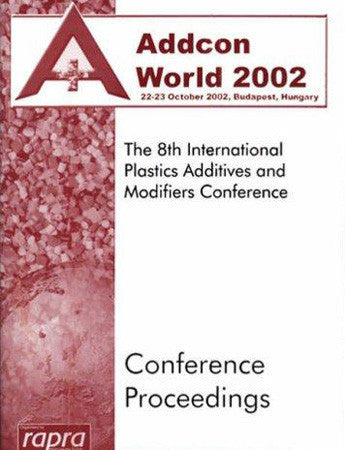
Addcon World is the established additives, modifiers and compounding conference. Running for the last seven years the two day conference focused on the technical advances and issues facing the plastic additives and modifiers industry. This year’s conference provided the best opportunity to hear the latest developments and discuss the future possibilities of the additives business.
The papers presented discussed new developments in polyolefin and PVC stabilizers, flame retardants, impact modifiers, compatibilizers, pelletizing, masterbatches, biodegradable blown film, dispersants, fillers and coupling agents. They offer the facts about biocides, in-line compounding, and colour variable pigments.
Delegates and speakers at Addcon were from all branches of the additives community, including industry, research institutes and universities; from Western and Eastern Europe, the USA, India and beyond.
The papers presented discussed new developments in polyolefin and PVC stabilizers, flame retardants, impact modifiers, compatibilizers, pelletizing, masterbatches, biodegradable blown film, dispersants, fillers and coupling agents. They offer the facts about biocides, in-line compounding, and colour variable pigments.
Delegates and speakers at Addcon were from all branches of the additives community, including industry, research institutes and universities; from Western and Eastern Europe, the USA, India and beyond.
List of Papers
SESSION 1: BROAD TRENDS IN THE ADDITIVES MARKET
Paper 1: Additive Trends in the Global Engineering Plastics Industry
Louis Kattas, BRG Townsend, Inc, USA
Paper 2: The Flame Retardants Controversy: Fire Safety and Environmental Protection
Adrian Beard, Clariant (Germany) - BU Additives FuE, Germany and Veronique Steukers, Albermarle Europe, Belgium
Paper 3: Plasticisers for PVC; Health and Environmental Impact
David Cadogan, European Council for Plasticisers and Intermediates, Belgium
Paper 4: Virtual Additive-Packages for Solving Technical Issues of Polymer Compounders and Processors
Raphael Mestanza and Karine Boutouta, SpecialChem, France
SESSION 2: FILLERS
Paper 5: Optical Aspects of Mineral Additives in Polymers~
Luc Van Aken, Sibelco, Belgium
Paper 6: A Novel Coupling Agent Technology
John D Schofield, Avecia Pigments & Additives, UK
SESSION 3: STABILISERS (1)
Paper 7: Organic Phosphate Stabilisers
Don Stevenson, Dover Chemicals Corporation, USA
Paper 8: Advances in Light Stabilisation for Plastics; New UV Stabilisers for Automotive Interior TPO Systems
Frank Cangelosi, Brent Saunders, Paolo Arnaboldi, Ivan Vulic, Cytec Industries, USA
Paper 9: New Solutions for PP Fibre Stabilisation
Klaus Keck-Antoine, Great Lakes Technology Belgium, Belgium
Paper 10: Synergism Between Polymer Antioxidants; Kinetic Modelling
Ludmila Audouin, ENSAM, Paris, France
SESSION 4: PROTECTING AGAINST MICRO-ORGANISMS
Paper 11: The Why, What and Wherefore of Anti-Microbial Systems Julie Simmons, Wells Plastics Ltd, UK
Paper 12: Problems and Pitfalls in the Evaluation and Design of New Biocides for Plastics
Chris Kneale, Avecia Biocides, UK
SESSION 5A: INNOVATIONS IN ADDITIVES
Paper 13: 3D-Microgranulates - Special Performance and Effects
Michael Bauer, Inprotec AG, Germany
Paper 14: Blown Films from LLDPE, incorporating Biodegradable Additive
Rangaprasad Rajanarasimhamurthy & Yatish B. Vasudeo, Reliance Industries Limited, India
Paper 15: Functionalised Polyolefins: performance Additives for Filled Polyolefin Composites
Mark Moody, Crompton Europe Ltd, UK
Paper 16: Compatibilisation of PC/ABS Blends with Core-Shell Particles
Jeroen Wiersma & Fabrizio Trinchero, Rohm & Haas France SAS, France
SESSION 6A: FLAME RETARDANTS
Paper 17: Excellent Flow and Conveyance Behaviour, Low Dust Emission and Outstanding Properties of Halogen Free Flame Retardant Compounds Realised by a New Generation of Aluminium Trihydrate (ATH)
Reiner Sauerwein, Nabaltec GmbH, Germany
Paper 18: Optimising Properties of Halogen Free Flame Retardant Polyolefins Through the Use of Zinc Borates as Multi-Functional Synergists
Robert Leeuwendal, Borax Europe Ltd, UK
Paper 19: Combination of Flame-Retardant and UV-Stabiliser Masterbatches for Outdoor Seating Areas
Johannes Suschnig, Gabriel-Chemie Ges.m.b.H, Austria
SESSION 7A: PVC STABILISERS
Paper 20: Degradation of PVC with Different Additives Studied by Micro Raman Spectroscopy
Andreas Gupper and Peter Wilhelm, Zentrum für Elektronenmikroskopie Graz, Austria and Michael Schiller, Chemson Polymer Additive AG, Austria
SESSION 5B: COMPOUNDING, MASTERBATCHES AND PROCESSING
Paper 21: In-Line Compounding - The Economic Way of Production
Detlef Kühlborn, Krauss-Maffei Kunststofftechnik GmbH, Germany
Paper 22: Perfect Spheres - A New Shape for Better Additives
Horst Müller, W Sigworth and D Roberts, Rieter Automatik GmbH, Germany
Paper 23: High Performance Dispersing Additives for Pigment Concentrates
Heike Buskies-Keup, Stefan Stadtmueller and Markus Weimann, Degussa Performance Chemicals, Germany
SESSION 6B: STABILISERS (2)
Paper 25 Stabilization of Syndiotactic Polystyrene Obtained in Presence of CpTiCl2(OPhCl) /MAO Catalyst
Ewa Kowalska, Prof. W. Skupiñski, T. Wolniewski, Chem.Eng.and Dr. Z. Wielgosz, Industrial Chemistry Research Institute, Poland
SESSION 7B: IMPACT MODIFIERS
Paper 27 Improvement of the Properties of Polyethylene with Chlorinated Polyethylene
Kalman Marossy, BorsodChem, Hungary
Paper 28 Tubular Acrylate Copolymers as Modifiers for Thermoplastics to Improve Impact Strength and Compatibility
Karlheinz Hausmann, DuPont de Nemours International SA, Switzerland
SESSION 8: STABILISERS (3)
Paper 29 Investigations into Weathered Profiles in Daily Use
Walter Fischer and Michael Schiller, Chemson Polymer-Additive AG, Austria
Paper 30 Effect of Testing Conditions on Performance and Durability of Stabilisers in Plastics
Jan Pospí?il, Inst. of Macromolecular Chemistry, Czech Republic, S Nespurek, Z Horak and W D Habicher, Inst of Organic Chemistry, Technical University of Dresden, Germany
Paper 31 ew Additive Solutions for Stabilising ABS
Alex Wegmann, Ciba Specialty Chemicals Inc, Switzerland
SESSION 1: BROAD TRENDS IN THE ADDITIVES MARKET
Paper 1: Additive Trends in the Global Engineering Plastics Industry
Louis Kattas, BRG Townsend, Inc, USA
Paper 2: The Flame Retardants Controversy: Fire Safety and Environmental Protection
Adrian Beard, Clariant (Germany) - BU Additives FuE, Germany and Veronique Steukers, Albermarle Europe, Belgium
Paper 3: Plasticisers for PVC; Health and Environmental Impact
David Cadogan, European Council for Plasticisers and Intermediates, Belgium
Paper 4: Virtual Additive-Packages for Solving Technical Issues of Polymer Compounders and Processors
Raphael Mestanza and Karine Boutouta, SpecialChem, France
SESSION 2: FILLERS
Paper 5: Optical Aspects of Mineral Additives in Polymers~
Luc Van Aken, Sibelco, Belgium
Paper 6: A Novel Coupling Agent Technology
John D Schofield, Avecia Pigments & Additives, UK
SESSION 3: STABILISERS (1)
Paper 7: Organic Phosphate Stabilisers
Don Stevenson, Dover Chemicals Corporation, USA
Paper 8: Advances in Light Stabilisation for Plastics; New UV Stabilisers for Automotive Interior TPO Systems
Frank Cangelosi, Brent Saunders, Paolo Arnaboldi, Ivan Vulic, Cytec Industries, USA
Paper 9: New Solutions for PP Fibre Stabilisation
Klaus Keck-Antoine, Great Lakes Technology Belgium, Belgium
Paper 10: Synergism Between Polymer Antioxidants; Kinetic Modelling
Ludmila Audouin, ENSAM, Paris, France
SESSION 4: PROTECTING AGAINST MICRO-ORGANISMS
Paper 11: The Why, What and Wherefore of Anti-Microbial Systems Julie Simmons, Wells Plastics Ltd, UK
Paper 12: Problems and Pitfalls in the Evaluation and Design of New Biocides for Plastics
Chris Kneale, Avecia Biocides, UK
SESSION 5A: INNOVATIONS IN ADDITIVES
Paper 13: 3D-Microgranulates - Special Performance and Effects
Michael Bauer, Inprotec AG, Germany
Paper 14: Blown Films from LLDPE, incorporating Biodegradable Additive
Rangaprasad Rajanarasimhamurthy & Yatish B. Vasudeo, Reliance Industries Limited, India
Paper 15: Functionalised Polyolefins: performance Additives for Filled Polyolefin Composites
Mark Moody, Crompton Europe Ltd, UK
Paper 16: Compatibilisation of PC/ABS Blends with Core-Shell Particles
Jeroen Wiersma & Fabrizio Trinchero, Rohm & Haas France SAS, France
SESSION 6A: FLAME RETARDANTS
Paper 17: Excellent Flow and Conveyance Behaviour, Low Dust Emission and Outstanding Properties of Halogen Free Flame Retardant Compounds Realised by a New Generation of Aluminium Trihydrate (ATH)
Reiner Sauerwein, Nabaltec GmbH, Germany
Paper 18: Optimising Properties of Halogen Free Flame Retardant Polyolefins Through the Use of Zinc Borates as Multi-Functional Synergists
Robert Leeuwendal, Borax Europe Ltd, UK
Paper 19: Combination of Flame-Retardant and UV-Stabiliser Masterbatches for Outdoor Seating Areas
Johannes Suschnig, Gabriel-Chemie Ges.m.b.H, Austria
SESSION 7A: PVC STABILISERS
Paper 20: Degradation of PVC with Different Additives Studied by Micro Raman Spectroscopy
Andreas Gupper and Peter Wilhelm, Zentrum für Elektronenmikroskopie Graz, Austria and Michael Schiller, Chemson Polymer Additive AG, Austria
SESSION 5B: COMPOUNDING, MASTERBATCHES AND PROCESSING
Paper 21: In-Line Compounding - The Economic Way of Production
Detlef Kühlborn, Krauss-Maffei Kunststofftechnik GmbH, Germany
Paper 22: Perfect Spheres - A New Shape for Better Additives
Horst Müller, W Sigworth and D Roberts, Rieter Automatik GmbH, Germany
Paper 23: High Performance Dispersing Additives for Pigment Concentrates
Heike Buskies-Keup, Stefan Stadtmueller and Markus Weimann, Degussa Performance Chemicals, Germany
SESSION 6B: STABILISERS (2)
Paper 25 Stabilization of Syndiotactic Polystyrene Obtained in Presence of CpTiCl2(OPhCl) /MAO Catalyst
Ewa Kowalska, Prof. W. Skupiñski, T. Wolniewski, Chem.Eng.and Dr. Z. Wielgosz, Industrial Chemistry Research Institute, Poland
SESSION 7B: IMPACT MODIFIERS
Paper 27 Improvement of the Properties of Polyethylene with Chlorinated Polyethylene
Kalman Marossy, BorsodChem, Hungary
Paper 28 Tubular Acrylate Copolymers as Modifiers for Thermoplastics to Improve Impact Strength and Compatibility
Karlheinz Hausmann, DuPont de Nemours International SA, Switzerland
SESSION 8: STABILISERS (3)
Paper 29 Investigations into Weathered Profiles in Daily Use
Walter Fischer and Michael Schiller, Chemson Polymer-Additive AG, Austria
Paper 30 Effect of Testing Conditions on Performance and Durability of Stabilisers in Plastics
Jan Pospí?il, Inst. of Macromolecular Chemistry, Czech Republic, S Nespurek, Z Horak and W D Habicher, Inst of Organic Chemistry, Technical University of Dresden, Germany
Paper 31 ew Additive Solutions for Stabilising ABS
Alex Wegmann, Ciba Specialty Chemicals Inc, Switzerland
Related Products

Databook of Antioxidan...
$350.00
{"id":8822318268573,"title":"Databook of Antioxidants, 2nd Ed","handle":"databook-of-antioxidants-2nd-ed","description":"\u003ch5\u003eDescription\u003c\/h5\u003e\n\u003cp\u003eAuthor: Anna \u0026amp; George Wypych\u003cbr\u003eISBN 978-1-927885-53-6 \u003cbr\u003e\u003cbr\u003e\u003cmeta charset=\"utf-8\"\u003e\u003c\/p\u003e\n\u003cp\u003e\u003cspan\u003ePublication date: \u003c\/span\u003e January 2025\u003cbr\u003eFirst Edition\u003cbr\u003eNumber of pages: 572+xii\u003cbr\u003e\u003cbr\u003e\u003c\/p\u003e\n\u003ch5\u003eSummary\u003c\/h5\u003e\n\u003cp class=\"p1\"\u003e\u003cbr\u003e\u003c\/p\u003e\n\u003cp class=\"p2\"\u003eIn general terms, antioxidants are expected to protect the \u003ci\u003estatus quo\u003c\/i\u003e by preventing oxidation. Oxidation is a chain reaction involving free radicals and hydroperoxide intermediates. Antioxidants act by reacting and decomposing free radicals and hydroperoxide intermediate species.\u003c\/p\u003e\n\u003cp class=\"p3\"\u003e\u003cbr\u003e\u003c\/p\u003e\n\u003cp class=\"p2\"\u003eIn polymeric materials, the oxidative changes may lead to several undesirable effects, including discoloration, changes in melt viscosity, and deterioration of mechanical properties, impacting the useful life of a polymer or a final article. Plastics are susceptible to oxidative degradation during high-temperature melt processing operations, their end-use, and during long-term storage. Also, the oxidation processes are accelerated by exposure to UV radiation of sunlight.\u003c\/p\u003e\n\u003cp class=\"p3\"\u003e\u003cbr\u003e\u003c\/p\u003e\n\u003cp class=\"p2\"\u003eAntioxidants are likely to form the most crucial protective barrier for cells of living organisms against the effects of free radicals. If these processes are not adequately controlled, they lead to outcomes dangerous to well-being because the cancerous cells multiply at accelerating rates.\u003c\/p\u003e\n\u003cp class=\"p3\"\u003e\u003cbr\u003e\u003c\/p\u003e\n\u003cp class=\"p2\"\u003eRadical formation on ultraviolet light exposure leads to changes in human skin such as the formation of dark spots, lesions, and frequent skin cancer if preventive measures, such as UV radiation filtration and the use of antioxidants\u003cspan class=\"s1\"\u003e \u003c\/span\u003edo not stop radical processes.\u003c\/p\u003e\n\u003cp class=\"p3\"\u003e\u003cbr\u003e\u003c\/p\u003e\n\u003cp class=\"p2\"\u003eIn similar reactions to oxidation, food and pharmaceutical products deteriorate faster, which can be prevented by small additions of antioxidants. Food products lose their nutritional value and may drastically change color and flavor. Pharmaceutical products become inactive and potentially toxic.\u003c\/p\u003e\n\u003cp class=\"p3\"\u003e\u003cbr\u003e\u003c\/p\u003e\n\u003cp class=\"p2\"\u003eIn summary, antioxidants form the most important group of compounds aiming at retardation of deterioration of organic materials and keeping living cells in their original conditions, which is the most common means to a healthy life.\u003c\/p\u003e\n\u003cp class=\"p3\"\u003e\u003cbr\u003e\u003c\/p\u003e\n\u003cp class=\"p2\"\u003eAntioxidants are typically divided into primary and secondary antioxidants. Primary antioxidants, such as hindered phenols, function mainly by scavenging the peroxy radical intermediates formed in the oxidation processes. They are effective over a wide temperature range, improving materials' processing and long-term thermal stability.\u003cspan class=\"Apple-converted-space\"\u003e \u003c\/span\u003eSecondary antioxidants, such as phosphites and thioethers, function by the decomposition of hydroperoxides. Phosphites are most effective at the high temperatures of melt processing operations, while thioethers operate best in the solid phase at long-term use temperatures.\u003c\/p\u003e\n\u003cp class=\"p3\"\u003e\u003cbr\u003e\u003c\/p\u003e\n\u003cp class=\"p2\"\u003eIn modern applications, synthetic antioxidants are slowly being replaced by products obtained from renewable resources, mostly of plant origin. This conversion in cosmetics, medicine, pharmacy, food additives, and food protection is very advanced. In polymer processing, applying of natural antioxidants is still in the development stage.\u003c\/p\u003e\n\u003cp class=\"p3\"\u003e\u003cbr\u003e\u003c\/p\u003e\n\u003cp class=\"p2\"\u003eConsidering the importance of antioxidants in medicine, cosmetics, pharmacy, and food processing, this book provides a selection of both important synthetic and natural products, stressing the commercially viable additives and most recent interest in the application and use of natural products.\u003c\/p\u003e\n\u003cp class=\"p3\"\u003e\u003cbr\u003e\u003c\/p\u003e\n\u003cp class=\"p2\"\u003eThe antioxidants included in this book belong to many groups of chemical products including acids and their esters, amines, anthocyanidines, ascorbates, benzofuranones, benzoimidazoles, benzoquinones, biopolyphenols, carotenoids, coumarines, enzymes, flavonoids, hydrazide metal deactivators, hydroquinidines, hydroquinones, hydroxylamines, isoflavones, lignanamides, liposomes, peptides, phenolics, phosphites, phospholipides, polyphenols, polysaccharides, sterically hindered phenolics, sulfur-containing compounds, tannin derivatives, terpenoids, thioethers, tocopherols, and quinolines. This shows a wide variety of options and applications, which are emphasized in this book.\u003c\/p\u003e\n\u003cp class=\"p3\"\u003e\u003cbr\u003e\u003c\/p\u003e\n\u003cp class=\"p2\"\u003eThe data for each antioxidant are presented in a separate table. The information in the table is divided into five sections: General, Physical properties, Health \u0026amp; safety, Ecological, and Use. The contents of these five sections are given below.\u003c\/p\u003e\n\u003cp class=\"p3\"\u003e\u003cbr\u003e\u003c\/p\u003e\n\u003cp class=\"p2\"\u003e\u003cb\u003eGeneral\u003c\/b\u003e section contains the following fields: product name, CAS #, EC number, acronym, chemical name, chemical synonym, chemical formula, molecular weight, chemical class, moisture contents, bio-origin, mixture, product contents, other properties, concentration of arsenic, heavy metals, molybdenum, nitrogen, phosphorus, sulfur, and zinc, and RTECS #.\u003c\/p\u003e\n\u003cp class=\"p3\"\u003e\u003cbr\u003e\u003c\/p\u003e\n\u003cp class=\"p2\"\u003e\u003cb\u003ePhysical\u003c\/b\u003e section contains the following fields: acid #, ash, acid dissociation constant, base dissociation constant, boiling point, bulk density, color (description, Hazen scale), density, freezing\/melting point, kinematic viscosity, maximum UV absorbance, odor, particle size, pH, refractive index, solubility in solvents, specific gravity, state, specific optical rotation, thermogravimetric analysis, total plate count, transmittance, vapor density, vapor pressure, viscosity, volatility, and yeast \u0026amp; molds.\u003c\/p\u003e\n\u003cp class=\"p3\"\u003e\u003cbr\u003e\u003c\/p\u003e\n\u003cp class=\"p2\"\u003e\u003cb\u003eHealth \u0026amp; safety\u003c\/b\u003e section contains the following fields: ADR\/RID class, autoignition temperature, HMIS (fire, health, reactivity), carcinogenicity, chronic effects, DOT class, explosive LEL \u0026amp; UEL, eye irritation, flash point and method, first aid (eye, skin, inhalation), ICAO\/IATA class, IMDG class, ingestion, inhalation (rat LC50), LD50 (dermal rat and rabbit, and oral rat), mutagenicity, NFPA (flammability, health, reactivity), proper shipping name, reproduction\/developmental toxicity, route of entry, skin irritation, target organs, teratogenicity, TLV (ACGIH, NIOSH, OSHA), UN packaging group, UN risk and safety phrases, and UN\/NA class.\u003c\/p\u003e\n\u003cp class=\"p3\"\u003e\u003cbr\u003e\u003c\/p\u003e\n\u003cp class=\"p2\"\u003e\u003cb\u003eEcological\u003c\/b\u003e section contains the following fields: aquatic toxicity algae, LC50 (\u003ci\u003eBluegill sunfish, Daphnia magna, Fathead minnow, Rainbow trout, Zebra fish\u003c\/i\u003e), bioaccumulative and toxic assessment, bioconcentration factor, biodegradation probability, biological oxygen demand, chemical oxygen demand, hydroxyl rate constant, and partition coefficient.\u003c\/p\u003e\n\u003cp class=\"p3\"\u003e\u003cbr\u003e\u003c\/p\u003e\n\u003cp class=\"p2\"\u003e\u003cb\u003eUse\u003c\/b\u003e section contains the following fields: manufacturer, outstanding properties, potential substitute, recommended for products, recommended for resins, processing methods, concentrations used, guidelines for use, E-number, food approval, and costabilizers enhancing light stability.\u003c\/p\u003e\n\u003cp class=\"p3\"\u003e\u003cbr\u003e\u003c\/p\u003e\n\u003cp class=\"p2\"\u003eWe use the same set of units to achieve the compatibility of data. At the same time, data can only be made available if the manufacturing companies provide them.\u003c\/p\u003e","published_at":"2026-01-19T19:34:05-05:00","created_at":"2026-01-19T19:30:28-05:00","vendor":"Chemtec Publishing","type":"Book","tags":["2025","antioxidant","book","plastics"],"price":35000,"price_min":35000,"price_max":35000,"available":true,"price_varies":false,"compare_at_price":null,"compare_at_price_min":0,"compare_at_price_max":0,"compare_at_price_varies":false,"variants":[{"id":47579360526493,"title":"Default Title","option1":"Default Title","option2":null,"option3":null,"sku":null,"requires_shipping":true,"taxable":false,"featured_image":null,"available":true,"name":"Databook of Antioxidants, 2nd Ed","public_title":null,"options":["Default Title"],"price":35000,"weight":1000,"compare_at_price":null,"inventory_quantity":0,"inventory_management":null,"inventory_policy":"continue","barcode":"978-1-77467-052-1","requires_selling_plan":false,"selling_plan_allocations":[],"quantity_rule":{"min":1,"max":null,"increment":1}}],"images":["\/\/chemtec.org\/cdn\/shop\/files\/978-1-77467-052-1.png?v=1768869227"],"featured_image":"\/\/chemtec.org\/cdn\/shop\/files\/978-1-77467-052-1.png?v=1768869227","options":["Title"],"media":[{"alt":null,"id":32634527121565,"position":1,"preview_image":{"aspect_ratio":0.62,"height":450,"width":279,"src":"\/\/chemtec.org\/cdn\/shop\/files\/978-1-77467-052-1.png?v=1768869227"},"aspect_ratio":0.62,"height":450,"media_type":"image","src":"\/\/chemtec.org\/cdn\/shop\/files\/978-1-77467-052-1.png?v=1768869227","width":279}],"requires_selling_plan":false,"selling_plan_groups":[],"content":"\u003ch5\u003eDescription\u003c\/h5\u003e\n\u003cp\u003eAuthor: Anna \u0026amp; George Wypych\u003cbr\u003eISBN 978-1-927885-53-6 \u003cbr\u003e\u003cbr\u003e\u003cmeta charset=\"utf-8\"\u003e\u003c\/p\u003e\n\u003cp\u003e\u003cspan\u003ePublication date: \u003c\/span\u003e January 2025\u003cbr\u003eFirst Edition\u003cbr\u003eNumber of pages: 572+xii\u003cbr\u003e\u003cbr\u003e\u003c\/p\u003e\n\u003ch5\u003eSummary\u003c\/h5\u003e\n\u003cp class=\"p1\"\u003e\u003cbr\u003e\u003c\/p\u003e\n\u003cp class=\"p2\"\u003eIn general terms, antioxidants are expected to protect the \u003ci\u003estatus quo\u003c\/i\u003e by preventing oxidation. Oxidation is a chain reaction involving free radicals and hydroperoxide intermediates. Antioxidants act by reacting and decomposing free radicals and hydroperoxide intermediate species.\u003c\/p\u003e\n\u003cp class=\"p3\"\u003e\u003cbr\u003e\u003c\/p\u003e\n\u003cp class=\"p2\"\u003eIn polymeric materials, the oxidative changes may lead to several undesirable effects, including discoloration, changes in melt viscosity, and deterioration of mechanical properties, impacting the useful life of a polymer or a final article. Plastics are susceptible to oxidative degradation during high-temperature melt processing operations, their end-use, and during long-term storage. Also, the oxidation processes are accelerated by exposure to UV radiation of sunlight.\u003c\/p\u003e\n\u003cp class=\"p3\"\u003e\u003cbr\u003e\u003c\/p\u003e\n\u003cp class=\"p2\"\u003eAntioxidants are likely to form the most crucial protective barrier for cells of living organisms against the effects of free radicals. If these processes are not adequately controlled, they lead to outcomes dangerous to well-being because the cancerous cells multiply at accelerating rates.\u003c\/p\u003e\n\u003cp class=\"p3\"\u003e\u003cbr\u003e\u003c\/p\u003e\n\u003cp class=\"p2\"\u003eRadical formation on ultraviolet light exposure leads to changes in human skin such as the formation of dark spots, lesions, and frequent skin cancer if preventive measures, such as UV radiation filtration and the use of antioxidants\u003cspan class=\"s1\"\u003e \u003c\/span\u003edo not stop radical processes.\u003c\/p\u003e\n\u003cp class=\"p3\"\u003e\u003cbr\u003e\u003c\/p\u003e\n\u003cp class=\"p2\"\u003eIn similar reactions to oxidation, food and pharmaceutical products deteriorate faster, which can be prevented by small additions of antioxidants. Food products lose their nutritional value and may drastically change color and flavor. Pharmaceutical products become inactive and potentially toxic.\u003c\/p\u003e\n\u003cp class=\"p3\"\u003e\u003cbr\u003e\u003c\/p\u003e\n\u003cp class=\"p2\"\u003eIn summary, antioxidants form the most important group of compounds aiming at retardation of deterioration of organic materials and keeping living cells in their original conditions, which is the most common means to a healthy life.\u003c\/p\u003e\n\u003cp class=\"p3\"\u003e\u003cbr\u003e\u003c\/p\u003e\n\u003cp class=\"p2\"\u003eAntioxidants are typically divided into primary and secondary antioxidants. Primary antioxidants, such as hindered phenols, function mainly by scavenging the peroxy radical intermediates formed in the oxidation processes. They are effective over a wide temperature range, improving materials' processing and long-term thermal stability.\u003cspan class=\"Apple-converted-space\"\u003e \u003c\/span\u003eSecondary antioxidants, such as phosphites and thioethers, function by the decomposition of hydroperoxides. Phosphites are most effective at the high temperatures of melt processing operations, while thioethers operate best in the solid phase at long-term use temperatures.\u003c\/p\u003e\n\u003cp class=\"p3\"\u003e\u003cbr\u003e\u003c\/p\u003e\n\u003cp class=\"p2\"\u003eIn modern applications, synthetic antioxidants are slowly being replaced by products obtained from renewable resources, mostly of plant origin. This conversion in cosmetics, medicine, pharmacy, food additives, and food protection is very advanced. In polymer processing, applying of natural antioxidants is still in the development stage.\u003c\/p\u003e\n\u003cp class=\"p3\"\u003e\u003cbr\u003e\u003c\/p\u003e\n\u003cp class=\"p2\"\u003eConsidering the importance of antioxidants in medicine, cosmetics, pharmacy, and food processing, this book provides a selection of both important synthetic and natural products, stressing the commercially viable additives and most recent interest in the application and use of natural products.\u003c\/p\u003e\n\u003cp class=\"p3\"\u003e\u003cbr\u003e\u003c\/p\u003e\n\u003cp class=\"p2\"\u003eThe antioxidants included in this book belong to many groups of chemical products including acids and their esters, amines, anthocyanidines, ascorbates, benzofuranones, benzoimidazoles, benzoquinones, biopolyphenols, carotenoids, coumarines, enzymes, flavonoids, hydrazide metal deactivators, hydroquinidines, hydroquinones, hydroxylamines, isoflavones, lignanamides, liposomes, peptides, phenolics, phosphites, phospholipides, polyphenols, polysaccharides, sterically hindered phenolics, sulfur-containing compounds, tannin derivatives, terpenoids, thioethers, tocopherols, and quinolines. This shows a wide variety of options and applications, which are emphasized in this book.\u003c\/p\u003e\n\u003cp class=\"p3\"\u003e\u003cbr\u003e\u003c\/p\u003e\n\u003cp class=\"p2\"\u003eThe data for each antioxidant are presented in a separate table. The information in the table is divided into five sections: General, Physical properties, Health \u0026amp; safety, Ecological, and Use. The contents of these five sections are given below.\u003c\/p\u003e\n\u003cp class=\"p3\"\u003e\u003cbr\u003e\u003c\/p\u003e\n\u003cp class=\"p2\"\u003e\u003cb\u003eGeneral\u003c\/b\u003e section contains the following fields: product name, CAS #, EC number, acronym, chemical name, chemical synonym, chemical formula, molecular weight, chemical class, moisture contents, bio-origin, mixture, product contents, other properties, concentration of arsenic, heavy metals, molybdenum, nitrogen, phosphorus, sulfur, and zinc, and RTECS #.\u003c\/p\u003e\n\u003cp class=\"p3\"\u003e\u003cbr\u003e\u003c\/p\u003e\n\u003cp class=\"p2\"\u003e\u003cb\u003ePhysical\u003c\/b\u003e section contains the following fields: acid #, ash, acid dissociation constant, base dissociation constant, boiling point, bulk density, color (description, Hazen scale), density, freezing\/melting point, kinematic viscosity, maximum UV absorbance, odor, particle size, pH, refractive index, solubility in solvents, specific gravity, state, specific optical rotation, thermogravimetric analysis, total plate count, transmittance, vapor density, vapor pressure, viscosity, volatility, and yeast \u0026amp; molds.\u003c\/p\u003e\n\u003cp class=\"p3\"\u003e\u003cbr\u003e\u003c\/p\u003e\n\u003cp class=\"p2\"\u003e\u003cb\u003eHealth \u0026amp; safety\u003c\/b\u003e section contains the following fields: ADR\/RID class, autoignition temperature, HMIS (fire, health, reactivity), carcinogenicity, chronic effects, DOT class, explosive LEL \u0026amp; UEL, eye irritation, flash point and method, first aid (eye, skin, inhalation), ICAO\/IATA class, IMDG class, ingestion, inhalation (rat LC50), LD50 (dermal rat and rabbit, and oral rat), mutagenicity, NFPA (flammability, health, reactivity), proper shipping name, reproduction\/developmental toxicity, route of entry, skin irritation, target organs, teratogenicity, TLV (ACGIH, NIOSH, OSHA), UN packaging group, UN risk and safety phrases, and UN\/NA class.\u003c\/p\u003e\n\u003cp class=\"p3\"\u003e\u003cbr\u003e\u003c\/p\u003e\n\u003cp class=\"p2\"\u003e\u003cb\u003eEcological\u003c\/b\u003e section contains the following fields: aquatic toxicity algae, LC50 (\u003ci\u003eBluegill sunfish, Daphnia magna, Fathead minnow, Rainbow trout, Zebra fish\u003c\/i\u003e), bioaccumulative and toxic assessment, bioconcentration factor, biodegradation probability, biological oxygen demand, chemical oxygen demand, hydroxyl rate constant, and partition coefficient.\u003c\/p\u003e\n\u003cp class=\"p3\"\u003e\u003cbr\u003e\u003c\/p\u003e\n\u003cp class=\"p2\"\u003e\u003cb\u003eUse\u003c\/b\u003e section contains the following fields: manufacturer, outstanding properties, potential substitute, recommended for products, recommended for resins, processing methods, concentrations used, guidelines for use, E-number, food approval, and costabilizers enhancing light stability.\u003c\/p\u003e\n\u003cp class=\"p3\"\u003e\u003cbr\u003e\u003c\/p\u003e\n\u003cp class=\"p2\"\u003eWe use the same set of units to achieve the compatibility of data. At the same time, data can only be made available if the manufacturing companies provide them.\u003c\/p\u003e"}

Handbook of Antioxidan...
$350.00
{"id":8814769537181,"title":"Handbook of Antioxidants, 2nd Ed","handle":"handbook-of-antioxidants-2nd-ed","description":"\u003ch5\u003eDescription\u003c\/h5\u003e\n\u003cp\u003eAuthor: George Wypych\u003cbr\u003eISBN 978-1-927885-59-8 \u003cbr\u003e\u003cbr\u003e\u003cmeta charset=\"utf-8\"\u003e\u003c\/p\u003e\n\u003cp\u003ePublished January 2025\u003cbr\u003eSecond Edition\u003cbr\u003eNumber of pages 330+vi\u003cbr\u003eFigures: 154\u003cbr\u003eTables: 37\u003cbr\u003e\u003cbr\u003e\u003c\/p\u003e\n\u003ch5\u003eSummary\u003c\/h5\u003e\n\u003cp\u003eHandbook of Antioxidants contains information on both natural and man-made antioxidants available in natural products and added to numerous industrial applications. The book contains 5 chapters, each discussing different aspects of phenomena occurring when materials are exposed to ambient air which contains oxygen, ozone, singlet oxygen, and many other oxidizing species (radicals).\u003c\/p\u003e\n\u003cp\u003eThe introduction includes a discussion of general concepts related to antioxidants and their application. This is followed in Chapter 2 by information on existing natural and synthetic antioxidants which are presented in the form of tables characterizing their general properties and applications. \u003c\/p\u003e\n\u003cp\u003eChapter 3 contains information on the physics and chemistry of oxidation and antioxidation, including the influence of UV radiation. In this chapter, the peculiarities of oxidation and its prevention by antioxidants are discussed for different groups of antioxidants. In total, 25 groups of antioxidants are discussed in separate sections of this chapter. The focus of the evaluation of research findings is on the mechanism of action of antioxidants, their stability, and eventual methods of its improvement.\u003c\/p\u003e\n\u003cp\u003eA separate discussion of the effects of oxidation and photooxidation on living cells is included in Chapter 4. In the introduction, the differences and similarities between the behavior of polymers and living things and their use of antioxidants are briefly outlined. The opening is followed by separate sections discussing oxidation phenomena in microorganisms, plants, fish, animals, and humans.\u003c\/p\u003e\n\u003cp\u003eChapter 5 constitutes the technological part of the book, which includes the analysis of progress and applications of antioxidants in different polymers and rubbers. In total, 66 polymers are discussed in separate sections of this chapter. The main subjects of this discussion include mechanisms of degradation and its prevention by antioxidants. The selection of the most suitable antioxidants and methods of their use constitutes one of the main subjects of discussion. This part of the book heavily relies on patent literature in addition to the scientific findings. The emphasis is given to the most recent applications rather than a historical review of applications.\u003c\/p\u003e\n\u003cp\u003eThis book is an excellent companion to the Databook of Antioxidants which has also been published recently. Both books supplement each other without repeating the same information – one contains data another theory, mechanisms of action, practical effects, and implications of application.\u003c\/p\u003e\n\u003cp\u003eThe information contained in both books is essential in medicine, pharmaceutical science and technology, the automotive industry, aerospace, oil industry, polymers and plastics, rubber, food preservation, cosmetics, natural oil production, lubrication, and many product groups derived from polymers and rubber.\u003c\/p\u003e\n\u003ch5\u003eTable of Contents\u003cbr\u003e\n\u003c\/h5\u003e\n\u003cp\u003e1 Introduction\u003cbr\u003e2 Typical Groups of Antioxidants\u003cbr\u003e2.1 Acids and their esters\u003cbr\u003e2.2 Algae\u003cbr\u003e2.3 Amines\u003cbr\u003e2.4 Anthocyanidins\u003cbr\u003e2.5 Ascorbates\u003cbr\u003e2.6 Benzofuranones\u003cbr\u003e2.7 Benzimidazoles\u003cbr\u003e2.8 Benzoquinones\u003cbr\u003e2.9 Biopolyphenols\u003cbr\u003e2.10 Curcumin\u003cbr\u003e2.11 Coumarin\u003cbr\u003e2.12 Enzymes\u003cbr\u003e2.13 Extracts\u003cbr\u003e2.14 Flavonoids\u003cbr\u003e2.15 Graphene\u003cbr\u003e2.16 Hydrazide metal deactivators\u003cbr\u003e2.17 Hydroquinidines\u003cbr\u003e2.18 Hydroquinone\u003cbr\u003e2.19 Hydroxylamines\u003cbr\u003e2.20 Isoflavones\u003cbr\u003e2.21 Lignanamide\u003cbr\u003e2.22 Liposomes\u003cbr\u003e2.23 Mitochondria-targeted antioxidants\u003cbr\u003e2.24 Oil-derivatives\u003cbr\u003e2.25 Peptides\u003cbr\u003e2.26 Phenolics\u003cbr\u003e2.27 Phosphites, diphosphite, and diphosphonites\u003cbr\u003e2.28 Polyphenols\u003cbr\u003e2.29 Stilbene derivatives\u003cbr\u003e2.30 Sulfur-containing compounds\u003cbr\u003e2.31 Terpenoids\u003cbr\u003e2.32 Tocopherols\u003cbr\u003e3 Physics and Chemistry of Oxidation and Antioxidants \u003cbr\u003e3.1 Acids\u003cbr\u003e3.2 Amines\u003cbr\u003e3.3 Anthocyanidins\u003cbr\u003e3.4 Ascorbates\u003cbr\u003e3.5 Benzofuranones\u003cbr\u003e3.6 Benzimidazoles\u003cbr\u003e3.7 Benzoquinones\u003cbr\u003e3.8 Curcumin\u003cbr\u003e3.9 Coumarin\u003cbr\u003e3.10 Enzymes\u003cbr\u003e3.11 Flavonoids\u003cbr\u003e3.12 Graphene\u003cbr\u003e3.13 Hydroquinones\u003cbr\u003e3.14 Hydroxylamines\u003cbr\u003e3.15 Isoflavones\u003cbr\u003e3.16 Lignanamide\u003cbr\u003e3.17 Oil components\u003cbr\u003e3.18 Peptides\u003cbr\u003e3.19 Phenolics\u003cbr\u003e3.20 Phosphites\u003cbr\u003e3.21 Polyphenols\u003cbr\u003e3.22 Stilbene derivatives\u003cbr\u003e3.23 Sulfur-containing compounds\u003cbr\u003e3.24 Terpenoids\u003cbr\u003e3.25 Tocopherols\u003cbr\u003e4 Oxidation in Living Cells\u003cbr\u003e4.1 Introduction\u003cbr\u003e4.2 Microorganisms\u003cbr\u003e4.3 Plants\u003cbr\u003e4.4 Fish\u003cbr\u003e4.5 Animals\u003cbr\u003e4.6 Humans\u003cbr\u003e5 Prevention of Oxidation of Selected Polymers and Rubbers\u003cbr\u003e5.1 ABS (Acrylonitrile-butadiene-styrene)\u003cbr\u003e5.2 AK (alkyd resin)\u003cbr\u003e5.3 C (cellulose)\u003cbr\u003e5.4 CA (cellulose acetate)\u003cbr\u003e5.5 CAR (carrageenan)\u003cbr\u003e5.6 CHI (chitosan)\u003cbr\u003e5.7 CMC (carboxymethyl cellulose)\u003cbr\u003e5.8 CN (cellulose nitrate)\u003cbr\u003e5.9 COC (cyclic olefin copolymer)\u003cbr\u003e5.10 CPE (chlorinated polyethylene)\u003cbr\u003e5.11 CPVC (chlorinated poly(vinyl chloride))\u003cbr\u003e5.12 CR (polychloroprene)\u003cbr\u003e5.13 CY (cyanoacrylate)\u003cbr\u003e5.14 EC (ethyl cellulose)\u003cbr\u003e5.15 ECTFE (poly(ethylene-co-chlorotrifluoroethylene))\u003cbr\u003e5.16 EP (epoxy resin)\u003cbr\u003e5.17 EPDM (ethylene-propylene diene terpolymer)\u003cbr\u003e5.18 EPR (ethylene-propylene rubber)\u003cbr\u003e5.19 EVAc (ethylene-vinyl acetate copolymer)\u003cbr\u003e5.20 EVOH (ethylene-vinyl alcohol copolymer)\u003cbr\u003e5.21 GEL (gelatin)\u003cbr\u003e5.22 HDPE (high-density polyethylene)\u003cbr\u003e5.23 LDPE (low-density polyethylene)\u003cbr\u003e5.24 LLDPE (linear low-density polyethylene)\u003cbr\u003e5.25 NBR (acrylonitrile-butadiene elastomer)\u003cbr\u003e5.26 PA (polyamide)\u003cbr\u003e5.27 PANI (polyaniline)\u003cbr\u003e5.28 PB (polybutylene)\u003cbr\u003e5.29 PBD (polybutadiene)\u003cbr\u003e5.30 PC (polycarbonate)\u003cbr\u003e5.31 PCL (poly(ε-caprolactone))\u003cbr\u003e5.32 PDL (polylysine)\u003cbr\u003e5.33 PDMS (polydimethylsiloxane)\u003cbr\u003e5.34 PEEK (polyetheretherketone)\u003cbr\u003e5.35 PET (poly(ethylene terephthalate))\u003cbr\u003e5.36 PEX (silane-crosslinkable polyethylene)\u003cbr\u003e5.37 PFPE (perfluoropolyether)\u003cbr\u003e5.38 PHB (poly(3-hydroxybutyrate))\u003cbr\u003e5.39 pHEMA (poly(2-hydroxyethyl methacrylate))\u003cbr\u003e5.40 PI (polyimide)\u003cbr\u003e5.41 PIB (polyisobutylene)\u003cbr\u003e5.42 PIP (polyisoprene)\u003cbr\u003e5.43 PK (polyketone)\u003cbr\u003e5.44 PLA (poly(lactic acid))\u003cbr\u003e5.45 PMMA (polymethylmethacrylate)\u003cbr\u003e5.46 PP (polypropylene)\u003cbr\u003e5.47 PPG (poly(propylene glycol))\u003cbr\u003e5.48 PPS (poly(p-phenylene sulfide))\u003cbr\u003e5.49 PPy (polypyrrole)\u003cbr\u003e5.50 PR (proteins)\u003cbr\u003e5.51 PS (polystyrene)\u003cbr\u003e5.52 PSR (polysulfide)\u003cbr\u003e5.53 PSU (polysulfone)\u003cbr\u003e5.54 PU (polyurethane)\u003cbr\u003e5.55 PVAl (poly(vinyl alcohol))\u003cbr\u003e5.56 PVB (poly(vinyl butyrate))\u003cbr\u003e5.57 PVC (poly(vinyl chloride))\u003cbr\u003e5.58 PVP (poly(N-vinyl pyrrolidone))\u003cbr\u003e5.59 SBC (styrene-butadiene block copolymer)\u003cbr\u003e5.60 SBR (poly(styrene-co-butadiene))\u003cbr\u003e5.61 SBS (styrene-butadiene-styrene triblock copolymer)\u003cbr\u003e5.62 SEBS (styrene-ethylene-butylene-styrene triblock copolymer)\u003cbr\u003e5.63 SIS (styrene-isoprene-styrene block copolymer)\u003cbr\u003e5.64 ST (starch)\u003cbr\u003e5.65 UHMWPE (ultrahigh molecular weight polyethylene)\u003cbr\u003e5.66 XG (xanthan gum)\u003cbr\u003eIndex \u003cbr\u003e\u003cbr\u003e\u003cbr\u003e\u003cbr\u003e\u003c\/p\u003e","published_at":"2026-01-08T15:49:45-05:00","created_at":"2026-01-08T15:39:09-05:00","vendor":"Chemtec Publishing","type":"Book","tags":["2025","book","plastics"],"price":35000,"price_min":35000,"price_max":35000,"available":true,"price_varies":false,"compare_at_price":null,"compare_at_price_min":0,"compare_at_price_max":0,"compare_at_price_varies":false,"variants":[{"id":47538104271005,"title":"Default Title","option1":"Default Title","option2":null,"option3":null,"sku":null,"requires_shipping":true,"taxable":false,"featured_image":null,"available":true,"name":"Handbook of Antioxidants, 2nd Ed","public_title":null,"options":["Default Title"],"price":35000,"weight":1000,"compare_at_price":null,"inventory_quantity":0,"inventory_management":null,"inventory_policy":"continue","barcode":"978-1-77467-056-9","requires_selling_plan":false,"selling_plan_allocations":[],"quantity_rule":{"min":1,"max":null,"increment":1}}],"images":["\/\/chemtec.org\/cdn\/shop\/files\/9781774670569.png?v=1767905331"],"featured_image":"\/\/chemtec.org\/cdn\/shop\/files\/9781774670569.png?v=1767905331","options":["Title"],"media":[{"alt":null,"id":32606353817757,"position":1,"preview_image":{"aspect_ratio":0.662,"height":450,"width":298,"src":"\/\/chemtec.org\/cdn\/shop\/files\/9781774670569.png?v=1767905331"},"aspect_ratio":0.662,"height":450,"media_type":"image","src":"\/\/chemtec.org\/cdn\/shop\/files\/9781774670569.png?v=1767905331","width":298}],"requires_selling_plan":false,"selling_plan_groups":[],"content":"\u003ch5\u003eDescription\u003c\/h5\u003e\n\u003cp\u003eAuthor: George Wypych\u003cbr\u003eISBN 978-1-927885-59-8 \u003cbr\u003e\u003cbr\u003e\u003cmeta charset=\"utf-8\"\u003e\u003c\/p\u003e\n\u003cp\u003ePublished January 2025\u003cbr\u003eSecond Edition\u003cbr\u003eNumber of pages 330+vi\u003cbr\u003eFigures: 154\u003cbr\u003eTables: 37\u003cbr\u003e\u003cbr\u003e\u003c\/p\u003e\n\u003ch5\u003eSummary\u003c\/h5\u003e\n\u003cp\u003eHandbook of Antioxidants contains information on both natural and man-made antioxidants available in natural products and added to numerous industrial applications. The book contains 5 chapters, each discussing different aspects of phenomena occurring when materials are exposed to ambient air which contains oxygen, ozone, singlet oxygen, and many other oxidizing species (radicals).\u003c\/p\u003e\n\u003cp\u003eThe introduction includes a discussion of general concepts related to antioxidants and their application. This is followed in Chapter 2 by information on existing natural and synthetic antioxidants which are presented in the form of tables characterizing their general properties and applications. \u003c\/p\u003e\n\u003cp\u003eChapter 3 contains information on the physics and chemistry of oxidation and antioxidation, including the influence of UV radiation. In this chapter, the peculiarities of oxidation and its prevention by antioxidants are discussed for different groups of antioxidants. In total, 25 groups of antioxidants are discussed in separate sections of this chapter. The focus of the evaluation of research findings is on the mechanism of action of antioxidants, their stability, and eventual methods of its improvement.\u003c\/p\u003e\n\u003cp\u003eA separate discussion of the effects of oxidation and photooxidation on living cells is included in Chapter 4. In the introduction, the differences and similarities between the behavior of polymers and living things and their use of antioxidants are briefly outlined. The opening is followed by separate sections discussing oxidation phenomena in microorganisms, plants, fish, animals, and humans.\u003c\/p\u003e\n\u003cp\u003eChapter 5 constitutes the technological part of the book, which includes the analysis of progress and applications of antioxidants in different polymers and rubbers. In total, 66 polymers are discussed in separate sections of this chapter. The main subjects of this discussion include mechanisms of degradation and its prevention by antioxidants. The selection of the most suitable antioxidants and methods of their use constitutes one of the main subjects of discussion. This part of the book heavily relies on patent literature in addition to the scientific findings. The emphasis is given to the most recent applications rather than a historical review of applications.\u003c\/p\u003e\n\u003cp\u003eThis book is an excellent companion to the Databook of Antioxidants which has also been published recently. Both books supplement each other without repeating the same information – one contains data another theory, mechanisms of action, practical effects, and implications of application.\u003c\/p\u003e\n\u003cp\u003eThe information contained in both books is essential in medicine, pharmaceutical science and technology, the automotive industry, aerospace, oil industry, polymers and plastics, rubber, food preservation, cosmetics, natural oil production, lubrication, and many product groups derived from polymers and rubber.\u003c\/p\u003e\n\u003ch5\u003eTable of Contents\u003cbr\u003e\n\u003c\/h5\u003e\n\u003cp\u003e1 Introduction\u003cbr\u003e2 Typical Groups of Antioxidants\u003cbr\u003e2.1 Acids and their esters\u003cbr\u003e2.2 Algae\u003cbr\u003e2.3 Amines\u003cbr\u003e2.4 Anthocyanidins\u003cbr\u003e2.5 Ascorbates\u003cbr\u003e2.6 Benzofuranones\u003cbr\u003e2.7 Benzimidazoles\u003cbr\u003e2.8 Benzoquinones\u003cbr\u003e2.9 Biopolyphenols\u003cbr\u003e2.10 Curcumin\u003cbr\u003e2.11 Coumarin\u003cbr\u003e2.12 Enzymes\u003cbr\u003e2.13 Extracts\u003cbr\u003e2.14 Flavonoids\u003cbr\u003e2.15 Graphene\u003cbr\u003e2.16 Hydrazide metal deactivators\u003cbr\u003e2.17 Hydroquinidines\u003cbr\u003e2.18 Hydroquinone\u003cbr\u003e2.19 Hydroxylamines\u003cbr\u003e2.20 Isoflavones\u003cbr\u003e2.21 Lignanamide\u003cbr\u003e2.22 Liposomes\u003cbr\u003e2.23 Mitochondria-targeted antioxidants\u003cbr\u003e2.24 Oil-derivatives\u003cbr\u003e2.25 Peptides\u003cbr\u003e2.26 Phenolics\u003cbr\u003e2.27 Phosphites, diphosphite, and diphosphonites\u003cbr\u003e2.28 Polyphenols\u003cbr\u003e2.29 Stilbene derivatives\u003cbr\u003e2.30 Sulfur-containing compounds\u003cbr\u003e2.31 Terpenoids\u003cbr\u003e2.32 Tocopherols\u003cbr\u003e3 Physics and Chemistry of Oxidation and Antioxidants \u003cbr\u003e3.1 Acids\u003cbr\u003e3.2 Amines\u003cbr\u003e3.3 Anthocyanidins\u003cbr\u003e3.4 Ascorbates\u003cbr\u003e3.5 Benzofuranones\u003cbr\u003e3.6 Benzimidazoles\u003cbr\u003e3.7 Benzoquinones\u003cbr\u003e3.8 Curcumin\u003cbr\u003e3.9 Coumarin\u003cbr\u003e3.10 Enzymes\u003cbr\u003e3.11 Flavonoids\u003cbr\u003e3.12 Graphene\u003cbr\u003e3.13 Hydroquinones\u003cbr\u003e3.14 Hydroxylamines\u003cbr\u003e3.15 Isoflavones\u003cbr\u003e3.16 Lignanamide\u003cbr\u003e3.17 Oil components\u003cbr\u003e3.18 Peptides\u003cbr\u003e3.19 Phenolics\u003cbr\u003e3.20 Phosphites\u003cbr\u003e3.21 Polyphenols\u003cbr\u003e3.22 Stilbene derivatives\u003cbr\u003e3.23 Sulfur-containing compounds\u003cbr\u003e3.24 Terpenoids\u003cbr\u003e3.25 Tocopherols\u003cbr\u003e4 Oxidation in Living Cells\u003cbr\u003e4.1 Introduction\u003cbr\u003e4.2 Microorganisms\u003cbr\u003e4.3 Plants\u003cbr\u003e4.4 Fish\u003cbr\u003e4.5 Animals\u003cbr\u003e4.6 Humans\u003cbr\u003e5 Prevention of Oxidation of Selected Polymers and Rubbers\u003cbr\u003e5.1 ABS (Acrylonitrile-butadiene-styrene)\u003cbr\u003e5.2 AK (alkyd resin)\u003cbr\u003e5.3 C (cellulose)\u003cbr\u003e5.4 CA (cellulose acetate)\u003cbr\u003e5.5 CAR (carrageenan)\u003cbr\u003e5.6 CHI (chitosan)\u003cbr\u003e5.7 CMC (carboxymethyl cellulose)\u003cbr\u003e5.8 CN (cellulose nitrate)\u003cbr\u003e5.9 COC (cyclic olefin copolymer)\u003cbr\u003e5.10 CPE (chlorinated polyethylene)\u003cbr\u003e5.11 CPVC (chlorinated poly(vinyl chloride))\u003cbr\u003e5.12 CR (polychloroprene)\u003cbr\u003e5.13 CY (cyanoacrylate)\u003cbr\u003e5.14 EC (ethyl cellulose)\u003cbr\u003e5.15 ECTFE (poly(ethylene-co-chlorotrifluoroethylene))\u003cbr\u003e5.16 EP (epoxy resin)\u003cbr\u003e5.17 EPDM (ethylene-propylene diene terpolymer)\u003cbr\u003e5.18 EPR (ethylene-propylene rubber)\u003cbr\u003e5.19 EVAc (ethylene-vinyl acetate copolymer)\u003cbr\u003e5.20 EVOH (ethylene-vinyl alcohol copolymer)\u003cbr\u003e5.21 GEL (gelatin)\u003cbr\u003e5.22 HDPE (high-density polyethylene)\u003cbr\u003e5.23 LDPE (low-density polyethylene)\u003cbr\u003e5.24 LLDPE (linear low-density polyethylene)\u003cbr\u003e5.25 NBR (acrylonitrile-butadiene elastomer)\u003cbr\u003e5.26 PA (polyamide)\u003cbr\u003e5.27 PANI (polyaniline)\u003cbr\u003e5.28 PB (polybutylene)\u003cbr\u003e5.29 PBD (polybutadiene)\u003cbr\u003e5.30 PC (polycarbonate)\u003cbr\u003e5.31 PCL (poly(ε-caprolactone))\u003cbr\u003e5.32 PDL (polylysine)\u003cbr\u003e5.33 PDMS (polydimethylsiloxane)\u003cbr\u003e5.34 PEEK (polyetheretherketone)\u003cbr\u003e5.35 PET (poly(ethylene terephthalate))\u003cbr\u003e5.36 PEX (silane-crosslinkable polyethylene)\u003cbr\u003e5.37 PFPE (perfluoropolyether)\u003cbr\u003e5.38 PHB (poly(3-hydroxybutyrate))\u003cbr\u003e5.39 pHEMA (poly(2-hydroxyethyl methacrylate))\u003cbr\u003e5.40 PI (polyimide)\u003cbr\u003e5.41 PIB (polyisobutylene)\u003cbr\u003e5.42 PIP (polyisoprene)\u003cbr\u003e5.43 PK (polyketone)\u003cbr\u003e5.44 PLA (poly(lactic acid))\u003cbr\u003e5.45 PMMA (polymethylmethacrylate)\u003cbr\u003e5.46 PP (polypropylene)\u003cbr\u003e5.47 PPG (poly(propylene glycol))\u003cbr\u003e5.48 PPS (poly(p-phenylene sulfide))\u003cbr\u003e5.49 PPy (polypyrrole)\u003cbr\u003e5.50 PR (proteins)\u003cbr\u003e5.51 PS (polystyrene)\u003cbr\u003e5.52 PSR (polysulfide)\u003cbr\u003e5.53 PSU (polysulfone)\u003cbr\u003e5.54 PU (polyurethane)\u003cbr\u003e5.55 PVAl (poly(vinyl alcohol))\u003cbr\u003e5.56 PVB (poly(vinyl butyrate))\u003cbr\u003e5.57 PVC (poly(vinyl chloride))\u003cbr\u003e5.58 PVP (poly(N-vinyl pyrrolidone))\u003cbr\u003e5.59 SBC (styrene-butadiene block copolymer)\u003cbr\u003e5.60 SBR (poly(styrene-co-butadiene))\u003cbr\u003e5.61 SBS (styrene-butadiene-styrene triblock copolymer)\u003cbr\u003e5.62 SEBS (styrene-ethylene-butylene-styrene triblock copolymer)\u003cbr\u003e5.63 SIS (styrene-isoprene-styrene block copolymer)\u003cbr\u003e5.64 ST (starch)\u003cbr\u003e5.65 UHMWPE (ultrahigh molecular weight polyethylene)\u003cbr\u003e5.66 XG (xanthan gum)\u003cbr\u003eIndex \u003cbr\u003e\u003cbr\u003e\u003cbr\u003e\u003cbr\u003e\u003c\/p\u003e"}

Handbook of Curatives ...
$350.00
{"id":8814762295453,"title":"Handbook of Curatives and Crosslinkers, 2nd Ed","handle":"handbook-of-curatives-and-crosslinkers-2nd-ed","description":"\u003ch5\u003eDescription\u003c\/h5\u003e\n\u003cp\u003eAuthor: George Wypych \u003cbr\u003eISBN 978-1-77467-038-5\u003cbr\u003e\u003cbr\u003eEdition: 2nd \u003cbr\u003ePublished Jan 2024\u003cbr\u003ePages: 376+vi\u003cbr\u003e\u003c\/p\u003e\n\u003ch5\u003eSummary\u003c\/h5\u003e\n\u003cp class=\"p1\"\u003eHandbook of Curatives and Crosslinkers, Second Edition is a comprehensive reference that provides detailed information on the formulation and manufacture of plastics. This authoritative work presents everything needed to produce strong and durable elastomers, using the best curatives and crosslinkers on the market now.\u003c\/p\u003e\n\u003cp class=\"p2\"\u003e\u003cbr\u003e\u003c\/p\u003e\n\u003cp class=\"p1\"\u003eThis book contains the most up-to-date information on additives that convert soluble monomers, prepolymers, or polymers to insoluble polymer networks popularly known as thermosetting polymers. The additives that cause these changes include crosslinkers and curatives. Both types of additives are discussed in separate chapters of the book because they substantially differ in the substrates that they convert. Curatives usually react with low molecular monomers, prepolymers, or oligomers whereas crosslinkers are frequently used to convert polymers. Both sections of crosslinker and curatives have a similar structure in which the effect of additives is presented, including the evaluation of chemical and physical properties of curatives or crosslinkers, selection of crosslinkers and curatives for specific polymers, the mechanisms of their action, parameters of crosslinking or curing process, and their effect on the properties of the converted polymers.\u003cspan class=\"Apple-converted-space\"\u003e \u003c\/span\u003eThe crosslinkers contain are used in 73 polymers and a curative in 13 polymers.\u003c\/p\u003e\n\u003cp class=\"p2\"\u003e\u003cbr\u003e\u003c\/p\u003e\n\u003cp class=\"p1\"\u003eThere is a substantial difference in the application of both types of additives. Curatives are in common use in many industrial products manufactured on a large scale, such as for example adhesives, sealants, coatings, inks, explosives, propellants, or foams. They are also used in some emerging products such as optoelectronics, shape-memory applications, light-emitting diodes, liquid crystal displays, self-healing materials, etc. \u003c\/p\u003e\n\u003cp class=\"p2\"\u003e\u003cbr\u003e\u003c\/p\u003e\n\u003cp class=\"p1\"\u003eCrosslinkers are also used in typical industrial processing methods including encapsulation of solar cells, vulcanization, adhesives, foams, roofing, etc. But their strength and future are more focused on emerging applications such as drug release, artificial muscles in microdevices, autonomous shape-memory actuators, hygienic textiles, membranes, scaffolds, recycling, sensors, and tissue adhesives or wound dressing, just to mention some.\u003c\/p\u003e\n\u003cp class=\"p2\"\u003e\u003cbr\u003e\u003c\/p\u003e\n\u003cp class=\"p1\"\u003eBoth groups of additives are very important in industrial applications, and we are hoping that this volume will find a broad readership, especially considering that it is the first book ever published on this subject in English literature.\u003c\/p\u003e\n\u003cp class=\"p2\"\u003e\u003cbr\u003e\u003c\/p\u003e\n\u003cp class=\"p1\"\u003eReaders of this book may find it interesting that \u003cb\u003eDatabook of Curatives and Crosslinkers\u003c\/b\u003e is published at the same time to provide information on the properties of both commercial and generic chemical products used as curatives and crosslinkers. The two books offer comprehensive information on the subject not found in any other source.\u003c\/p\u003e\n\u003cp class=\"p2\"\u003e\u003cbr\u003e\u003c\/p\u003e\n\u003cp class=\"p1\"\u003eThe book contains an invaluable reference for industry professionals, such as research scientists, development chemists, polymer engineers, and project managers who work in related applications.\u003c\/p\u003e\n\u003cp class=\"p2\"\u003e\u003cbr\u003e\u003c\/p\u003e\n\u003cp class=\"p1\"\u003eThe table of contents includes more details of coverage.\u003c\/p\u003e\n\u003ch5\u003eTable of Contents \u003c\/h5\u003e\n\u003cp class=\"p1\"\u003e\u003cb\u003e1 \u003cspan class=\"Apple-tab-span\"\u003e \u003c\/span\u003eIntroduction\u003c\/b\u003e\u003c\/p\u003e\n\u003cp class=\"p2\"\u003e\u003cb\u003e\u003c\/b\u003e\u003cbr\u003e\u003c\/p\u003e\n\u003cp class=\"p1\"\u003e\u003cb\u003e2 \u003cspan class=\"Apple-tab-span\"\u003e \u003c\/span\u003eCrosslinkers. Chemical Composition and Properties\u003c\/b\u003e\u003c\/p\u003e\n\u003cp class=\"p2\"\u003e\u003cb\u003e\u003c\/b\u003e\u003cbr\u003e\u003c\/p\u003e\n\u003cp class=\"p1\"\u003e\u003cb\u003e3 \u003cspan class=\"Apple-tab-span\"\u003e \u003c\/span\u003ePolymers and Their Crosslinkers\u003c\/b\u003e\u003c\/p\u003e\n\u003cp class=\"p3\"\u003e\u003cb\u003e3.1 \u003cspan class=\"Apple-tab-span\"\u003e \u003c\/span\u003eAcrylamide \u003c\/b\u003e\u003c\/p\u003e\n\u003cp class=\"p3\"\u003e\u003cb\u003e3.2 \u003cspan class=\"Apple-tab-span\"\u003e \u003c\/span\u003eAcrylics \u003c\/b\u003e\u003c\/p\u003e\n\u003cp class=\"p3\"\u003e\u003cb\u003e3.3 \u003cspan class=\"Apple-tab-span\"\u003e \u003c\/span\u003eAcrylonitrile-butadiene rubber (nitrile rubber), NBR \u003c\/b\u003e\u003c\/p\u003e\n\u003cp class=\"p3\"\u003e\u003cb\u003e3.4 \u003cspan class=\"Apple-tab-span\"\u003e \u003c\/span\u003eAcrylonitrile-butadiene-styrene \u003c\/b\u003e\u003c\/p\u003e\n\u003cp class=\"p3\"\u003e\u003cb\u003e3.5 \u003cspan class=\"Apple-tab-span\"\u003e \u003c\/span\u003eAgar \u003c\/b\u003e\u003c\/p\u003e\n\u003cp class=\"p3\"\u003e\u003cb\u003e3.6 \u003cspan class=\"Apple-tab-span\"\u003e \u003c\/span\u003eAlkyd resin \u003c\/b\u003e\u003c\/p\u003e\n\u003cp class=\"p3\"\u003e\u003cb\u003e3.7 \u003cspan class=\"Apple-tab-span\"\u003e \u003c\/span\u003eAramid \u003c\/b\u003e\u003c\/p\u003e\n\u003cp class=\"p3\"\u003e\u003cb\u003e3.8 \u003cspan class=\"Apple-tab-span\"\u003e \u003c\/span\u003eBiopolymers \u003c\/b\u003e\u003c\/p\u003e\n\u003cp class=\"p3\"\u003e\u003cb\u003e3.9 \u003cspan class=\"Apple-tab-span\"\u003e \u003c\/span\u003eBromobutyl rubber \u003c\/b\u003e\u003c\/p\u003e\n\u003cp class=\"p3\"\u003e\u003cb\u003e3.10 \u003cspan class=\"Apple-tab-span\"\u003e \u003c\/span\u003eButyl rubber \u003c\/b\u003e\u003c\/p\u003e\n\u003cp class=\"p3\"\u003e\u003cb\u003e3.11 \u003cspan class=\"Apple-tab-span\"\u003e \u003c\/span\u003eCarboxymethylcellulose \u003c\/b\u003e\u003c\/p\u003e\n\u003cp class=\"p3\"\u003e\u003cb\u003e3.12 \u003cspan class=\"Apple-tab-span\"\u003e \u003c\/span\u003eCellulose \u003c\/b\u003e\u003c\/p\u003e\n\u003cp class=\"p3\"\u003e\u003cb\u003e3.13 \u003cspan class=\"Apple-tab-span\"\u003e \u003c\/span\u003eCellulose acetate butyrate \u003c\/b\u003e\u003c\/p\u003e\n\u003cp class=\"p3\"\u003e\u003cb\u003e3.14 \u003cspan class=\"Apple-tab-span\"\u003e \u003c\/span\u003eCellulose acetate propionate \u003c\/b\u003e\u003c\/p\u003e\n\u003cp class=\"p3\"\u003e\u003cb\u003e3.15 \u003cspan class=\"Apple-tab-span\"\u003e \u003c\/span\u003eChitosan \u003c\/b\u003e\u003c\/p\u003e\n\u003cp class=\"p3\"\u003e\u003cb\u003e3.16 \u003cspan class=\"Apple-tab-span\"\u003e \u003c\/span\u003eChlorinated and chlorosulfonated polyethylene \u003c\/b\u003e\u003c\/p\u003e\n\u003cp class=\"p3\"\u003e\u003cb\u003e3.17 \u003cspan class=\"Apple-tab-span\"\u003e \u003c\/span\u003eCyanoacrylate \u003c\/b\u003e\u003c\/p\u003e\n\u003cp class=\"p3\"\u003e\u003cb\u003e3.18 \u003cspan class=\"Apple-tab-span\"\u003e \u003c\/span\u003eEpoxidized natural rubber \u003c\/b\u003e\u003c\/p\u003e\n\u003cp class=\"p3\"\u003e\u003cb\u003e3.19 \u003cspan class=\"Apple-tab-span\"\u003e \u003c\/span\u003eEpoxy resin \u003c\/b\u003e\u003c\/p\u003e\n\u003cp class=\"p3\"\u003e\u003cb\u003e3.20 \u003cspan class=\"Apple-tab-span\"\u003e \u003c\/span\u003eEthylene-propylene diene monomer rubber \u003c\/b\u003e\u003c\/p\u003e\n\u003cp class=\"p3\"\u003e\u003cb\u003e3.21 \u003cspan class=\"Apple-tab-span\"\u003e \u003c\/span\u003eEthylene-propylene rubber \u003c\/b\u003e\u003c\/p\u003e\n\u003cp class=\"p3\"\u003e\u003cb\u003e3.22 \u003cspan class=\"Apple-tab-span\"\u003e \u003c\/span\u003eEthylene-vinyl acetate copolymer \u003c\/b\u003e\u003c\/p\u003e\n\u003cp class=\"p3\"\u003e\u003cb\u003e3.23 \u003cspan class=\"Apple-tab-span\"\u003e \u003c\/span\u003eFluoroelastomer \u003c\/b\u003e\u003c\/p\u003e\n\u003cp class=\"p3\"\u003e\u003cb\u003e3.24 \u003cspan class=\"Apple-tab-span\"\u003e \u003c\/span\u003eGelatin \u003c\/b\u003e\u003c\/p\u003e\n\u003cp class=\"p3\"\u003e\u003cb\u003e3.25 \u003cspan class=\"Apple-tab-span\"\u003e \u003c\/span\u003eGuar gum \u003c\/b\u003e\u003c\/p\u003e\n\u003cp class=\"p3\"\u003e\u003cb\u003e3.26 \u003cspan class=\"Apple-tab-span\"\u003e \u003c\/span\u003eHydrogenated nitrile rubber \u003c\/b\u003e\u003c\/p\u003e\n\u003cp class=\"p3\"\u003e\u003cb\u003e3.27 \u003cspan class=\"Apple-tab-span\"\u003e \u003c\/span\u003eHyperbranched polymer \u003c\/b\u003e\u003c\/p\u003e\n\u003cp class=\"p3\"\u003e\u003cb\u003e3.28 \u003cspan class=\"Apple-tab-span\"\u003e \u003c\/span\u003eLiquid crystalline elastomers \u003c\/b\u003e\u003c\/p\u003e\n\u003cp class=\"p3\"\u003e\u003cb\u003e3.29 \u003cspan class=\"Apple-tab-span\"\u003e \u003c\/span\u003eMelamine \u003c\/b\u003e\u003c\/p\u003e\n\u003cp class=\"p3\"\u003e\u003cb\u003e3.30 \u003cspan class=\"Apple-tab-span\"\u003e \u003c\/span\u003eMethyl vinyl silicone rubber \u003c\/b\u003e\u003c\/p\u003e\n\u003cp class=\"p3\"\u003e\u003cb\u003e3.31 \u003cspan class=\"Apple-tab-span\"\u003e \u003c\/span\u003eN-isopropylacrylamide \u003c\/b\u003e\u003c\/p\u003e\n\u003cp class=\"p3\"\u003e\u003cb\u003e3.32 \u003cspan class=\"Apple-tab-span\"\u003e \u003c\/span\u003eNatural rubber \u003c\/b\u003e\u003c\/p\u003e\n\u003cp class=\"p3\"\u003e\u003cb\u003e3.33 \u003cspan class=\"Apple-tab-span\"\u003e \u003c\/span\u003ePhenolic resin \u003c\/b\u003e\u003c\/p\u003e\n\u003cp class=\"p3\"\u003e\u003cb\u003e3.34 \u003cspan class=\"Apple-tab-span\"\u003e \u003c\/span\u003ePoly(2-oxazoline) \u003c\/b\u003e\u003c\/p\u003e\n\u003cp class=\"p3\"\u003e\u003cb\u003e3.35 \u003cspan class=\"Apple-tab-span\"\u003e \u003c\/span\u003ePolyacrylamide \u003c\/b\u003e\u003c\/p\u003e\n\u003cp class=\"p3\"\u003e\u003cb\u003e3.36 \u003cspan class=\"Apple-tab-span\"\u003e \u003c\/span\u003ePolyacrylate \u003c\/b\u003e\u003c\/p\u003e\n\u003cp class=\"p3\"\u003e\u003cb\u003e3.37 \u003cspan class=\"Apple-tab-span\"\u003e \u003c\/span\u003ePolyamide \u003c\/b\u003e\u003c\/p\u003e\n\u003cp class=\"p3\"\u003e\u003cb\u003e3.38 \u003cspan class=\"Apple-tab-span\"\u003e \u003c\/span\u003ePolybenzimidazole \u003c\/b\u003e\u003c\/p\u003e\n\u003cp class=\"p3\"\u003e\u003cb\u003e3.39 \u003cspan class=\"Apple-tab-span\"\u003e \u003c\/span\u003ePolybutadiene \u003c\/b\u003e\u003c\/p\u003e\n\u003cp class=\"p3\"\u003e\u003cb\u003e3.40 \u003cspan class=\"Apple-tab-span\"\u003e \u003c\/span\u003ePoly(butylene succinate-co-butylene fumarate) \u003c\/b\u003e\u003c\/p\u003e\n\u003cp class=\"p3\"\u003e\u003cb\u003e3.41 \u003cspan class=\"Apple-tab-span\"\u003e \u003c\/span\u003ePoly(butylene terephthalate) \u003c\/b\u003e\u003c\/p\u003e\n\u003cp class=\"p3\"\u003e\u003cb\u003e3.42 \u003cspan class=\"Apple-tab-span\"\u003e \u003c\/span\u003ePolycaprolactone \u003c\/b\u003e\u003c\/p\u003e\n\u003cp class=\"p3\"\u003e\u003cb\u003e3.43 \u003cspan class=\"Apple-tab-span\"\u003e \u003c\/span\u003ePolycarbonate \u003c\/b\u003e\u003c\/p\u003e\n\u003cp class=\"p3\"\u003e\u003cb\u003e3.44 \u003cspan class=\"Apple-tab-span\"\u003e \u003c\/span\u003ePolychloroprene \u003c\/b\u003e\u003c\/p\u003e\n\u003cp class=\"p3\"\u003e\u003cb\u003e3.45 \u003cspan class=\"Apple-tab-span\"\u003e \u003c\/span\u003ePolydimethylsiloxane \u003c\/b\u003e\u003c\/p\u003e\n\u003cp class=\"p3\"\u003e\u003cb\u003e3.46 \u003cspan class=\"Apple-tab-span\"\u003e \u003c\/span\u003ePolyetheretherketone \u003c\/b\u003e\u003c\/p\u003e\n\u003cp class=\"p3\"\u003e\u003cb\u003e3.47 \u003cspan class=\"Apple-tab-span\"\u003e \u003c\/span\u003ePolyetherketoneketone \u003c\/b\u003e\u003c\/p\u003e\n\u003cp class=\"p3\"\u003e\u003cb\u003e3.48 \u003cspan class=\"Apple-tab-span\"\u003e \u003c\/span\u003ePolyetherimide \u003c\/b\u003e\u003c\/p\u003e\n\u003cp class=\"p3\"\u003e\u003cb\u003e3.49 \u003cspan class=\"Apple-tab-span\"\u003e \u003c\/span\u003ePolyethylene \u003c\/b\u003e\u003c\/p\u003e\n\u003cp class=\"p3\"\u003e\u003cb\u003e3.50 \u003cspan class=\"Apple-tab-span\"\u003e \u003c\/span\u003ePoly(ethylene terephthalate) \u003c\/b\u003e\u003c\/p\u003e\n\u003cp class=\"p3\"\u003e\u003cb\u003e3.51 \u003cspan class=\"Apple-tab-span\"\u003e \u003c\/span\u003ePoly(hydroxyethyl methacrylate) \u003c\/b\u003e\u003c\/p\u003e\n\u003cp class=\"p3\"\u003e\u003cb\u003e3.52 \u003cspan class=\"Apple-tab-span\"\u003e \u003c\/span\u003ePolyimide \u003c\/b\u003e\u003c\/p\u003e\n\u003cp class=\"p3\"\u003e\u003cb\u003e3.53 \u003cspan class=\"Apple-tab-span\"\u003e \u003c\/span\u003ePolyisobutylene \u003c\/b\u003e\u003c\/p\u003e\n\u003cp class=\"p3\"\u003e\u003cb\u003e3.54 \u003cspan class=\"Apple-tab-span\"\u003e \u003c\/span\u003ePoly(lactic acid) \u003c\/b\u003e\u003c\/p\u003e\n\u003cp class=\"p3\"\u003e\u003cb\u003e3.55 \u003cspan class=\"Apple-tab-span\"\u003e \u003c\/span\u003ePolymethylmethacrylate \u003c\/b\u003e\u003c\/p\u003e\n\u003cp class=\"p3\"\u003e\u003cb\u003e3.56 \u003cspan class=\"Apple-tab-span\"\u003e \u003c\/span\u003ePoly(methylmethacrylate-co-hydroxyethyl acrylate) \u003c\/b\u003e\u003c\/p\u003e\n\u003cp class=\"p3\"\u003e\u003cb\u003e3.57 \u003cspan class=\"Apple-tab-span\"\u003e \u003c\/span\u003ePoly(N-isopropylacrylamide) \u003c\/b\u003e\u003c\/p\u003e\n\u003cp class=\"p3\"\u003e\u003cb\u003e3.58 \u003cspan class=\"Apple-tab-span\"\u003e \u003c\/span\u003ePoly(phenylene sulfide) \u003c\/b\u003e\u003c\/p\u003e\n\u003cp class=\"p3\"\u003e\u003cb\u003e3.59 \u003cspan class=\"Apple-tab-span\"\u003e \u003c\/span\u003ePolypropylene \u003c\/b\u003e\u003c\/p\u003e\n\u003cp class=\"p3\"\u003e\u003cb\u003e3.60 \u003cspan class=\"Apple-tab-span\"\u003e \u003c\/span\u003ePolystyrene \u003c\/b\u003e\u003c\/p\u003e\n\u003cp class=\"p3\"\u003e\u003cb\u003e3.61 \u003cspan class=\"Apple-tab-span\"\u003e \u003c\/span\u003ePolystyrene-co-poly(N-isopropylacrylamide) \u003c\/b\u003e\u003c\/p\u003e\n\u003cp class=\"p3\"\u003e\u003cb\u003e3.62 \u003cspan class=\"Apple-tab-span\"\u003e \u003c\/span\u003ePoly(sulfobetaine methacrylate) \u003c\/b\u003e\u003c\/p\u003e\n\u003cp class=\"p3\"\u003e\u003cb\u003e3.63 \u003cspan class=\"Apple-tab-span\"\u003e \u003c\/span\u003ePolysulfone \u003c\/b\u003e\u003c\/p\u003e\n\u003cp class=\"p3\"\u003e\u003cb\u003e3.64 \u003cspan class=\"Apple-tab-span\"\u003e \u003c\/span\u003ePolyurethane \u003c\/b\u003e\u003c\/p\u003e\n\u003cp class=\"p3\"\u003e\u003cb\u003e3.65 \u003cspan class=\"Apple-tab-span\"\u003e \u003c\/span\u003ePolyvinylalcohol \u003c\/b\u003e\u003c\/p\u003e\n\u003cp class=\"p3\"\u003e\u003cb\u003e3.66 \u003cspan class=\"Apple-tab-span\"\u003e \u003c\/span\u003ePolyvinylchloride \u003c\/b\u003e\u003c\/p\u003e\n\u003cp class=\"p3\"\u003e\u003cb\u003e3.67 \u003cspan class=\"Apple-tab-span\"\u003e \u003c\/span\u003eProteins \u003c\/b\u003e\u003c\/p\u003e\n\u003cp class=\"p3\"\u003e\u003cb\u003e368 \u003cspan class=\"Apple-tab-span\"\u003e \u003c\/span\u003eSilicone rubber \u003c\/b\u003e\u003c\/p\u003e\n\u003cp class=\"p3\"\u003e\u003cb\u003e3.69 \u003cspan class=\"Apple-tab-span\"\u003e \u003c\/span\u003eStarch \u003c\/b\u003e\u003c\/p\u003e\n\u003cp class=\"p3\"\u003e\u003cb\u003e3.70 \u003cspan class=\"Apple-tab-span\"\u003e \u003c\/span\u003eStyrene-butadiene rubber \u003c\/b\u003e\u003c\/p\u003e\n\u003cp class=\"p3\"\u003e\u003cb\u003e3.71 \u003cspan class=\"Apple-tab-span\"\u003e \u003c\/span\u003eSulfonated polyetheretherketone \u003c\/b\u003e\u003c\/p\u003e\n\u003cp class=\"p3\"\u003e\u003cb\u003e3.72 \u003cspan class=\"Apple-tab-span\"\u003e \u003c\/span\u003eSulfonated polysulfone \u003c\/b\u003e\u003c\/p\u003e\n\u003cp class=\"p3\"\u003e\u003cb\u003e3.73 \u003cspan class=\"Apple-tab-span\"\u003e \u003c\/span\u003eUnsaturated polyester \u003c\/b\u003e\u003c\/p\u003e\n\u003cp class=\"p4\"\u003e\u003cb\u003e\u003c\/b\u003e\u003cbr\u003e\u003c\/p\u003e\n\u003cp class=\"p1\"\u003e\u003cb\u003e4 \u003cspan class=\"Apple-tab-span\"\u003e \u003c\/span\u003eParameters of Crosslinking\u003c\/b\u003e\u003c\/p\u003e\n\u003cp class=\"p1\"\u003e4.1 \u003cspan class=\"Apple-tab-span\"\u003e \u003c\/span\u003eActivation energy\u003c\/p\u003e\n\u003cp class=\"p1\"\u003e4.2 \u003cspan class=\"Apple-tab-span\"\u003e \u003c\/span\u003eConcentration of crosslinker\u003c\/p\u003e\n\u003cp class=\"p1\"\u003e4.3 \u003cspan class=\"Apple-tab-span\"\u003e \u003c\/span\u003eConversion degree\u003c\/p\u003e\n\u003cp class=\"p1\"\u003e4.4 \u003cspan class=\"Apple-tab-span\"\u003e \u003c\/span\u003eGlass transition temperature\u003c\/p\u003e\n\u003cp class=\"p1\"\u003e4.5 \u003cspan class=\"Apple-tab-span\"\u003e \u003c\/span\u003eMelting temperature\u003c\/p\u003e\n\u003cp class=\"p1\"\u003e4.6 \u003cspan class=\"Apple-tab-span\"\u003e \u003c\/span\u003eRadiation dose\u003c\/p\u003e\n\u003cp class=\"p1\"\u003e4.7 \u003cspan class=\"Apple-tab-span\"\u003e \u003c\/span\u003eTemperature\u003c\/p\u003e\n\u003cp class=\"p1\"\u003e4.8 \u003cspan class=\"Apple-tab-span\"\u003e \u003c\/span\u003eThickness of a part\u003c\/p\u003e\n\u003cp class=\"p1\"\u003e4.9 \u003cspan class=\"Apple-tab-span\"\u003e \u003c\/span\u003eTime\u003c\/p\u003e\n\u003cp class=\"p1\"\u003e4.10 \u003cspan class=\"Apple-tab-span\"\u003e \u003c\/span\u003eViscosity\u003c\/p\u003e\n\u003cp class=\"p2\"\u003e\u003cbr\u003e\u003c\/p\u003e\n\u003cp class=\"p1\"\u003e\u003cb\u003e5 \u003cspan class=\"Apple-tab-span\"\u003e \u003c\/span\u003eEffect of Crosslinkers on Properties\u003c\/b\u003e\u003c\/p\u003e\n\u003cp class=\"p1\"\u003e5.1 \u003cspan class=\"Apple-tab-span\"\u003e \u003c\/span\u003eAdhesion\u003c\/p\u003e\n\u003cp class=\"p1\"\u003e5.2 \u003cspan class=\"Apple-tab-span\"\u003e \u003c\/span\u003eAntibacterial properties\u003c\/p\u003e\n\u003cp class=\"p1\"\u003e5.3 \u003cspan class=\"Apple-tab-span\"\u003e \u003c\/span\u003eBiocompatibility\u003c\/p\u003e\n\u003cp class=\"p1\"\u003e5.4 \u003cspan class=\"Apple-tab-span\"\u003e \u003c\/span\u003eCell size\u003c\/p\u003e\n\u003cp class=\"p1\"\u003e5.5 \u003cspan class=\"Apple-tab-span\"\u003e \u003c\/span\u003eCompression set\u003c\/p\u003e\n\u003cp class=\"p1\"\u003e5.6 \u003cspan class=\"Apple-tab-span\"\u003e \u003c\/span\u003eCompressive strength\u003c\/p\u003e\n\u003cp class=\"p1\"\u003e5.7 \u003cspan class=\"Apple-tab-span\"\u003e \u003c\/span\u003eContact angle and surface energy\u003c\/p\u003e\n\u003cp class=\"p1\"\u003e5.8 \u003cspan class=\"Apple-tab-span\"\u003e \u003c\/span\u003eCrosslink density\u003c\/p\u003e\n\u003cp class=\"p1\"\u003e5.9 \u003cspan class=\"Apple-tab-span\"\u003e \u003c\/span\u003eCrosslinking kinetics\u003c\/p\u003e\n\u003cp class=\"p1\"\u003e5.10 \u003cspan class=\"Apple-tab-span\"\u003e \u003c\/span\u003eCrystallization temperature\u003c\/p\u003e\n\u003cp class=\"p1\"\u003e5.11 \u003cspan class=\"Apple-tab-span\"\u003e \u003c\/span\u003eCrystalline structure\u003c\/p\u003e\n\u003cp class=\"p1\"\u003e5.12 \u003cspan class=\"Apple-tab-span\"\u003e \u003c\/span\u003eCrystallinity\u003c\/p\u003e\n\u003cp class=\"p1\"\u003e5.13 \u003cspan class=\"Apple-tab-span\"\u003e \u003c\/span\u003eCytotoxicity\u003c\/p\u003e\n\u003cp class=\"p1\"\u003e5.14 \u003cspan class=\"Apple-tab-span\"\u003e \u003c\/span\u003eFoam morphology\u003c\/p\u003e\n\u003cp class=\"p1\"\u003e5.15 \u003cspan class=\"Apple-tab-span\"\u003e \u003c\/span\u003eFriction\u003c\/p\u003e\n\u003cp class=\"p1\"\u003e5.16 \u003cspan class=\"Apple-tab-span\"\u003e \u003c\/span\u003eGel content\u003c\/p\u003e\n\u003cp class=\"p1\"\u003e5.17 \u003cspan class=\"Apple-tab-span\"\u003e \u003c\/span\u003eGrafting\u003c\/p\u003e\n\u003cp class=\"p1\"\u003e5.18 \u003cspan class=\"Apple-tab-span\"\u003e \u003c\/span\u003eHardness\u003c\/p\u003e\n\u003cp class=\"p1\"\u003e5.19 \u003cspan class=\"Apple-tab-span\"\u003e \u003c\/span\u003eHydrophilicity\u003c\/p\u003e\n\u003cp class=\"p1\"\u003e5.20 \u003cspan class=\"Apple-tab-span\"\u003e \u003c\/span\u003eImpact strength\u003c\/p\u003e\n\u003cp class=\"p1\"\u003e5.21 \u003cspan class=\"Apple-tab-span\"\u003e \u003c\/span\u003eMiscibility\u003c\/p\u003e\n\u003cp class=\"p1\"\u003e5.22 \u003cspan class=\"Apple-tab-span\"\u003e \u003c\/span\u003eMolecular weight\u003c\/p\u003e\n\u003cp class=\"p1\"\u003e5.23 \u003cspan class=\"Apple-tab-span\"\u003e \u003c\/span\u003eMorphology\u003c\/p\u003e\n\u003cp class=\"p1\"\u003e5.24 \u003cspan class=\"Apple-tab-span\"\u003e \u003c\/span\u003ePhoto and thermal actuation\u003c\/p\u003e\n\u003cp class=\"p1\"\u003e5.25 \u003cspan class=\"Apple-tab-span\"\u003e \u003c\/span\u003eRecycling\u003c\/p\u003e\n\u003cp class=\"p1\"\u003e5.26 \u003cspan class=\"Apple-tab-span\"\u003e \u003c\/span\u003eSwelling\u003c\/p\u003e\n\u003cp class=\"p1\"\u003e5.27 \u003cspan class=\"Apple-tab-span\"\u003e \u003c\/span\u003eTear strength\u003c\/p\u003e\n\u003cp class=\"p1\"\u003e5.28 \u003cspan class=\"Apple-tab-span\"\u003e \u003c\/span\u003eTensile strength\u003c\/p\u003e\n\u003cp class=\"p1\"\u003e5.29 \u003cspan class=\"Apple-tab-span\"\u003e \u003c\/span\u003eThermal conductivity\u003c\/p\u003e\n\u003cp class=\"p1\"\u003e5.30 \u003cspan class=\"Apple-tab-span\"\u003e \u003c\/span\u003eThermal stability\u003c\/p\u003e\n\u003cp class=\"p1\"\u003e5.31 \u003cspan class=\"Apple-tab-span\"\u003e \u003c\/span\u003eVulcanization rate\u003c\/p\u003e\n\u003cp class=\"p1\"\u003e5.32 \u003cspan class=\"Apple-tab-span\"\u003e \u003c\/span\u003eWater uptake\u003c\/p\u003e\n\u003cp class=\"p2\"\u003e\u003cbr\u003e\u003c\/p\u003e\n\u003cp class=\"p1\"\u003e\u003cb\u003e6 \u003cspan class=\"Apple-tab-span\"\u003e \u003c\/span\u003eCuratives. Chemical Composition and Properties\u003c\/b\u003e\u003c\/p\u003e\n\u003cp class=\"p2\"\u003e\u003cb\u003e\u003c\/b\u003e\u003cbr\u003e\u003c\/p\u003e\n\u003cp class=\"p1\"\u003e\u003cb\u003e7 \u003cspan class=\"Apple-tab-span\"\u003e \u003c\/span\u003ePolymers and Their Curatives\u003c\/b\u003e\u003c\/p\u003e\n\u003cp class=\"p1\"\u003e7.1 \u003cspan class=\"Apple-tab-span\"\u003e \u003c\/span\u003eAcrylics\u003c\/p\u003e\n\u003cp class=\"p1\"\u003e7.2 \u003cspan class=\"Apple-tab-span\"\u003e \u003c\/span\u003eAlginates\u003c\/p\u003e\n\u003cp class=\"p1\"\u003e7.3 \u003cspan class=\"Apple-tab-span\"\u003e \u003c\/span\u003eBromobutyl rubber\u003c\/p\u003e\n\u003cp class=\"p1\"\u003e7.4 \u003cspan class=\"Apple-tab-span\"\u003e \u003c\/span\u003eCyanate resin\u003c\/p\u003e\n\u003cp class=\"p1\"\u003e7.5 \u003cspan class=\"Apple-tab-span\"\u003e \u003c\/span\u003eEpoxy resins\u003c\/p\u003e\n\u003cp class=\"p1\"\u003e7.6 \u003cspan class=\"Apple-tab-span\"\u003e \u003c\/span\u003eEpoxy-novolac\u003c\/p\u003e\n\u003cp class=\"p1\"\u003e7.7 \u003cspan class=\"Apple-tab-span\"\u003e \u003c\/span\u003eHydroxyl terminated azido polymer\u003c\/p\u003e\n\u003cp class=\"p1\"\u003e7.8 \u003cspan class=\"Apple-tab-span\"\u003e \u003c\/span\u003eNonisocyanate polyhydroxyurethane\u003c\/p\u003e\n\u003cp class=\"p1\"\u003e7.9 \u003cspan class=\"Apple-tab-span\"\u003e \u003c\/span\u003ePhthalonitrile resin\u003c\/p\u003e\n\u003cp class=\"p1\"\u003e7.10 \u003cspan class=\"Apple-tab-span\"\u003e \u003c\/span\u003ePolyimide\u003c\/p\u003e\n\u003cp class=\"p1\"\u003e7.11 \u003cspan class=\"Apple-tab-span\"\u003e \u003c\/span\u003ePolysiloxane\u003c\/p\u003e\n\u003cp class=\"p1\"\u003e7.12 \u003cspan class=\"Apple-tab-span\"\u003e \u003c\/span\u003ePolyurethane\u003c\/p\u003e\n\u003cp class=\"p1\"\u003e7.13 \u003cspan class=\"Apple-tab-span\"\u003e \u003c\/span\u003eResorcinol\u003c\/p\u003e\n\u003cp class=\"p2\"\u003e\u003cbr\u003e\u003c\/p\u003e\n\u003cp class=\"p1\"\u003e\u003cb\u003e8 \u003cspan class=\"Apple-tab-span\"\u003e \u003c\/span\u003eParameters of Curing\u003c\/b\u003e\u003c\/p\u003e\n\u003cp class=\"p1\"\u003e8.1 \u003cspan class=\"Apple-tab-span\"\u003e \u003c\/span\u003eActivation energy\u003c\/p\u003e\n\u003cp class=\"p1\"\u003e8.2 \u003cspan class=\"Apple-tab-span\"\u003e \u003c\/span\u003eComponent ratio\u003c\/p\u003e\n\u003cp class=\"p1\"\u003e8.3 \u003cspan class=\"Apple-tab-span\"\u003e \u003c\/span\u003eConversion degree\u003c\/p\u003e\n\u003cp class=\"p1\"\u003e8.4 \u003cspan class=\"Apple-tab-span\"\u003e \u003c\/span\u003eGlass transition temperature\u003c\/p\u003e\n\u003cp class=\"p1\"\u003e8.5 \u003cspan class=\"Apple-tab-span\"\u003e \u003c\/span\u003eMelting point\u003c\/p\u003e\n\u003cp class=\"p1\"\u003e8.6 \u003cspan class=\"Apple-tab-span\"\u003e \u003c\/span\u003eTemperature\u003c\/p\u003e\n\u003cp class=\"p1\"\u003e8.7 \u003cspan class=\"Apple-tab-span\"\u003e \u003c\/span\u003eThickness\u003c\/p\u003e\n\u003cp class=\"p1\"\u003e8.8 \u003cspan class=\"Apple-tab-span\"\u003e \u003c\/span\u003eTime\u003c\/p\u003e\n\u003cp class=\"p1\"\u003e8.9 \u003cspan class=\"Apple-tab-span\"\u003e \u003c\/span\u003eViscosity\u003c\/p\u003e\n\u003cp class=\"p2\"\u003e\u003cbr\u003e\u003c\/p\u003e\n\u003cp class=\"p1\"\u003e\u003cb\u003e9 \u003cspan class=\"Apple-tab-span\"\u003e \u003c\/span\u003eEffect of Curatives on Properties\u003c\/b\u003e\u003c\/p\u003e\n\u003cp class=\"p1\"\u003e9.1 \u003cspan class=\"Apple-tab-span\"\u003e \u003c\/span\u003eAcid rain\u003c\/p\u003e\n\u003cp class=\"p1\"\u003e9.2 \u003cspan class=\"Apple-tab-span\"\u003e \u003c\/span\u003eAdhesion\u003c\/p\u003e\n\u003cp class=\"p1\"\u003e9.3 \u003cspan class=\"Apple-tab-span\"\u003e \u003c\/span\u003eCell morphology\u003c\/p\u003e\n\u003cp class=\"p1\"\u003e9.4 \u003cspan class=\"Apple-tab-span\"\u003e \u003c\/span\u003eDiffusion\u003c\/p\u003e\n\u003cp class=\"p1\"\u003e9.5 \u003cspan class=\"Apple-tab-span\"\u003e \u003c\/span\u003eElectrical resistivity\u003c\/p\u003e\n\u003cp class=\"p1\"\u003e9.6 \u003cspan class=\"Apple-tab-span\"\u003e \u003c\/span\u003eFlame retardancy\u003c\/p\u003e\n\u003cp class=\"p1\"\u003e9.7 \u003cspan class=\"Apple-tab-span\"\u003e \u003c\/span\u003eFlexibility\u003c\/p\u003e\n\u003cp class=\"p1\"\u003e9.8 \u003cspan class=\"Apple-tab-span\"\u003e \u003c\/span\u003eFlexural strength\u003c\/p\u003e\n\u003cp class=\"p1\"\u003e9.9 \u003cspan class=\"Apple-tab-span\"\u003e \u003c\/span\u003eFracture5\u003c\/p\u003e\n\u003cp class=\"p1\"\u003e9.10 \u003cspan class=\"Apple-tab-span\"\u003e \u003c\/span\u003eGel fraction and time\u003c\/p\u003e\n\u003cp class=\"p1\"\u003e9.11 \u003cspan class=\"Apple-tab-span\"\u003e \u003c\/span\u003eGlass transition temperature\u003c\/p\u003e\n\u003cp class=\"p1\"\u003e9.12 \u003cspan class=\"Apple-tab-span\"\u003e \u003c\/span\u003eHealing\u003c\/p\u003e\n\u003cp class=\"p1\"\u003e9.13 \u003cspan class=\"Apple-tab-span\"\u003e \u003c\/span\u003eImpact strength\u003c\/p\u003e\n\u003cp class=\"p1\"\u003e9.14 \u003cspan class=\"Apple-tab-span\"\u003e \u003c\/span\u003eMorphology\u003c\/p\u003e\n\u003cp class=\"p1\"\u003e9.15 \u003cspan class=\"Apple-tab-span\"\u003e \u003c\/span\u003eOptical properties\u003c\/p\u003e\n\u003cp class=\"p1\"\u003e9.16 \u003cspan class=\"Apple-tab-span\"\u003e \u003c\/span\u003eReaction order and rate\u003c\/p\u003e\n\u003cp class=\"p1\"\u003e9.17 \u003cspan class=\"Apple-tab-span\"\u003e \u003c\/span\u003eShape memory\u003c\/p\u003e\n\u003cp class=\"p1\"\u003e9.18 \u003cspan class=\"Apple-tab-span\"\u003e \u003c\/span\u003eStorage stability\u003c\/p\u003e\n\u003cp class=\"p1\"\u003e9.19 \u003cspan class=\"Apple-tab-span\"\u003e \u003c\/span\u003eStress relaxation\u003c\/p\u003e\n\u003cp class=\"p1\"\u003e9.20 \u003cspan class=\"Apple-tab-span\"\u003e \u003c\/span\u003eTensile strength\u003c\/p\u003e\n\u003cp class=\"p1\"\u003e9.21 \u003cspan class=\"Apple-tab-span\"\u003e \u003c\/span\u003eThermal conductivity\u003c\/p\u003e\n\u003cp class=\"p1\"\u003e9.22 \u003cspan class=\"Apple-tab-span\"\u003e \u003c\/span\u003eThermal stability\u003c\/p\u003e\n\u003cp class=\"p1\"\u003e9.23 \u003cspan class=\"Apple-tab-span\"\u003e \u003c\/span\u003eToughness\u003c\/p\u003e\n\u003cp class=\"p1\"\u003e9.24 \u003cspan class=\"Apple-tab-span\"\u003e \u003c\/span\u003eTransparency\u003c\/p\u003e\n\u003cp class=\"p1\"\u003e9.25 \u003cspan class=\"Apple-tab-span\"\u003e \u003c\/span\u003eWettability\u003c\/p\u003e\n\u003cp class=\"p2\"\u003e \u003c\/p\u003e\n\u003cp class=\"p1\"\u003e\u003cb\u003e\u003cspan class=\"Apple-tab-span\"\u003e \u003c\/span\u003eIndex\u003c\/b\u003e\u003c\/p\u003e","published_at":"2026-01-08T16:00:58-05:00","created_at":"2026-01-08T15:36:02-05:00","vendor":"Chemtec Publishing","type":"Book","tags":["2024","book"],"price":35000,"price_min":35000,"price_max":35000,"available":true,"price_varies":false,"compare_at_price":null,"compare_at_price_min":0,"compare_at_price_max":0,"compare_at_price_varies":false,"variants":[{"id":47538093949085,"title":"Default Title","option1":"Default Title","option2":null,"option3":null,"sku":null,"requires_shipping":true,"taxable":false,"featured_image":null,"available":true,"name":"Handbook of Curatives and Crosslinkers, 2nd Ed","public_title":null,"options":["Default Title"],"price":35000,"weight":1000,"compare_at_price":null,"inventory_quantity":0,"inventory_management":null,"inventory_policy":"continue","barcode":"978-1-77467-038-5","requires_selling_plan":false,"selling_plan_allocations":[],"quantity_rule":{"min":1,"max":null,"increment":1}}],"images":["\/\/chemtec.org\/cdn\/shop\/files\/9781774670385.png?v=1767906002"],"featured_image":"\/\/chemtec.org\/cdn\/shop\/files\/9781774670385.png?v=1767906002","options":["Title"],"media":[{"alt":null,"id":32606508646557,"position":1,"preview_image":{"aspect_ratio":0.671,"height":450,"width":302,"src":"\/\/chemtec.org\/cdn\/shop\/files\/9781774670385.png?v=1767906002"},"aspect_ratio":0.671,"height":450,"media_type":"image","src":"\/\/chemtec.org\/cdn\/shop\/files\/9781774670385.png?v=1767906002","width":302}],"requires_selling_plan":false,"selling_plan_groups":[],"content":"\u003ch5\u003eDescription\u003c\/h5\u003e\n\u003cp\u003eAuthor: George Wypych \u003cbr\u003eISBN 978-1-77467-038-5\u003cbr\u003e\u003cbr\u003eEdition: 2nd \u003cbr\u003ePublished Jan 2024\u003cbr\u003ePages: 376+vi\u003cbr\u003e\u003c\/p\u003e\n\u003ch5\u003eSummary\u003c\/h5\u003e\n\u003cp class=\"p1\"\u003eHandbook of Curatives and Crosslinkers, Second Edition is a comprehensive reference that provides detailed information on the formulation and manufacture of plastics. This authoritative work presents everything needed to produce strong and durable elastomers, using the best curatives and crosslinkers on the market now.\u003c\/p\u003e\n\u003cp class=\"p2\"\u003e\u003cbr\u003e\u003c\/p\u003e\n\u003cp class=\"p1\"\u003eThis book contains the most up-to-date information on additives that convert soluble monomers, prepolymers, or polymers to insoluble polymer networks popularly known as thermosetting polymers. The additives that cause these changes include crosslinkers and curatives. Both types of additives are discussed in separate chapters of the book because they substantially differ in the substrates that they convert. Curatives usually react with low molecular monomers, prepolymers, or oligomers whereas crosslinkers are frequently used to convert polymers. Both sections of crosslinker and curatives have a similar structure in which the effect of additives is presented, including the evaluation of chemical and physical properties of curatives or crosslinkers, selection of crosslinkers and curatives for specific polymers, the mechanisms of their action, parameters of crosslinking or curing process, and their effect on the properties of the converted polymers.\u003cspan class=\"Apple-converted-space\"\u003e \u003c\/span\u003eThe crosslinkers contain are used in 73 polymers and a curative in 13 polymers.\u003c\/p\u003e\n\u003cp class=\"p2\"\u003e\u003cbr\u003e\u003c\/p\u003e\n\u003cp class=\"p1\"\u003eThere is a substantial difference in the application of both types of additives. Curatives are in common use in many industrial products manufactured on a large scale, such as for example adhesives, sealants, coatings, inks, explosives, propellants, or foams. They are also used in some emerging products such as optoelectronics, shape-memory applications, light-emitting diodes, liquid crystal displays, self-healing materials, etc. \u003c\/p\u003e\n\u003cp class=\"p2\"\u003e\u003cbr\u003e\u003c\/p\u003e\n\u003cp class=\"p1\"\u003eCrosslinkers are also used in typical industrial processing methods including encapsulation of solar cells, vulcanization, adhesives, foams, roofing, etc. But their strength and future are more focused on emerging applications such as drug release, artificial muscles in microdevices, autonomous shape-memory actuators, hygienic textiles, membranes, scaffolds, recycling, sensors, and tissue adhesives or wound dressing, just to mention some.\u003c\/p\u003e\n\u003cp class=\"p2\"\u003e\u003cbr\u003e\u003c\/p\u003e\n\u003cp class=\"p1\"\u003eBoth groups of additives are very important in industrial applications, and we are hoping that this volume will find a broad readership, especially considering that it is the first book ever published on this subject in English literature.\u003c\/p\u003e\n\u003cp class=\"p2\"\u003e\u003cbr\u003e\u003c\/p\u003e\n\u003cp class=\"p1\"\u003eReaders of this book may find it interesting that \u003cb\u003eDatabook of Curatives and Crosslinkers\u003c\/b\u003e is published at the same time to provide information on the properties of both commercial and generic chemical products used as curatives and crosslinkers. The two books offer comprehensive information on the subject not found in any other source.\u003c\/p\u003e\n\u003cp class=\"p2\"\u003e\u003cbr\u003e\u003c\/p\u003e\n\u003cp class=\"p1\"\u003eThe book contains an invaluable reference for industry professionals, such as research scientists, development chemists, polymer engineers, and project managers who work in related applications.\u003c\/p\u003e\n\u003cp class=\"p2\"\u003e\u003cbr\u003e\u003c\/p\u003e\n\u003cp class=\"p1\"\u003eThe table of contents includes more details of coverage.\u003c\/p\u003e\n\u003ch5\u003eTable of Contents \u003c\/h5\u003e\n\u003cp class=\"p1\"\u003e\u003cb\u003e1 \u003cspan class=\"Apple-tab-span\"\u003e \u003c\/span\u003eIntroduction\u003c\/b\u003e\u003c\/p\u003e\n\u003cp class=\"p2\"\u003e\u003cb\u003e\u003c\/b\u003e\u003cbr\u003e\u003c\/p\u003e\n\u003cp class=\"p1\"\u003e\u003cb\u003e2 \u003cspan class=\"Apple-tab-span\"\u003e \u003c\/span\u003eCrosslinkers. Chemical Composition and Properties\u003c\/b\u003e\u003c\/p\u003e\n\u003cp class=\"p2\"\u003e\u003cb\u003e\u003c\/b\u003e\u003cbr\u003e\u003c\/p\u003e\n\u003cp class=\"p1\"\u003e\u003cb\u003e3 \u003cspan class=\"Apple-tab-span\"\u003e \u003c\/span\u003ePolymers and Their Crosslinkers\u003c\/b\u003e\u003c\/p\u003e\n\u003cp class=\"p3\"\u003e\u003cb\u003e3.1 \u003cspan class=\"Apple-tab-span\"\u003e \u003c\/span\u003eAcrylamide \u003c\/b\u003e\u003c\/p\u003e\n\u003cp class=\"p3\"\u003e\u003cb\u003e3.2 \u003cspan class=\"Apple-tab-span\"\u003e \u003c\/span\u003eAcrylics \u003c\/b\u003e\u003c\/p\u003e\n\u003cp class=\"p3\"\u003e\u003cb\u003e3.3 \u003cspan class=\"Apple-tab-span\"\u003e \u003c\/span\u003eAcrylonitrile-butadiene rubber (nitrile rubber), NBR \u003c\/b\u003e\u003c\/p\u003e\n\u003cp class=\"p3\"\u003e\u003cb\u003e3.4 \u003cspan class=\"Apple-tab-span\"\u003e \u003c\/span\u003eAcrylonitrile-butadiene-styrene \u003c\/b\u003e\u003c\/p\u003e\n\u003cp class=\"p3\"\u003e\u003cb\u003e3.5 \u003cspan class=\"Apple-tab-span\"\u003e \u003c\/span\u003eAgar \u003c\/b\u003e\u003c\/p\u003e\n\u003cp class=\"p3\"\u003e\u003cb\u003e3.6 \u003cspan class=\"Apple-tab-span\"\u003e \u003c\/span\u003eAlkyd resin \u003c\/b\u003e\u003c\/p\u003e\n\u003cp class=\"p3\"\u003e\u003cb\u003e3.7 \u003cspan class=\"Apple-tab-span\"\u003e \u003c\/span\u003eAramid \u003c\/b\u003e\u003c\/p\u003e\n\u003cp class=\"p3\"\u003e\u003cb\u003e3.8 \u003cspan class=\"Apple-tab-span\"\u003e \u003c\/span\u003eBiopolymers \u003c\/b\u003e\u003c\/p\u003e\n\u003cp class=\"p3\"\u003e\u003cb\u003e3.9 \u003cspan class=\"Apple-tab-span\"\u003e \u003c\/span\u003eBromobutyl rubber \u003c\/b\u003e\u003c\/p\u003e\n\u003cp class=\"p3\"\u003e\u003cb\u003e3.10 \u003cspan class=\"Apple-tab-span\"\u003e \u003c\/span\u003eButyl rubber \u003c\/b\u003e\u003c\/p\u003e\n\u003cp class=\"p3\"\u003e\u003cb\u003e3.11 \u003cspan class=\"Apple-tab-span\"\u003e \u003c\/span\u003eCarboxymethylcellulose \u003c\/b\u003e\u003c\/p\u003e\n\u003cp class=\"p3\"\u003e\u003cb\u003e3.12 \u003cspan class=\"Apple-tab-span\"\u003e \u003c\/span\u003eCellulose \u003c\/b\u003e\u003c\/p\u003e\n\u003cp class=\"p3\"\u003e\u003cb\u003e3.13 \u003cspan class=\"Apple-tab-span\"\u003e \u003c\/span\u003eCellulose acetate butyrate \u003c\/b\u003e\u003c\/p\u003e\n\u003cp class=\"p3\"\u003e\u003cb\u003e3.14 \u003cspan class=\"Apple-tab-span\"\u003e \u003c\/span\u003eCellulose acetate propionate \u003c\/b\u003e\u003c\/p\u003e\n\u003cp class=\"p3\"\u003e\u003cb\u003e3.15 \u003cspan class=\"Apple-tab-span\"\u003e \u003c\/span\u003eChitosan \u003c\/b\u003e\u003c\/p\u003e\n\u003cp class=\"p3\"\u003e\u003cb\u003e3.16 \u003cspan class=\"Apple-tab-span\"\u003e \u003c\/span\u003eChlorinated and chlorosulfonated polyethylene \u003c\/b\u003e\u003c\/p\u003e\n\u003cp class=\"p3\"\u003e\u003cb\u003e3.17 \u003cspan class=\"Apple-tab-span\"\u003e \u003c\/span\u003eCyanoacrylate \u003c\/b\u003e\u003c\/p\u003e\n\u003cp class=\"p3\"\u003e\u003cb\u003e3.18 \u003cspan class=\"Apple-tab-span\"\u003e \u003c\/span\u003eEpoxidized natural rubber \u003c\/b\u003e\u003c\/p\u003e\n\u003cp class=\"p3\"\u003e\u003cb\u003e3.19 \u003cspan class=\"Apple-tab-span\"\u003e \u003c\/span\u003eEpoxy resin \u003c\/b\u003e\u003c\/p\u003e\n\u003cp class=\"p3\"\u003e\u003cb\u003e3.20 \u003cspan class=\"Apple-tab-span\"\u003e \u003c\/span\u003eEthylene-propylene diene monomer rubber \u003c\/b\u003e\u003c\/p\u003e\n\u003cp class=\"p3\"\u003e\u003cb\u003e3.21 \u003cspan class=\"Apple-tab-span\"\u003e \u003c\/span\u003eEthylene-propylene rubber \u003c\/b\u003e\u003c\/p\u003e\n\u003cp class=\"p3\"\u003e\u003cb\u003e3.22 \u003cspan class=\"Apple-tab-span\"\u003e \u003c\/span\u003eEthylene-vinyl acetate copolymer \u003c\/b\u003e\u003c\/p\u003e\n\u003cp class=\"p3\"\u003e\u003cb\u003e3.23 \u003cspan class=\"Apple-tab-span\"\u003e \u003c\/span\u003eFluoroelastomer \u003c\/b\u003e\u003c\/p\u003e\n\u003cp class=\"p3\"\u003e\u003cb\u003e3.24 \u003cspan class=\"Apple-tab-span\"\u003e \u003c\/span\u003eGelatin \u003c\/b\u003e\u003c\/p\u003e\n\u003cp class=\"p3\"\u003e\u003cb\u003e3.25 \u003cspan class=\"Apple-tab-span\"\u003e \u003c\/span\u003eGuar gum \u003c\/b\u003e\u003c\/p\u003e\n\u003cp class=\"p3\"\u003e\u003cb\u003e3.26 \u003cspan class=\"Apple-tab-span\"\u003e \u003c\/span\u003eHydrogenated nitrile rubber \u003c\/b\u003e\u003c\/p\u003e\n\u003cp class=\"p3\"\u003e\u003cb\u003e3.27 \u003cspan class=\"Apple-tab-span\"\u003e \u003c\/span\u003eHyperbranched polymer \u003c\/b\u003e\u003c\/p\u003e\n\u003cp class=\"p3\"\u003e\u003cb\u003e3.28 \u003cspan class=\"Apple-tab-span\"\u003e \u003c\/span\u003eLiquid crystalline elastomers \u003c\/b\u003e\u003c\/p\u003e\n\u003cp class=\"p3\"\u003e\u003cb\u003e3.29 \u003cspan class=\"Apple-tab-span\"\u003e \u003c\/span\u003eMelamine \u003c\/b\u003e\u003c\/p\u003e\n\u003cp class=\"p3\"\u003e\u003cb\u003e3.30 \u003cspan class=\"Apple-tab-span\"\u003e \u003c\/span\u003eMethyl vinyl silicone rubber \u003c\/b\u003e\u003c\/p\u003e\n\u003cp class=\"p3\"\u003e\u003cb\u003e3.31 \u003cspan class=\"Apple-tab-span\"\u003e \u003c\/span\u003eN-isopropylacrylamide \u003c\/b\u003e\u003c\/p\u003e\n\u003cp class=\"p3\"\u003e\u003cb\u003e3.32 \u003cspan class=\"Apple-tab-span\"\u003e \u003c\/span\u003eNatural rubber \u003c\/b\u003e\u003c\/p\u003e\n\u003cp class=\"p3\"\u003e\u003cb\u003e3.33 \u003cspan class=\"Apple-tab-span\"\u003e \u003c\/span\u003ePhenolic resin \u003c\/b\u003e\u003c\/p\u003e\n\u003cp class=\"p3\"\u003e\u003cb\u003e3.34 \u003cspan class=\"Apple-tab-span\"\u003e \u003c\/span\u003ePoly(2-oxazoline) \u003c\/b\u003e\u003c\/p\u003e\n\u003cp class=\"p3\"\u003e\u003cb\u003e3.35 \u003cspan class=\"Apple-tab-span\"\u003e \u003c\/span\u003ePolyacrylamide \u003c\/b\u003e\u003c\/p\u003e\n\u003cp class=\"p3\"\u003e\u003cb\u003e3.36 \u003cspan class=\"Apple-tab-span\"\u003e \u003c\/span\u003ePolyacrylate \u003c\/b\u003e\u003c\/p\u003e\n\u003cp class=\"p3\"\u003e\u003cb\u003e3.37 \u003cspan class=\"Apple-tab-span\"\u003e \u003c\/span\u003ePolyamide \u003c\/b\u003e\u003c\/p\u003e\n\u003cp class=\"p3\"\u003e\u003cb\u003e3.38 \u003cspan class=\"Apple-tab-span\"\u003e \u003c\/span\u003ePolybenzimidazole \u003c\/b\u003e\u003c\/p\u003e\n\u003cp class=\"p3\"\u003e\u003cb\u003e3.39 \u003cspan class=\"Apple-tab-span\"\u003e \u003c\/span\u003ePolybutadiene \u003c\/b\u003e\u003c\/p\u003e\n\u003cp class=\"p3\"\u003e\u003cb\u003e3.40 \u003cspan class=\"Apple-tab-span\"\u003e \u003c\/span\u003ePoly(butylene succinate-co-butylene fumarate) \u003c\/b\u003e\u003c\/p\u003e\n\u003cp class=\"p3\"\u003e\u003cb\u003e3.41 \u003cspan class=\"Apple-tab-span\"\u003e \u003c\/span\u003ePoly(butylene terephthalate) \u003c\/b\u003e\u003c\/p\u003e\n\u003cp class=\"p3\"\u003e\u003cb\u003e3.42 \u003cspan class=\"Apple-tab-span\"\u003e \u003c\/span\u003ePolycaprolactone \u003c\/b\u003e\u003c\/p\u003e\n\u003cp class=\"p3\"\u003e\u003cb\u003e3.43 \u003cspan class=\"Apple-tab-span\"\u003e \u003c\/span\u003ePolycarbonate \u003c\/b\u003e\u003c\/p\u003e\n\u003cp class=\"p3\"\u003e\u003cb\u003e3.44 \u003cspan class=\"Apple-tab-span\"\u003e \u003c\/span\u003ePolychloroprene \u003c\/b\u003e\u003c\/p\u003e\n\u003cp class=\"p3\"\u003e\u003cb\u003e3.45 \u003cspan class=\"Apple-tab-span\"\u003e \u003c\/span\u003ePolydimethylsiloxane \u003c\/b\u003e\u003c\/p\u003e\n\u003cp class=\"p3\"\u003e\u003cb\u003e3.46 \u003cspan class=\"Apple-tab-span\"\u003e \u003c\/span\u003ePolyetheretherketone \u003c\/b\u003e\u003c\/p\u003e\n\u003cp class=\"p3\"\u003e\u003cb\u003e3.47 \u003cspan class=\"Apple-tab-span\"\u003e \u003c\/span\u003ePolyetherketoneketone \u003c\/b\u003e\u003c\/p\u003e\n\u003cp class=\"p3\"\u003e\u003cb\u003e3.48 \u003cspan class=\"Apple-tab-span\"\u003e \u003c\/span\u003ePolyetherimide \u003c\/b\u003e\u003c\/p\u003e\n\u003cp class=\"p3\"\u003e\u003cb\u003e3.49 \u003cspan class=\"Apple-tab-span\"\u003e \u003c\/span\u003ePolyethylene \u003c\/b\u003e\u003c\/p\u003e\n\u003cp class=\"p3\"\u003e\u003cb\u003e3.50 \u003cspan class=\"Apple-tab-span\"\u003e \u003c\/span\u003ePoly(ethylene terephthalate) \u003c\/b\u003e\u003c\/p\u003e\n\u003cp class=\"p3\"\u003e\u003cb\u003e3.51 \u003cspan class=\"Apple-tab-span\"\u003e \u003c\/span\u003ePoly(hydroxyethyl methacrylate) \u003c\/b\u003e\u003c\/p\u003e\n\u003cp class=\"p3\"\u003e\u003cb\u003e3.52 \u003cspan class=\"Apple-tab-span\"\u003e \u003c\/span\u003ePolyimide \u003c\/b\u003e\u003c\/p\u003e\n\u003cp class=\"p3\"\u003e\u003cb\u003e3.53 \u003cspan class=\"Apple-tab-span\"\u003e \u003c\/span\u003ePolyisobutylene \u003c\/b\u003e\u003c\/p\u003e\n\u003cp class=\"p3\"\u003e\u003cb\u003e3.54 \u003cspan class=\"Apple-tab-span\"\u003e \u003c\/span\u003ePoly(lactic acid) \u003c\/b\u003e\u003c\/p\u003e\n\u003cp class=\"p3\"\u003e\u003cb\u003e3.55 \u003cspan class=\"Apple-tab-span\"\u003e \u003c\/span\u003ePolymethylmethacrylate \u003c\/b\u003e\u003c\/p\u003e\n\u003cp class=\"p3\"\u003e\u003cb\u003e3.56 \u003cspan class=\"Apple-tab-span\"\u003e \u003c\/span\u003ePoly(methylmethacrylate-co-hydroxyethyl acrylate) \u003c\/b\u003e\u003c\/p\u003e\n\u003cp class=\"p3\"\u003e\u003cb\u003e3.57 \u003cspan class=\"Apple-tab-span\"\u003e \u003c\/span\u003ePoly(N-isopropylacrylamide) \u003c\/b\u003e\u003c\/p\u003e\n\u003cp class=\"p3\"\u003e\u003cb\u003e3.58 \u003cspan class=\"Apple-tab-span\"\u003e \u003c\/span\u003ePoly(phenylene sulfide) \u003c\/b\u003e\u003c\/p\u003e\n\u003cp class=\"p3\"\u003e\u003cb\u003e3.59 \u003cspan class=\"Apple-tab-span\"\u003e \u003c\/span\u003ePolypropylene \u003c\/b\u003e\u003c\/p\u003e\n\u003cp class=\"p3\"\u003e\u003cb\u003e3.60 \u003cspan class=\"Apple-tab-span\"\u003e \u003c\/span\u003ePolystyrene \u003c\/b\u003e\u003c\/p\u003e\n\u003cp class=\"p3\"\u003e\u003cb\u003e3.61 \u003cspan class=\"Apple-tab-span\"\u003e \u003c\/span\u003ePolystyrene-co-poly(N-isopropylacrylamide) \u003c\/b\u003e\u003c\/p\u003e\n\u003cp class=\"p3\"\u003e\u003cb\u003e3.62 \u003cspan class=\"Apple-tab-span\"\u003e \u003c\/span\u003ePoly(sulfobetaine methacrylate) \u003c\/b\u003e\u003c\/p\u003e\n\u003cp class=\"p3\"\u003e\u003cb\u003e3.63 \u003cspan class=\"Apple-tab-span\"\u003e \u003c\/span\u003ePolysulfone \u003c\/b\u003e\u003c\/p\u003e\n\u003cp class=\"p3\"\u003e\u003cb\u003e3.64 \u003cspan class=\"Apple-tab-span\"\u003e \u003c\/span\u003ePolyurethane \u003c\/b\u003e\u003c\/p\u003e\n\u003cp class=\"p3\"\u003e\u003cb\u003e3.65 \u003cspan class=\"Apple-tab-span\"\u003e \u003c\/span\u003ePolyvinylalcohol \u003c\/b\u003e\u003c\/p\u003e\n\u003cp class=\"p3\"\u003e\u003cb\u003e3.66 \u003cspan class=\"Apple-tab-span\"\u003e \u003c\/span\u003ePolyvinylchloride \u003c\/b\u003e\u003c\/p\u003e\n\u003cp class=\"p3\"\u003e\u003cb\u003e3.67 \u003cspan class=\"Apple-tab-span\"\u003e \u003c\/span\u003eProteins \u003c\/b\u003e\u003c\/p\u003e\n\u003cp class=\"p3\"\u003e\u003cb\u003e368 \u003cspan class=\"Apple-tab-span\"\u003e \u003c\/span\u003eSilicone rubber \u003c\/b\u003e\u003c\/p\u003e\n\u003cp class=\"p3\"\u003e\u003cb\u003e3.69 \u003cspan class=\"Apple-tab-span\"\u003e \u003c\/span\u003eStarch \u003c\/b\u003e\u003c\/p\u003e\n\u003cp class=\"p3\"\u003e\u003cb\u003e3.70 \u003cspan class=\"Apple-tab-span\"\u003e \u003c\/span\u003eStyrene-butadiene rubber \u003c\/b\u003e\u003c\/p\u003e\n\u003cp class=\"p3\"\u003e\u003cb\u003e3.71 \u003cspan class=\"Apple-tab-span\"\u003e \u003c\/span\u003eSulfonated polyetheretherketone \u003c\/b\u003e\u003c\/p\u003e\n\u003cp class=\"p3\"\u003e\u003cb\u003e3.72 \u003cspan class=\"Apple-tab-span\"\u003e \u003c\/span\u003eSulfonated polysulfone \u003c\/b\u003e\u003c\/p\u003e\n\u003cp class=\"p3\"\u003e\u003cb\u003e3.73 \u003cspan class=\"Apple-tab-span\"\u003e \u003c\/span\u003eUnsaturated polyester \u003c\/b\u003e\u003c\/p\u003e\n\u003cp class=\"p4\"\u003e\u003cb\u003e\u003c\/b\u003e\u003cbr\u003e\u003c\/p\u003e\n\u003cp class=\"p1\"\u003e\u003cb\u003e4 \u003cspan class=\"Apple-tab-span\"\u003e \u003c\/span\u003eParameters of Crosslinking\u003c\/b\u003e\u003c\/p\u003e\n\u003cp class=\"p1\"\u003e4.1 \u003cspan class=\"Apple-tab-span\"\u003e \u003c\/span\u003eActivation energy\u003c\/p\u003e\n\u003cp class=\"p1\"\u003e4.2 \u003cspan class=\"Apple-tab-span\"\u003e \u003c\/span\u003eConcentration of crosslinker\u003c\/p\u003e\n\u003cp class=\"p1\"\u003e4.3 \u003cspan class=\"Apple-tab-span\"\u003e \u003c\/span\u003eConversion degree\u003c\/p\u003e\n\u003cp class=\"p1\"\u003e4.4 \u003cspan class=\"Apple-tab-span\"\u003e \u003c\/span\u003eGlass transition temperature\u003c\/p\u003e\n\u003cp class=\"p1\"\u003e4.5 \u003cspan class=\"Apple-tab-span\"\u003e \u003c\/span\u003eMelting temperature\u003c\/p\u003e\n\u003cp class=\"p1\"\u003e4.6 \u003cspan class=\"Apple-tab-span\"\u003e \u003c\/span\u003eRadiation dose\u003c\/p\u003e\n\u003cp class=\"p1\"\u003e4.7 \u003cspan class=\"Apple-tab-span\"\u003e \u003c\/span\u003eTemperature\u003c\/p\u003e\n\u003cp class=\"p1\"\u003e4.8 \u003cspan class=\"Apple-tab-span\"\u003e \u003c\/span\u003eThickness of a part\u003c\/p\u003e\n\u003cp class=\"p1\"\u003e4.9 \u003cspan class=\"Apple-tab-span\"\u003e \u003c\/span\u003eTime\u003c\/p\u003e\n\u003cp class=\"p1\"\u003e4.10 \u003cspan class=\"Apple-tab-span\"\u003e \u003c\/span\u003eViscosity\u003c\/p\u003e\n\u003cp class=\"p2\"\u003e\u003cbr\u003e\u003c\/p\u003e\n\u003cp class=\"p1\"\u003e\u003cb\u003e5 \u003cspan class=\"Apple-tab-span\"\u003e \u003c\/span\u003eEffect of Crosslinkers on Properties\u003c\/b\u003e\u003c\/p\u003e\n\u003cp class=\"p1\"\u003e5.1 \u003cspan class=\"Apple-tab-span\"\u003e \u003c\/span\u003eAdhesion\u003c\/p\u003e\n\u003cp class=\"p1\"\u003e5.2 \u003cspan class=\"Apple-tab-span\"\u003e \u003c\/span\u003eAntibacterial properties\u003c\/p\u003e\n\u003cp class=\"p1\"\u003e5.3 \u003cspan class=\"Apple-tab-span\"\u003e \u003c\/span\u003eBiocompatibility\u003c\/p\u003e\n\u003cp class=\"p1\"\u003e5.4 \u003cspan class=\"Apple-tab-span\"\u003e \u003c\/span\u003eCell size\u003c\/p\u003e\n\u003cp class=\"p1\"\u003e5.5 \u003cspan class=\"Apple-tab-span\"\u003e \u003c\/span\u003eCompression set\u003c\/p\u003e\n\u003cp class=\"p1\"\u003e5.6 \u003cspan class=\"Apple-tab-span\"\u003e \u003c\/span\u003eCompressive strength\u003c\/p\u003e\n\u003cp class=\"p1\"\u003e5.7 \u003cspan class=\"Apple-tab-span\"\u003e \u003c\/span\u003eContact angle and surface energy\u003c\/p\u003e\n\u003cp class=\"p1\"\u003e5.8 \u003cspan class=\"Apple-tab-span\"\u003e \u003c\/span\u003eCrosslink density\u003c\/p\u003e\n\u003cp class=\"p1\"\u003e5.9 \u003cspan class=\"Apple-tab-span\"\u003e \u003c\/span\u003eCrosslinking kinetics\u003c\/p\u003e\n\u003cp class=\"p1\"\u003e5.10 \u003cspan class=\"Apple-tab-span\"\u003e \u003c\/span\u003eCrystallization temperature\u003c\/p\u003e\n\u003cp class=\"p1\"\u003e5.11 \u003cspan class=\"Apple-tab-span\"\u003e \u003c\/span\u003eCrystalline structure\u003c\/p\u003e\n\u003cp class=\"p1\"\u003e5.12 \u003cspan class=\"Apple-tab-span\"\u003e \u003c\/span\u003eCrystallinity\u003c\/p\u003e\n\u003cp class=\"p1\"\u003e5.13 \u003cspan class=\"Apple-tab-span\"\u003e \u003c\/span\u003eCytotoxicity\u003c\/p\u003e\n\u003cp class=\"p1\"\u003e5.14 \u003cspan class=\"Apple-tab-span\"\u003e \u003c\/span\u003eFoam morphology\u003c\/p\u003e\n\u003cp class=\"p1\"\u003e5.15 \u003cspan class=\"Apple-tab-span\"\u003e \u003c\/span\u003eFriction\u003c\/p\u003e\n\u003cp class=\"p1\"\u003e5.16 \u003cspan class=\"Apple-tab-span\"\u003e \u003c\/span\u003eGel content\u003c\/p\u003e\n\u003cp class=\"p1\"\u003e5.17 \u003cspan class=\"Apple-tab-span\"\u003e \u003c\/span\u003eGrafting\u003c\/p\u003e\n\u003cp class=\"p1\"\u003e5.18 \u003cspan class=\"Apple-tab-span\"\u003e \u003c\/span\u003eHardness\u003c\/p\u003e\n\u003cp class=\"p1\"\u003e5.19 \u003cspan class=\"Apple-tab-span\"\u003e \u003c\/span\u003eHydrophilicity\u003c\/p\u003e\n\u003cp class=\"p1\"\u003e5.20 \u003cspan class=\"Apple-tab-span\"\u003e \u003c\/span\u003eImpact strength\u003c\/p\u003e\n\u003cp class=\"p1\"\u003e5.21 \u003cspan class=\"Apple-tab-span\"\u003e \u003c\/span\u003eMiscibility\u003c\/p\u003e\n\u003cp class=\"p1\"\u003e5.22 \u003cspan class=\"Apple-tab-span\"\u003e \u003c\/span\u003eMolecular weight\u003c\/p\u003e\n\u003cp class=\"p1\"\u003e5.23 \u003cspan class=\"Apple-tab-span\"\u003e \u003c\/span\u003eMorphology\u003c\/p\u003e\n\u003cp class=\"p1\"\u003e5.24 \u003cspan class=\"Apple-tab-span\"\u003e \u003c\/span\u003ePhoto and thermal actuation\u003c\/p\u003e\n\u003cp class=\"p1\"\u003e5.25 \u003cspan class=\"Apple-tab-span\"\u003e \u003c\/span\u003eRecycling\u003c\/p\u003e\n\u003cp class=\"p1\"\u003e5.26 \u003cspan class=\"Apple-tab-span\"\u003e \u003c\/span\u003eSwelling\u003c\/p\u003e\n\u003cp class=\"p1\"\u003e5.27 \u003cspan class=\"Apple-tab-span\"\u003e \u003c\/span\u003eTear strength\u003c\/p\u003e\n\u003cp class=\"p1\"\u003e5.28 \u003cspan class=\"Apple-tab-span\"\u003e \u003c\/span\u003eTensile strength\u003c\/p\u003e\n\u003cp class=\"p1\"\u003e5.29 \u003cspan class=\"Apple-tab-span\"\u003e \u003c\/span\u003eThermal conductivity\u003c\/p\u003e\n\u003cp class=\"p1\"\u003e5.30 \u003cspan class=\"Apple-tab-span\"\u003e \u003c\/span\u003eThermal stability\u003c\/p\u003e\n\u003cp class=\"p1\"\u003e5.31 \u003cspan class=\"Apple-tab-span\"\u003e \u003c\/span\u003eVulcanization rate\u003c\/p\u003e\n\u003cp class=\"p1\"\u003e5.32 \u003cspan class=\"Apple-tab-span\"\u003e \u003c\/span\u003eWater uptake\u003c\/p\u003e\n\u003cp class=\"p2\"\u003e\u003cbr\u003e\u003c\/p\u003e\n\u003cp class=\"p1\"\u003e\u003cb\u003e6 \u003cspan class=\"Apple-tab-span\"\u003e \u003c\/span\u003eCuratives. Chemical Composition and Properties\u003c\/b\u003e\u003c\/p\u003e\n\u003cp class=\"p2\"\u003e\u003cb\u003e\u003c\/b\u003e\u003cbr\u003e\u003c\/p\u003e\n\u003cp class=\"p1\"\u003e\u003cb\u003e7 \u003cspan class=\"Apple-tab-span\"\u003e \u003c\/span\u003ePolymers and Their Curatives\u003c\/b\u003e\u003c\/p\u003e\n\u003cp class=\"p1\"\u003e7.1 \u003cspan class=\"Apple-tab-span\"\u003e \u003c\/span\u003eAcrylics\u003c\/p\u003e\n\u003cp class=\"p1\"\u003e7.2 \u003cspan class=\"Apple-tab-span\"\u003e \u003c\/span\u003eAlginates\u003c\/p\u003e\n\u003cp class=\"p1\"\u003e7.3 \u003cspan class=\"Apple-tab-span\"\u003e \u003c\/span\u003eBromobutyl rubber\u003c\/p\u003e\n\u003cp class=\"p1\"\u003e7.4 \u003cspan class=\"Apple-tab-span\"\u003e \u003c\/span\u003eCyanate resin\u003c\/p\u003e\n\u003cp class=\"p1\"\u003e7.5 \u003cspan class=\"Apple-tab-span\"\u003e \u003c\/span\u003eEpoxy resins\u003c\/p\u003e\n\u003cp class=\"p1\"\u003e7.6 \u003cspan class=\"Apple-tab-span\"\u003e \u003c\/span\u003eEpoxy-novolac\u003c\/p\u003e\n\u003cp class=\"p1\"\u003e7.7 \u003cspan class=\"Apple-tab-span\"\u003e \u003c\/span\u003eHydroxyl terminated azido polymer\u003c\/p\u003e\n\u003cp class=\"p1\"\u003e7.8 \u003cspan class=\"Apple-tab-span\"\u003e \u003c\/span\u003eNonisocyanate polyhydroxyurethane\u003c\/p\u003e\n\u003cp class=\"p1\"\u003e7.9 \u003cspan class=\"Apple-tab-span\"\u003e \u003c\/span\u003ePhthalonitrile resin\u003c\/p\u003e\n\u003cp class=\"p1\"\u003e7.10 \u003cspan class=\"Apple-tab-span\"\u003e \u003c\/span\u003ePolyimide\u003c\/p\u003e\n\u003cp class=\"p1\"\u003e7.11 \u003cspan class=\"Apple-tab-span\"\u003e \u003c\/span\u003ePolysiloxane\u003c\/p\u003e\n\u003cp class=\"p1\"\u003e7.12 \u003cspan class=\"Apple-tab-span\"\u003e \u003c\/span\u003ePolyurethane\u003c\/p\u003e\n\u003cp class=\"p1\"\u003e7.13 \u003cspan class=\"Apple-tab-span\"\u003e \u003c\/span\u003eResorcinol\u003c\/p\u003e\n\u003cp class=\"p2\"\u003e\u003cbr\u003e\u003c\/p\u003e\n\u003cp class=\"p1\"\u003e\u003cb\u003e8 \u003cspan class=\"Apple-tab-span\"\u003e \u003c\/span\u003eParameters of Curing\u003c\/b\u003e\u003c\/p\u003e\n\u003cp class=\"p1\"\u003e8.1 \u003cspan class=\"Apple-tab-span\"\u003e \u003c\/span\u003eActivation energy\u003c\/p\u003e\n\u003cp class=\"p1\"\u003e8.2 \u003cspan class=\"Apple-tab-span\"\u003e \u003c\/span\u003eComponent ratio\u003c\/p\u003e\n\u003cp class=\"p1\"\u003e8.3 \u003cspan class=\"Apple-tab-span\"\u003e \u003c\/span\u003eConversion degree\u003c\/p\u003e\n\u003cp class=\"p1\"\u003e8.4 \u003cspan class=\"Apple-tab-span\"\u003e \u003c\/span\u003eGlass transition temperature\u003c\/p\u003e\n\u003cp class=\"p1\"\u003e8.5 \u003cspan class=\"Apple-tab-span\"\u003e \u003c\/span\u003eMelting point\u003c\/p\u003e\n\u003cp class=\"p1\"\u003e8.6 \u003cspan class=\"Apple-tab-span\"\u003e \u003c\/span\u003eTemperature\u003c\/p\u003e\n\u003cp class=\"p1\"\u003e8.7 \u003cspan class=\"Apple-tab-span\"\u003e \u003c\/span\u003eThickness\u003c\/p\u003e\n\u003cp class=\"p1\"\u003e8.8 \u003cspan class=\"Apple-tab-span\"\u003e \u003c\/span\u003eTime\u003c\/p\u003e\n\u003cp class=\"p1\"\u003e8.9 \u003cspan class=\"Apple-tab-span\"\u003e \u003c\/span\u003eViscosity\u003c\/p\u003e\n\u003cp class=\"p2\"\u003e\u003cbr\u003e\u003c\/p\u003e\n\u003cp class=\"p1\"\u003e\u003cb\u003e9 \u003cspan class=\"Apple-tab-span\"\u003e \u003c\/span\u003eEffect of Curatives on Properties\u003c\/b\u003e\u003c\/p\u003e\n\u003cp class=\"p1\"\u003e9.1 \u003cspan class=\"Apple-tab-span\"\u003e \u003c\/span\u003eAcid rain\u003c\/p\u003e\n\u003cp class=\"p1\"\u003e9.2 \u003cspan class=\"Apple-tab-span\"\u003e \u003c\/span\u003eAdhesion\u003c\/p\u003e\n\u003cp class=\"p1\"\u003e9.3 \u003cspan class=\"Apple-tab-span\"\u003e \u003c\/span\u003eCell morphology\u003c\/p\u003e\n\u003cp class=\"p1\"\u003e9.4 \u003cspan class=\"Apple-tab-span\"\u003e \u003c\/span\u003eDiffusion\u003c\/p\u003e\n\u003cp class=\"p1\"\u003e9.5 \u003cspan class=\"Apple-tab-span\"\u003e \u003c\/span\u003eElectrical resistivity\u003c\/p\u003e\n\u003cp class=\"p1\"\u003e9.6 \u003cspan class=\"Apple-tab-span\"\u003e \u003c\/span\u003eFlame retardancy\u003c\/p\u003e\n\u003cp class=\"p1\"\u003e9.7 \u003cspan class=\"Apple-tab-span\"\u003e \u003c\/span\u003eFlexibility\u003c\/p\u003e\n\u003cp class=\"p1\"\u003e9.8 \u003cspan class=\"Apple-tab-span\"\u003e \u003c\/span\u003eFlexural strength\u003c\/p\u003e\n\u003cp class=\"p1\"\u003e9.9 \u003cspan class=\"Apple-tab-span\"\u003e \u003c\/span\u003eFracture5\u003c\/p\u003e\n\u003cp class=\"p1\"\u003e9.10 \u003cspan class=\"Apple-tab-span\"\u003e \u003c\/span\u003eGel fraction and time\u003c\/p\u003e\n\u003cp class=\"p1\"\u003e9.11 \u003cspan class=\"Apple-tab-span\"\u003e \u003c\/span\u003eGlass transition temperature\u003c\/p\u003e\n\u003cp class=\"p1\"\u003e9.12 \u003cspan class=\"Apple-tab-span\"\u003e \u003c\/span\u003eHealing\u003c\/p\u003e\n\u003cp class=\"p1\"\u003e9.13 \u003cspan class=\"Apple-tab-span\"\u003e \u003c\/span\u003eImpact strength\u003c\/p\u003e\n\u003cp class=\"p1\"\u003e9.14 \u003cspan class=\"Apple-tab-span\"\u003e \u003c\/span\u003eMorphology\u003c\/p\u003e\n\u003cp class=\"p1\"\u003e9.15 \u003cspan class=\"Apple-tab-span\"\u003e \u003c\/span\u003eOptical properties\u003c\/p\u003e\n\u003cp class=\"p1\"\u003e9.16 \u003cspan class=\"Apple-tab-span\"\u003e \u003c\/span\u003eReaction order and rate\u003c\/p\u003e\n\u003cp class=\"p1\"\u003e9.17 \u003cspan class=\"Apple-tab-span\"\u003e \u003c\/span\u003eShape memory\u003c\/p\u003e\n\u003cp class=\"p1\"\u003e9.18 \u003cspan class=\"Apple-tab-span\"\u003e \u003c\/span\u003eStorage stability\u003c\/p\u003e\n\u003cp class=\"p1\"\u003e9.19 \u003cspan class=\"Apple-tab-span\"\u003e \u003c\/span\u003eStress relaxation\u003c\/p\u003e\n\u003cp class=\"p1\"\u003e9.20 \u003cspan class=\"Apple-tab-span\"\u003e \u003c\/span\u003eTensile strength\u003c\/p\u003e\n\u003cp class=\"p1\"\u003e9.21 \u003cspan class=\"Apple-tab-span\"\u003e \u003c\/span\u003eThermal conductivity\u003c\/p\u003e\n\u003cp class=\"p1\"\u003e9.22 \u003cspan class=\"Apple-tab-span\"\u003e \u003c\/span\u003eThermal stability\u003c\/p\u003e\n\u003cp class=\"p1\"\u003e9.23 \u003cspan class=\"Apple-tab-span\"\u003e \u003c\/span\u003eToughness\u003c\/p\u003e\n\u003cp class=\"p1\"\u003e9.24 \u003cspan class=\"Apple-tab-span\"\u003e \u003c\/span\u003eTransparency\u003c\/p\u003e\n\u003cp class=\"p1\"\u003e9.25 \u003cspan class=\"Apple-tab-span\"\u003e \u003c\/span\u003eWettability\u003c\/p\u003e\n\u003cp class=\"p2\"\u003e \u003c\/p\u003e\n\u003cp class=\"p1\"\u003e\u003cb\u003e\u003cspan class=\"Apple-tab-span\"\u003e \u003c\/span\u003eIndex\u003c\/b\u003e\u003c\/p\u003e"}